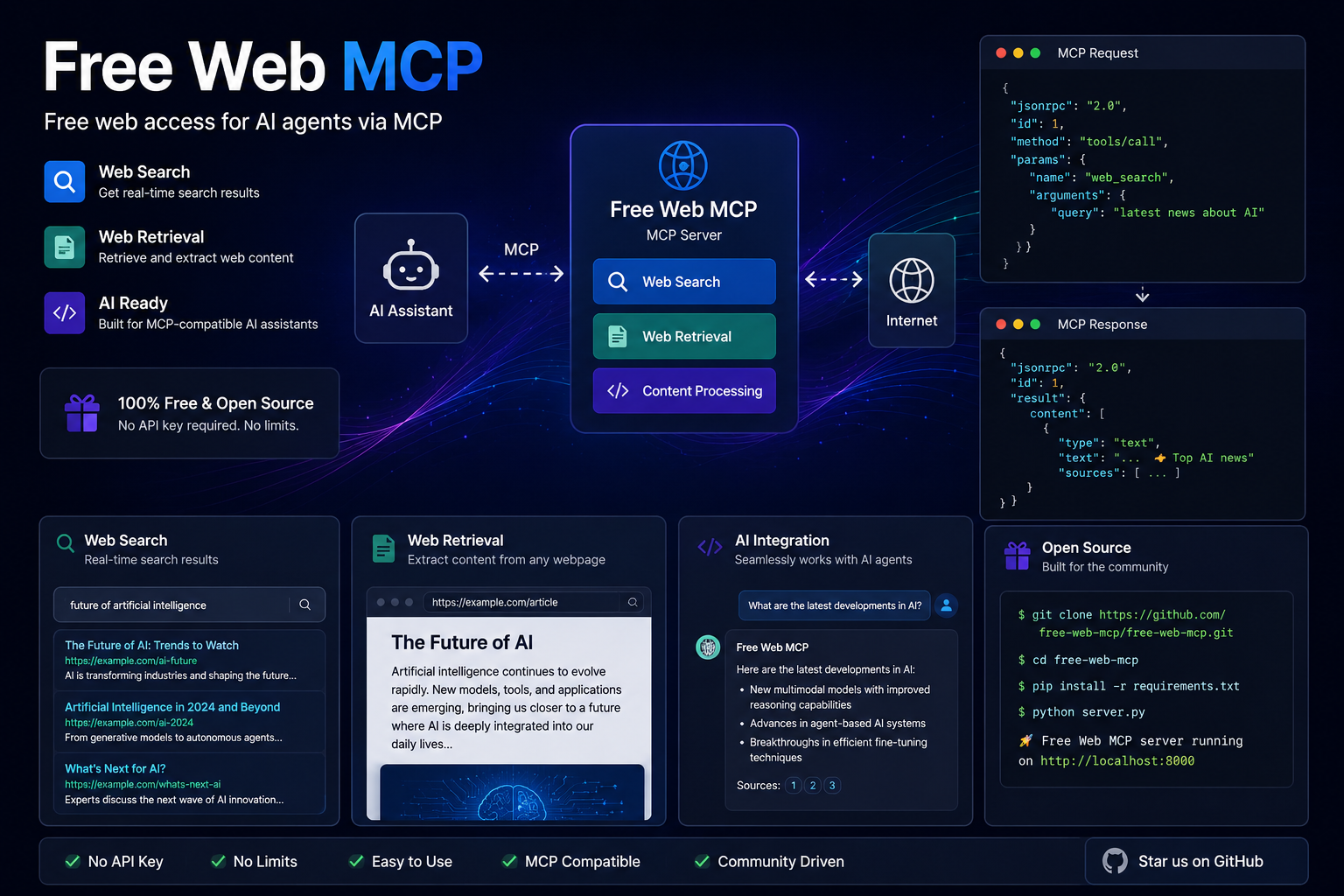
Free Web MCP was inspired by a simple problem: AI agents are becoming increasingly capable, but their ability to access and understand the live web is still limited by fragmented tools, APIs, and paid services.
We wanted to build a lightweight, accessible solution that gives MCP-compatible AI assistants a practical way to search and interact with the web without requiring users to maintain a complex infrastructure or expensive API subscriptions.
What we built
Free Web MCP is an MCP (Model Context Protocol) server for web access. It provides AI agents with web-oriented capabilities through a standardized MCP interface, allowing an AI assistant to discover information from the web and incorporate fresh external knowledge into its reasoning.
The goal was to keep the architecture simple:
AI Assistant
     │
     │ MCP
     ▼
Free Web MCP
     │
     ├── Web Search
     ├── Web Retrieval
     └── Content Processing
             │
             ▼
           Internet
Instead of building another standalone search application, we focused on making web capabilities easy for AI agents to consume.
How we built it
We designed the project around the MCP protocol so that the web capabilities can be exposed as structured tools rather than requiring every AI application to implement its own web integration.
The main engineering challenges were:
- Designing clean MCP tool interfaces that AI agents can reliably understand and invoke.
- Handling different web page structures and extracting useful content from them.
- Dealing with pages that are dynamic, incomplete, or difficult to parse.
- Keeping the service lightweight enough to be useful without expensive infrastructure.
- Making failures graceful so that a single unavailable website does not break the entire workflow.
- Balancing simplicity, reliability, response speed, and the quality of retrieved information.
What we learned
The biggest lesson was that giving an AI access to the web is not simply a matter of adding search.
The difficult part is turning messy, unpredictable web content into information that an AI can actually use effectively. Search results need context, retrieved pages need processing, and tool outputs need to be structured in a way that minimizes ambiguity for the model.
We also learned a lot about designing tools specifically for AI agents. A tool that looks intuitive to a human developer is not necessarily the best tool for an LLM. Clear names, predictable parameters, concise outputs, and well-defined failure behavior can make a significant difference.
Challenges
One of the hardest parts was dealing with the unpredictability of the open web.
Websites change frequently, pages may use JavaScript to generate content, anti-bot mechanisms can interfere with retrieval, and the same piece of information can appear in very different formats across different sites.
Rather than trying to build a perfect universal web crawler, we focused on creating a practical abstraction layer that can provide useful web access while remaining lightweight and extensible.
Why it matters
We believe MCP can become an important interface between AI models and the tools they need to interact with the real world.
Free Web MCP is our attempt to make one of those capabilities—web access—more open, accessible, and easy to integrate.
The long-term vision is simple:
AI should not be limited to the knowledge contained in its training data. It should be able to safely reach the information it needs, when it needs it.
Free Web MCP is a step toward that goal.
Built With
- agentic-ai
- ai
- ai-agents
- api
- automation
- developer-tools
- fastapi
- generative-ai
- internet
- llm
- machine
- mcp
- model-context-protocol
- natural-language-processing
- open-source
- python
- web-retrieval
- web-scraping
- web-search

Log in or sign up for Devpost to join the conversation.