-
-
FREE Time
Inspiration
FREE Time — Feeling Relieved Experience Engine
Inspiration
Most recommendation apps answer a simple question: “What is nearby?”
That is not enough.
People often have a very specific block of free time, a fixed return deadline, personal health and accessibility needs, sensory preferences, companion or pet requirements, budget limits, and a real-world tolerance for walking, noise, crowds, weather, or uncertainty.
FREE Time was created to answer a better question:
“Given this exact amount of time, what can this person realistically do, enjoy, afford, and return from on time?”
The goal is not merely to recommend an activity. The goal is to recommend a complete experience that fits the whole person.
What it does
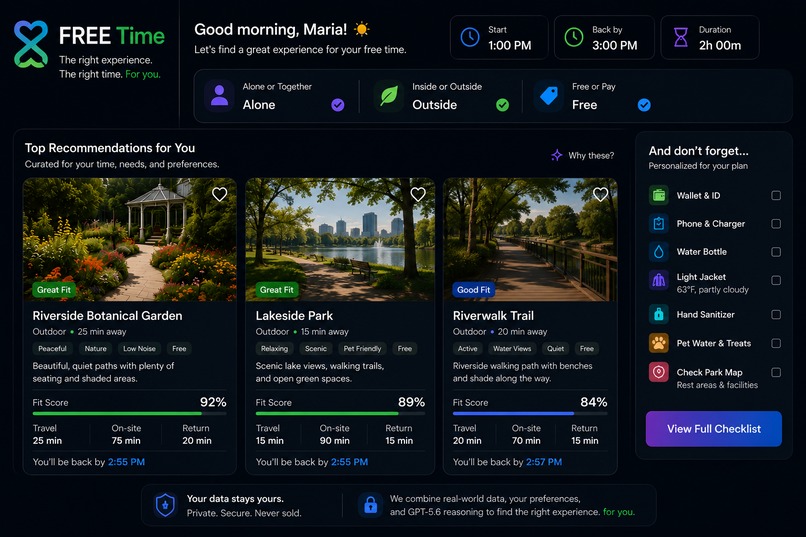
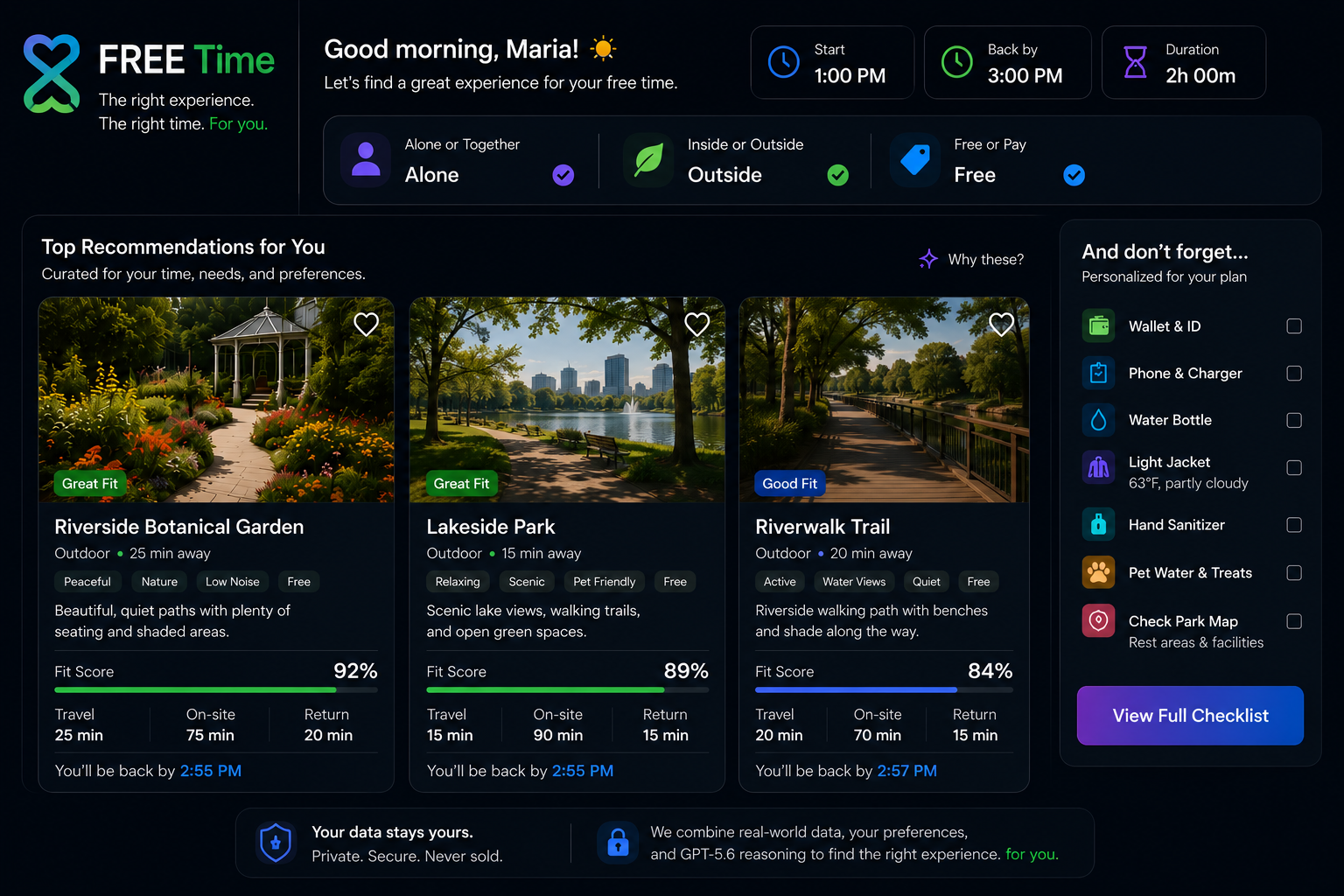
FREE Time asks the user to make only three simple choices:
Alone or Together
Inside or Outside
Free or Pay
The user then enters an exact start time and the time they must be back.
Behind that simple interface, FREE Time evaluates a much richer Personal Fit profile, including:
- physical capability and walking tolerance
- seating and accessibility needs
- mental and sensory comfort
- crowd, noise, and lighting tolerance
- companion or pet requirements
- current energy and stimulation preference
- travel time and return buffer
- budget and payment compatibility
- prior feedback and successful plans
The system first applies deterministic hard constraints. Any plan that violates the user’s time window, return deadline, pet access, walking limit, seating needs, sensory restrictions, or selected mode is rejected before AI ranking begins.
The remaining plans are scored for whole-person fit.
GPT-5.6 then generates a concise explanation of why each plan fits, what remains uncertain, and what the user should prepare before leaving.
After selecting a plan, the user sees:
“And don’t forget…”
This personalized readiness checklist may include:
- wallet, keys, phone, and identification
- weather-appropriate clothing
- sunscreen or water
- pet supplies
- accessibility or mobility items
- departure time
- parking or entrance instructions
- saved errands, such as picking up diapers on the way home
FREE Time also includes a feedback loop. If the user reports that a plan was too loud, too crowded, too far, or had unsuitable seating, the Personal Fit profile updates and future recommendations change.
How we built it
The project was built with:
- Node.js
- Express
- OpenAI Responses API
- GPT-5.6
- deterministic JavaScript constraint logic
- cosine-similarity nearest-neighbor scoring
- a responsive browser interface
- automated tests
- Codex for implementation, debugging, testing, and documentation
The system separates AI reasoning from non-negotiable rules.
GPT-5.6 is used for nuanced whole-person interpretation, explanation, and personalized readiness guidance.
Deterministic code is used for:
- time arithmetic
- return buffers
- accessibility exclusions
- sensory exclusions
- pet access
- walking limits
- seating requirements
- selected Alone/Together, Inside/Outside, and Free/Pay combinations
The language model cannot override those constraints.
We also implemented a small nearest-neighbor model using anonymous derived feature vectors. Similar-user evidence contributes to ranking only after hard constraints have passed.
Challenges
The biggest challenge was avoiding two common failures.
The first was building a generic recommendation app with a health-themed interface.
The second was allowing the language model to make decisions that should be deterministic.
We solved this by separating the engine into layers:
- exact time and hard-constraint filtering
- whole-person scoring
- anonymous-neighbor evidence
- GPT-5.6 explanation
- user feedback and profile updates
Another challenge was health-sensitive personalization.
FREE Time does not map a diagnosis directly to an activity. It does not assume that a 70-year-old user wants passive activities or that a younger user wants physically demanding ones.
Instead, it uses functional reality:
- what the person can comfortably do
- what may overwhelm them
- what they enjoy
- what they want today
- what the venue can actually support
Accomplishments that we are proud of
We are most proud of building a recommendation system that treats dignity as part of suitability.
FREE Time can distinguish between:
- a user who needs calm, reliable seating, pet access, and an easy exit
- a highly active older adult who wants competition, challenge, and novelty
- a user with limited walking tolerance who still wants an engaging, non-patronizing experience
We also built:
- deterministic rejection reasons
- explainable fit scores
- visible uncertainty
- feedback-driven profile updates
- an anonymous nearest-neighbor proof of concept
- a personalized readiness checklist
- automated tests for the core engine
What we learned
We learned that trust is not created by claiming that the AI knows everything.
Trust is created by showing:
- what is verified
- what is inferred
- what is unknown
- why a plan was accepted
- why another was rejected
- how the user can correct the system
We also learned that the best role for AI is not replacing deterministic logic.
AI is strongest when it interprets nuance, explains tradeoffs, and understands the relationship between a person and an experience.
What’s next
The next version of FREE Time would add:
- live venue and event discovery
- route and traffic verification
- weather-aware recommendations
- calendar integration
- saved errands and return-route optimization
- Apple Health and HealthKit support
- Android Health Connect support
- optional smartwatch and companion-app data
- privacy-preserving learning across larger anonymous user groups
- source provenance and timestamps for venue information
- direct profile export, correction, and deletion controls
The long-term vision is simple:
FREE Time should understand not only what a person likes, but what their body, mind, schedule, companion, pet, budget, and environment can realistically support today.
FREE Time helps people feel good about what they do next.
What it does
How we built it
Challenges we ran into
Accomplishments that we're proud of
What we learned
What's next for FREE Time
Built With
- accessibility
- ai
- artificial-intelligence
- codex
- consumer-app
- event-discovery
- explainable-ai
- gpt-5.6
- health-tech
- human-centered-design
- inclusive-design
- lifestyle
- location-based
- machine-learning
- mental-wellness
- nearest-neighbors
- personalization
- physical-wellness
- privacy
- productivity
- recommendation-engine
- smartwatch-integration
- time-management
- wearables
- whole-person

Log in or sign up for Devpost to join the conversation.