-
ContributionPage
-
homePage
Inspiration
The inspiration behind this idea stems from the team’s work in community gardens. This exposure to what it means to be in an area with sparse amounts of food and what institutions like community gardens and food banks can do to help this issue was the driving force behind our idea.
What it does
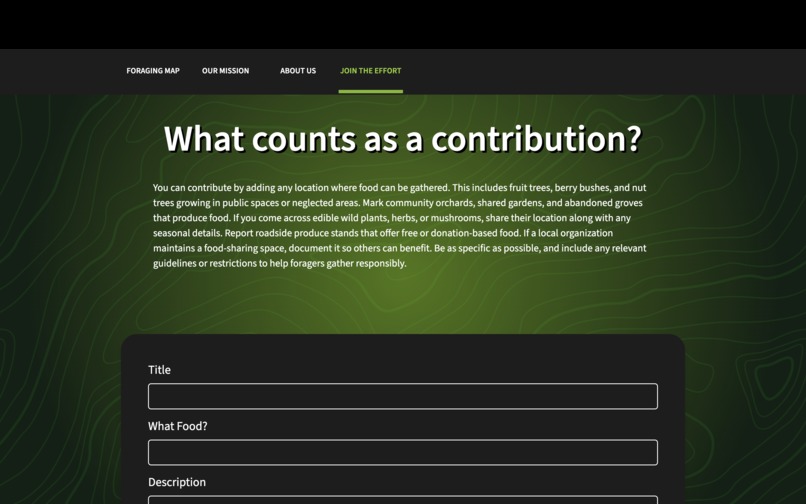
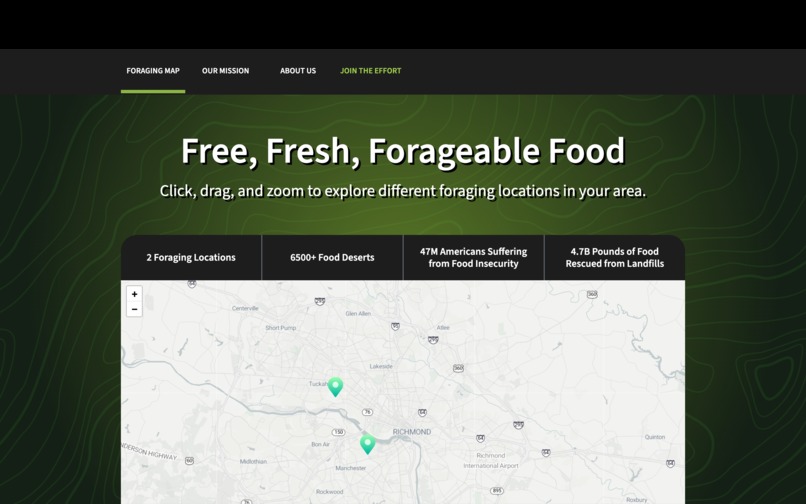
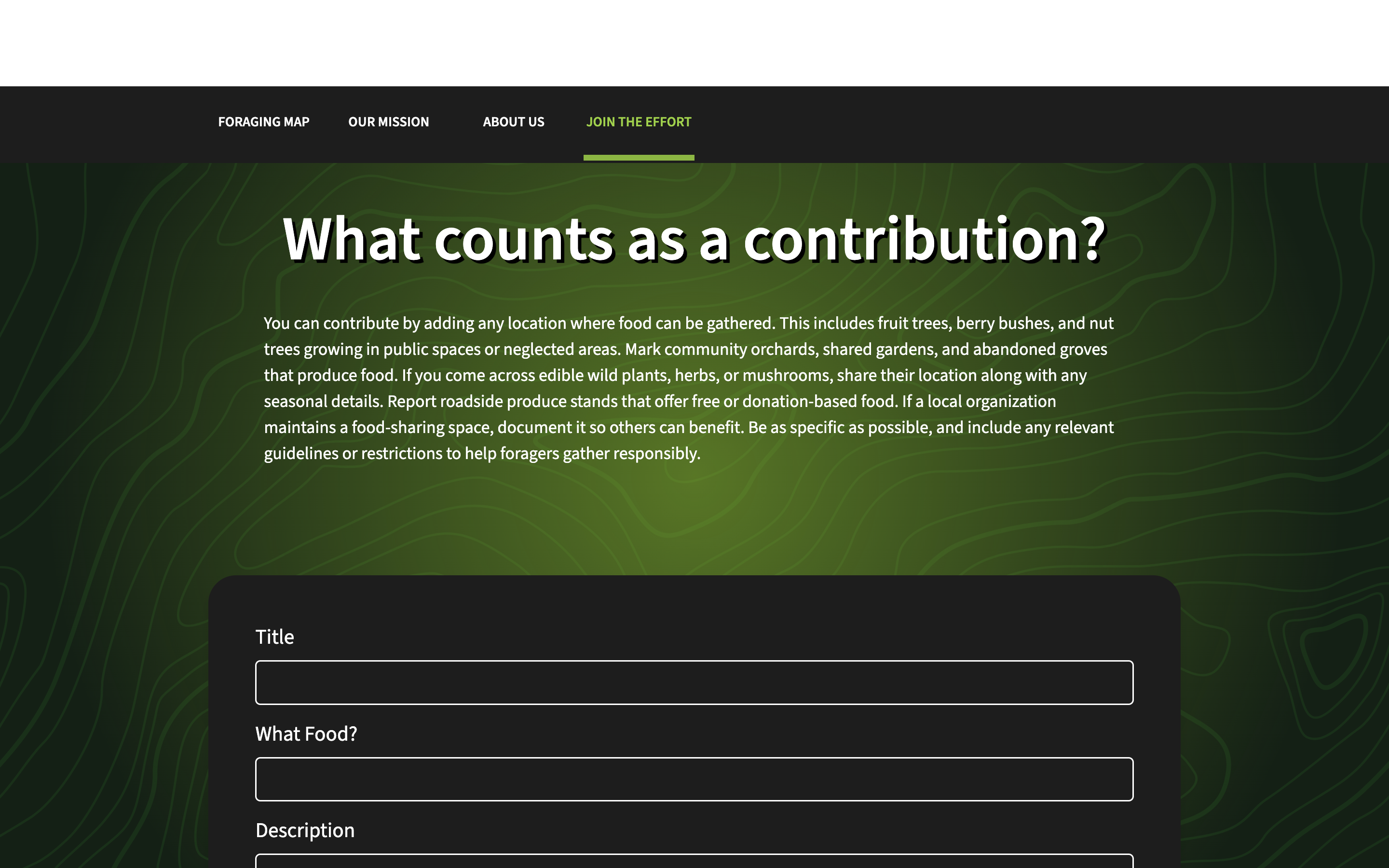
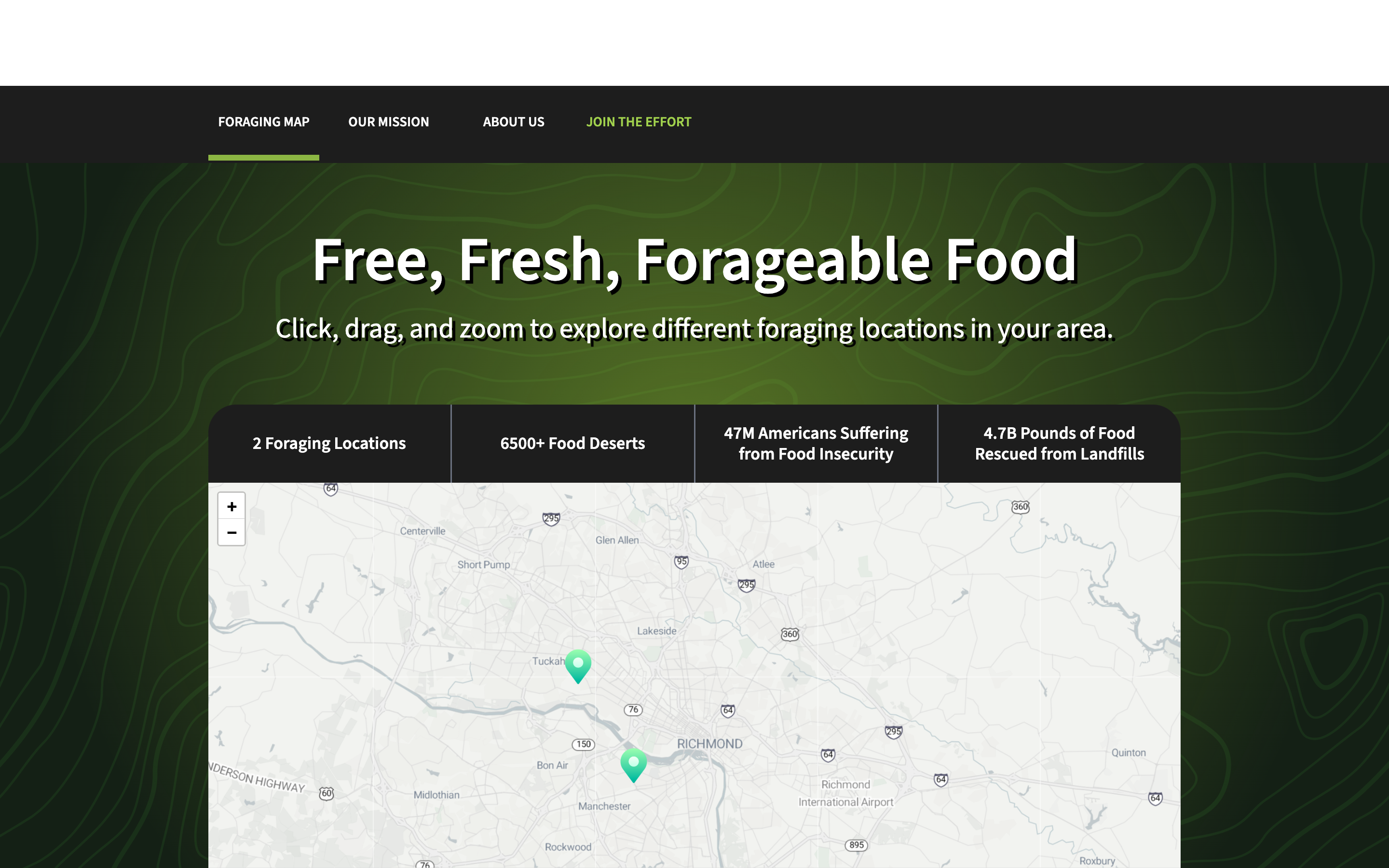
The idea is simple: we put people who need access to food in contact with the resources that can provide free, sustainable, nutritious food close to their location. The website has a central database that stores the location of the resources, their contact info, a short description, and what food can be found at that site. The site displays an interactive map with way points of the food resources local to the user. When clicked, the waypoints display all of this highly useful information. Additionally, a user can contribute to the cause by adding any resource they’ve found out in the wild. This is done through a separate section of the website, and this information is added directly to the database.
How we built it
On the frontend, we are using React hosted on Netlify for deployment. On the backend, we are using Python (Flask) hosted on Render for deployment. Render also hosts our PostgreSQL database we use to store our locations and their information. The front end takes care of all data input and passes it through to the backend, which processes our data and sends it to the database. We also are using a library called Leaflet for assistance getting a live map onto our website.
Challenges we ran into
We ran into quite a few challenges during this hackathon. For us, the two most difficult challenges were deploying and scoping. Before this hackathon, none of us had any experience in deployment of a project across different services on this scale and timeline. Learning to use Render, Netlify and various networking skills was quite the challenge. Along these lines, getting the backend and frontend integrated and working well together was difficult, but a challenge we managed to overcome nonetheless. Managerially speaking, scoping was tough. We wanted to produce a well-rounded, fully-fleshed out project but wanted we had enough time to do so. We had to do multiple revisions of our task list and website design to make sure we did the best work with the little time we had.
Accomplishments that we're proud of
We think our overall output satisfies the goals that we set for ourselves! Our project has features that we think accomplish the objective of the project and we added as many as we could in the time we had. For most of us, this is the first time we have implemented the backend and frontend in different languages as well as the first time we have deployed three separate services. We are quite satisfied with the way the project came together. And for staying up for 24 hours.
What we learned
Aaron - I gained a solid amount of knowledge about integrating Python and React into one project. Also, while I already knew React, I had a lot of practice, picking up useful tips and tricks along the way. Chris - I learned a whole lot about the services used to deploy projects. In all honesty, that was my main task throughout most of the hackathon and I learned so much about DNS, hosting, deploying, automation of deployment, etc. Definitely useful skills to know in the future. Jack - I learned a ton about both scoping and the importance of deploying early. I have worked on numerous personal projects in the past, and while I have always employed iterative enhancement while testing locally, I usually leave deployment for the end. This has been detrimental to the success of my past projects, and this experience both taught me the importance of deploying early and helped me acquire the skills to deploy.
What's next for Free Forage
We have a list of features that we think would compliment the site as it currently stands. We’d like to add accounts, a dedicated message board/forum to help facilitate grassroots movements and more features common to maps such the user's active location and the ability to search for an address. In the far future, we'd like to incorporate some sort of machine learning model to try and predict where adding a food resource would benefit the most people to advise organizations where they should set up resources.
Built With
- flask
- leaflet.js
- netlify
- postgresql
- python
- react
- render
- sqlalchemy

Log in or sign up for Devpost to join the conversation.