-
-
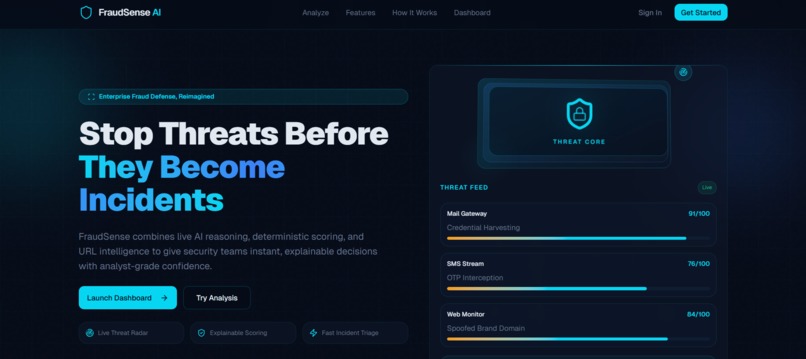
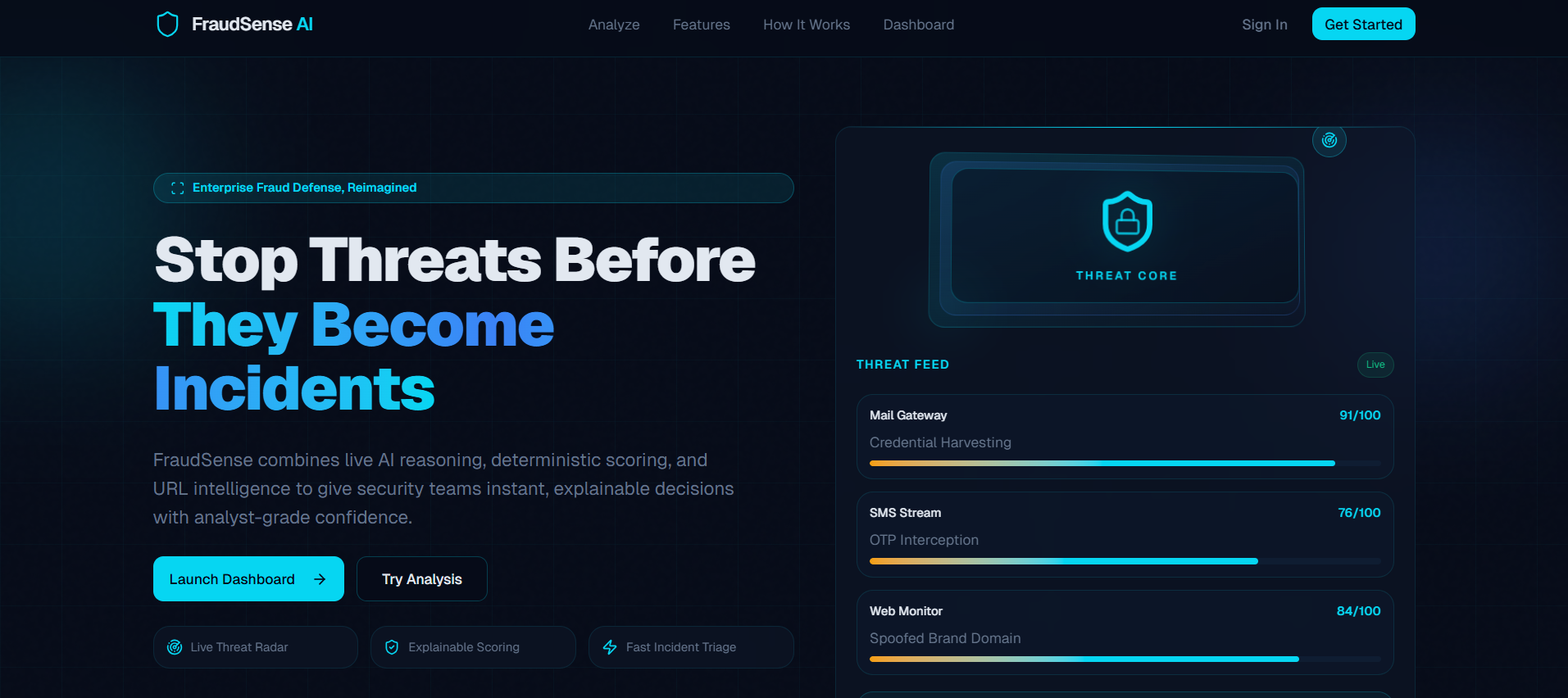
Landing Page
-
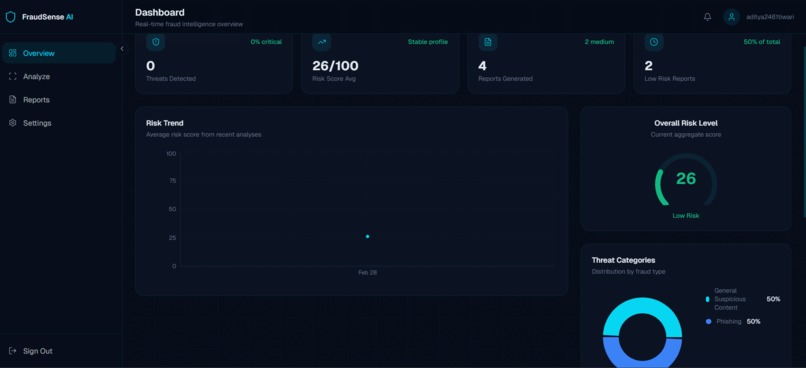
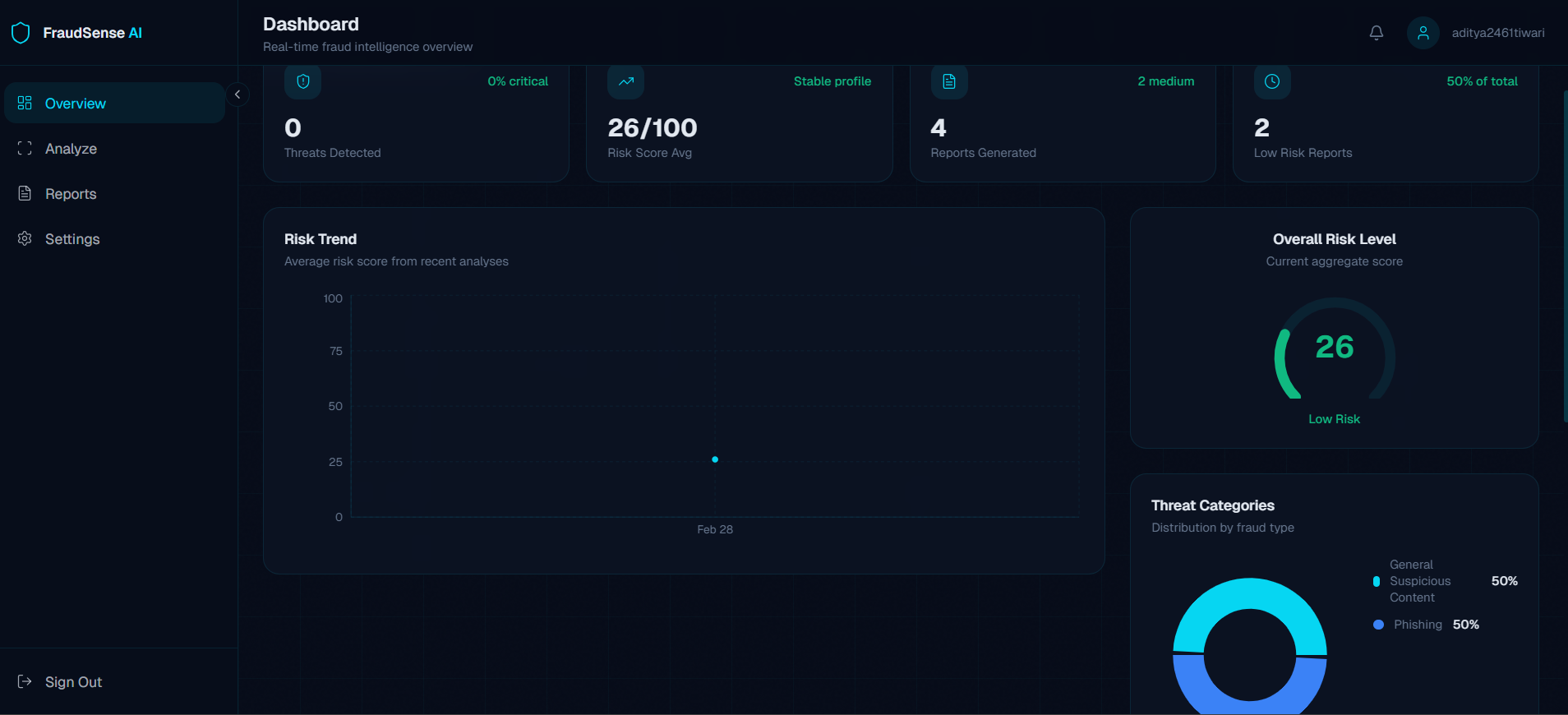
Dashboard
Inspiration
FraudSense AI was born out of a simple observation: most fraud detection tools either rely entirely on opaque AI models or depend on rigid rule engines that fail to adapt. In both cases, users are left with decisions they cannot fully trust or explain.
We wanted to build something different. A platform where intelligence is not only powerful but transparent. A system where every risk score has a reason, every alert has context, and every analyst feels in control rather than overwhelmed. FraudSense AI was inspired by the need for clarity in a space filled with uncertainty.
What it does
FraudSense AI is a real-time fraud detection platform that analyzes suspicious text and URLs to determine risk levels. It generates structured risk reports that include a score, confidence level, category classification, clear reasoning, and practical recommendations.
Beyond analysis, it provides a live dashboard that tracks threat trends, average risk metrics, category distribution, and recent activity. Users can manage incidents by marking reports as resolved or reopening them when necessary. The platform keeps everything synchronized, ensuring that the dashboard reflects the current risk landscape without delay.
How we built it
We built FraudSense AI using a hybrid intelligence approach. The core engine combines AI-based semantic analysis for contextual understanding with deterministic scoring logic to ensure consistency and explainability.
The backend handles content processing, structured report generation, and lifecycle management for each incident. On the frontend, we designed a responsive and mobile-friendly interface that updates instantly after every analysis. The dashboard components dynamically reflect new reports, status changes, and evolving risk signals.
Our focus was not only on functionality but also on usability. Every action, from analyzing content to resolving an incident, is designed to feel smooth and intuitive.
Challenges we ran into
One of the biggest challenges was balancing AI flexibility with deterministic consistency. Pure AI systems can provide deep context but may produce unpredictable variations. Rule-based systems are consistent but often too rigid. Designing a hybrid model that preserves context while maintaining predictable scoring required multiple iterations and careful calibration.
Another challenge was real-time synchronization. Ensuring that dashboard metrics, filters, and notifications remained accurate after every report update demanded efficient state management and backend coordination.
We also faced design challenges in presenting complex risk data in a way that feels simple and accessible to non-technical users.
Accomplishments that we're proud of
We are proud of creating a system that does not just detect risk but explains it clearly. Every report provides structured reasoning instead of vague warnings.
The real-time dashboard experience stands out as a key achievement. The ability to analyze, generate a report, and immediately see its impact on threat metrics gives users confidence in the system’s reliability.
Most importantly, we built a foundation that can scale into a full incident response ecosystem while remaining clean and intuitive.
What we learned
Building FraudSense AI reinforced the importance of explainability in AI systems. Intelligence without clarity does not build trust.
We also learned that user workflow matters as much as model accuracy. Analysts need tools that reduce cognitive load rather than add to it. Small features like status filters, quick actions, and clear categorization make a significant difference in usability.
Finally, we understood that real-time systems demand thoughtful architecture. Performance, synchronization, and clean data modeling are critical from day one.
What's next for FraudSense AI
The next phase focuses on expanding from a detection platform to a collaborative incident management system. We plan to introduce multi-user ownership so teams can assign and track incidents efficiently.
Advanced alert integrations, including email and chat channels, will ensure faster response times. We also aim to implement structured triage pipelines with escalation rules, allowing organizations to handle threats in a systematic way.
In the long term, FraudSense AI will evolve into a comprehensive security operations companion, combining explainable intelligence with structured workflows to help teams stay ahead of emerging threats.
Built With
- access
- ai
- analysis
- api
- architecture
- backend
- capabilities
- chart.js
- configuration
- core
- css
- custom
- data
- database
- designed
- detection
- deterministic
- dynamic
- engine
- environment-based
- experience.
- express.js
- for
- fraud
- fraudsense-ai-was-built-using-a-modern
- frontend
- hybrid
- integration
- language
- large
- management
- model
- next.js
- node.js
- orm
- performance-focused
- postgresql
- powered
- prisma
- react
- real-time
- report
- restful
- risk
- rule-based
- scalable
- scoring
- seamless
- secure
- semantic
- stack
- storage
- structured
- system
- tailwind
- technology
- type-safe
- typescript
- user
- visualization

Log in or sign up for Devpost to join the conversation.