-
-
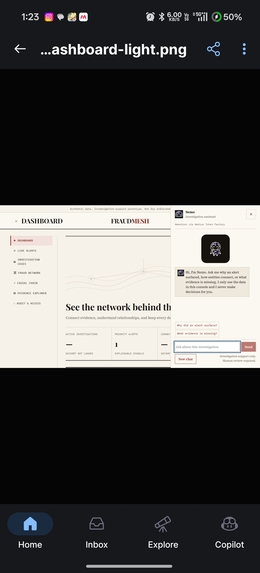
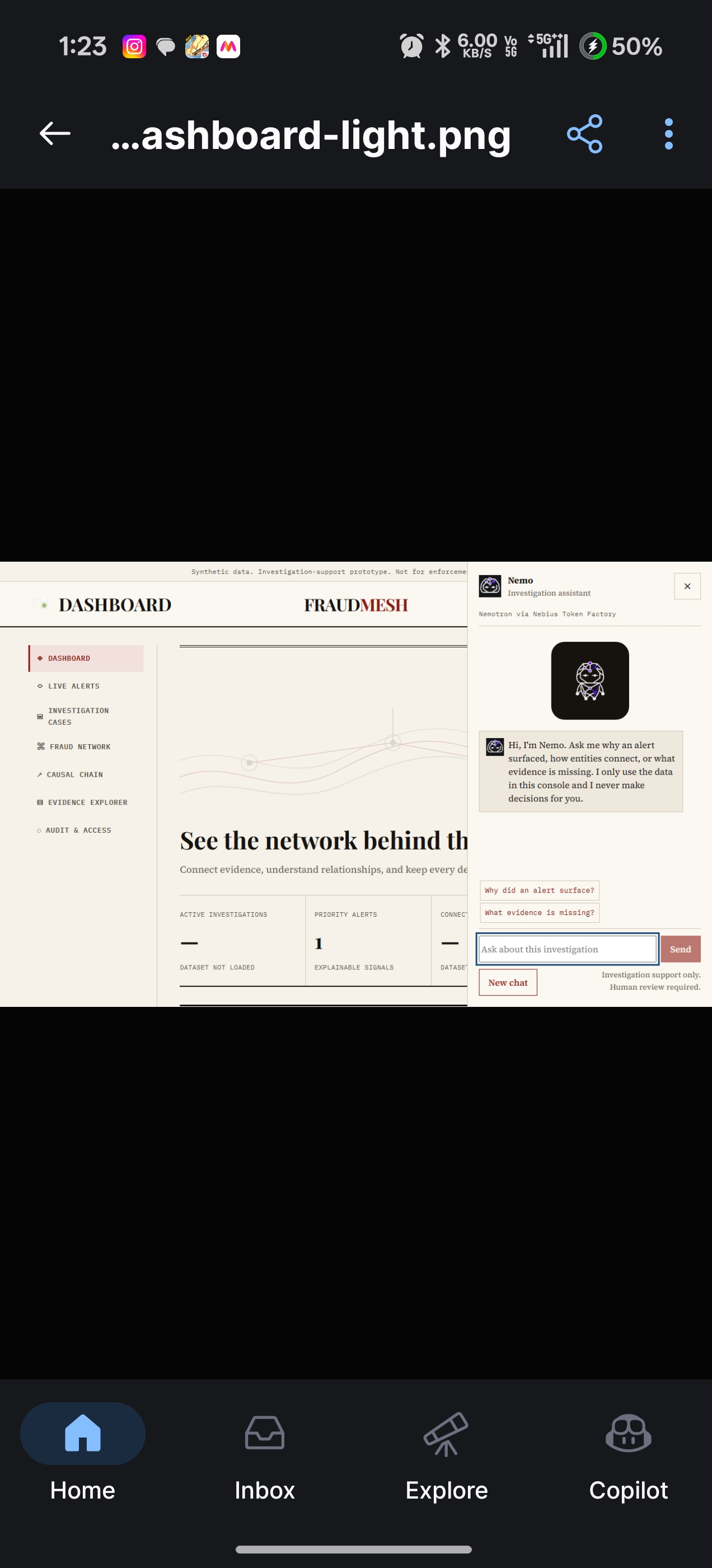
Dashboard
-
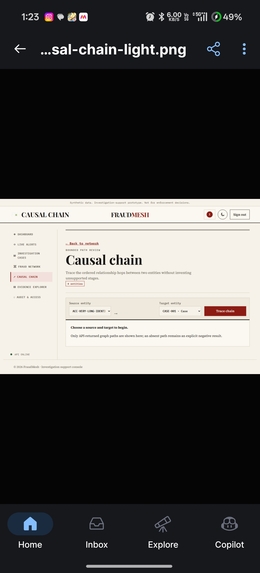
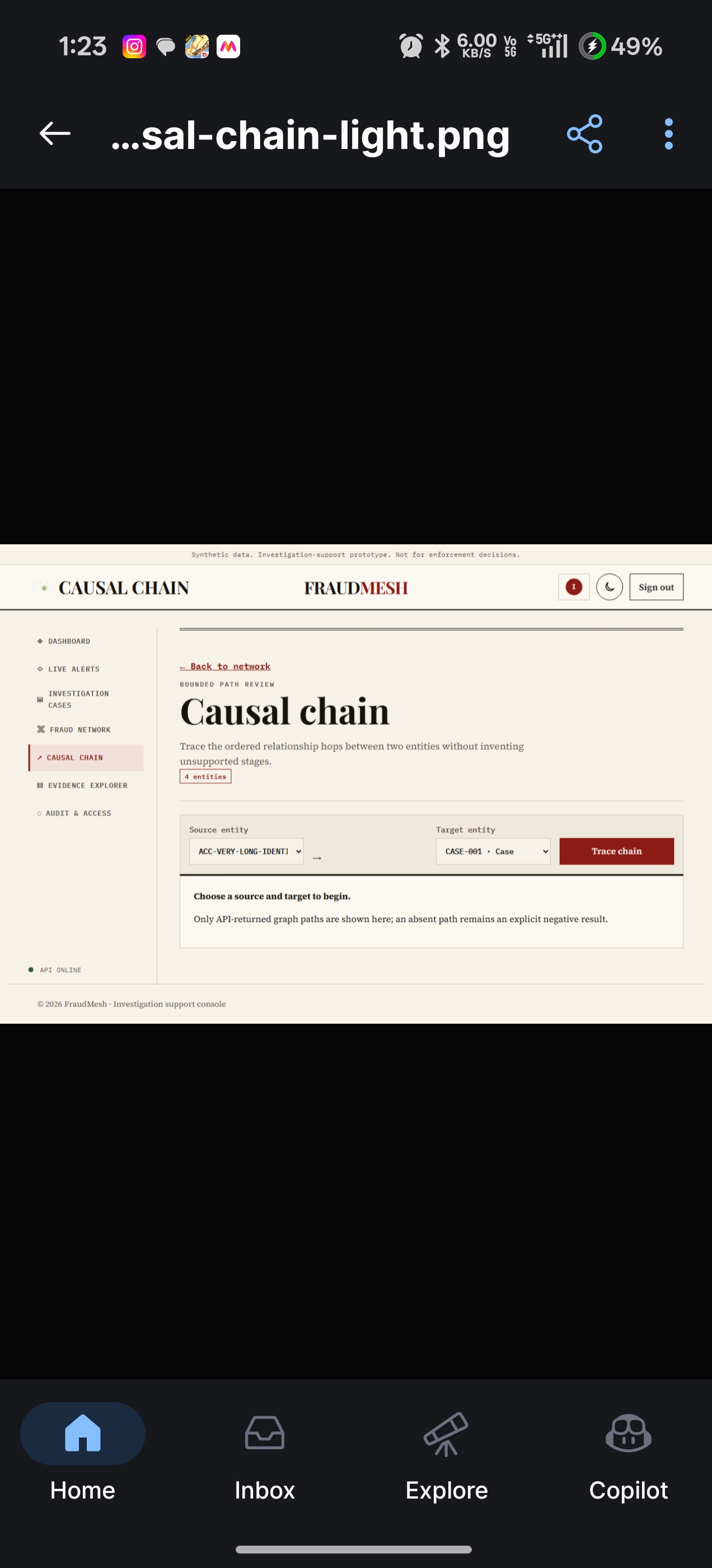
Casual chain page
-
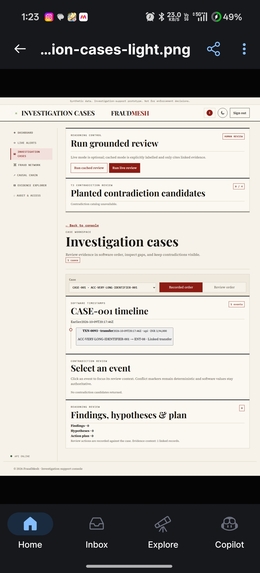
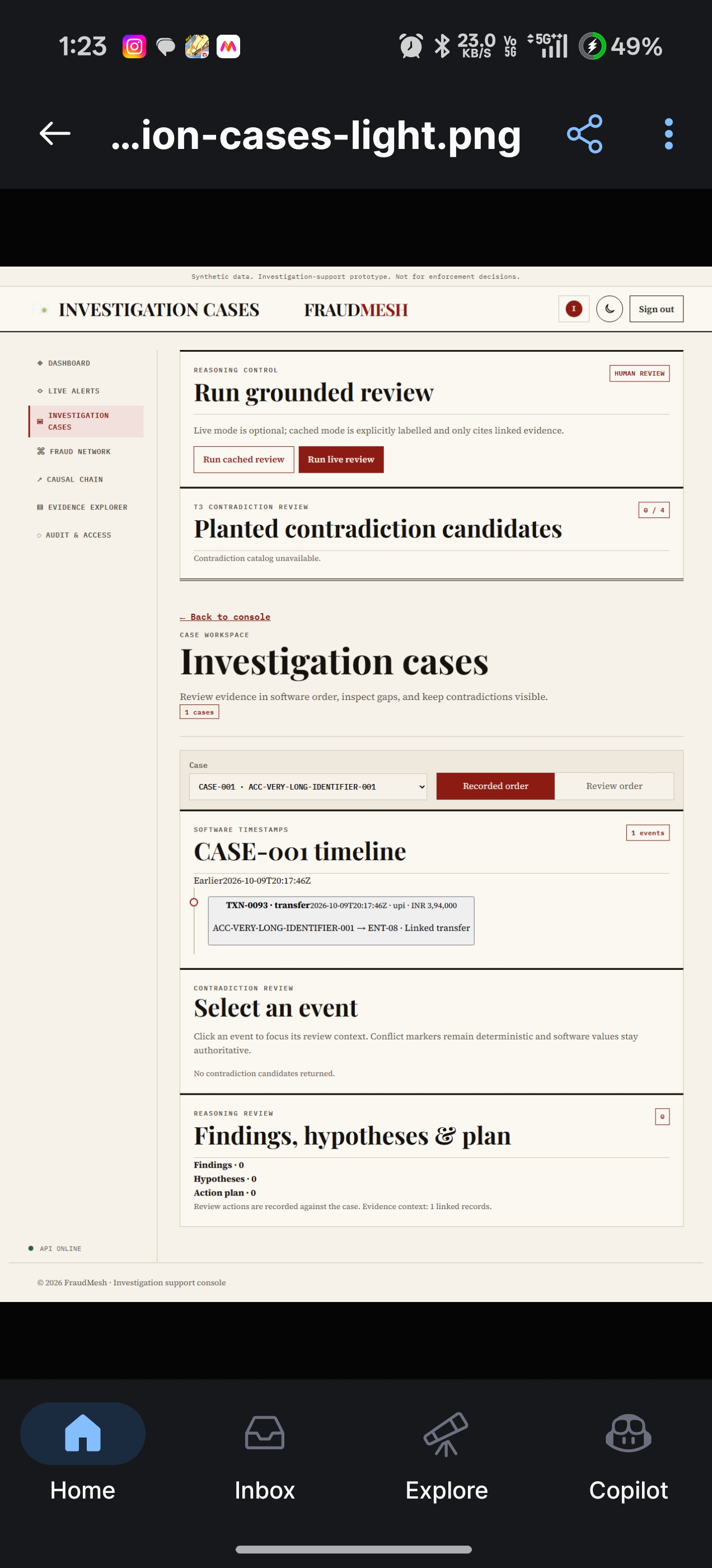
Investigation Cases
-
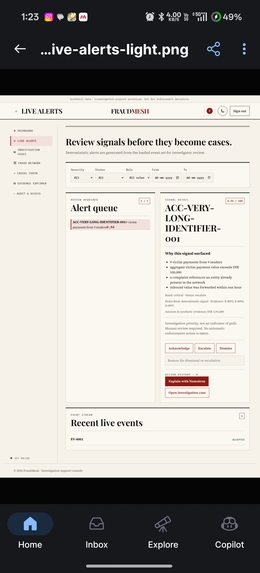
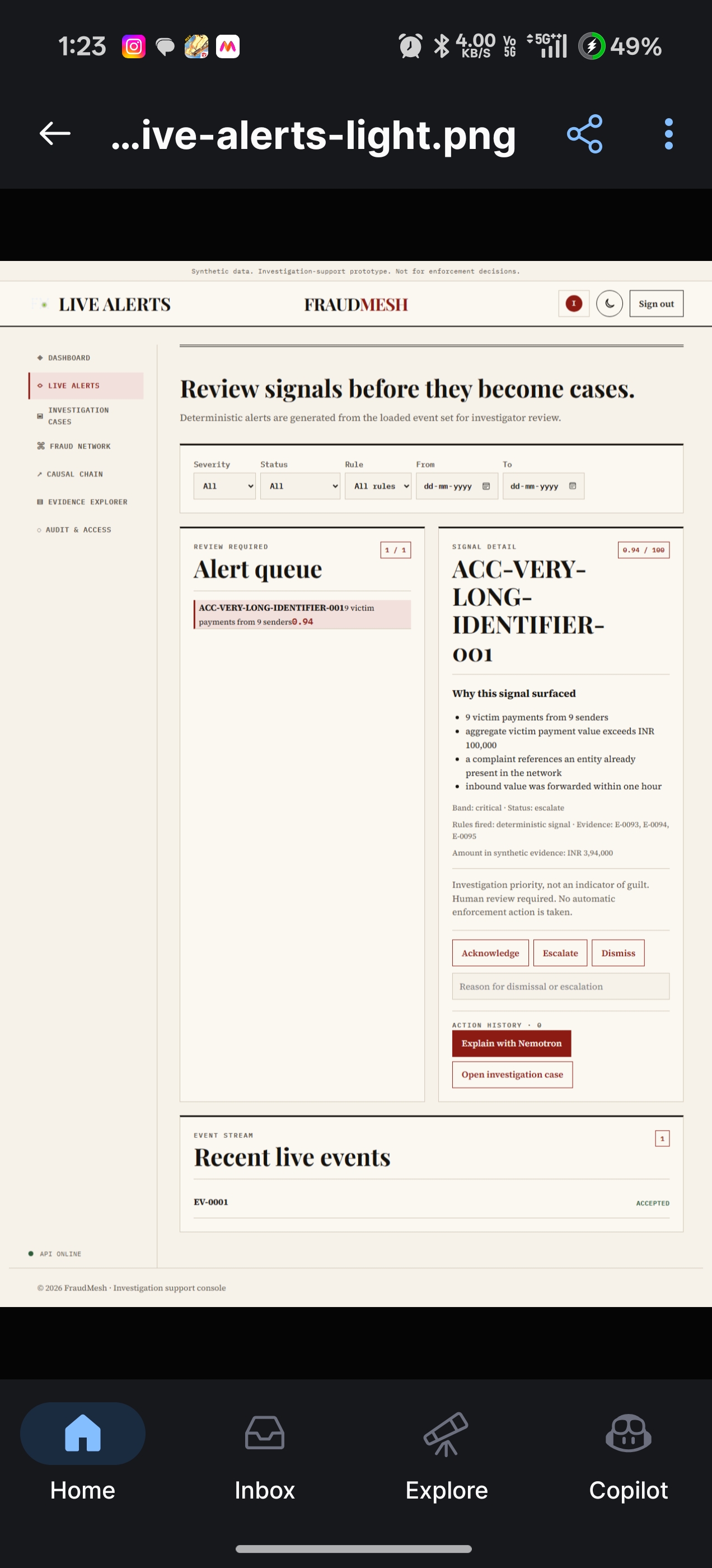
Live Alerts
Inspiration
Modern fraud is a network problem, not a single suspicious transaction. One scam operation can involve many victims, bank accounts, UPI IDs, phone numbers and devices, yet each victim files a separate complaint and each case is worked in isolation. Existing systems can flag a transaction, but investigators still connect the dots by hand. We wanted to build the tool that does the connecting, while keeping the human in charge.
What it does
FraudMesh is an investigation-support platform. It ingests synthetic evidence and reconstructs the fraud network in these steps:
- Evidence to graph: victims, accounts, phones, UPI IDs, devices, transactions, complaints and withdrawals become a relationship graph. Four apparently separate cases merge into one cluster through shared devices and fast pass-through transfers.
- Real-time detection: a new event is validated, the graph updates, risk is recalculated and an alert is raised with the rule, the values and the evidence behind it.
- Explainable risk score: an "investigation priority" built from listed factors (rapid fund movement, account hopping, shared identifiers, multiple victims and more). It is never presented as a probability of guilt.
- Nemotron reasoning: NVIDIA Nemotron reads messy complaint narratives, flags contradictions, reconstructs the chronology and the causal chain, and proposes evidence-backed hypotheses and a ranked investigation plan.
- Evidence-grounded output: every AI finding shows its evidence IDs, reasoning, confidence and next step. Findings with invented or missing evidence are withheld.
- Human in the loop: the investigator accepts or rejects each finding, and every action is written to an audit log. FraudMesh never accuses anyone and never freezes accounts or takes enforcement action.
How we built it
We followed one principle: deterministic systems + graph analysis + Nemotron reasoning + human investigation. Normal code handles everything exact (identifier matching, timestamps, transaction maths, graph construction, risk scoring, alert rules). Nemotron only gets the structured case context the system prepares, and its output is validated before anyone sees it. The stack is a Python/FastAPI backend with SQLite and an in-memory graph, a React/TypeScript frontend with an interactive network view and timeline, JWT authentication with role-based access, PII masking and audit logging. The demo runs on a deterministic synthetic dataset (20 victims, 50+ transactions, a hidden mule network, plus decoys and planted contradictions) that the system actually processes.
Challenges we ran into
- Making the AI trustworthy: we built a validator that rejects invented evidence IDs, mismatched numbers and accusatory language.
- Avoiding over-merging in the graph: weak or unconfirmed links never form clusters, and benign identifiers are ignored.
- Keeping the demo reliable: a labelled cached-reasoning mode and graceful degradation when the model is unavailable.
Accomplishments that we're proud of
Four "unrelated" cases become one explainable network, with a timeline, a causal chain and a plan, and every claim traces back to evidence an investigator can open and check.
What we learned
The hard part of fraud investigation is reasoning across messy, conflicting evidence. The best use of an LLM there is a narrow, validated role, not a chatbot.
What's next
Authorised-data pipelines with proper legal review, stronger security (encryption at rest, SSO), richer graph analytics and a supervisor sign-off workflow.
Note: FraudMesh is a hackathon prototype that uses synthetic data only. It has no integration with real banks, and its outputs are risk indicators and hypotheses, not findings of guilt.
Built With
- cytoscape.js
- fastapi
- jwt
- networkx
- nvidia-nemotron
- pydantic
- pytest
- python
- react
- render
- sqlalchemy
- sqlite
- tailwindcss
- typescript
- vite
