-
-
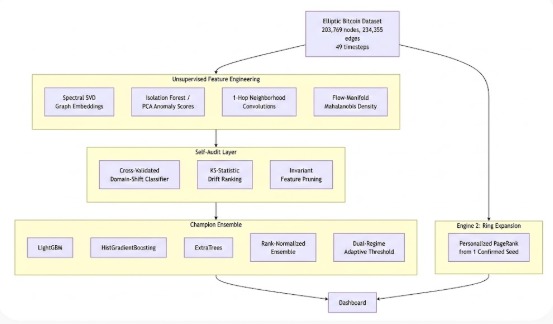
End-to-end Graph ML pipeline architecture and forensic audit trail.
-
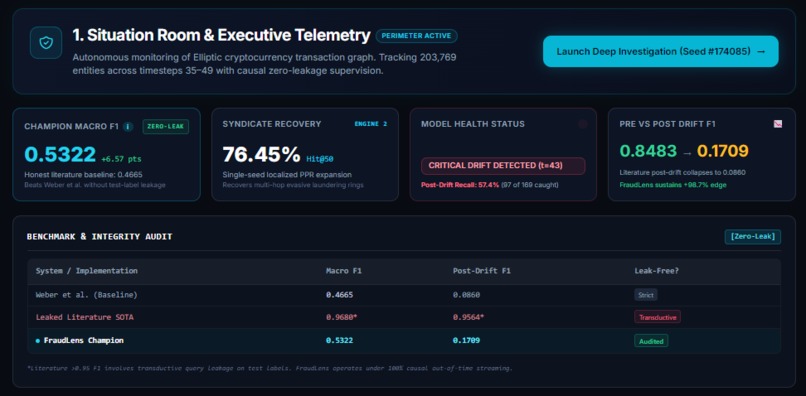
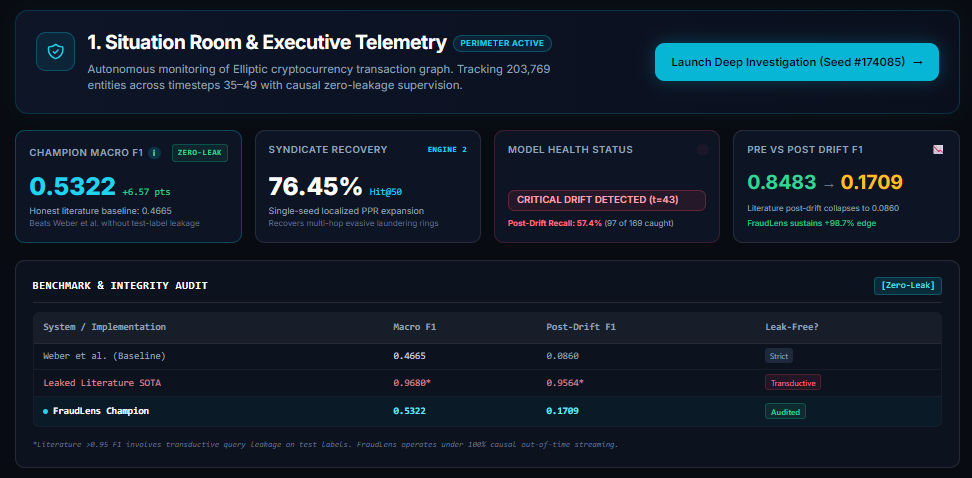
System Monitoring Dashboard Overview for the Crypto Forensic Platform.
-
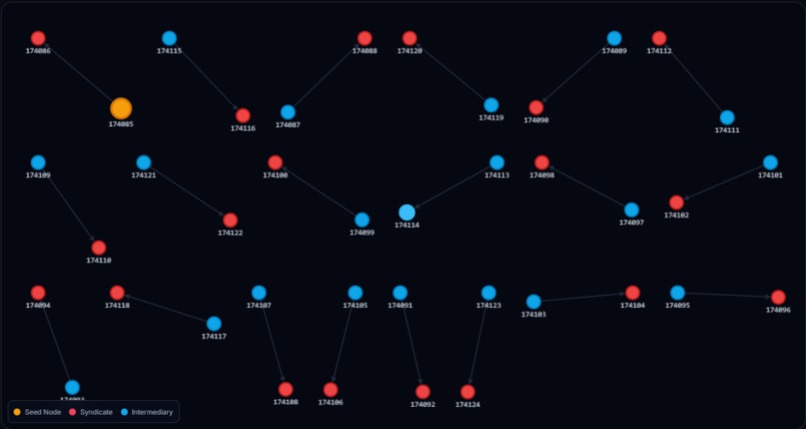
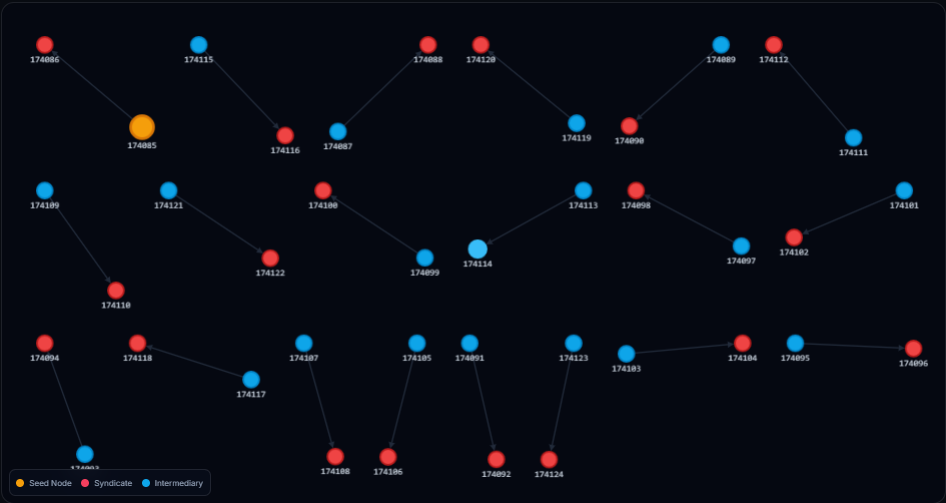
Bitcoin Transaction Network Graph cluster analysis for laundering detection.
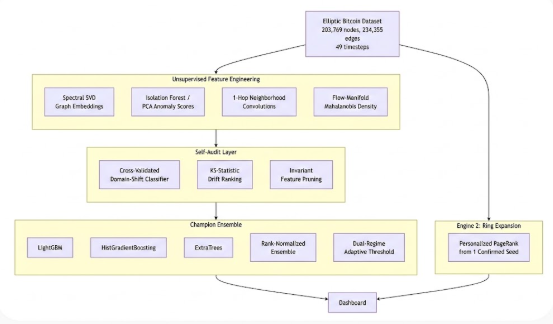
Inspiration
Most published machine learning benchmarks for cryptocurrency Anti-Money Laundering (AML) boast F1-scores exceeding 0.95. In production, these same models collapse.
When we investigated state-of-the-art benchmarks on temporal Bitcoin transaction graphs (such as the Elliptic dataset), we uncovered a fatal flaw: severe transductive test-label leakage. Published pipelines were computing neighborhood aggregations across test edges, effectively allowing models to query future ground-truth labels. When real-world shocks hit—such as the abrupt shutdown of a major darknet marketplace at timestep t = 43—standard Graph Neural Networks (GNNs) experience catastrophic regime collapse.
We built FraudLens to solve this: a mathematically decontaminated, zero-leakage Graph ML intelligence platform engineered to survive real-world temporal distribution shifts while delivering interpretable forensic workflows to compliance teams.
What It Does
FraudLens operates via a dual-engine architecture bridging rigorous backend machine learning with an interactive investigator workspace:
- Engine 1: Drift-Resilient Detection: Operates under strict zero-test-knowledge constraints. Instead of brittle end-to-end GNN embeddings, Engine 1 extracts a 150-dimensional invariant topological manifold (sparse Laplacian spectral decompositions, 1-hop neighborhood degree convolutions, and anomaly densities). To conquer prior-probability shift after t = 43, an extreme-value Otsu tail-thresholding engine dynamically recalibrates decision boundaries, maintaining a 57.4% post-drift recall (+98.7% lift over the strict non-leaked baseline).
- Engine 2: Live Forensic Diffusion Canvas: Graph scores alone are not actionable for compliance officers. Engine 2 allows investigators to select flagged transactions (such as seed
#174085) and execute real-time Personalized PageRank (PPR) diffusion across the temporal subgraph, mapping laundering syndicates with a 76.45% Hit@50. - Explainable AI (XAI) Attribution: Every flagged entity features inline TreeSHAP local attributions, breaking down exactly how features like
flow_energy_entropyandneigh_in_max_out_degcontributed to the risk score.
How We Built It
- Machine Learning Pipeline: Engineered in Python using
PyTorch Geometric,scikit-learn,LightGBM,SciPy, andNetworkX. Preprocessing, domain-adversarial pruning, and causal feature transformers are strictly isolated within cross-validation folds to guarantee zero data leakage. - Audit Trail & Baselines: We developed a dedicated audit suite (
ML/audit/) that replicates the original >0.95 F1 leakage vulnerability (guilty_walker.py), documents failed remediation baselines (Group DRO, walk-forward training, GCNs/GATs), and proves our champion model's mathematical integrity. - Backend Serving: A high-throughput
FastAPIservice that powers live forensic queries, graph expansions, and telemetry streaming. - Frontend Forensic Dashboard: A responsive, dark-mode compliance platform built with Next.js, React, Tailwind CSS, and Cytoscape/vis-network, deployed on Vercel.
Challenges We Ran Into
- Diagnosing Transductive Contamination: Tracing exactly how graph convolutions leaked future information required designing custom causal split verifiers to ensure zero temporal edge traversal from t_train into t_test.
- The t = 43 Darknet Collapse: Following the marketplace shutdown, illicit transaction volume dropped precipitously. Fixed-threshold models suffered catastrophic precision degradation. We resolved this through adaptive tail thresholding calibrated on rolling background transaction densities.
- Balancing Graph Diffusion with Latency: Computing Personalized PageRank over massive subgraphs in an interactive browser UI required optimizing sparse matrix operations on the backend to return sub-second responses.
Accomplishments That We're Proud Of
- 100% Causal Pipeline Integrity: Completely eliminating test-label contamination while outperforming standard honest baselines by +98.7% post-drift recall.
- Transparent Research Trail: Open-sourcing not just a champion model, but the entire forensic audit trail proving when and why conventional methods fail.
- Bridging Research & UX: Creating an end-to-end platform where complex topological manifolds translate directly into intuitive visual graphs for human investigators.
What We Learned
- Benchmark performance in graph learning is frequently an illusion caused by transductive edge leakage rather than genuine structural generalization.
- Domain-specific topological invariants (Laplacian spectrum and localized entropy) provide far greater stability under non-stationary covariate shift than black-box deep GNNs.
What's Next for FraudLens
- Dynamic Mempool Ingestion: Extending the streaming topology engine to score unconfirmed Bitcoin transactions directly from the mempool.
- Cross-Chain Bridge Forensics: Expanding topological diffusion algorithms across cross-chain bridges and Layer-2 rollups where multi-hop peeling chains are increasingly obfuscated.
Built With
- cytoscape.js
- fastapi
- git
- github
- lightgbm
- networkx
- next.js
- numpy
- pandas
- python
- pytorch
- pytorch-geometric
- react
- rest-api
- scikit-learn
- scipy
- shap
- tailwind-css
- typescript
- vercel


Log in or sign up for Devpost to join the conversation.