-
-
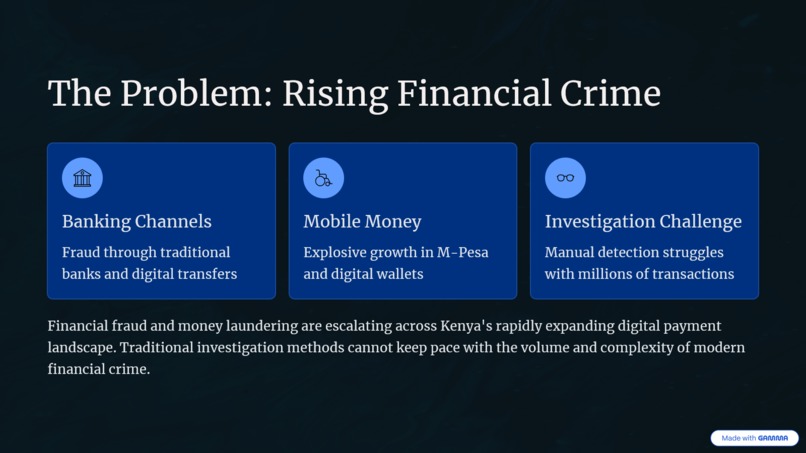
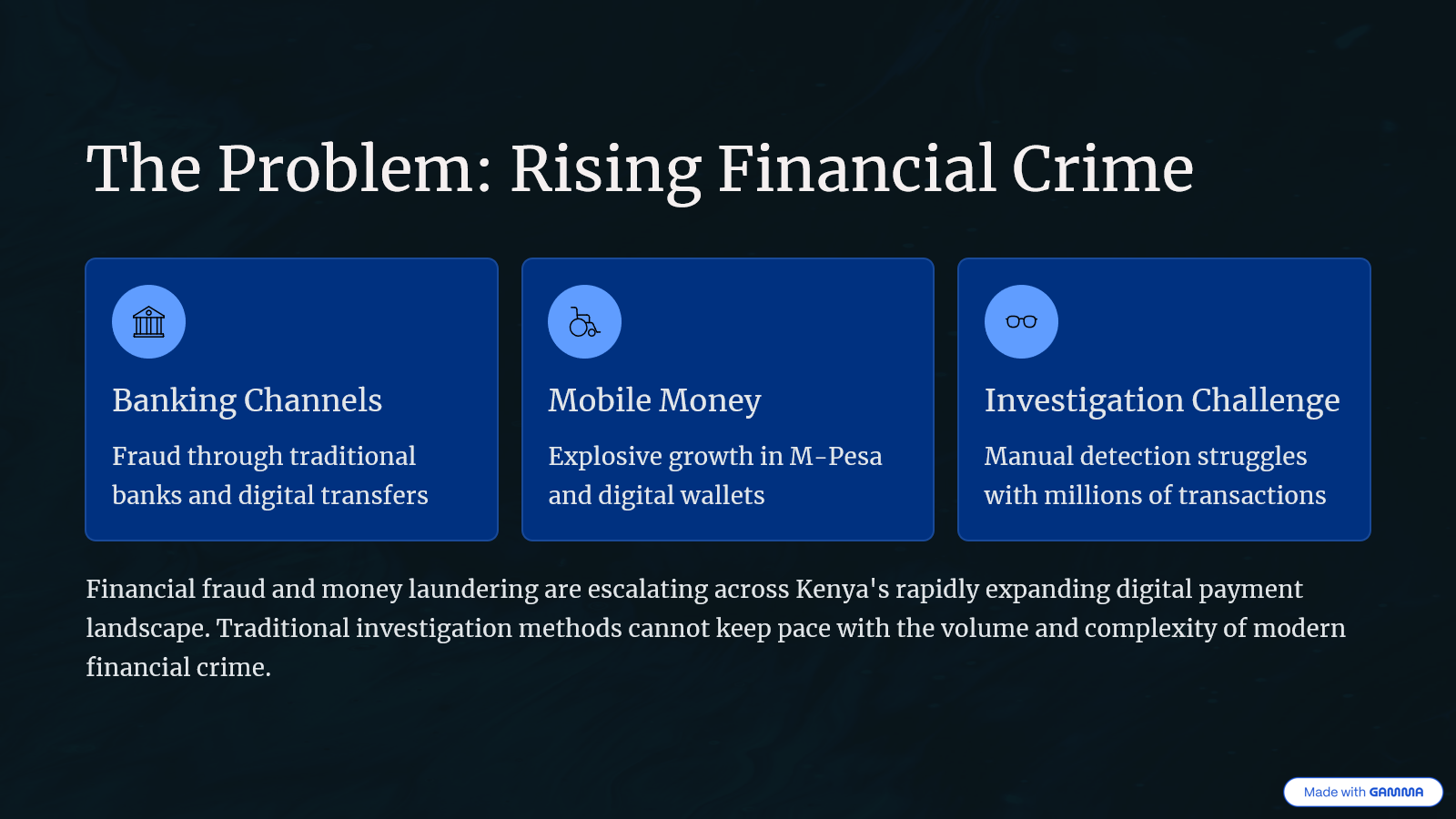
Problem Raised
Inspiration
Fraud continues to be one of the biggest challenges facing financial institutions, businesses, and digital payment platforms. Fraud investigators often have to manually review large volumes of transactions, making it difficult to identify suspicious activities quickly and accurately. We were inspired by the need to reduce investigation time, improve fraud detection efficiency, and support decision-makers with intelligent insights while maintaining human oversight.
Our goal was to create an AI-powered system that helps investigators focus on the most critical cases first instead of spending hours reviewing every transaction manually.
What it does
FraudGuard is an AI-powered Fraud Risk Classification System that analyzes transaction data and predicts the likelihood of fraudulent activity.
Users upload transaction datasets into the platform, where the Fraud Risk Classification System (FRCS) processes and analyzes the data using machine learning techniques. The system evaluates transaction patterns, calculates fraud probability scores, classifies transactions by risk level, and presents the results through an interactive dashboard.
The platform provides:
- Fraud probability scoring
- Risk classification
- Pattern recognition
- Transaction analytics and visualization
- Decision-support recommendations
- Human-in-the-loop review process
By prioritizing high-risk transactions, FraudGuard helps investigators work more efficiently and respond faster to potential fraud threats.
How we built it
FraudGuard was developed using data science, machine learning, and web application technologies.
The development process included:
- Collecting and preparing transaction datasets.
- Cleaning and preprocessing the data.
- Engineering features relevant to fraud detection.
- Training and evaluating machine learning classification models.
- Building the Fraud Risk Classification System (FRCS) for prediction and scoring.
- Developing a dashboard to display fraud probabilities, risk levels, and visual analytics.
- Implementing human review mechanisms to ensure responsible AI decision-making.
The overall workflow follows:
Transaction Data → Data Processing → Machine Learning Classification → Fraud Probability Score → Risk Classification → Investigator Dashboard.
Challenges we ran into
One of the biggest challenges was dealing with fraud detection's inherent complexity. Fraudulent transactions are often rare compared to legitimate transactions, creating class imbalance challenges during model training.
Another challenge was minimizing false positives. Incorrectly flagging legitimate transactions can negatively impact customers and business operations. To address this, we focused on model evaluation, threshold tuning, and maintaining human oversight.
We also faced challenges in presenting complex AI outputs in a simple and understandable way for investigators through visual dashboards and risk scoring systems.
Accomplishments that we're proud of
We successfully built a working AI-powered fraud classification system capable of analyzing transaction data and generating fraud risk predictions.
Key accomplishments include:
- Developing an end-to-end fraud detection workflow.
- Creating an interactive dashboard for fraud analysis.
- Implementing fraud probability scoring.
- Designing a human-in-the-loop decision framework.
- Incorporating responsible AI principles into the system.
- Demonstrating how AI can improve fraud investigation efficiency.
What we learned
This project deepened our understanding of machine learning, fraud detection methodologies, data preprocessing, model evaluation, and responsible AI practices.
We learned that building effective AI systems is not only about achieving high prediction accuracy but also about ensuring transparency, explainability, and human accountability.
The project also strengthened our skills in data analytics, AI system design, problem-solving, and developing practical solutions for real-world challenges.
What's next for FraudGuard: AI-Powered Fraud Risk Classification System
Our future roadmap includes:
- Real-time fraud monitoring and alert generation.
- Explainable AI features that provide reasons behind fraud predictions.
- Continuous learning from investigator feedback.
- Advanced anomaly detection capabilities.
- Integration with banking, fintech, and enterprise systems.
- Enhanced reporting and compliance tools.
- Scalable deployment for large-scale transaction environments.
Our vision is to transform FraudGuard into a comprehensive fraud intelligence platform that enables faster, smarter, and more responsible fraud detection across industries.
Built With
- analytics
- classification
- csv
- data
- dataset
- engineering
- feature
- github
- jupyter
- learning
- linearregression
- machine
- matplotlib
- notebook
- numpy
- pandas
- plotly
- preprocessing
- processing
- python
- scikit-learn
- scoring
- seaborn
- streamlit

Log in or sign up for Devpost to join the conversation.