-
-
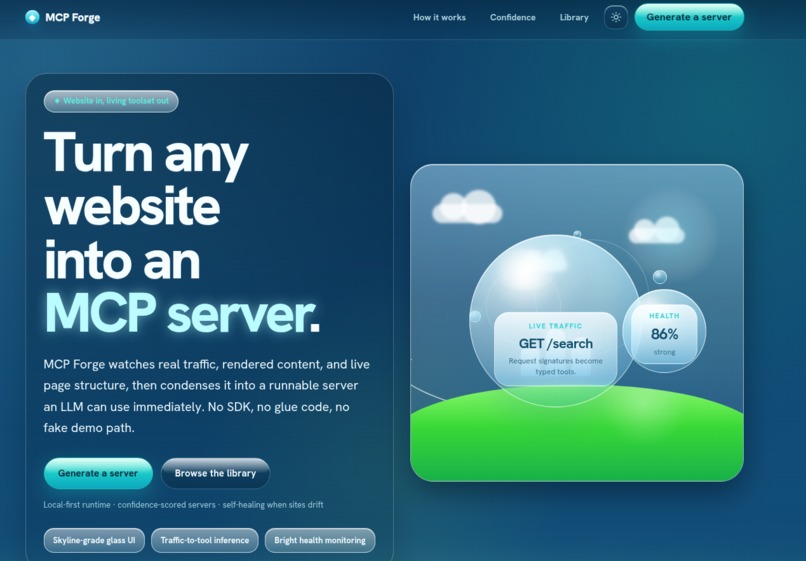
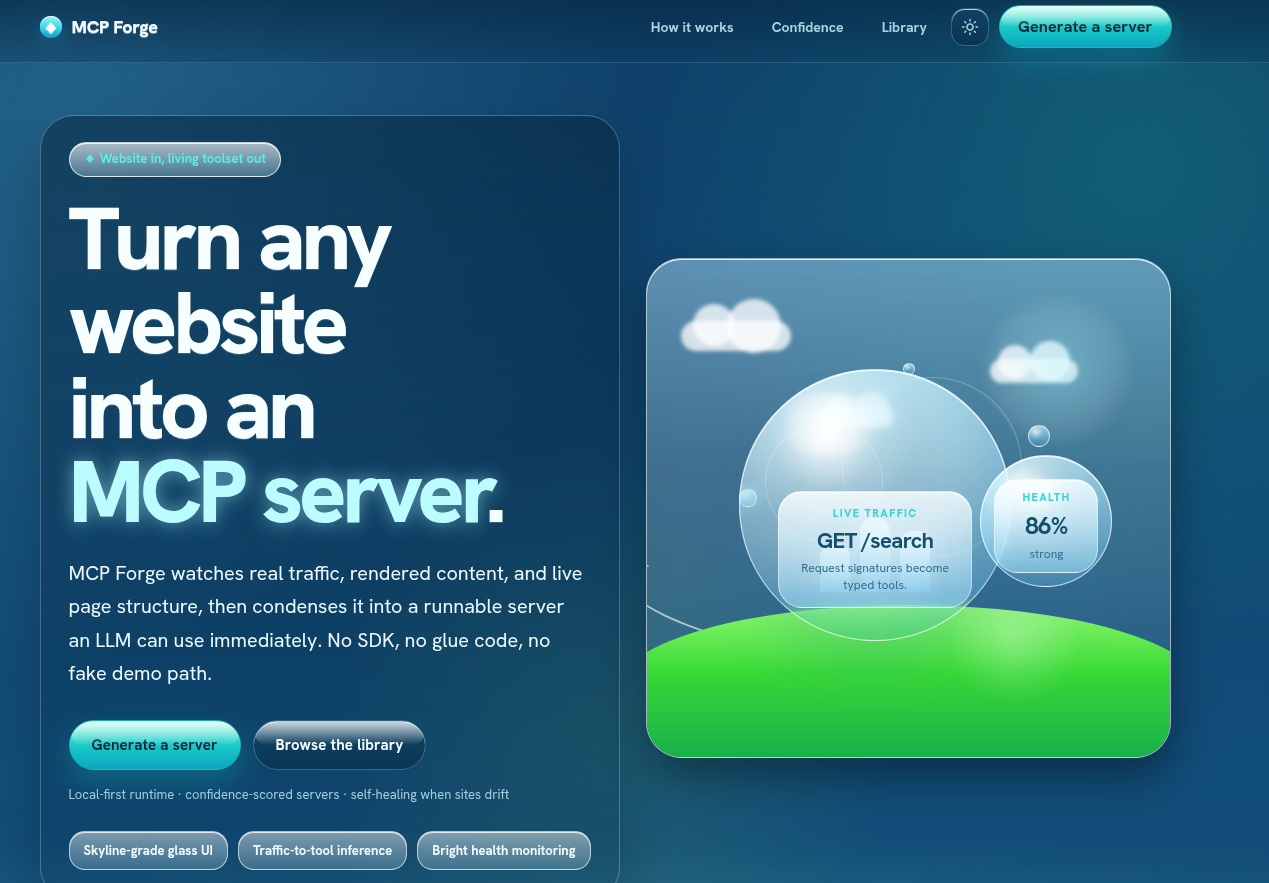
Home Page
-
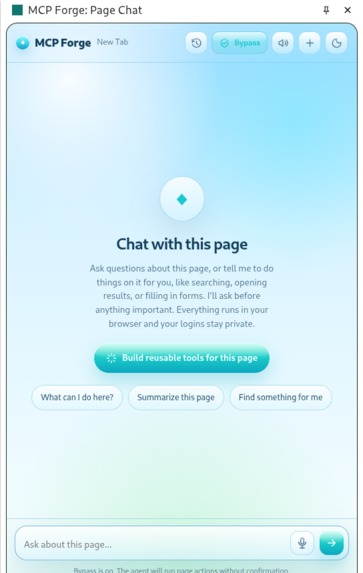
Chrome Extension
-
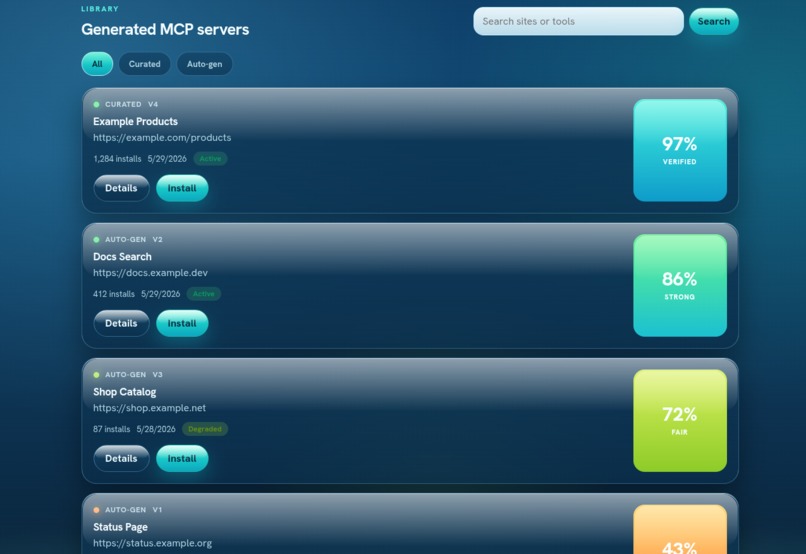
All MCP
Inspiration
AI agents are getting smarter, but they are still trapped behind a basic problem: most of the web was never built for agents.
MCP is becoming the standard way agents connect to tools, APIs, files, databases, and apps. Public reporting puts the ecosystem at 10,000+ MCP servers and around 97 million monthly SDK downloads in early 2026.
But every MCP server still has to be built by hand.
That means a developer has to inspect the website, understand its network calls, write protocol boilerplate, define tools, test workflows, and keep everything alive when the site changes.
That does not scale to the web.
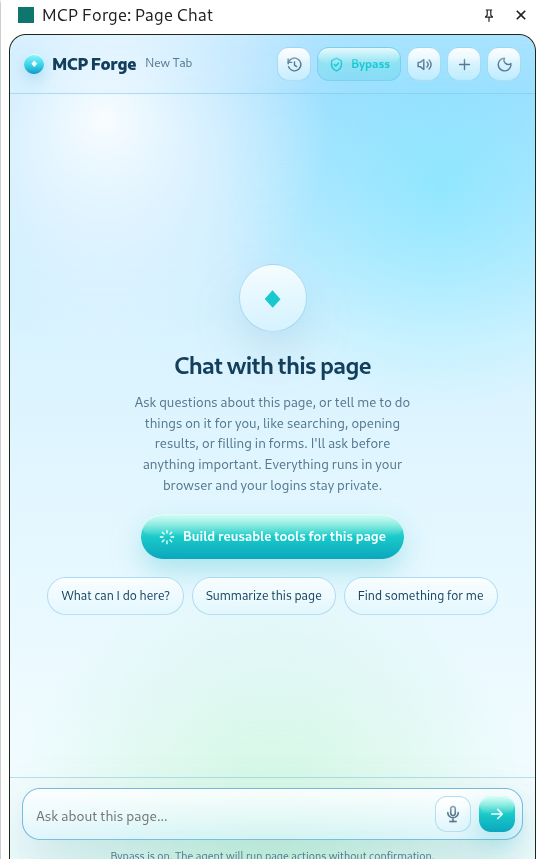
So we built MCP Forge: a Chrome extension and generation platform that lets you turn the website you are already browsing into a runnable MCP server.
## What it does
MCP Forge is a Chrome extension that lets you generate MCP tools directly from any website.
Instead of leaving the browser, copying docs, or hand-building integrations, you open the extension on the page you want and forge an MCP server from the live site.
The extension captures what matters from the current website, sends it through our generation pipeline, and produces a runnable MCP server that an AI agent can use.
It is designed for websites with:
- No public API
- No documentation
- Dynamic pages
- Search flows
- Forms
- Pagination
- Product pages
- Internal dashboards
- Multi-step browser workflows
If a human can use the site in Chrome, MCP Forge is designed to help an agent use it as a tool.
## Why the Chrome extension matters
The browser is where the web actually happens.
Most agent tooling starts from an API, a repo, or a docs page. MCP Forge starts from the live website itself.
The Chrome extension makes the flow feel natural:
- Go to any website.
- Open MCP Forge.
- Click forge.
- The extension captures the page context and behavior.
- MCP Forge generates an MCP server.
- Install it into an agent client.
- The agent can now use that website through tools.
That is the unlock.
You do not have to explain the website to the agent. You do not have to build the integration manually. You do not even have to leave the page.
The extension turns browsing into tool creation.
## How we built it
We built a full-stack platform with Next.js, a Chrome extension, Node workers, Redis/BullMQ queues, Postgres, MongoDB catalog storage, a Python scraper, Gemini-powered generation, and a Solana on-chain registry.
Why it matters
Agents are not limited by intelligence anymore. They are limited by what they can access.
Today, if a website has no API or no MCP server, an agent is mostly stuck. It can maybe read the page, but it cannot reliably act on it like a real tool.
MCP Forge changes that.
It turns websites into MCP servers from the browser, so the long tail of the internet becomes usable by agents:
- E-commerce sites
- Search pages
- SaaS dashboards
- Admin panels
- Internal company tools
- Forms and workflows
- Websites that were never designed for AI
This attacks the supply side of the agent economy. Everyone is building agents, but not enough people are building the tools fast enough. MCP Forge makes tool creation instant.
## How it works
MCP Forge combines a Chrome extension with a server generation pipeline.
The extension captures live website context from the page you are on. Then the backend does the heavy lifting:
- Captures real page behavior and network traffic.
- Detects useful actions and data flows.
- Escalates scraping tiers when basic capture is blocked.
- Uses Gemini to infer action-capable MCP tools.
- Generates a runnable MCP server.
- Includes browser tools so agents can continue driving the live site.
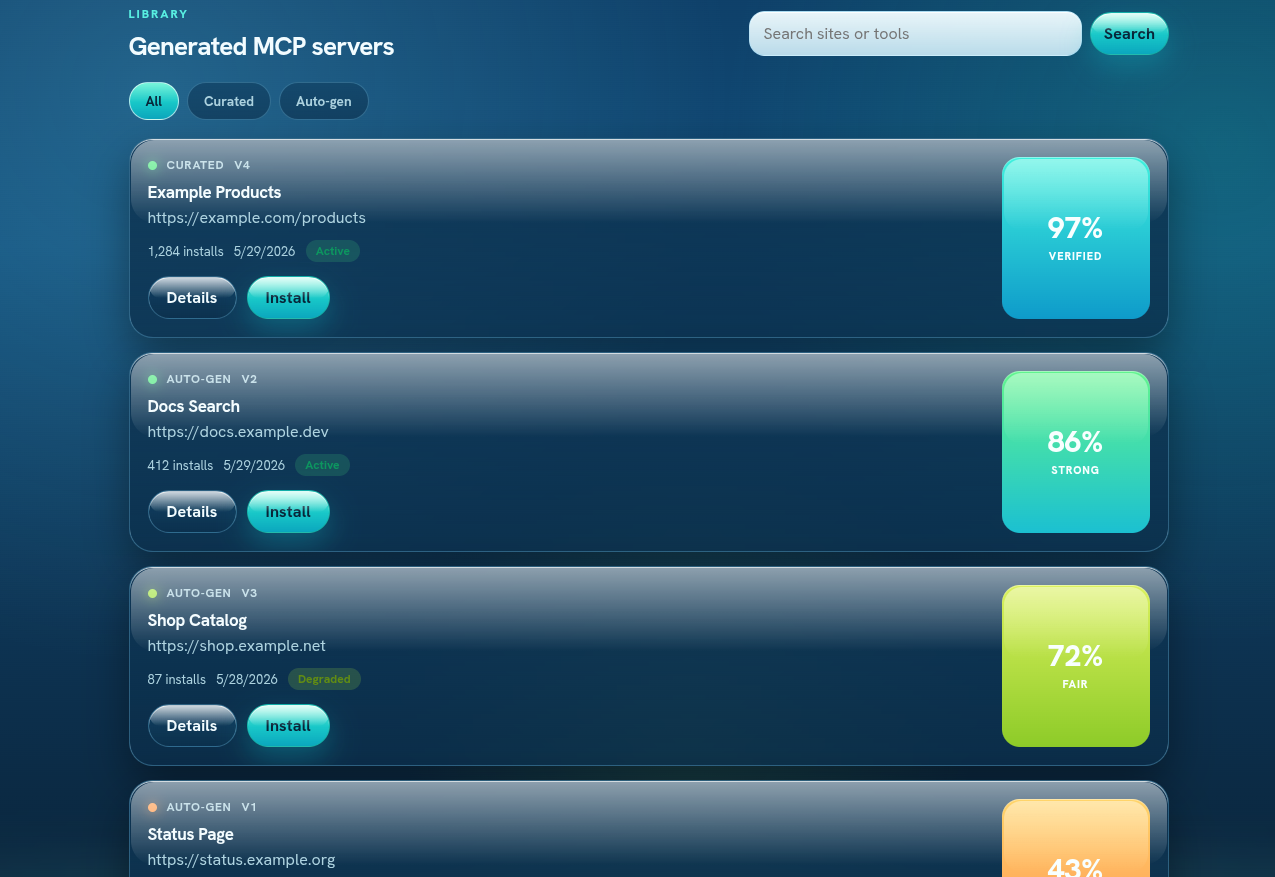
- Stores generated servers in a searchable registry.
- Monitors server health and regenerates when sites change.
- Registers tool metadata on Solana devnet for verification and trust.
This is not just scraping. Scraping gives you HTML. MCP Forge gives agents tools.
## Built with
- Chrome Extension for one-click website-to-tool generation
- Gemini for tool inference and agent reasoning
- Chromium / browser automation for live website capture
- Python scraper service for multi-tier capture
- Node / TypeScript for MCP server generation
- Go monitor for server health checks and self-healing
- MongoDB Atlas for the generated server registry
- Solana devnet for on-chain tool signatures and verification
- Vultr for deployed microservice infrastructure
## What makes it different
Most MCP products focus on installing servers.
MCP Forge focuses on creating them.
That is the hard part.
Claude Desktop Extensions make installation easier, but someone still has to build the server. MCP Forge automates the creation step from the website itself.
The Chrome extension makes this even more direct. You are not starting from docs or API specs. You are starting from the real page in front of you.
It is the difference between:
“Find or build an MCP server for this service”
and
“I am on the website. Forge it now.”
## Challenges we ran into
The hardest part was making this work on real websites.
Modern websites are messy. They load data dynamically, use hidden network calls, paginate differently, rely on browser state, require user context, and sometimes block automation.
We had to build a system that could:
- Capture live browser context from the extension
- Understand useful actions from noisy website behavior
- Generate valid MCP server code
- Preserve browser control for multi-step workflows
- Handle sites without public APIs
- Track generated tools in a registry
- Add a trust layer for agent-installed servers
- Detect when a generated server breaks
The challenge was not making a demo scraper. The challenge was making the browser itself become the forge.
## Accomplishments that we are proud of
We built a Chrome extension that turns live websites into MCP servers.
That feels like the right interface for this problem. The web lives in the browser, so tool generation should start there too.
We are proud of connecting all the pieces:
- Browser extension capture
- Real website analysis
- Gemini tool inference
- MCP server generation
- Live browsing tools
- Registry storage
- Self-healing monitor
- Solana verification
The “wow” moment is opening a normal website, clicking the extension, and watching it become something an AI agent can actually use.
## What we learned
We learned that MCP is exploding, but MCP creation is still too manual.
The protocol is becoming the agent tool standard, but the supply of servers cannot keep up if every one has to be written by hand.
We also learned that the browser is the best place to solve this. APIs only cover a small part of the internet. Websites cover everything. The Chrome extension lets MCP Forge meet users where the actual workflows happen.
## What’s next
Next, we want MCP Forge to become the default Chrome extension for creating agent tools from the web.
Planned next steps:
- Better authenticated website flows
- Stronger extension-based action recording
- More reliable multi-step workflow generation
- Hosted generated MCP servers
- Private enterprise servers for internal dashboards
- Marketplace for generated MCP servers
- Reputation and payments for tool creators
- Stronger on-chain trust metadata
The long-term vision is simple: every website should have an agent interface, even if the website owner never built one.

Log in or sign up for Devpost to join the conversation.