-
-
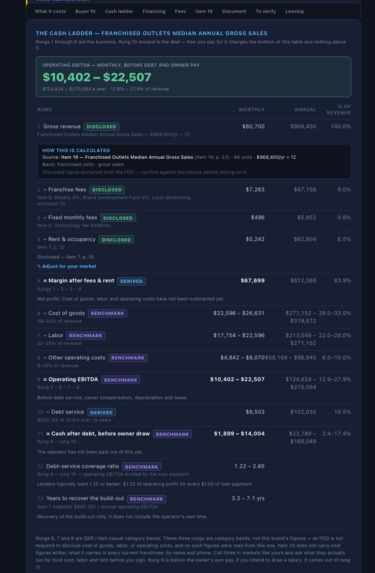
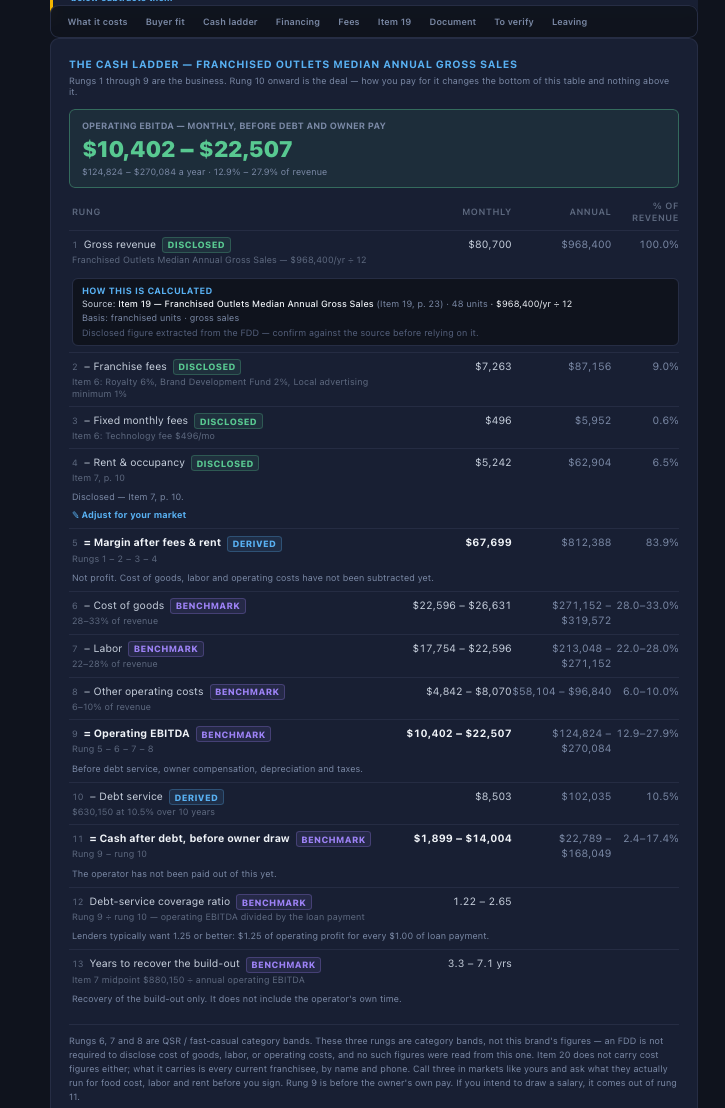
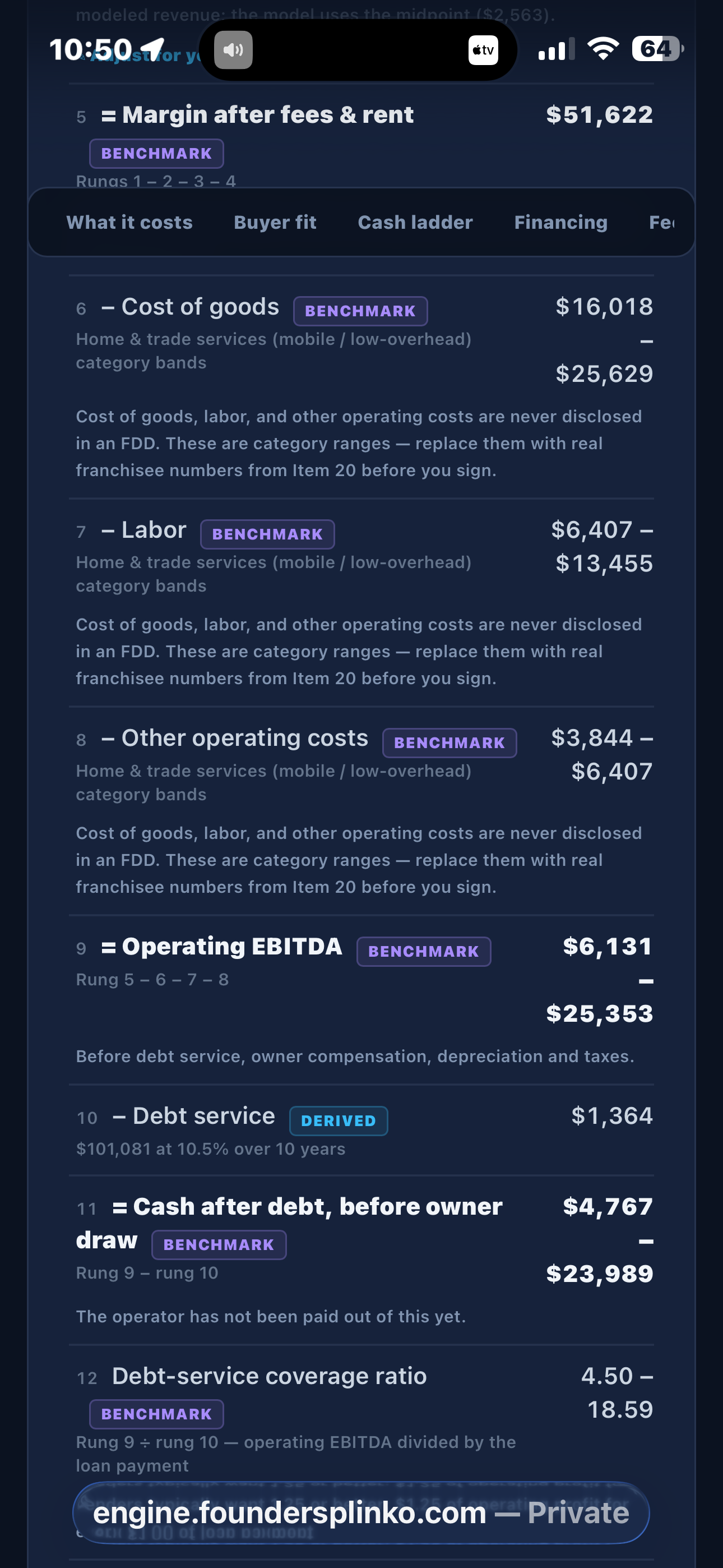
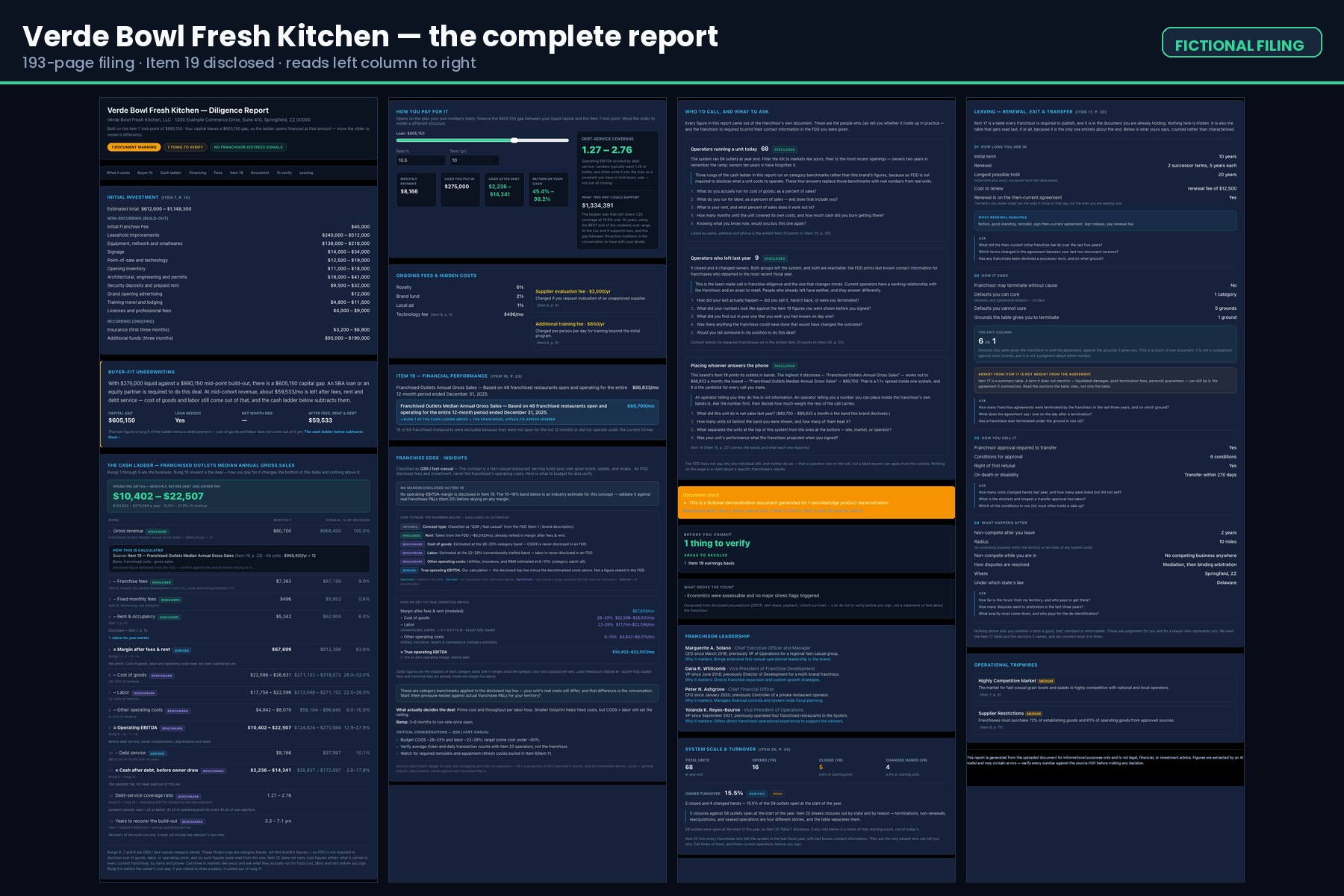
Thirteen rungs from the disclosed top line down to what a buyer keeps. Every figure computed by code, not the model. Fictional filing.
-
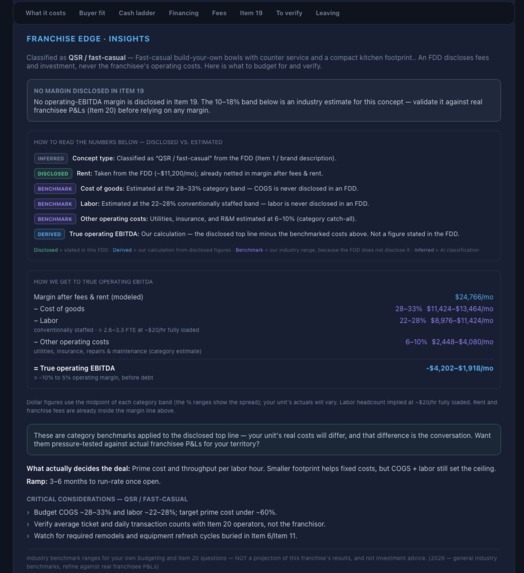
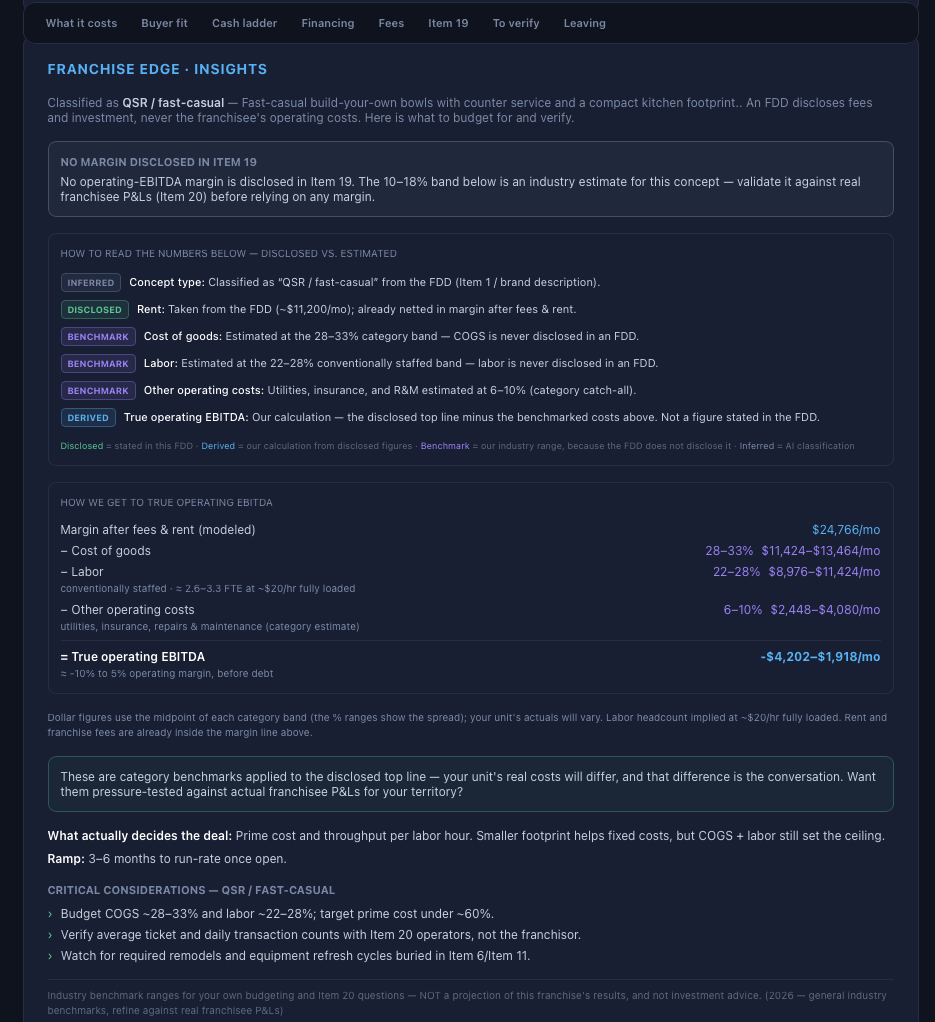
Disclosed, derived, benchmark, inferred — every figure carries one. Here the honest answer is a negative margin, and it prints it.
-
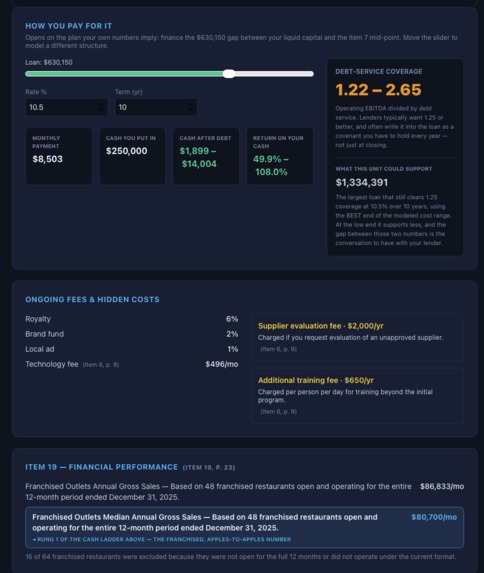
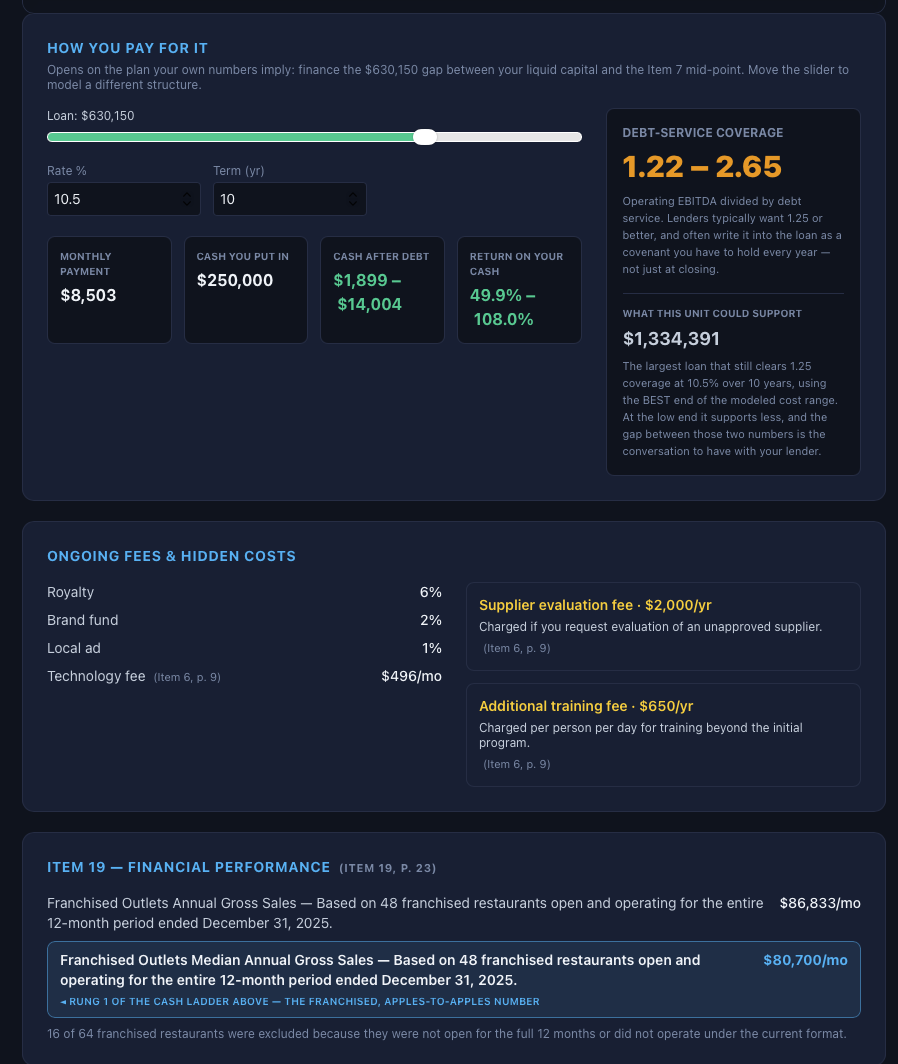
Debt-service coverage against a lender's 1.25 floor — the ratio that ends a months-long underwriting conversation, shown up front.
-
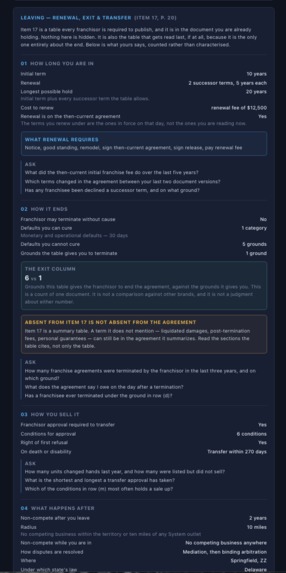
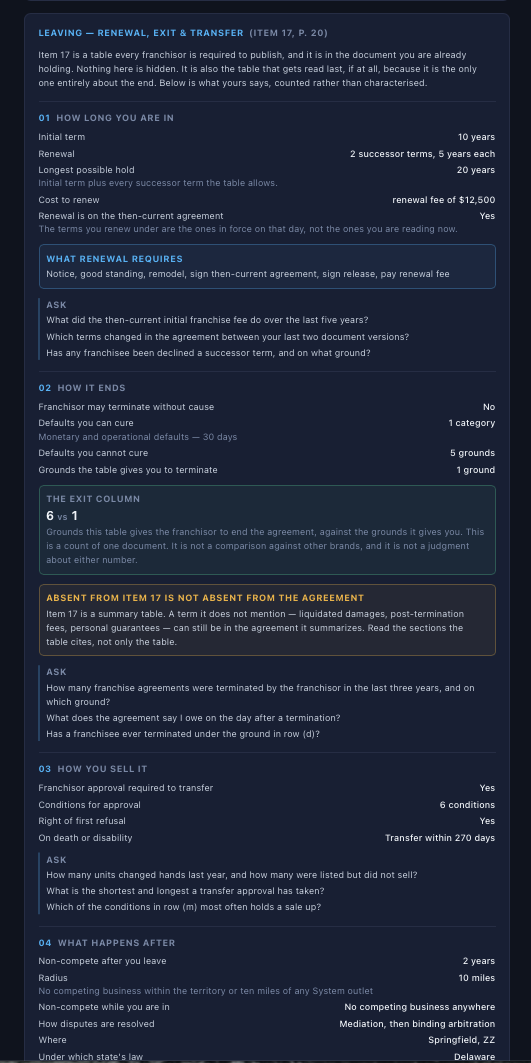
Renewal, termination, transfer, non-compete, and the forum you'd argue in. Least-read section before signing, most-read after
-
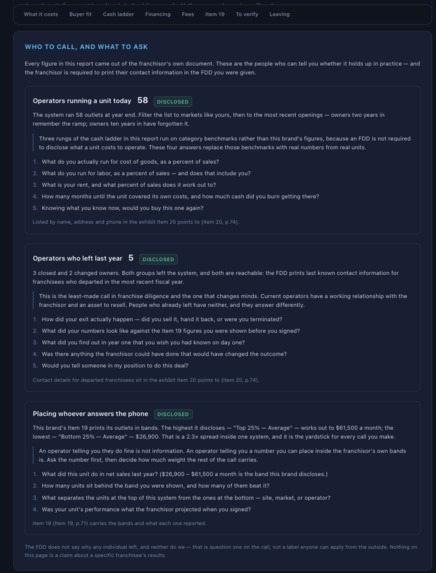
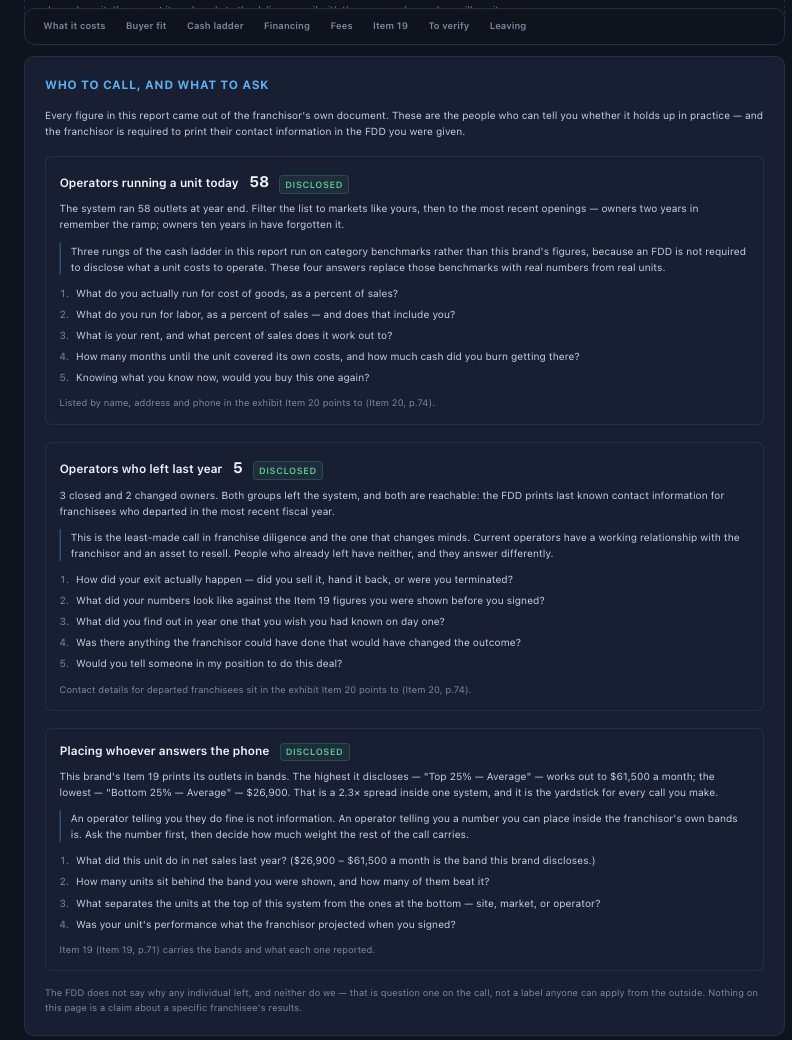
Current operators, those who left, and the disclosed band — each with the question that opens the call. Fictional filing, no real data.
-
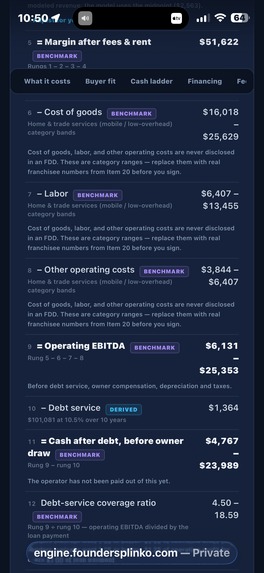
Most real traffic is mobile. The ladder drops columns rather than squeezing eleven rows of figures onto a phone screen.
-
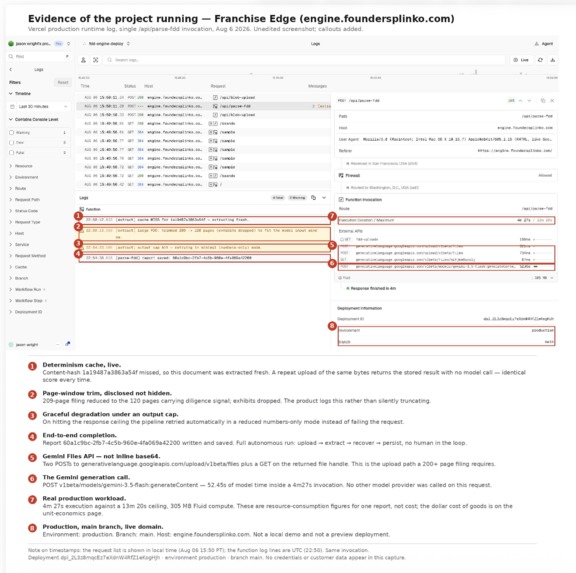
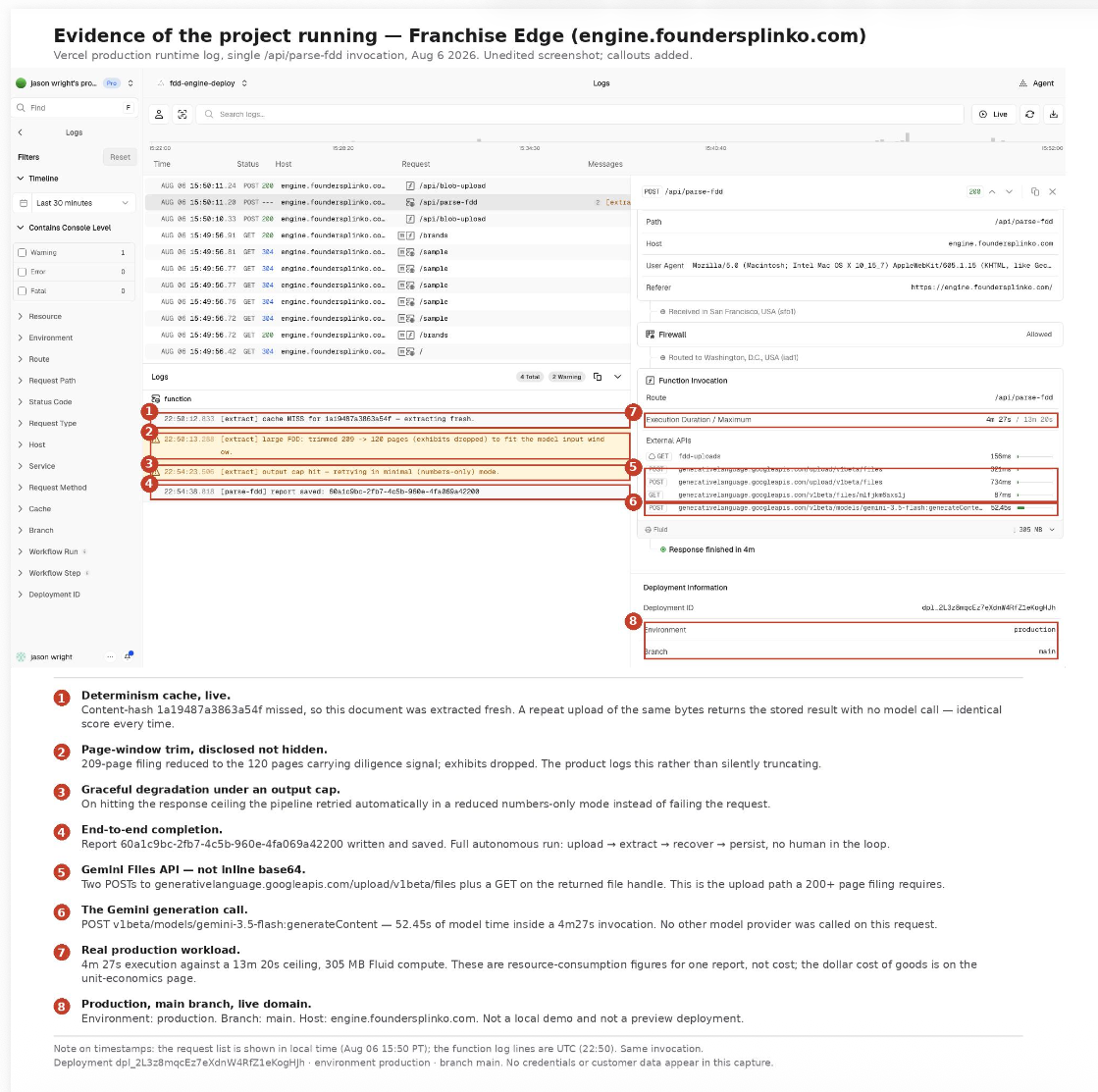
One filing read by gemini-3.5-flash via the Files API: 52.45s of model time inside a 4m27s production run. No other vendor called.
-
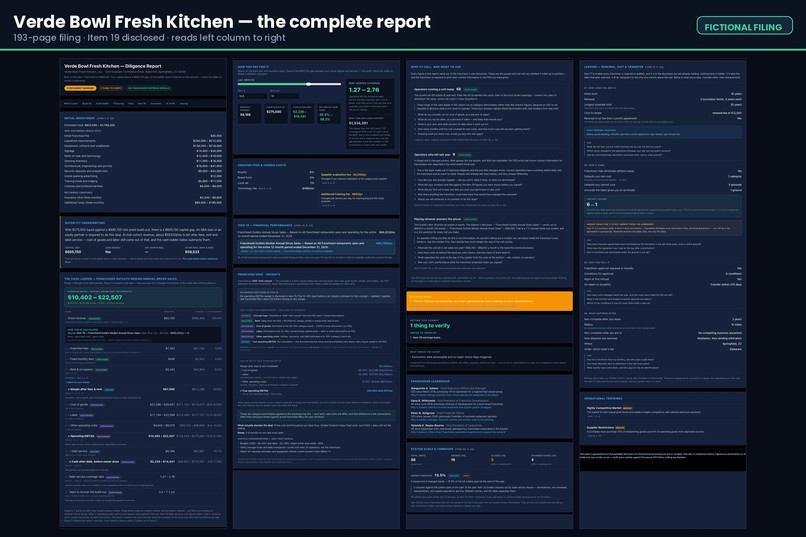
The complete report, top to bottom. Every figure labelled disclosed, derived, benchmarked or inferred. Fictional filing, downloadable.
-
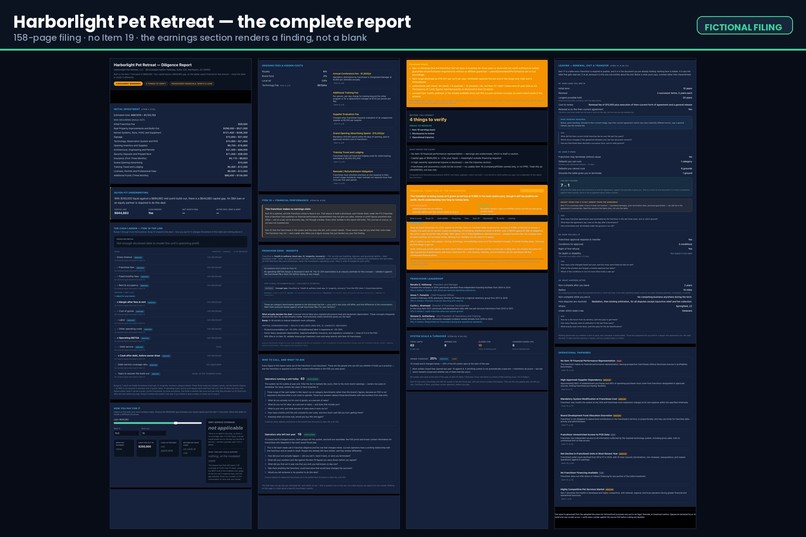
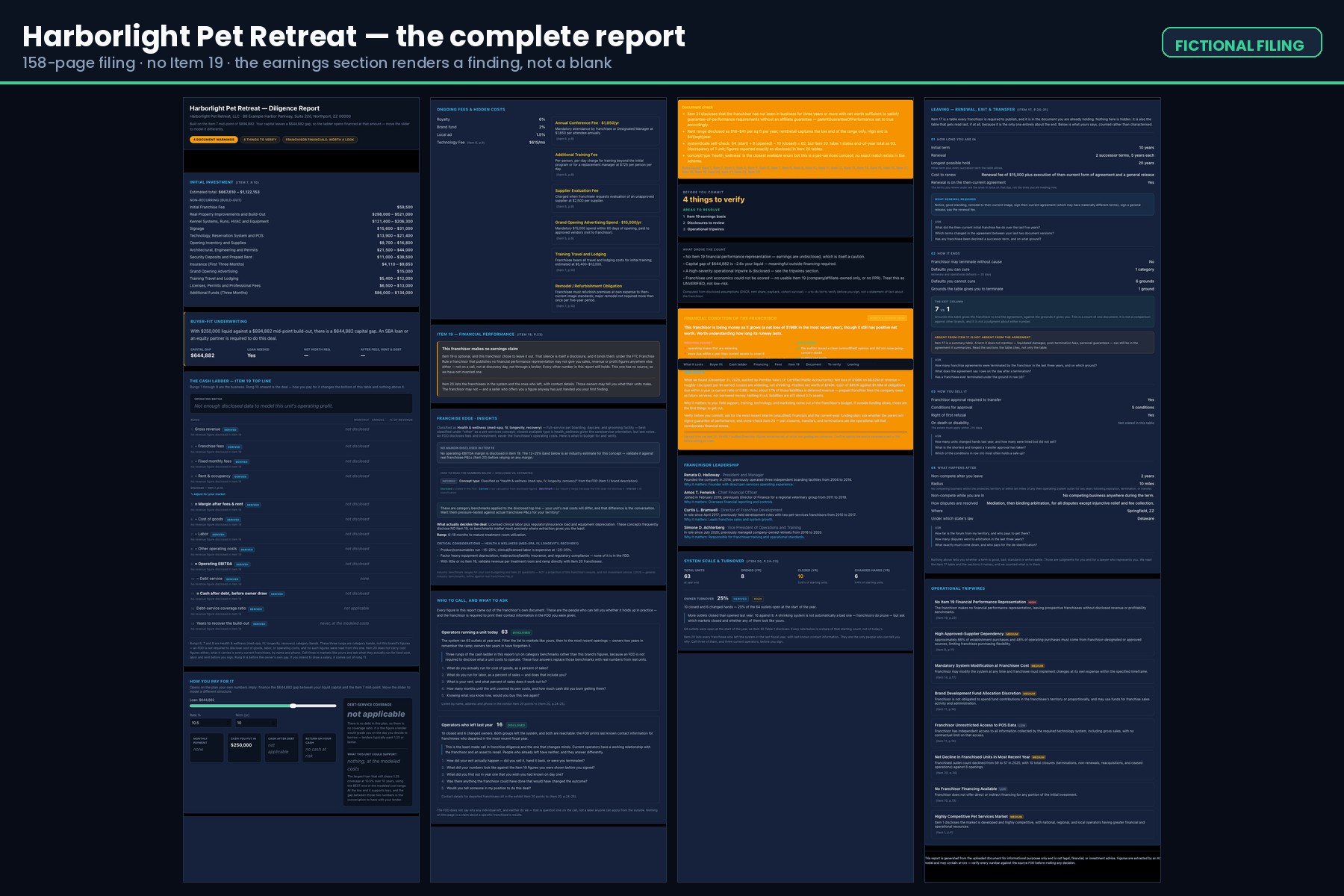
A filing with no Item 19. The earnings section renders a finding, not a blank — and the list of franchisees to call instead.
Before anyone can buy a franchise, federal law hands them a disclosure document — typically 200 to 700 pages of legal and financial text — and fourteen days to decide. The longest filing in my library runs 723 pages. Every number in it is true and arranged to flatter. And the person reading it is about to sign a personal guarantee on a half-million-dollar loan.
I was that person.
The hardest part was not the decision; it was that nobody would sit down and do the whole-picture evaluation with me inside the window where it could still change the answer. So in late May I opened a Google Cloud project, started feeding filings to Gemini, and built the thing I could not hire.
Franchise Edge is a business-model evaluation engine. It reads the filing and underwrites the deal: what it truly costs to open, what a unit earns where the franchisor discloses it, the full fee stack, debt service against a lender's coverage floor, the franchisor's financial condition, churn among existing owners, the exit terms, and who to call to check all of it.
That is buy-side M&A diligence — quality of earnings, debt-service capacity, return on capital — and it exists for a $50 million acquisition because that deal carries six figures of professional time. It has never existed for the $500,000 franchise. That is the constraint I set out to break.
Business Viability
Every franchise sold in America is underwritten by somebody. It is almost never the buyer.
Eighty-three real filings went through the engine as a baseline corpus, built in weeks — more than 22,000 pages of franchisor disclosure measured so far, the longest running 723. The model does not read all of it, and that is deliberate: on a large filing it decides which pages carry diligence signal and narrows the read, dropping exhibits, and it logs that decision rather than truncating in silence. Every one produced a complete report. No run has failed because the model could not read the business — reliability is a property of the design, not a lucky streak. Read the same corpus the way the industry does today, one specialist at a time, and it is six figures of professional time. There is no marginal analyst here and no marginal week.
The $199 came out of the ecosystem rather than a spreadsheet — an order of magnitude under what a single specialist charges for a partial answer, and small enough against a half-million-dollar decision that it never has to be justified. It is the entry rung of a ladder whose upper rungs already have demand.
Everything after that is measured. In thirty days the site drew 802 visitors and 984 sessions, 60% on a phone — confirmed across two independent windows against an earlier estimate. Bounce 40%, mean session four and a half minutes. I did not stop at the dashboard: I watched recorded sessions of real buyers moving through the product — which pages they opened, how far they scrolled, what they did with the capital slider, which inputs they never touched. Three shipped changes came out of that, including rebuilding the all-cash path after watching people use the financing section as a breakeven calculator.
Acquisition was measured the same way. Paid search returned 9,921 impressions and 512 clicks at a 5.16% click-through rate against brand-specific queries, with the highest-intent campaign capped by budget rather than exhausted. Generic-intent copy drew 16 impressions in three weeks — a segmentation finding, not a spend report: value concentrates in buyers who have already named a brand or are asking what one costs.
Two routes are live and I am funding both. Direct to consumer is measured, not solved — the audience is real and reachable at a known price; conversion is what is unproven, and price, trust and timing are all adjustable. The second is partnership. Every discipline around this transaction stays in its lane — lawyers read legal text, accountants read statements, brokers read leases, lenders read credit — and none steps outside it to build a cross-disciplinary evaluation engine, because that is not the business they are in. The gap between the lanes is structural, not competitive. Two partners are already in it: a national franchise broker network in conversation since June, whose feedback put brand-to-brand comparison first on my build list, and a commercial real-estate group specializing in franchise. The report travels out to the buyer alongside the partner; buyer data never travels the other way.
AI-Native Operations
Gemini does the hard part first. A several-hundred-page filing goes up through the Files API and comes back as structured facts against a strict schema covering all 23 disclosure Items — no regex parser, no human transcription, no template. The model decides which pages carry diligence signal and narrows the read. It classifies the industry and sub-segment, which selects every benchmark band applied downstream, because a rule that is right for a restaurant is wrong for home services. It determines whether each Item is present, absent, or explicitly disclosed as absent — a positive finding, never inferred from an empty result. And it records the page every figure came from.
What the buyer sees is then assembled live, filing by filing. No two reports are the same document: sections appear or disappear on what the model found, severity and coverage and payback compute against that brand's own disclosed figures, and where a franchisor discloses nothing the report says so and hands the buyer a call list instead of a number. Instant, different every time, and never a figure the model did not read.
That division is the whole architecture — the model decides what the document says; the deterministic layer decides what it means for your money — and it is why a corrected formula reaches reports already sold, and why two buyers holding the same filing get the same answer.
The system also decides for itself at runtime. When the primary reader cannot complete a filing, it detects that, retries in reduced mode, then routes to a second extractor on an identical schema — decided by software while a buyer waits, not by me the next morning.
Beyond the product, AI is the operating team. Every line of code in this system was written with it and reviewed by it, front end to back end — the extraction schema, the financial derivation layer, the server-side paywall gating, the test suite that gates every commit. It writes the ad copy and the landing-page variants, reads the product analytics and tells me what the session recordings actually showed, drafts the support replies, triages what broke, researches the state FDD registries, normalises transaction data and reconciles the books. There is no hour of this business it is not in.
What it does not do is decide. Which underwriting rules are right for which industry, what the kill criterion is before an experiment starts, which findings actually decide a deal, and whether a claim is honest enough to publish — those come from having sat on the buy side of this transaction, and they are the part that cannot be delegated. AI carries the execution; the judgment is mine, and it is written into tests rather than into my head, so it survives me. One person ships several times a day, and a partner's feedback reaches production in hours.
Category Impact
Franchise disclosure has not changed shape in fifty years. The federal rule has been amended once, in 2007, and the artifact a buyer stakes their savings on is still a several-hundred-page PDF handed over two weeks before signature. None of the specialists who can read it, at $1,500 to $5,000 each, answers the question the buyer is actually asking: does this business make money?
Franchise Edge answers it in minutes, for $199, on any brand. US franchising runs roughly 845,000 establishments and 8.9 million jobs, with more than 12,000 net new franchised businesses opening this year — every one of those buyers on the same fourteen-day clock. The economic opportunity this enables sits outside the company, which is the point. A buyer who underwrites the deal correctly opens a business that survives, and the jobs that follow are the ones that last; a buyer who walks away from a deal that could never have carried its debt keeps the capital to fund a better one. That is the opportunity: not more franchises sold, better ones bought. Nearer in, the professionals already sitting beside that buyer — attorneys, accountants, brokers, SBA lenders — gain an input to work they already charge for. And the first hires this business makes will be the ones that build that channel, not the ones that read documents. Reading documents is what the engine is for.
And the discipline holds under pressure. Of the 83 filings we parsed, five make no earnings claim. Most tools would fill that silence with a comparable brand and call it typical. We leave it blank, tell the buyer the franchisor is legally barred from giving them numbers anywhere else, and hand them who to call instead. It costs us the sale. That's why a buyer can trust every other number on the page.
Built With
- gemini
- google-ai
- google-gemini-files-api
- next.js
- pdf-lib
- postgresql
- posthog
- react
- resend
- stripe
- supabase
- typescript
- vercel
- vitest

Log in or sign up for Devpost to join the conversation.