-
-

FrameSeek — Basketball Film Room. AI-created sports cover illustrating the product direction.
-
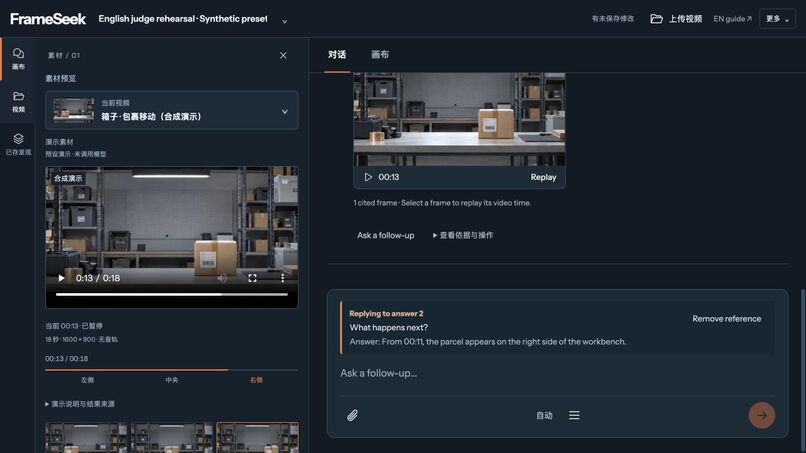
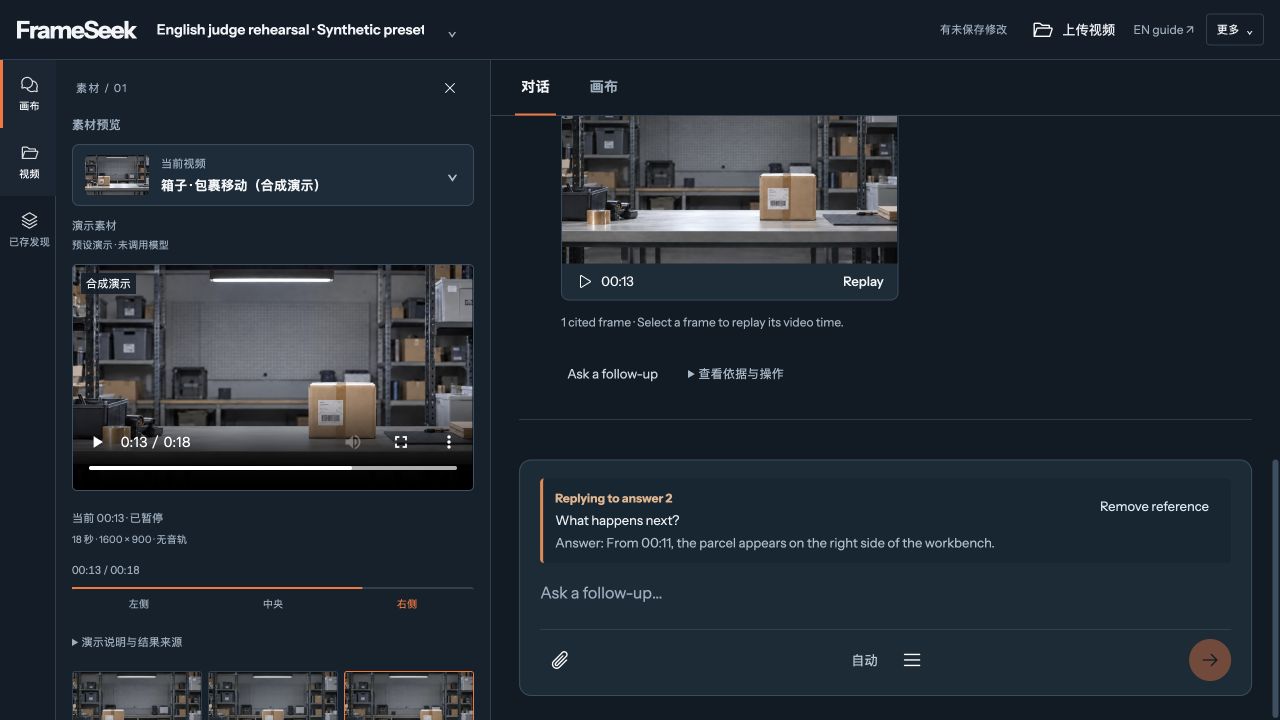
Synthetic demo: contextual follow-up, cited frame and replay at 00:13. Preset answers; no model calls.
-
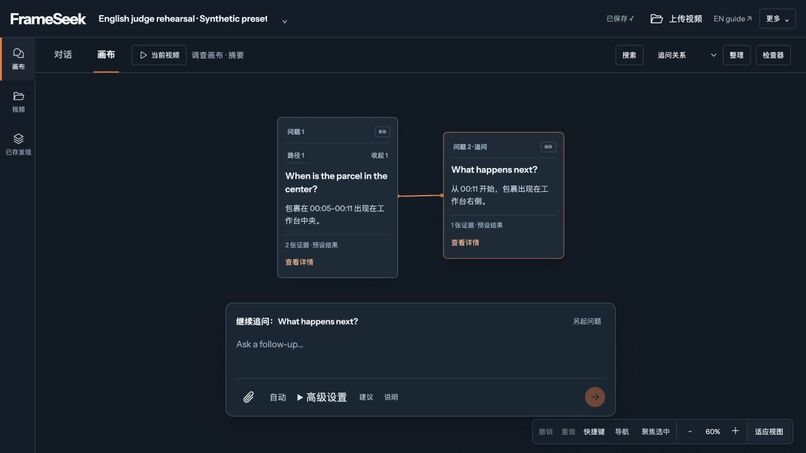
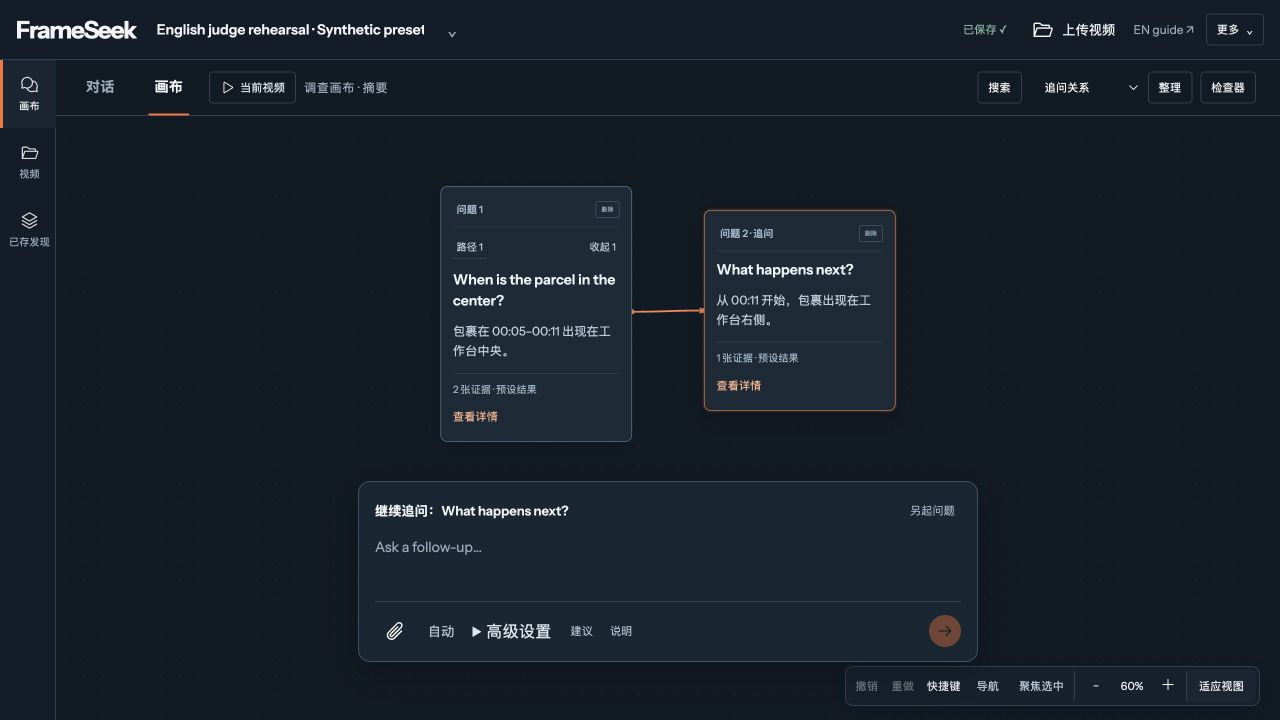
Synthetic demo: connected questions on the spatial canvas. Follow-ups stay attached to their source question.

Inspiration
Basketball film contains useful details that are difficult to find again. A coach, player or analyst may remember a jersey, a scoreboard or a moment before a play, but still has to scrub through the recording. We wanted a film room where a question leads back to the footage that supports the answer.
What it does
FrameSeek is a desktop video investigation workspace. Users can upload a recording, ask about visible details, inspect cited source frames and replay their original timestamps. Follow-up questions stay connected to the earlier answer. Conversation and spatial canvas views present the same investigation, and saved findings can be organized and exported with their references.
The basketball-focused interface is designed for inspecting evidence. It does not claim complete shot counts, player identity tracking or automatic coaching advice.
How we built it
The backend uses Python, FastAPI and SQLite. FFmpeg and ffprobe preflight uploaded media and decode bounded samples with original video timestamps. A React workbench connects the source player, questions and evidence. Evidence references and model output are validated before publication; interrupted work preserves valid partial results. Private sources remain protected by session ownership and expiry checks.
The NVIDIA route uses Nemotron 3.5 Super VL through Nebius Token Factory for visual inspection and answer generation, with Qwen3 Embedding 8B for text retrieval. The application is hosted on a Nebius AI Cloud CPU instance; this route does not rent a dedicated GPU. Model requests pass through finite owner and deployment budgets.
What has been demonstrated
An earlier limited Nemotron/Token Factory basketball run returned scoreboard evidence at source time 05:26.1 and a contextual follow-up. These saved answers were partial and used sparse sampling. The newer reusable basketball index was tested separately with a local Qwen processor; those results are not Nemotron results or a controlled model comparison.
The currently available public synthetic parcel demo uses preset answers and no model calls. It demonstrates the question, cited frame, replay and saved-workspace interaction. The sports images on the landing page are illustrative. A fresh-judge live sports-analysis flow is not yet verified.
Challenges we faced
A plausible answer is not enough: its frame must belong to the correct video and seek to the correct time. Sampling can miss a short appearance, and a number of cited images is not a count of unique events. We also had to handle cancellation, late responses, persistent edits and uncertain model attempts without silently repeating paid requests or replacing real answers with synthetic ones.
Accomplishments and lessons
The workspace joins questions and playback into a reviewable investigation rather than a disconnected chat transcript. Uploads, private playback, saved investigations and original-time evidence navigation work locally. The cloud integration has recorded limited real evidence as well as explicit failures; mock regressions cover the surrounding contracts. We learned to distinguish valid output structure from visual correctness, and to preserve uncertainty alongside useful evidence.
What is next
The immediate goal is a repeatable NVIDIA/Nebius basketball workflow that a fresh judge can operate. Next come human-reviewed sports examples, measured review-time comparisons and broader testing across recordings. Event counting, identity tracking and additional sports remain outside the demonstrated scope.

Log in or sign up for Devpost to join the conversation.