Inspiration
AI can generate impressive individual images and video clips, but creating a complete multi-scene story with consistent characters, props, environments, and story states remains difficult.
While working with generative video, we repeatedly encountered continuity problems: characters changing appearance, weather disappearing, objects switching state too early, and scenes drifting away from the intended story.
FrameKeeper was built to solve that problem.
What it does
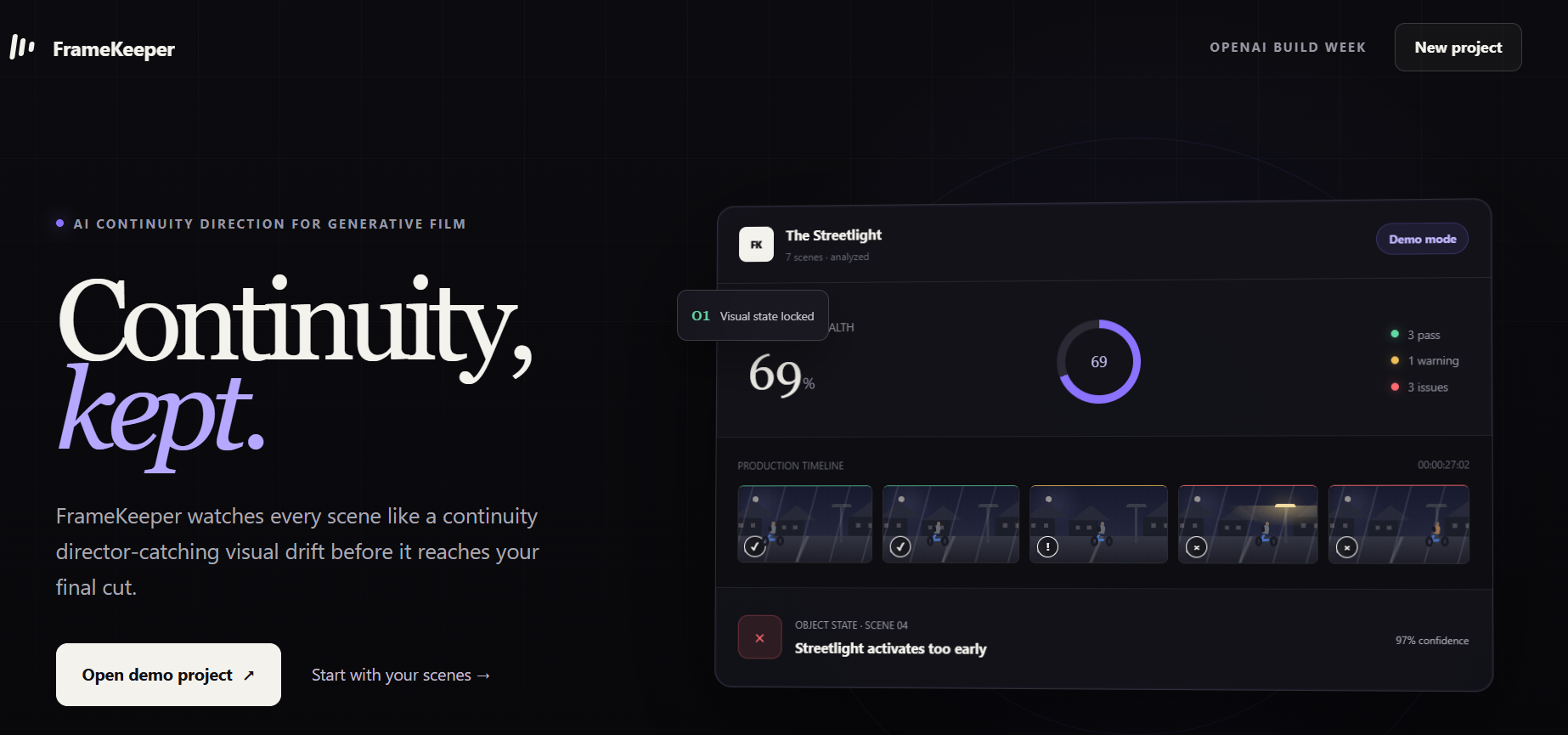
FrameKeeper is an AI continuity director for generative video.
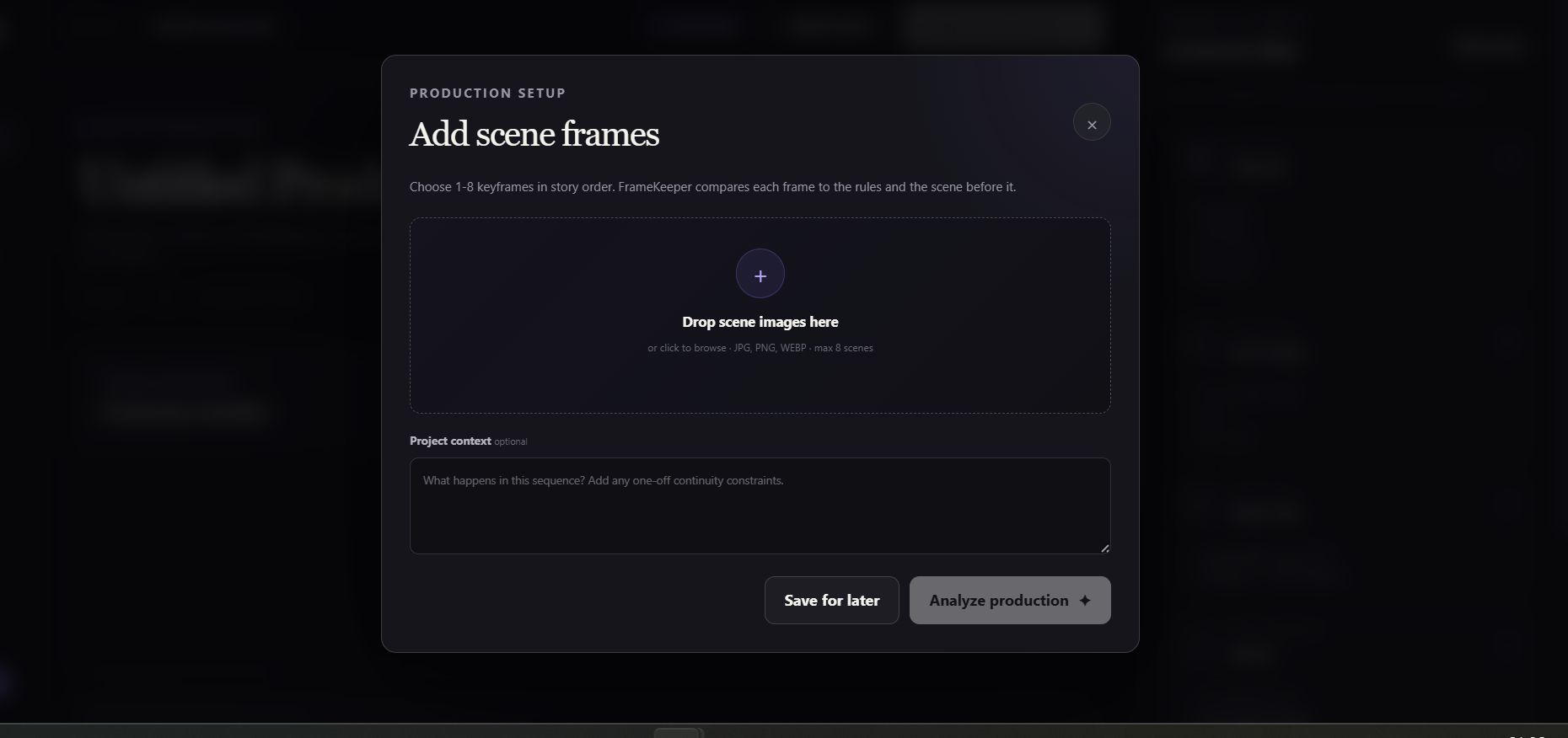
It analyzes scenes across a project and checks them against persistent story rules.
FrameKeeper can identify continuity issues involving:
- Characters
- Clothing
- Environment and weather
- Props and object state
- Movement
- Visual style
- Scene-to-scene consistency
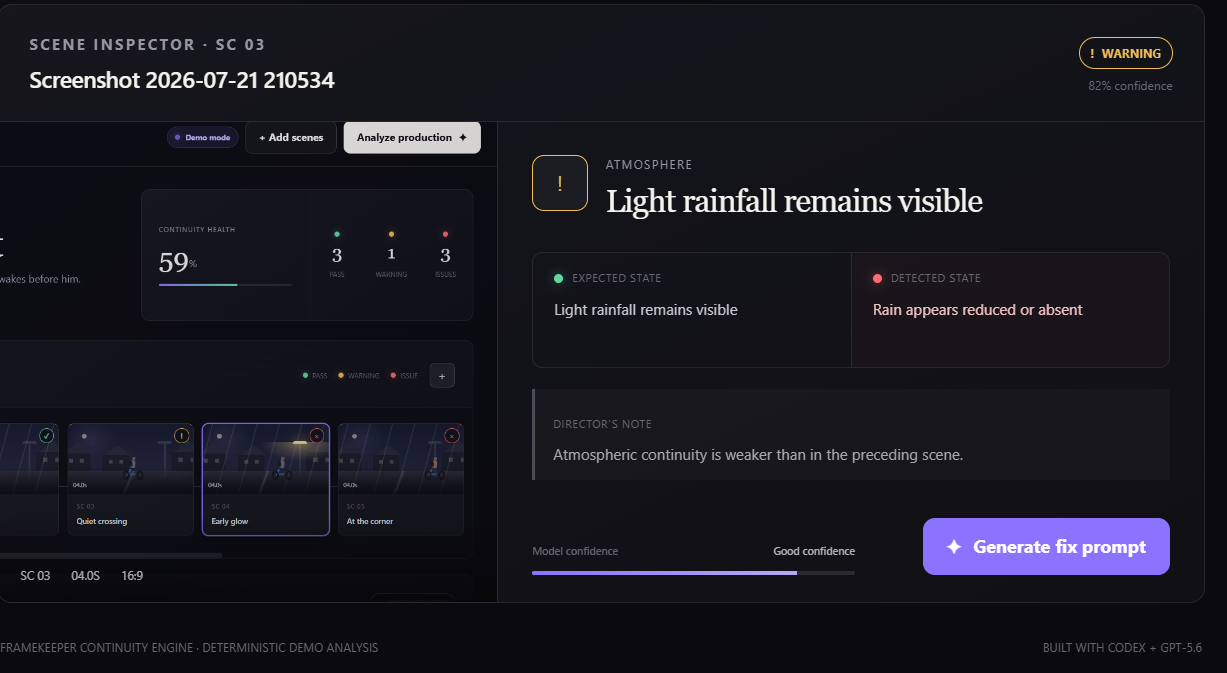
When an issue is detected, FrameKeeper shows:
- Expected state
- Detected state
- Explanation
- Confidence score
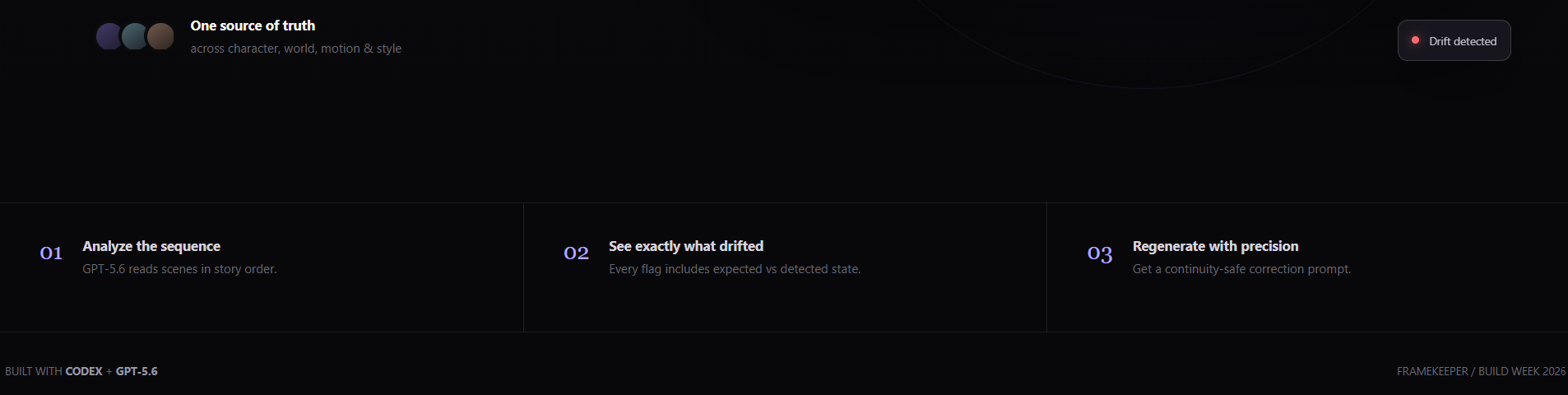
It can then generate a precise correction prompt for regenerating the affected scene.
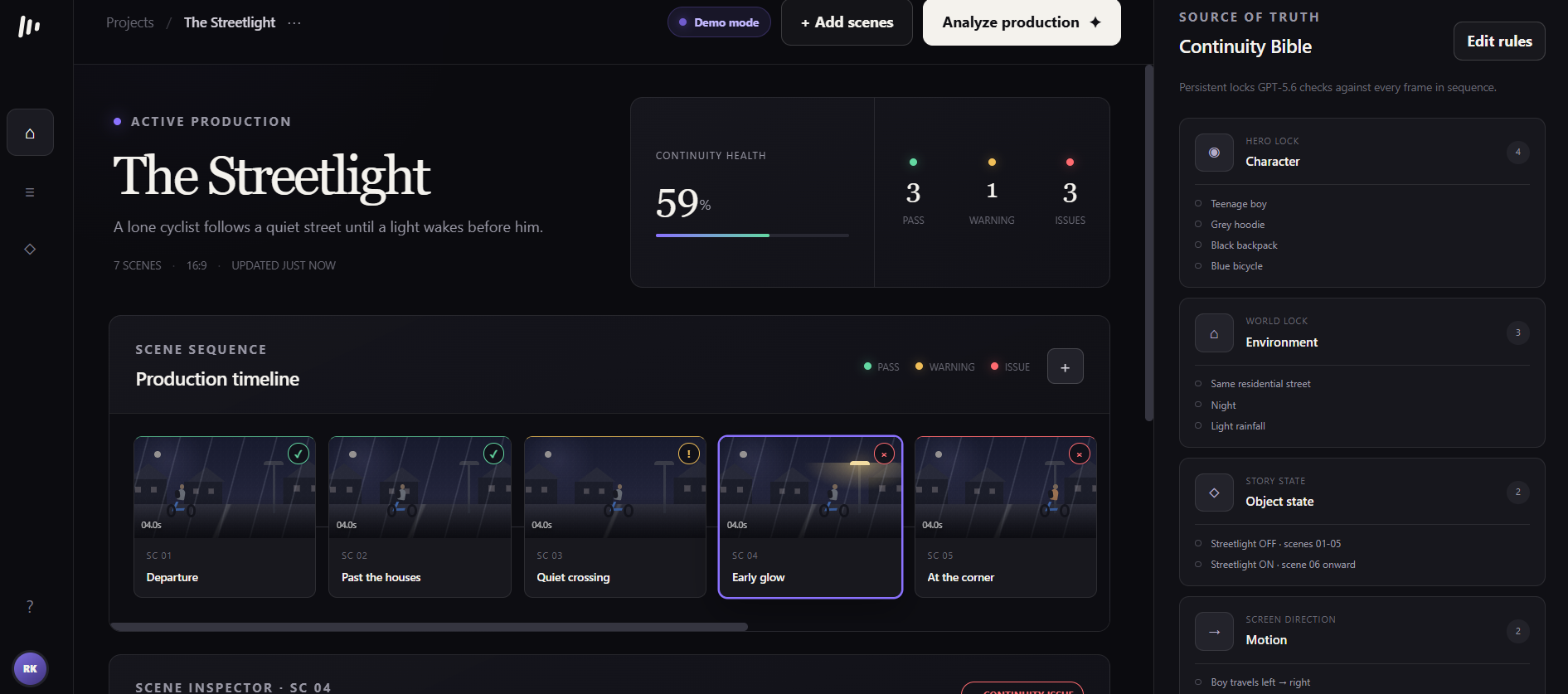
FrameKeeper also maintains a Continuity Bible containing persistent project rules for characters, environments, props, motion, and style.
How we built it
FrameKeeper was built with Codex and GPT-5.6.
Codex was used throughout development to design, implement, debug, test, document, and deploy the application.
GPT-5.6 powers the structured continuity-analysis layer. The application can send scene context, continuity rules, and images to the model and receive structured analysis describing detected continuity issues and correction prompts.
The hosted Build Week version also includes Demo Mode, allowing judges to test the complete workflow without requiring an API key.
Challenges
The biggest challenge is that continuity is contextual.
A streetlight being ON is not inherently an error. It becomes an error when the story says it must remain OFF until a later scene.
FrameKeeper therefore needs to reason about both individual scenes and the evolving state of the overall story.
What we learned
Generative video has a missing workflow layer between generation and editing.
AI tools are increasingly good at generating individual shots, but creators still need tools that understand how those shots relate to each other.
FrameKeeper explores how AI can act not only as a generator, but as a production supervisor.
What's next
Future versions could include:
- Video-level motion continuity analysis
- Automatic character identity tracking
- Timeline-aware object-state tracking
- Automatic regeneration through supported generation APIs
- Team collaboration
- Integrations with major generative-video platforms
Our goal is to make FrameKeeper the continuity layer for AI-native filmmaking.
Built With
- api
- codex
- gpt-5.6
- next.js
- openai
- react
- tailwind
- typescript

Log in or sign up for Devpost to join the conversation.