Inspiration
Ring devices record everything—but finding one specific moment is still painfully manual.
When a package disappears or something unusual happens overnight, people rarely know the exact timestamp. They remember a question:
“Who came to the door?”
“When did the package disappear?”
“What happened before the alarm?”
Answering it can mean scrubbing through hours of footage across multiple Ring devices.
BackTrack turns that investigation into a question.
What it does
BackTrack is an investigation layer for Ring footage.
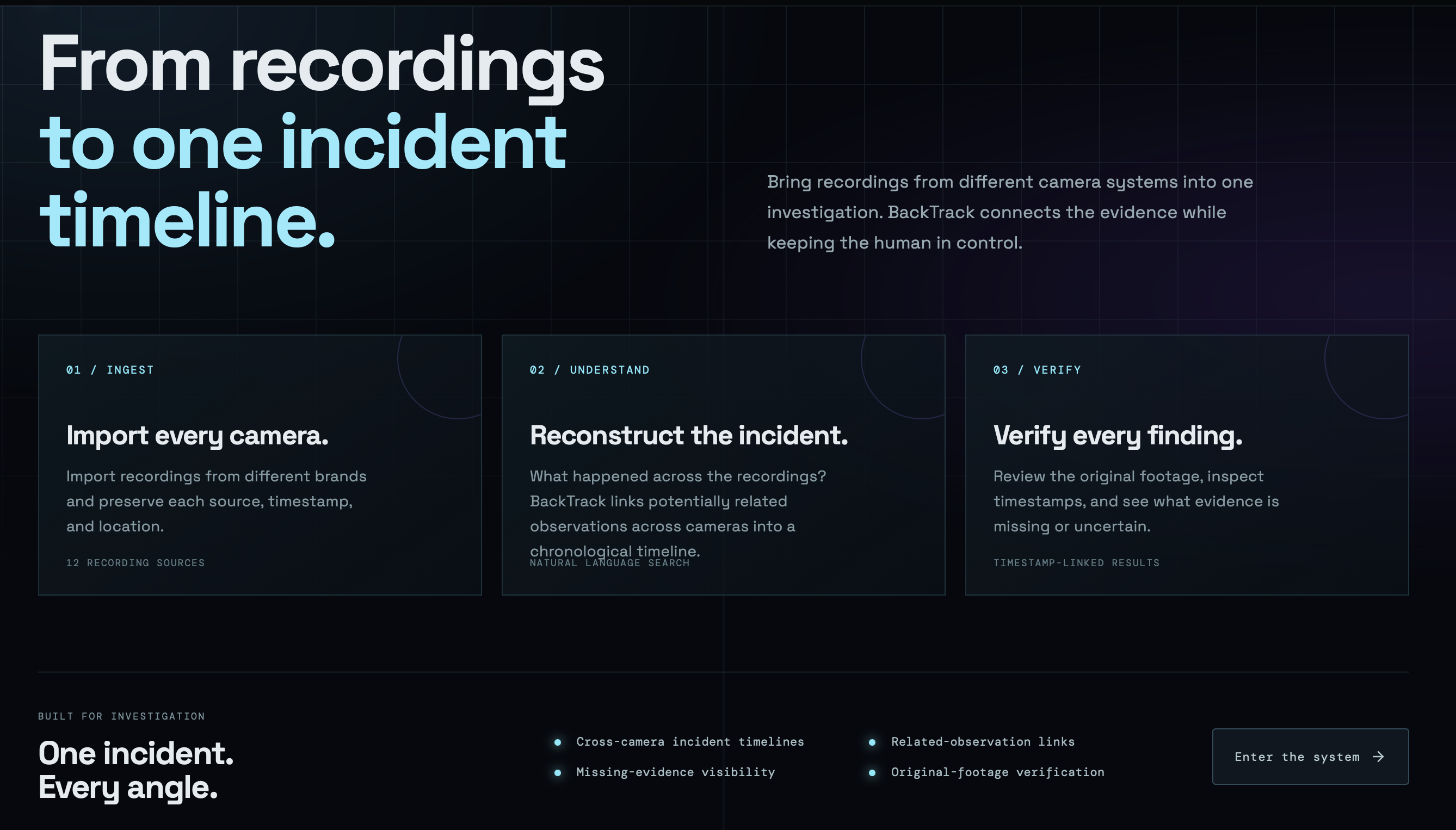
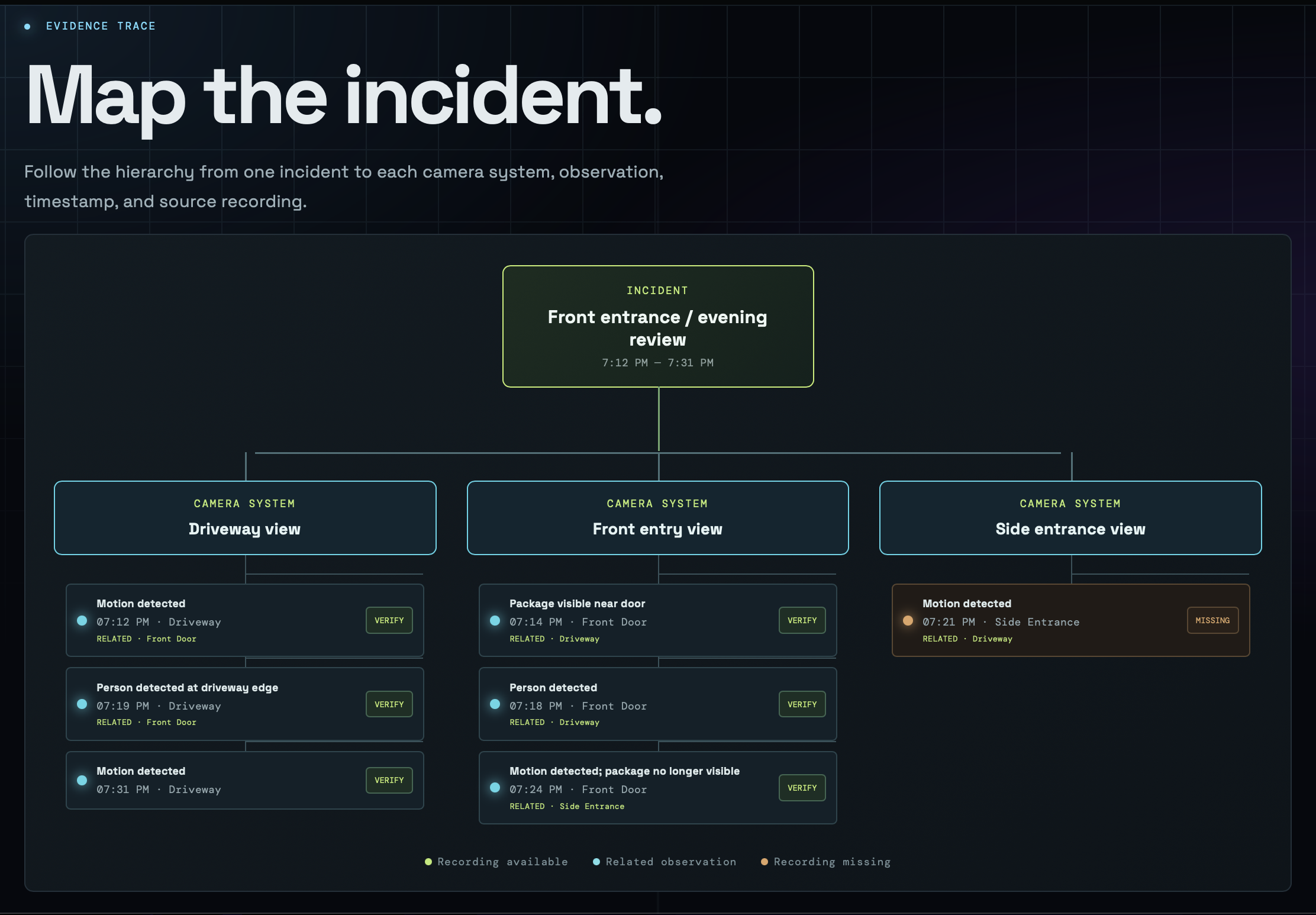
Users ask what happened in plain language. BackTrack identifies relevant observations, builds a chronological incident timeline, connects related moments across Ring devices, and opens the original footage for verification.
It helps users:
- Find the right moment
- Follow an incident across Ring devices
- See timestamps and recording locations
- Identify missing footage
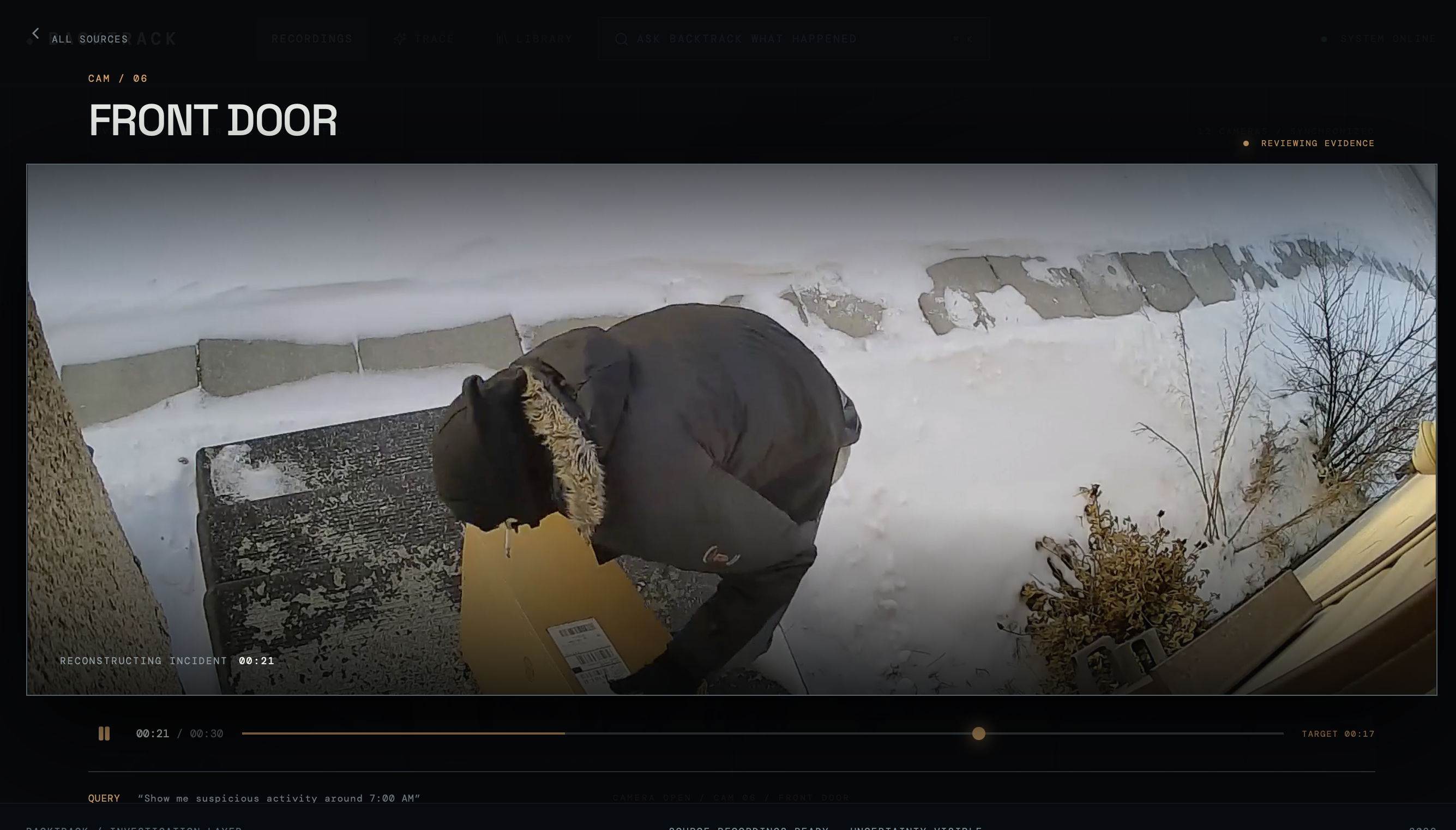
- Verify every finding against the original video
The result is simple:
Ask a question. Find the moment. See the evidence.
How it works
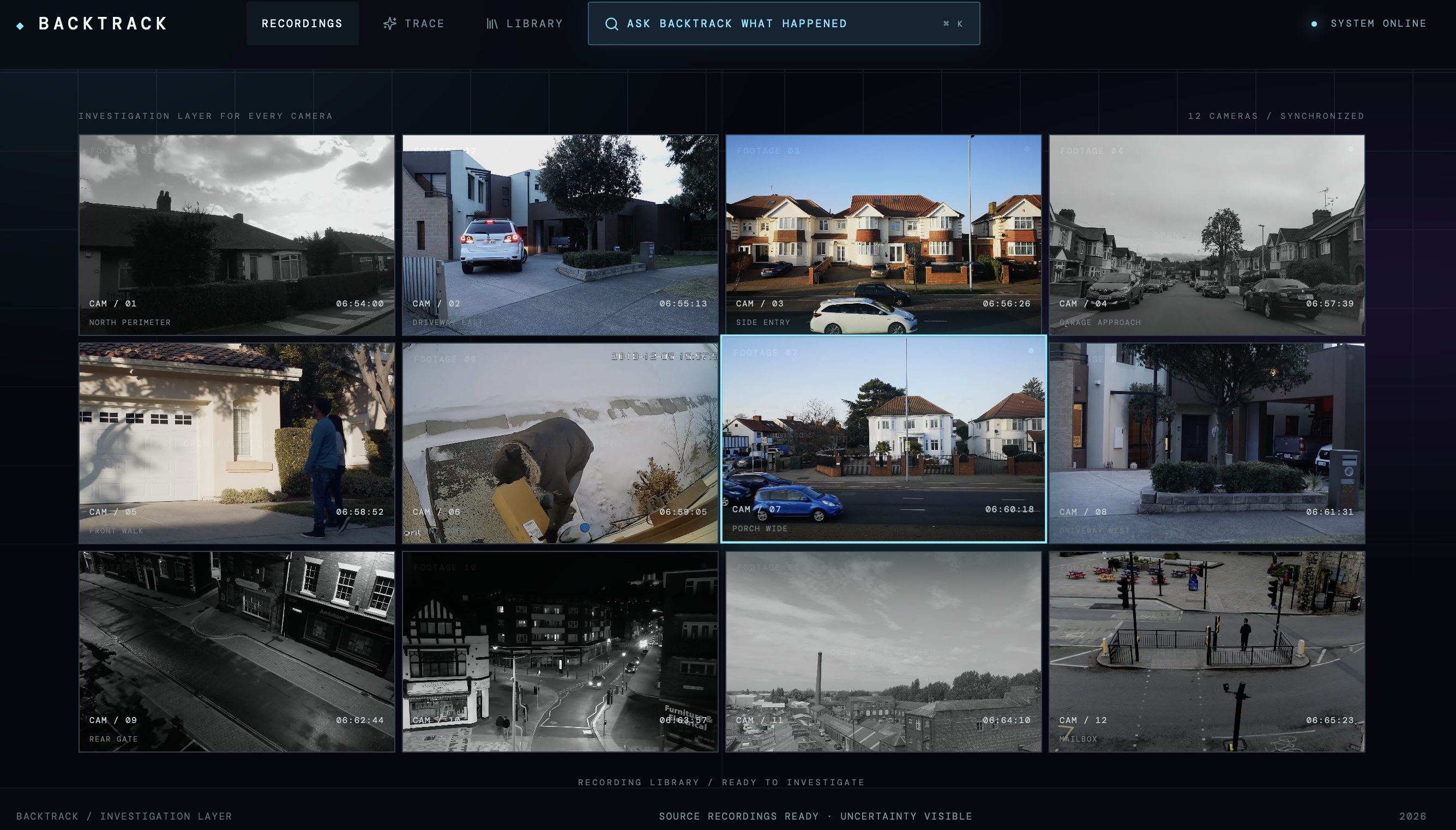
BackTrack organizes Ring footage by device, timestamp, and location.
A user starts with a question such as:
“What happened near the front door last night?”
BackTrack maps the question to the most relevant Ring footage, opens the right moment, and presents surrounding observations as a connected incident trace.
Users can then:
- Watch the original Ring recording
- Move through the timeline
- Compare related Ring views
- Inspect what happened before and after
- See where footage is unavailable or uncertain
BackTrack helps users investigate faster without hiding the original source.
What makes it different?
Most Ring experiences are designed for live viewing, motion alerts, or opening one event at a time.
BackTrack is built for the question that comes afterward:
“What actually happened?”
Its defining feature is cross-device incident reconstruction. Instead of returning an isolated Ring clip, BackTrack connects potentially related observations into one traceable story—with the time, device, location, and source footage attached to every step.
It does not ask users to blindly trust an AI-generated explanation. It shows the Ring evidence and makes uncertainty visible.
Why BackTrack?
Important evidence is often buried inside hours of Ring footage.
BackTrack gives people a faster starting point. They do not need to remember exact timestamps, know which Ring device captured an event, or manually compare recordings.
They can start with the question already in their head:
“I think something happened.”
BackTrack turns that into:
“Here is where to look—and here is the footage that supports it.”
Built with
React, TypeScript, Vite, Node.js, Express, HTML5 video, the Ring API, Amazon Bedrock, AWS SDK, Zod, and Vercel.
The prototype includes a 12-device Ring footage workspace, local video playback, natural-language investigation, cross-device incident tracing, and source-linked review.
Challenges
The hardest part was not displaying Ring video. It was making Ring footage useful for investigation without making the results untrustworthy.
Footage can be incomplete, unclear, or captured from difficult angles. BackTrack needed to help users discover relevant moments while clearly separating:
- What the Ring footage shows
- What the system connects
- What remains uncertain
- What evidence is missing
We also had to coordinate Ring media access, large video files, timestamps, browser playback, device navigation, and evidence relationships in one smooth workflow.
What’s next?
Future versions could support:
- Cross-device movement tracking
- Saved investigations
- Automatically generated incident reports
- Voice-based investigation
- User-defined zones
- Privacy-preserving video analysis
- Support for additional camera platforms
BackTrack’s immediate goal is clear:
Turn hours of Ring footage into one understandable, verifiable incident.
Built With
- computer-vision
- react
