Inspiration
- Both participants are originally from Southern India where Agriculture is deeply rooted in society
- We saw that the agriculture industry is often underrepresented and taken advantage of
What it does
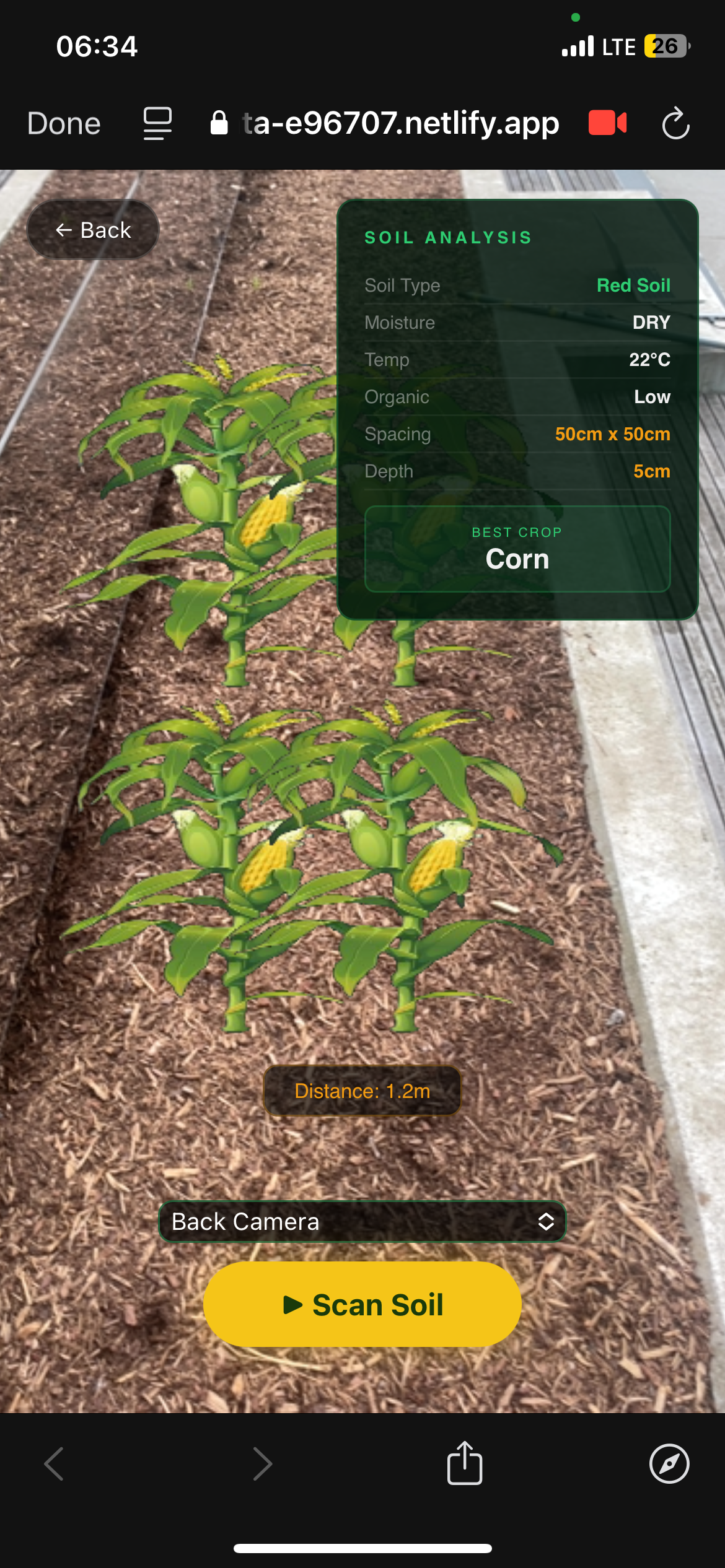
- It is able to use the iphone camera to scan a certain space, determine what type of soil the space has if any, reccomend which crops should be planted on that soil, a augmented-reality based visualization of how the farm should look when planted.
How we built it
We built the hardware component using an Arduino Leonardo mounted on a rod, with two soil sensors (a moisture sensor and a temperature sensor) attached at the base where they make direct contact with the ground. The Arduino is connected to a laptop via USB, which both powers the device and enables real-time serial data transmission to our Flask backend.
Software: We built the software using the Claude API (Anthropic) for AI-powered soil analysis and crop recommendations. The frontend is built in HTML5 and JavaScript, using the Canvas API to project AR plant overlays directly onto the camera feed — simulating what a VR/AR headset would display, as dedicated AR hardware was not available at the hackathon. A Python Flask backend handles communication between the Arduino sensors and the Claude API, with a Cloudflare tunnel enabling secure real-time data transfer from the laptop to any browser.
Challenges we ran into
1: Raspberry Pi) We had a lot of trouble booting a raspberry pi and when it was finally working we were unable to use it because our sensors submitted analog data where as the raspberry pi only intakes digital data. This led us to switch to an arduino which we are not fully familiar with either but we eventually got it to work.
2: Machine Learning Model) We initially used an API to fins soil quality but decided to change to a teachable - machines model to make sure it is more accurate and diverse. While doing this we were unable to use the terminal leadign to termination of code and ultimatley a step back on the project.
Accomplishments that we're proud of
We were able to use hardware which we both are not familar with.
What we learned
We learned to always commit to git and make sure it stays up to date to deal with any drawbacks. We also learned that we should understand the connection from hardware to software to ease the flow of the program.
What's next for Frame a Farm
- This project is extremely expandable with stronger hardware and existing agriculture machinery. For example, instead of a stick the user holds, it can be attatched to the backside of a tractor to simultainousley track moisture while on normal procedure.


Log in or sign up for Devpost to join the conversation.