-
-
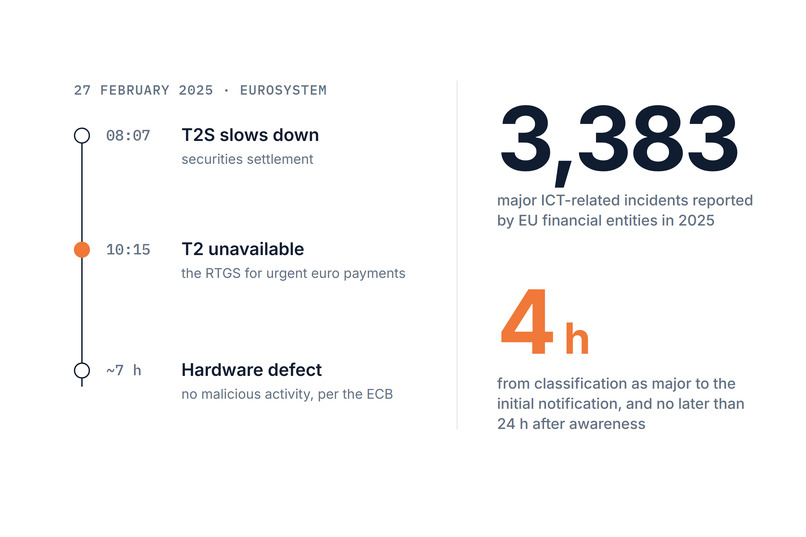
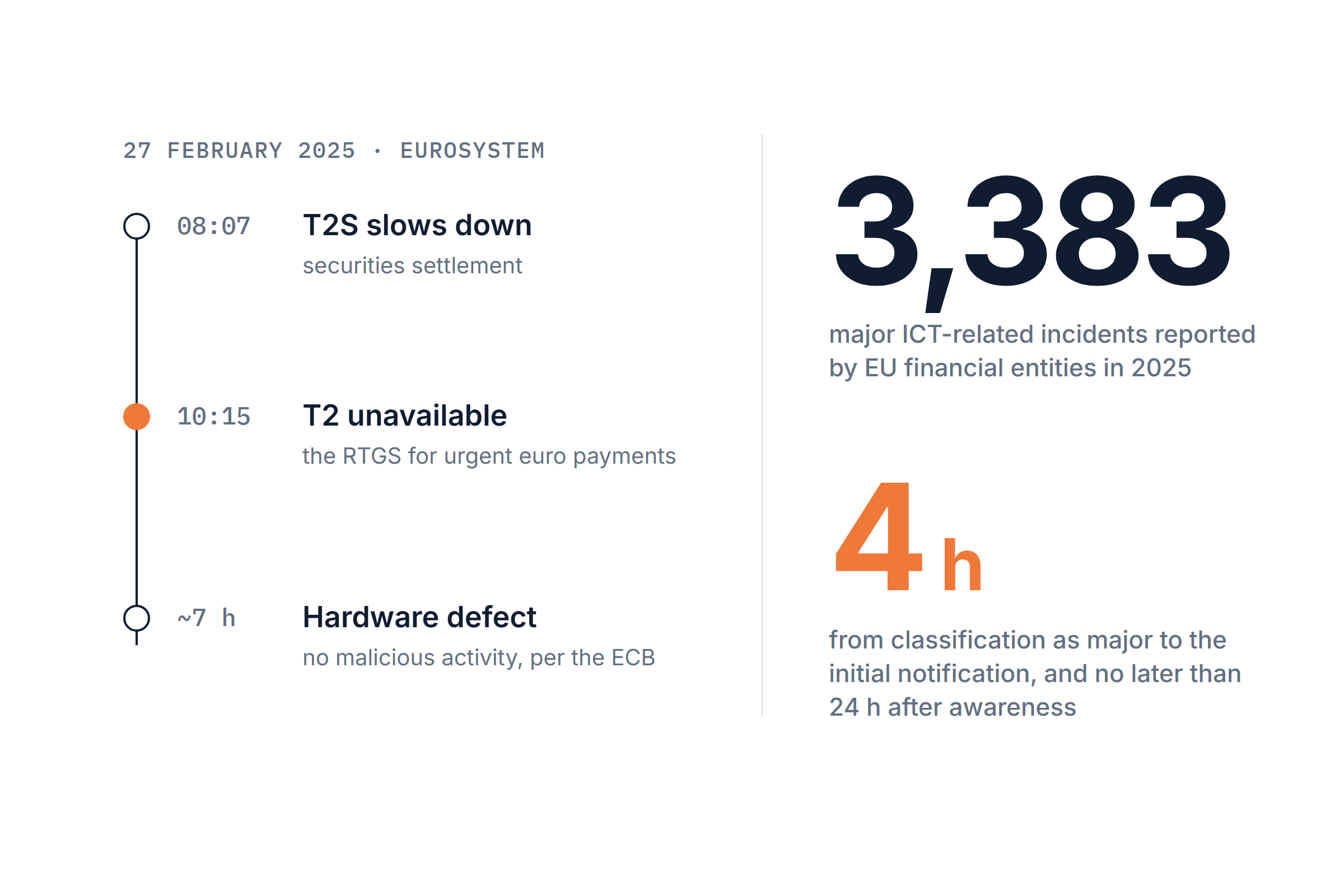
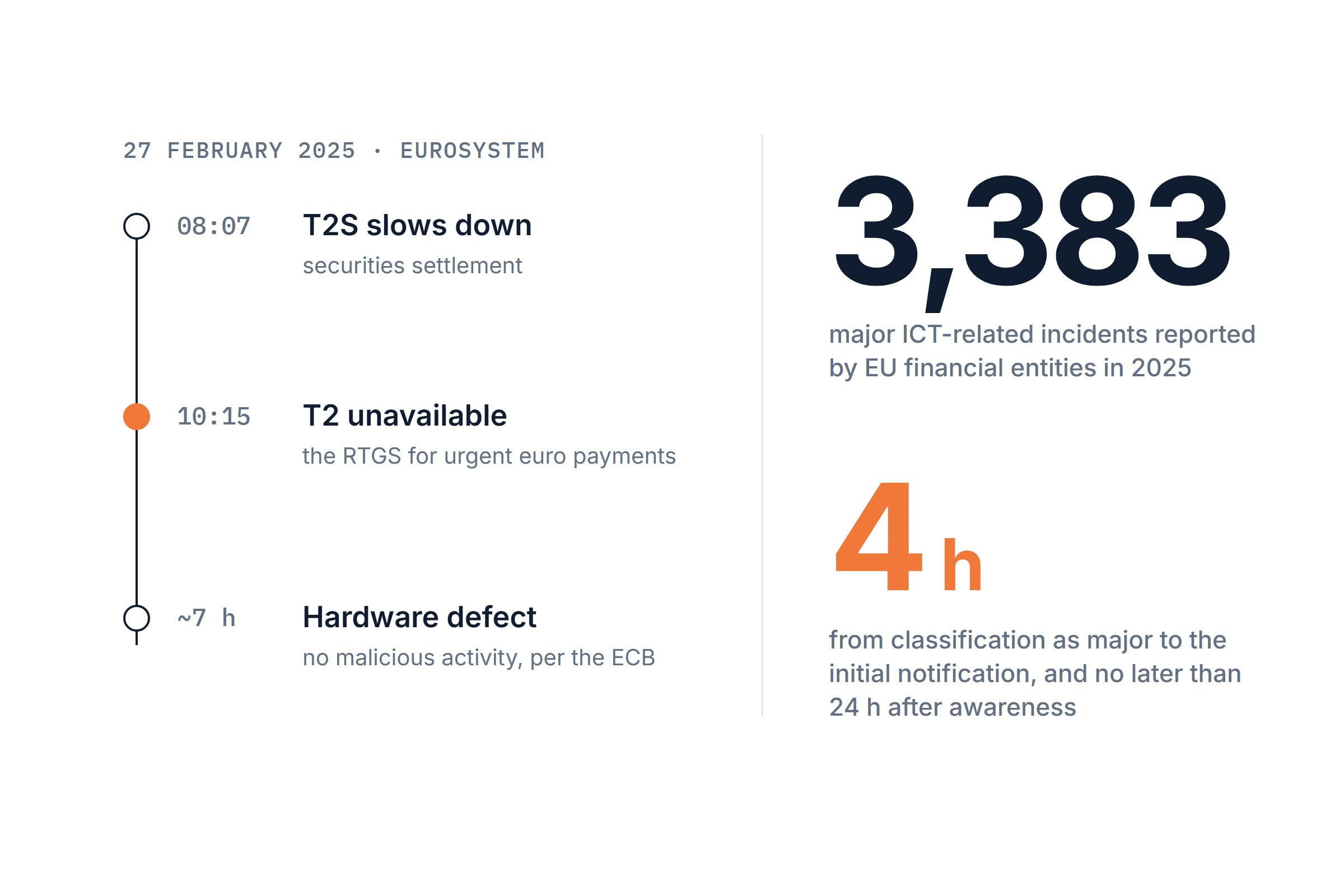
On 27 February 2025 the euro RTGS stopped from 10:15; EU financial entities reported 3,383 major ICT incidents in 2025.
-
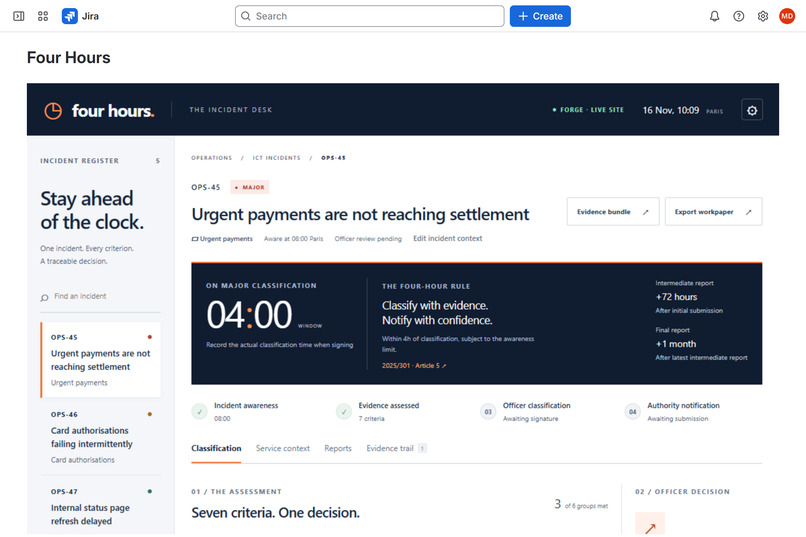
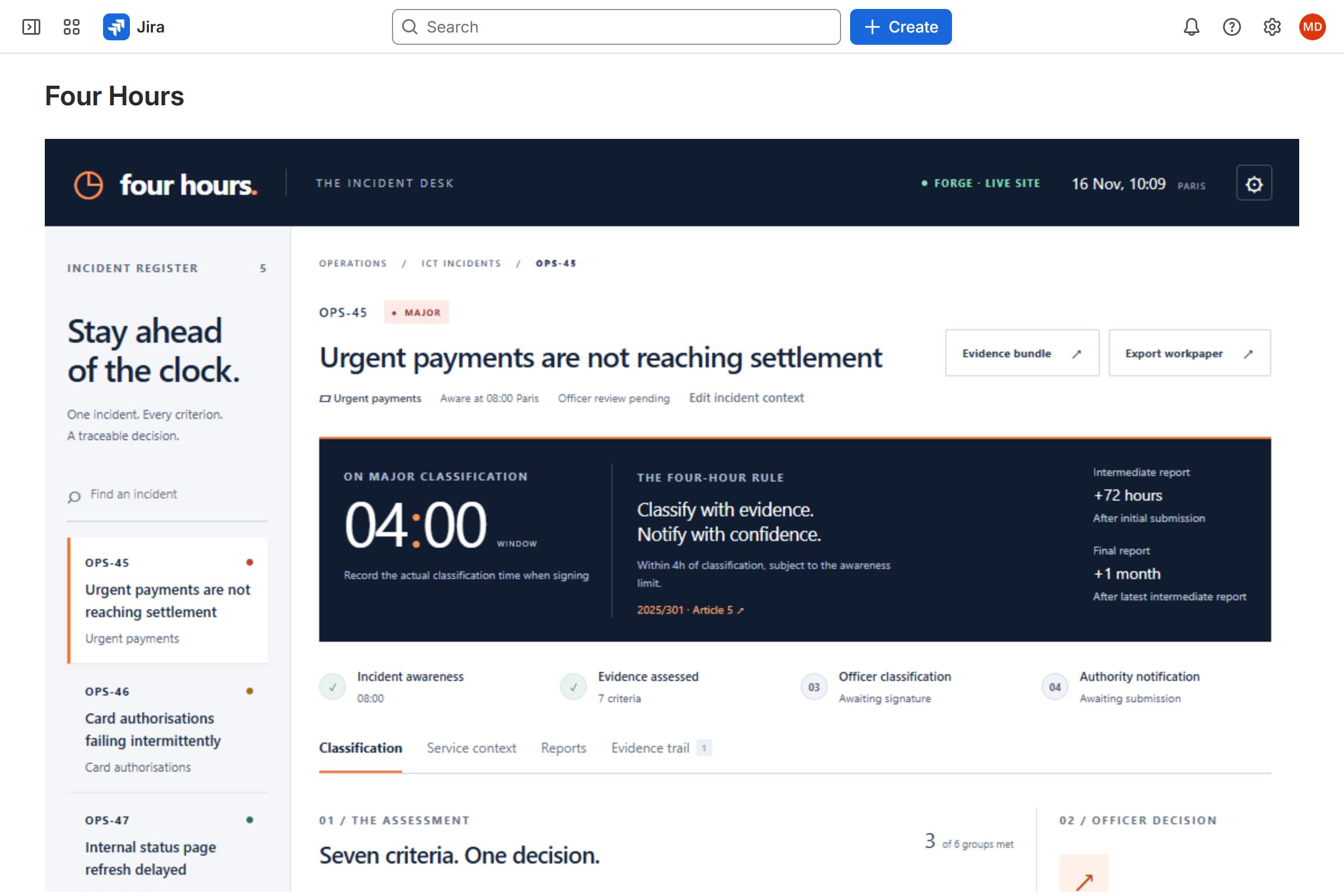
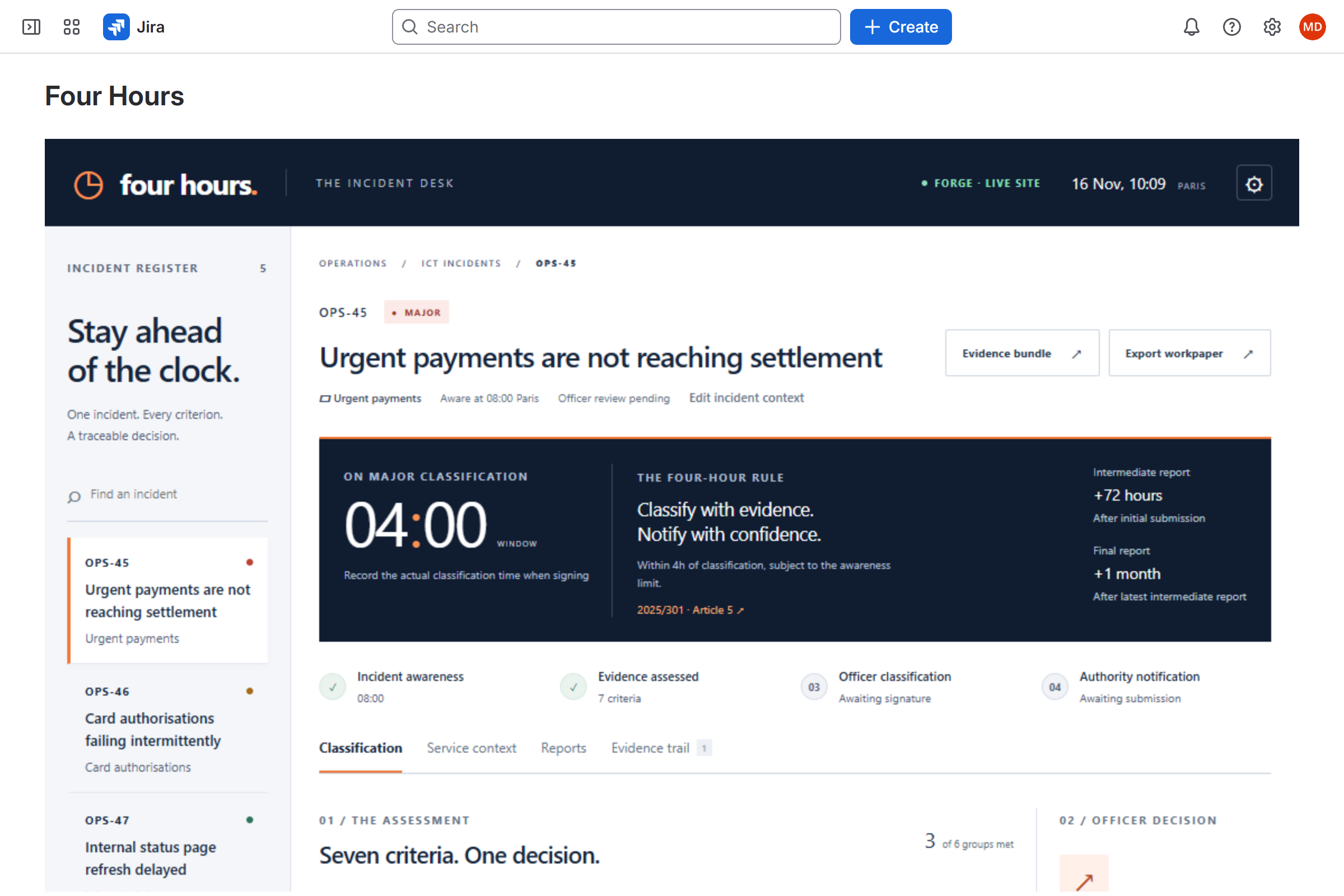
The incident desk in Jira: seven DORA criteria, the verdict, and the four-hour window that opens when an officer signs.
-
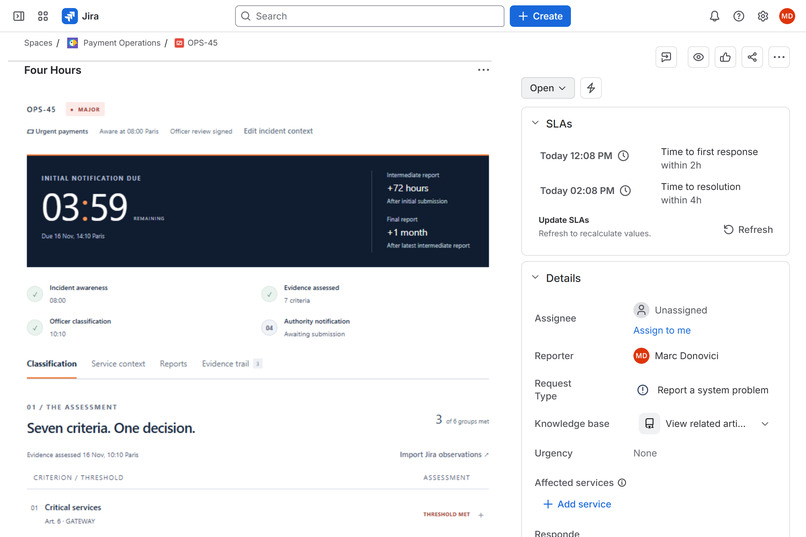
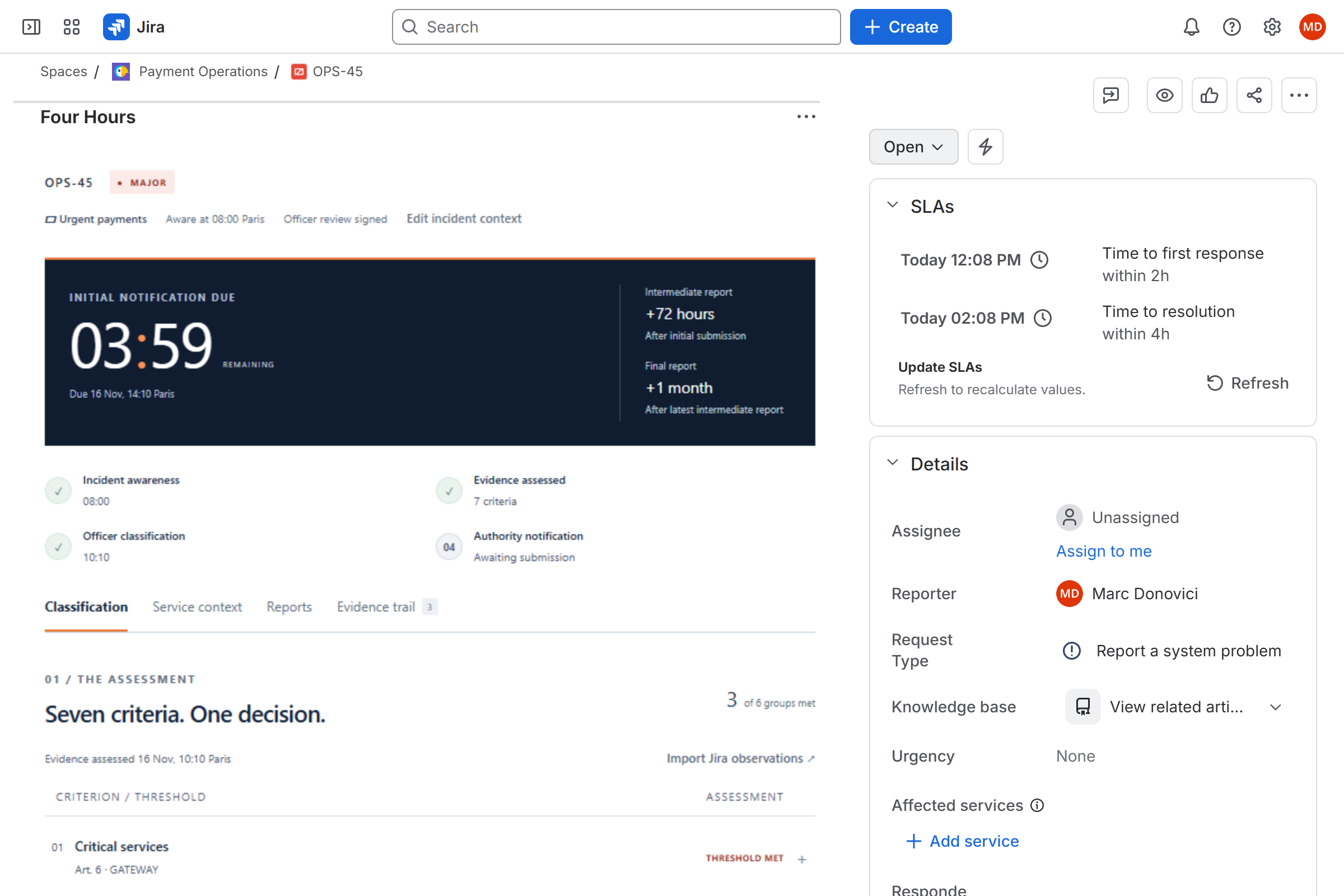
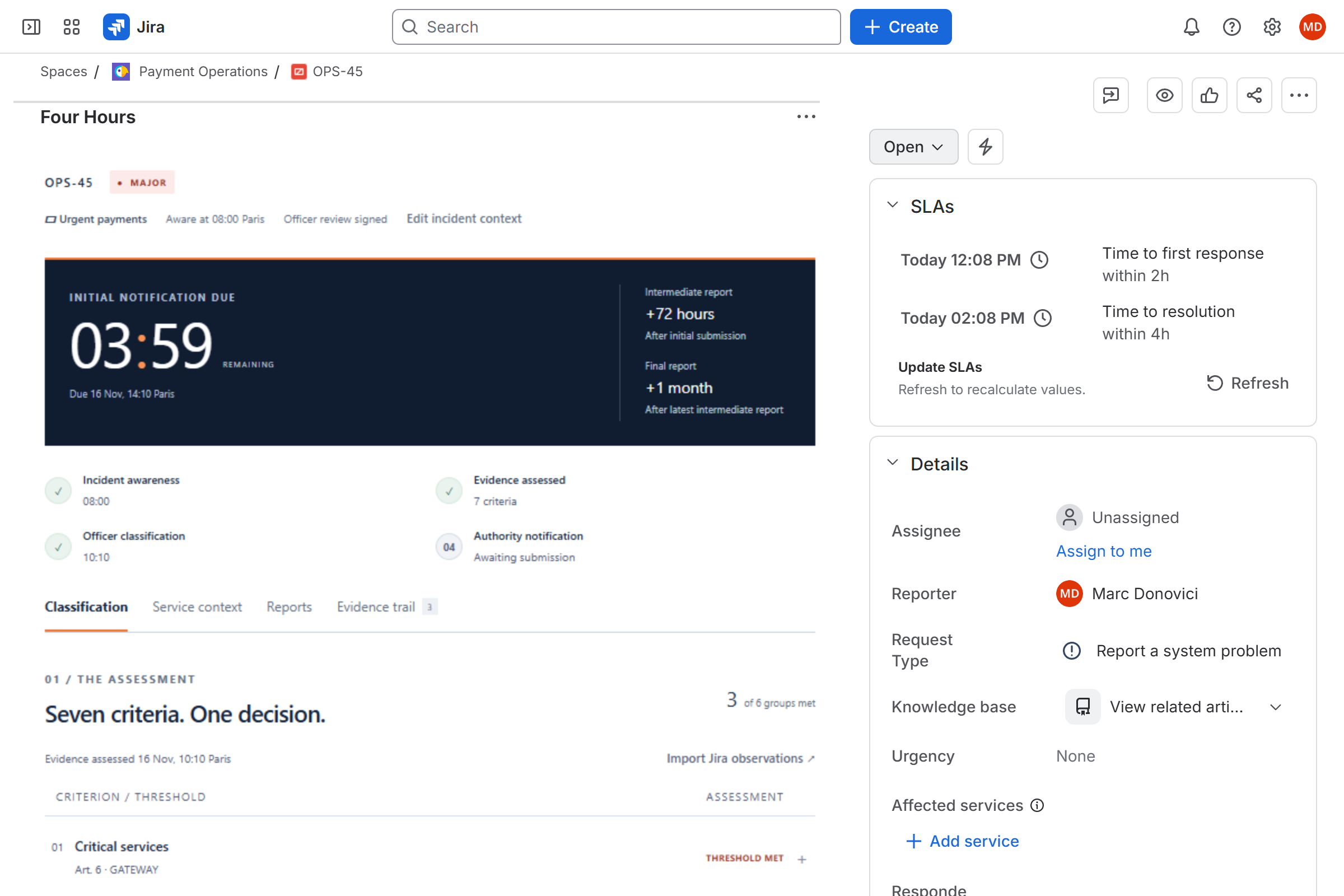
Inside the JSM incident, the Four Hours panel shows the signed MAJOR verdict and the initial notification due in 03:59.
-
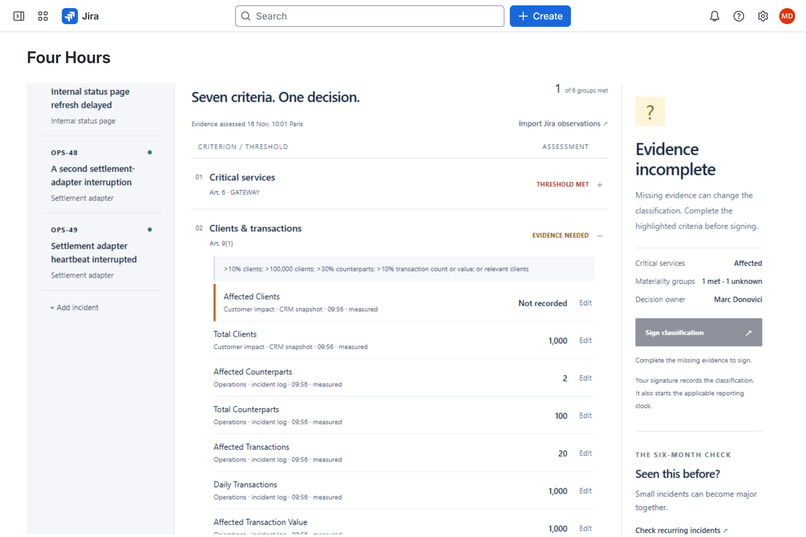
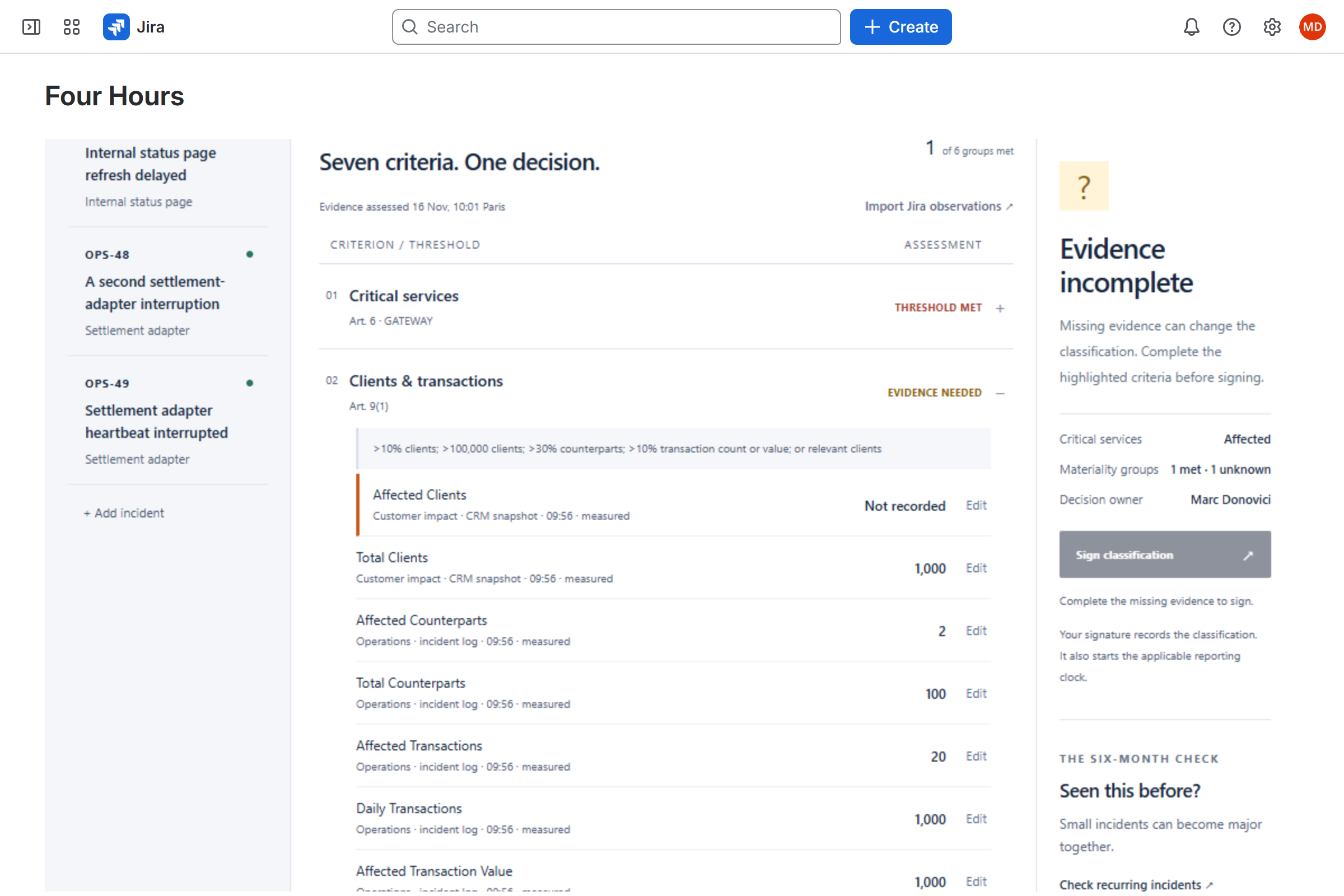
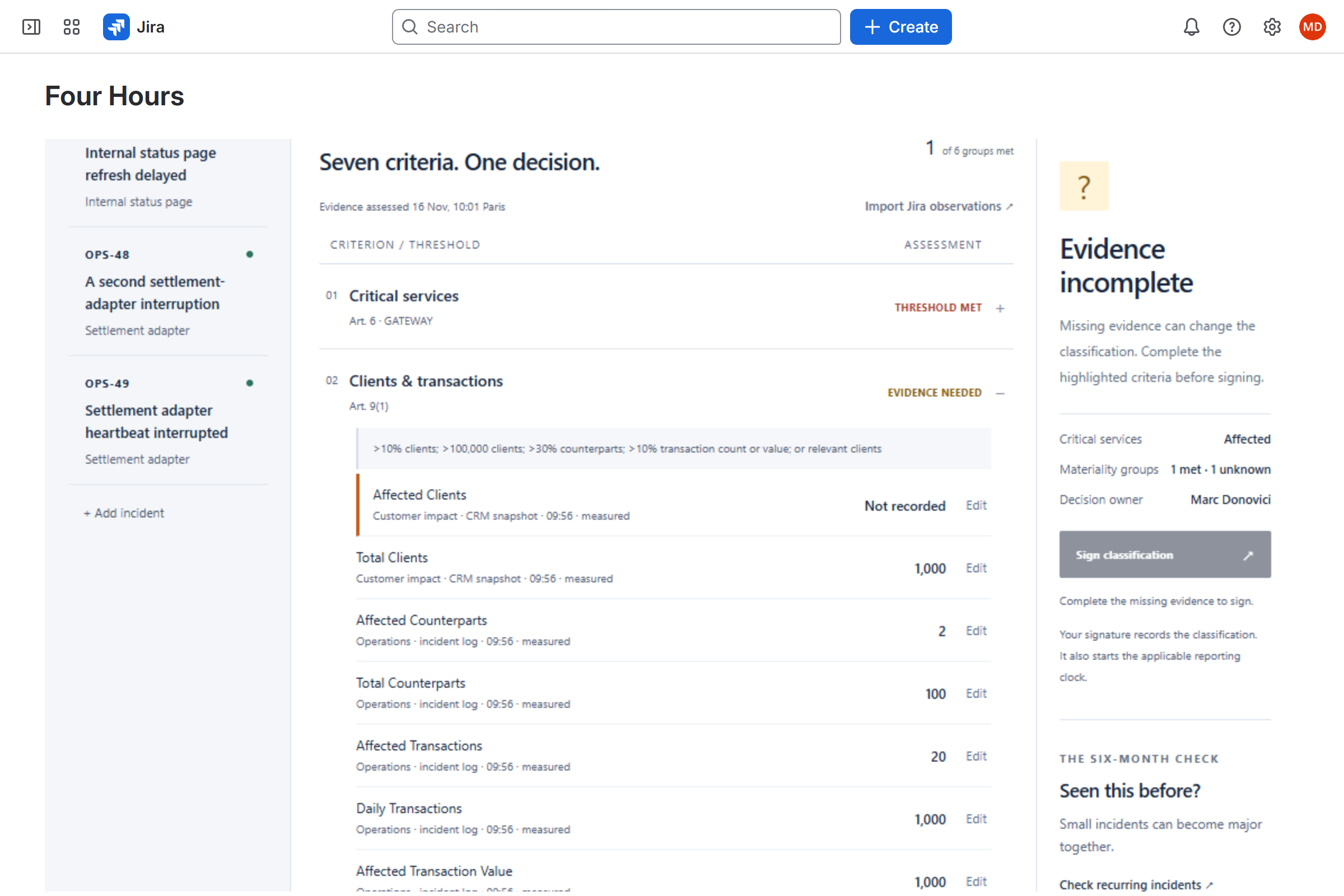
A missing client count can change the outcome, so the verdict stays INCOMPLETE and signing is blocked until it is filled.
-
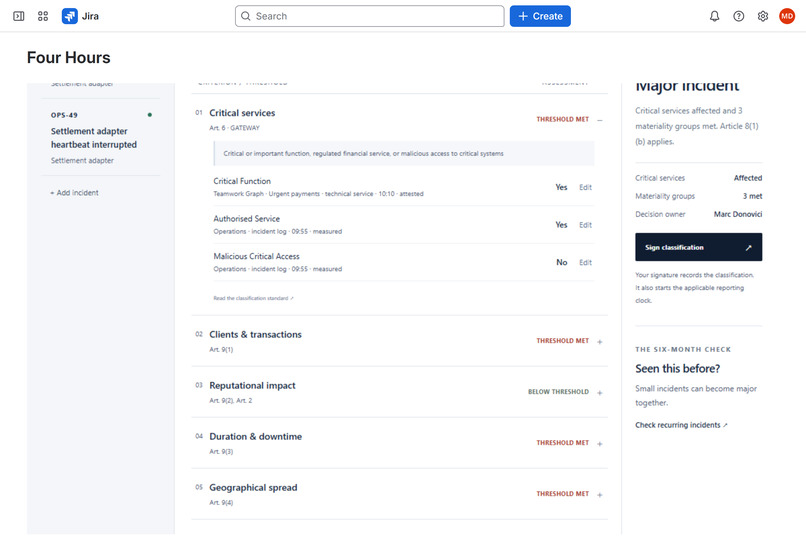
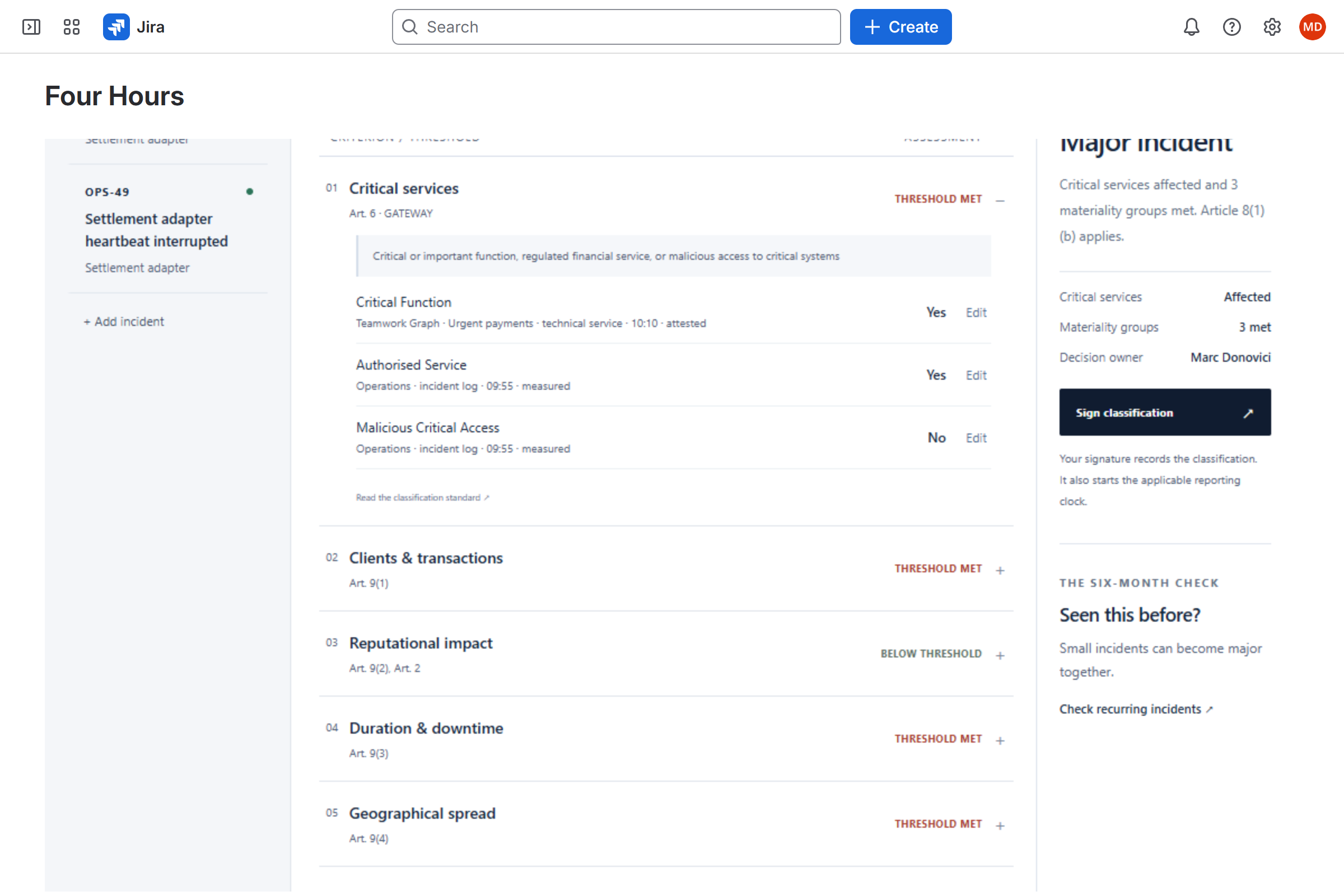
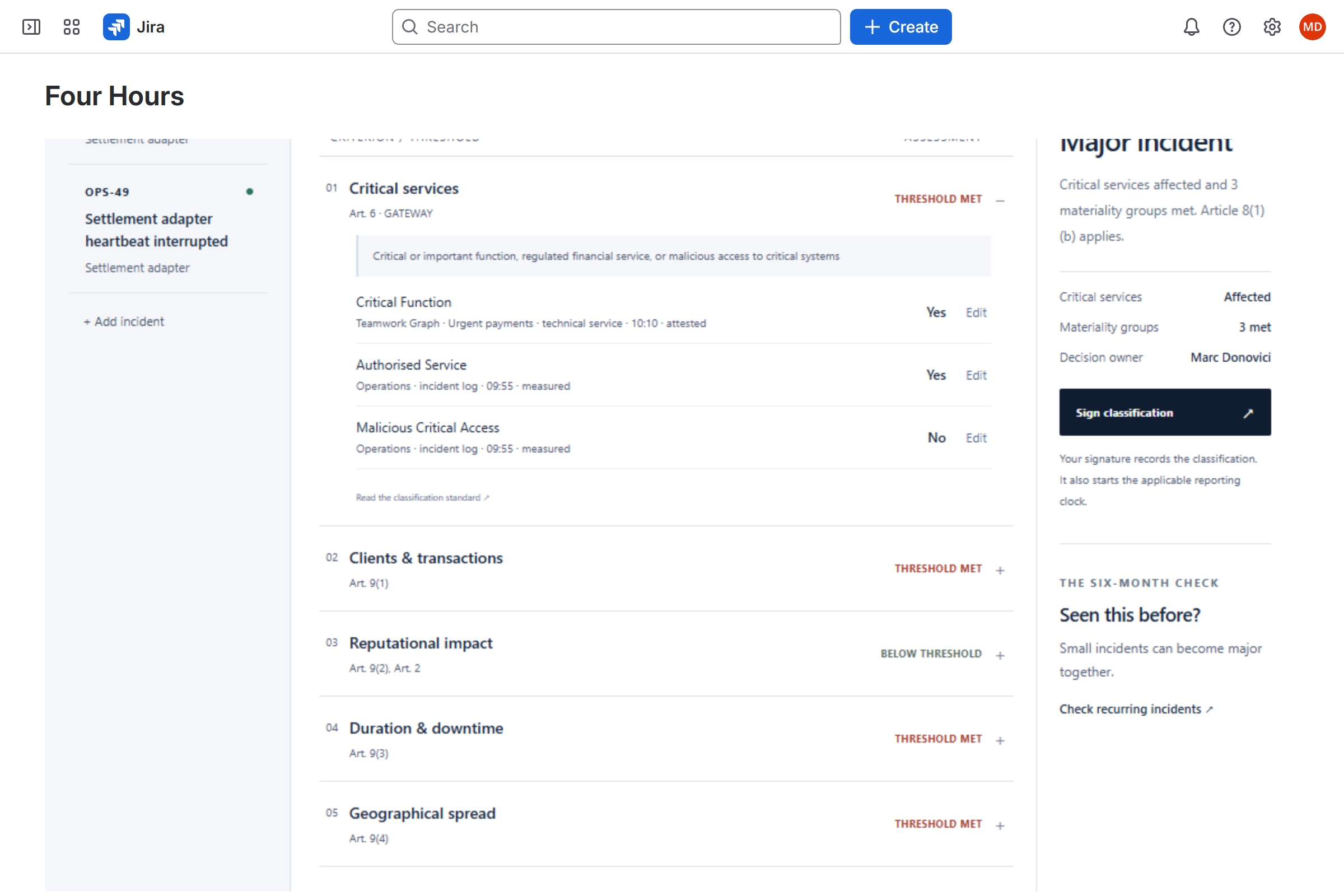
The critical-function fact is read back from Teamwork Graph and cites its source next to the incident log entries.
-
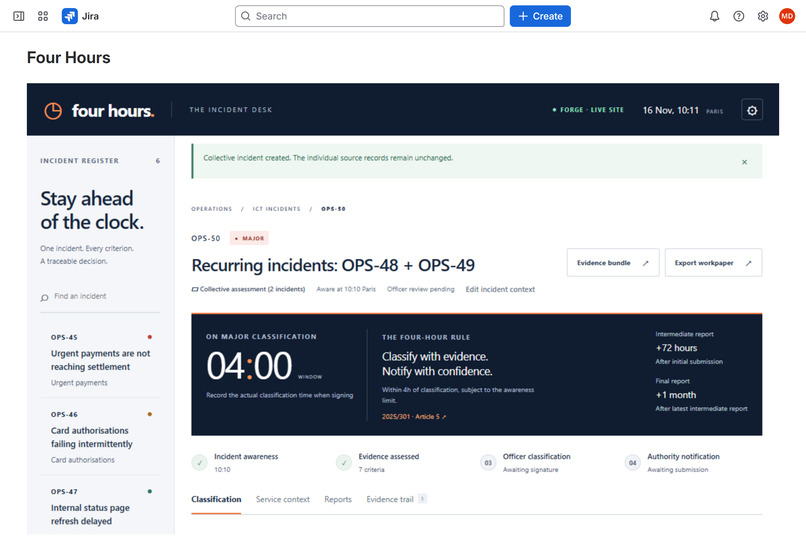
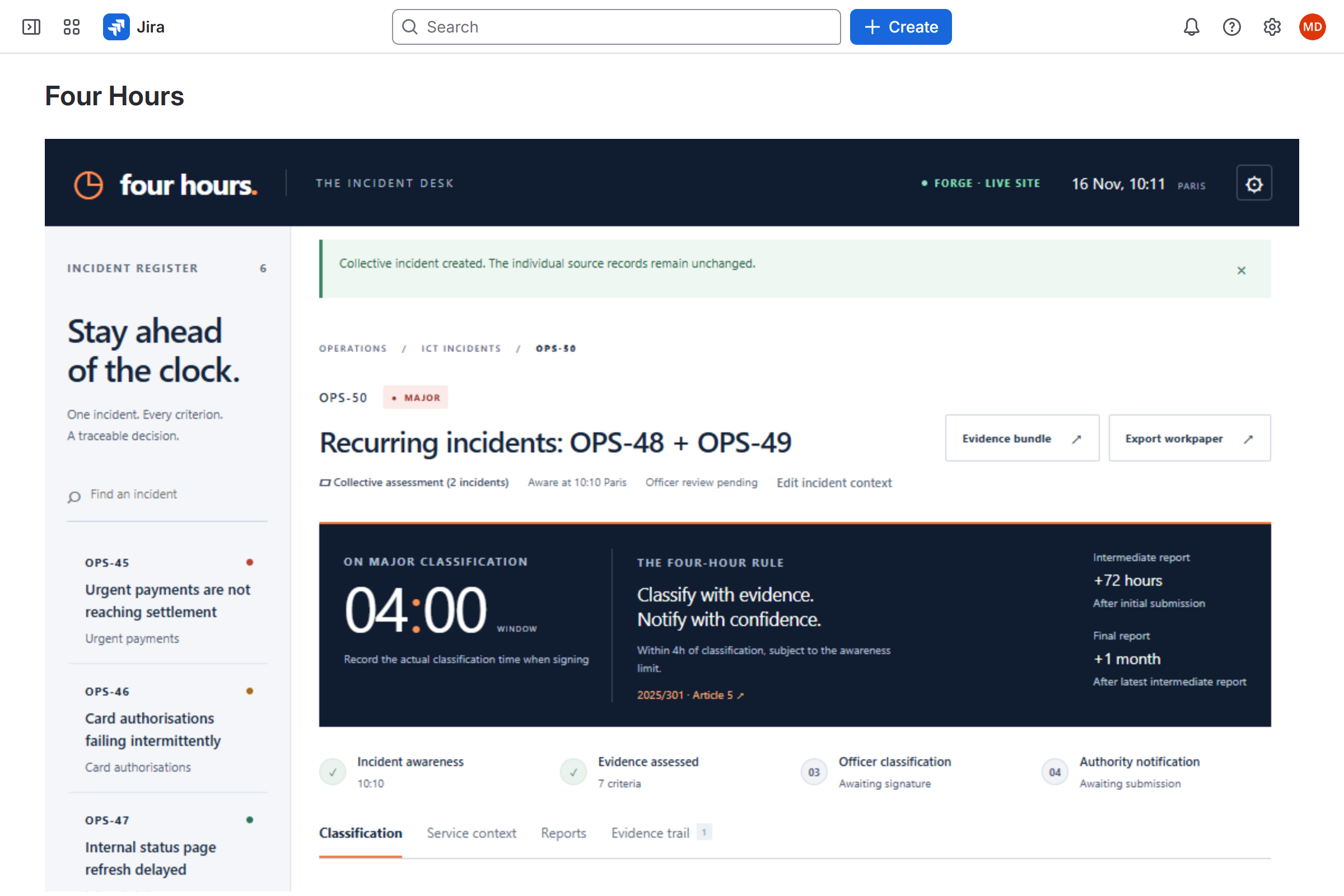
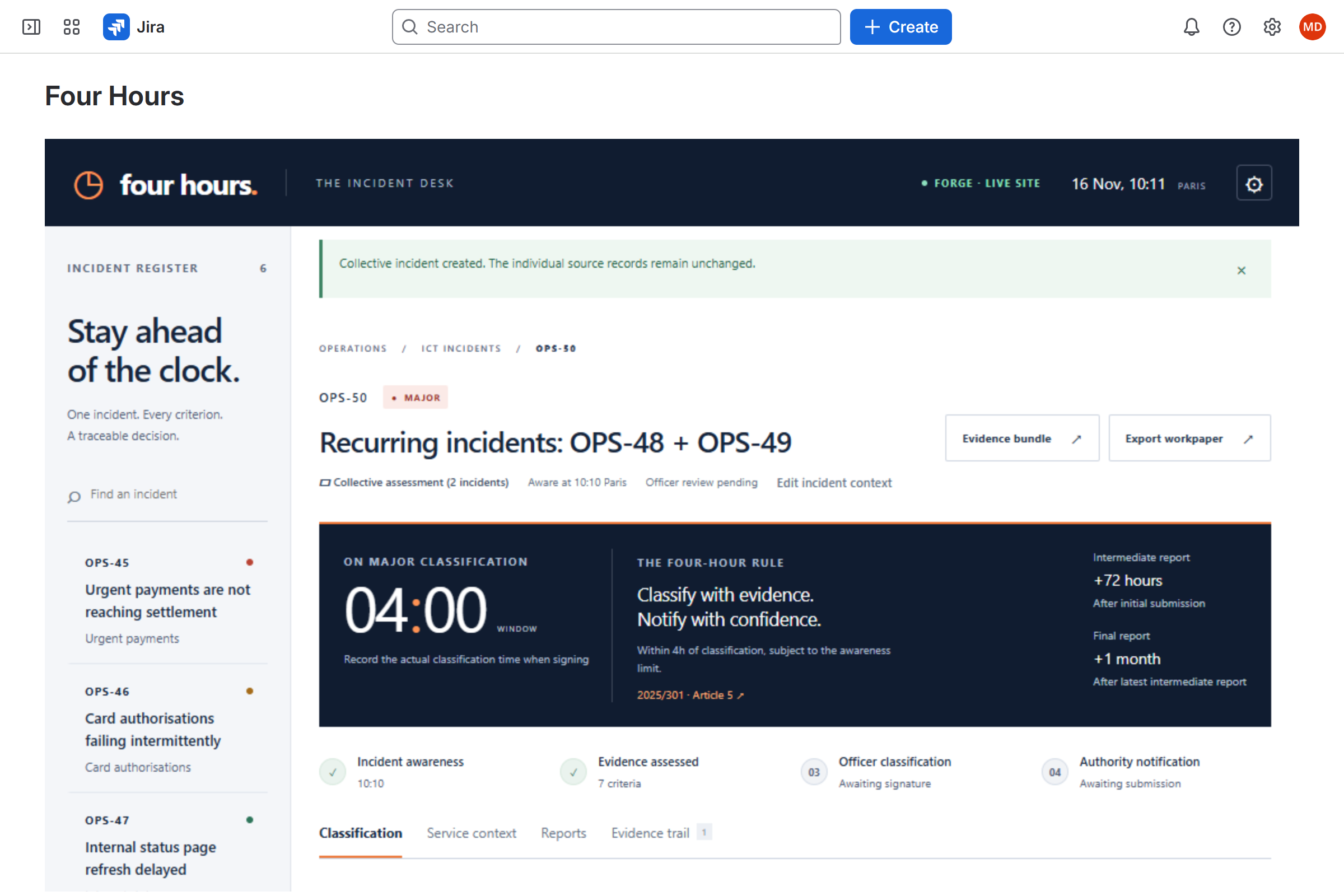
Two small settlement-adapter outages share a root cause within six months, so Four Hours opens a collective MAJOR record.
-
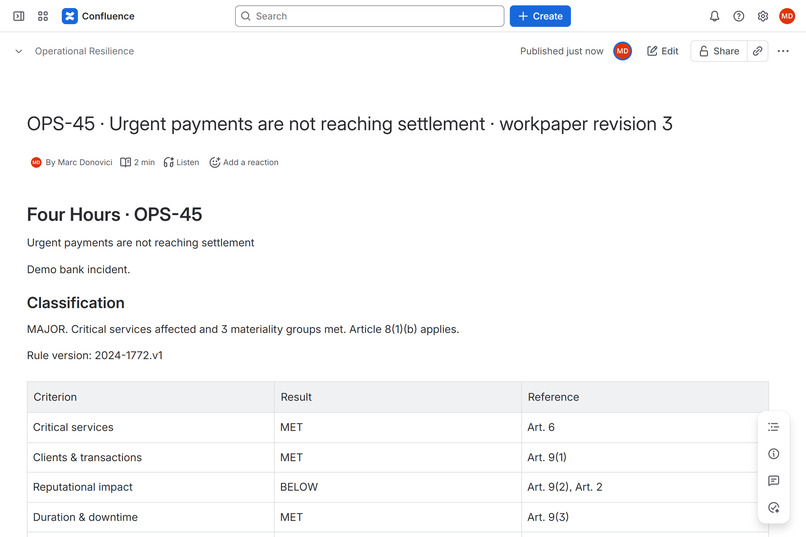
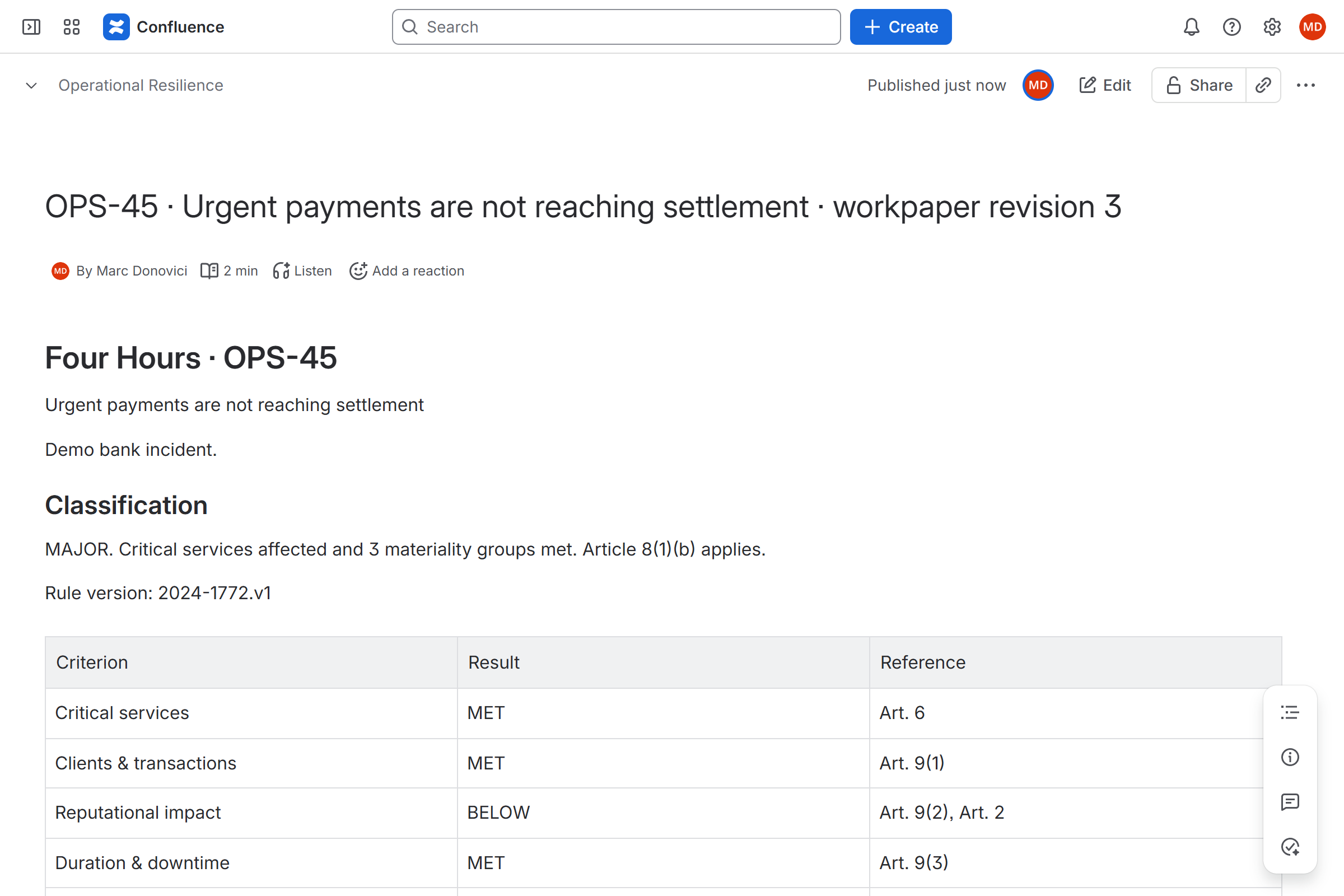
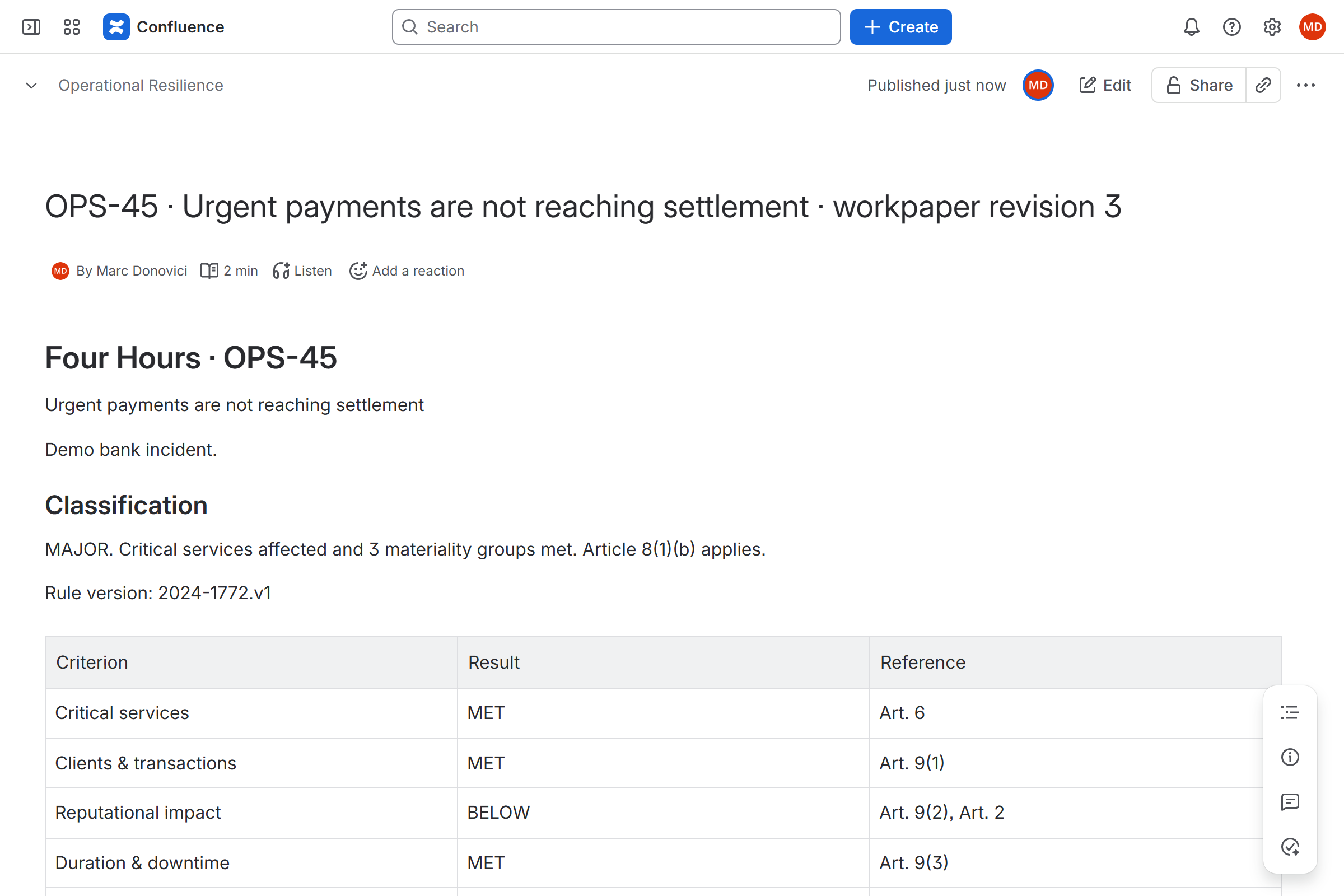
Publish writes the signed workpaper to Confluence as real headings and tables: criteria, signature, evidence hash, sources.
-
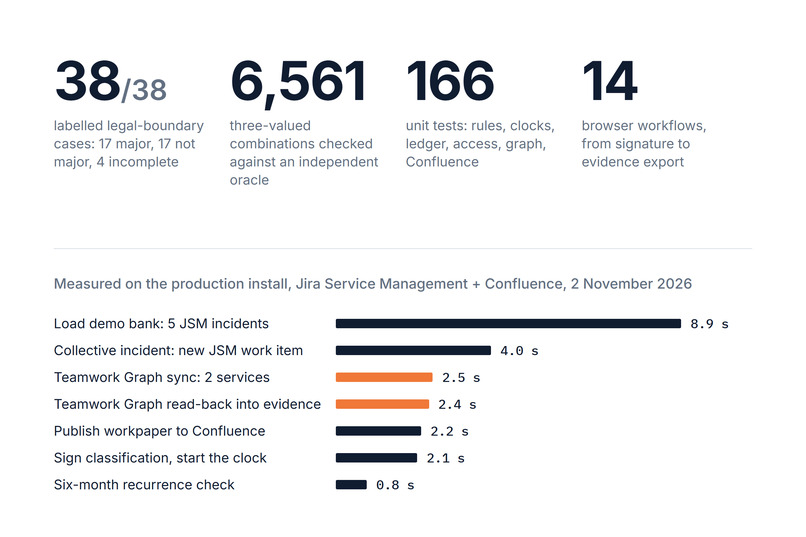
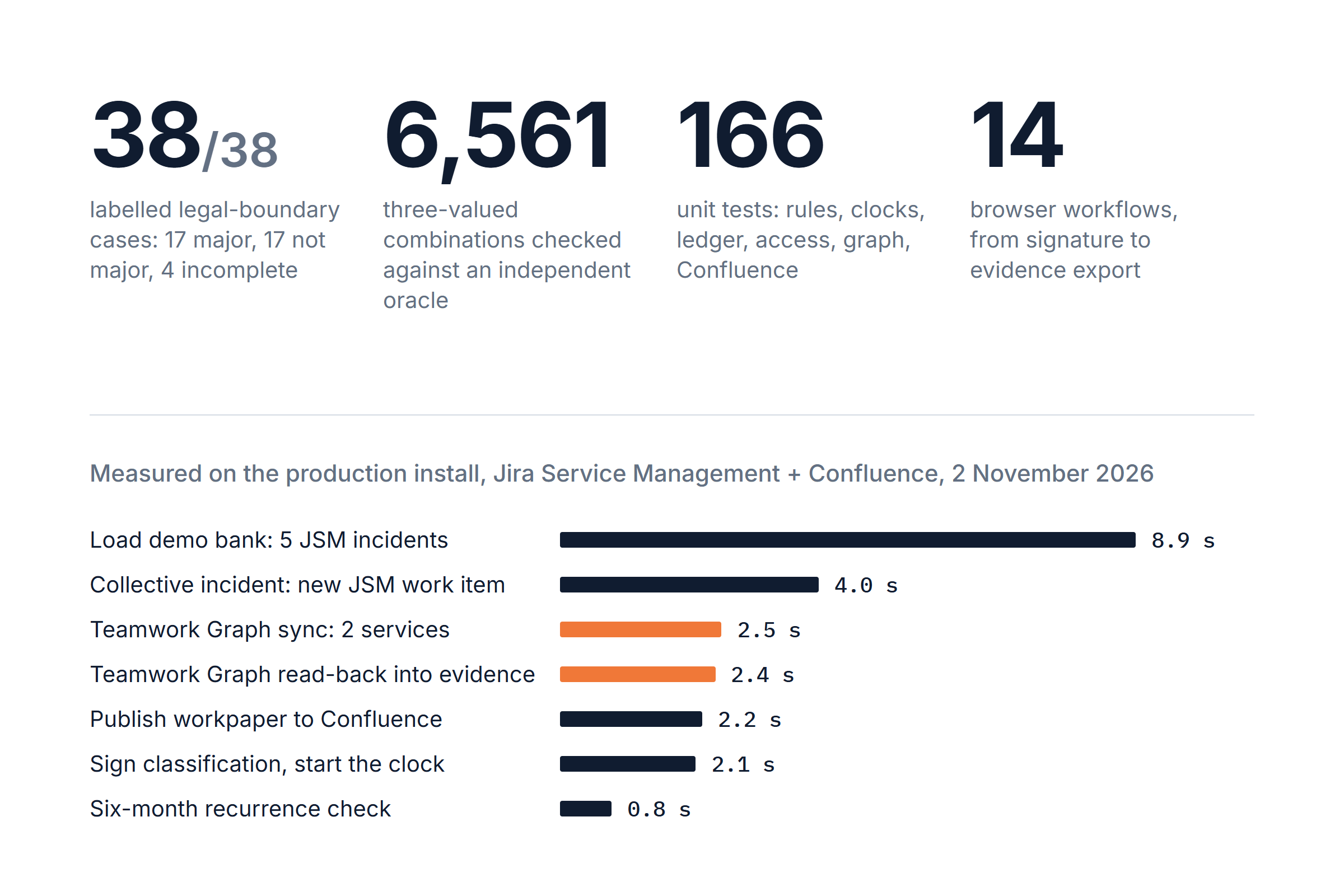
38 of 38 labelled cases, 6,561 oracle combinations, 166 unit tests and 14 browser workflows; live actions in 0.8 to 8.9 s.
-
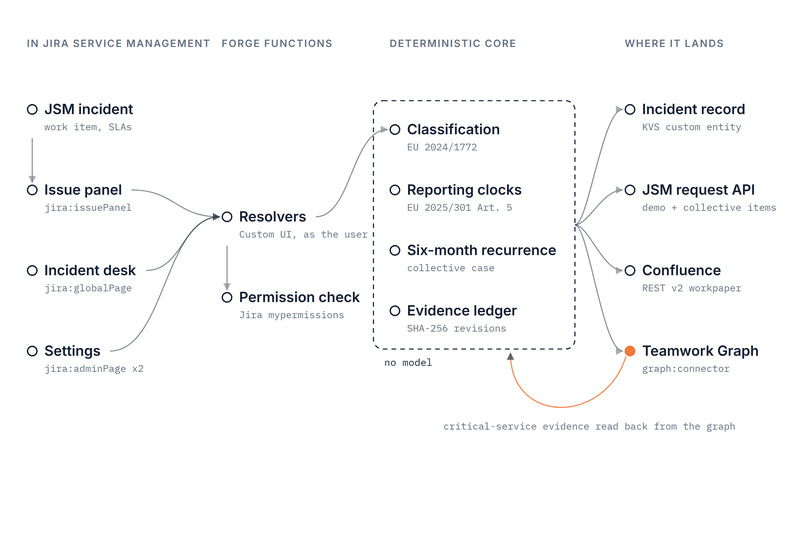
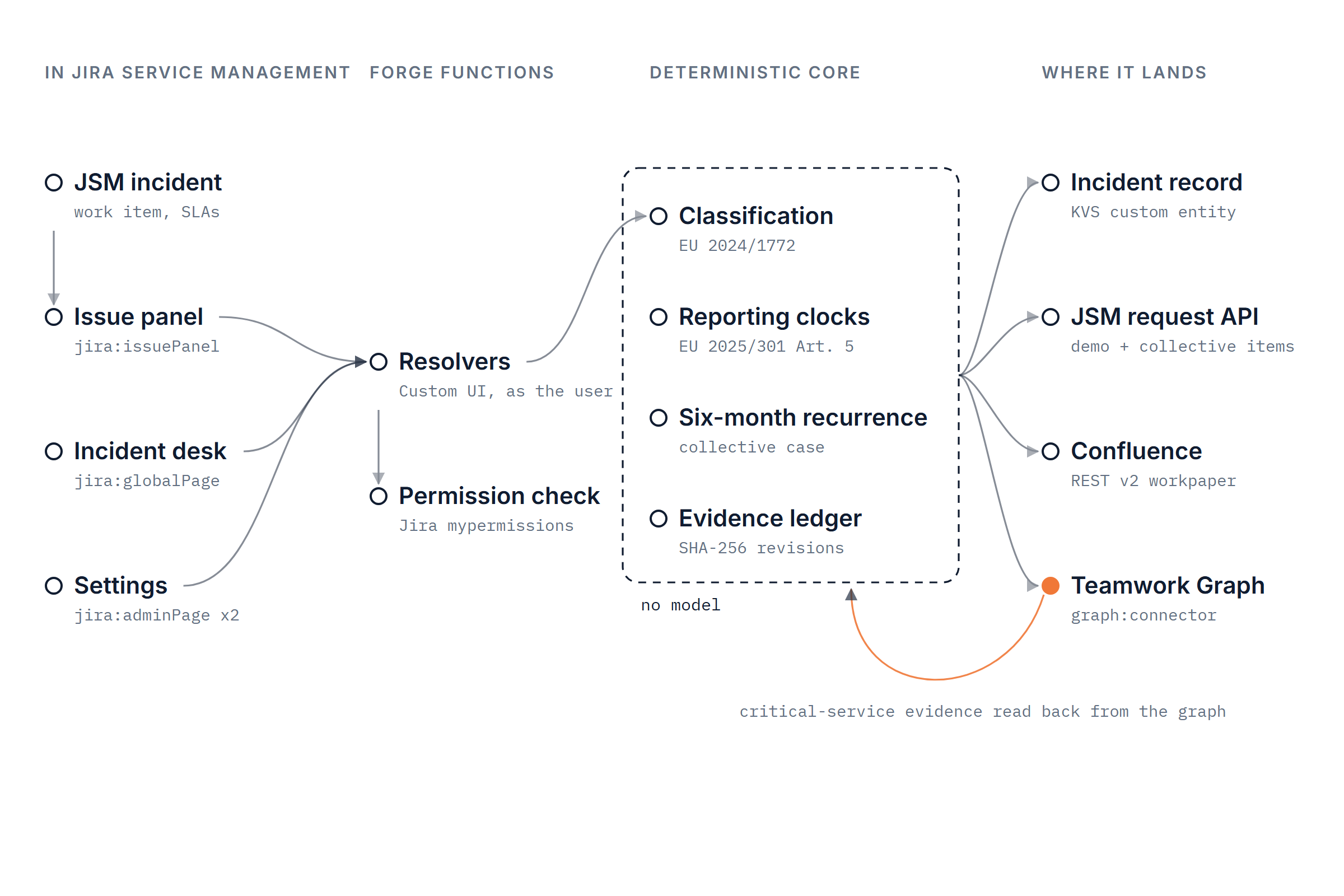
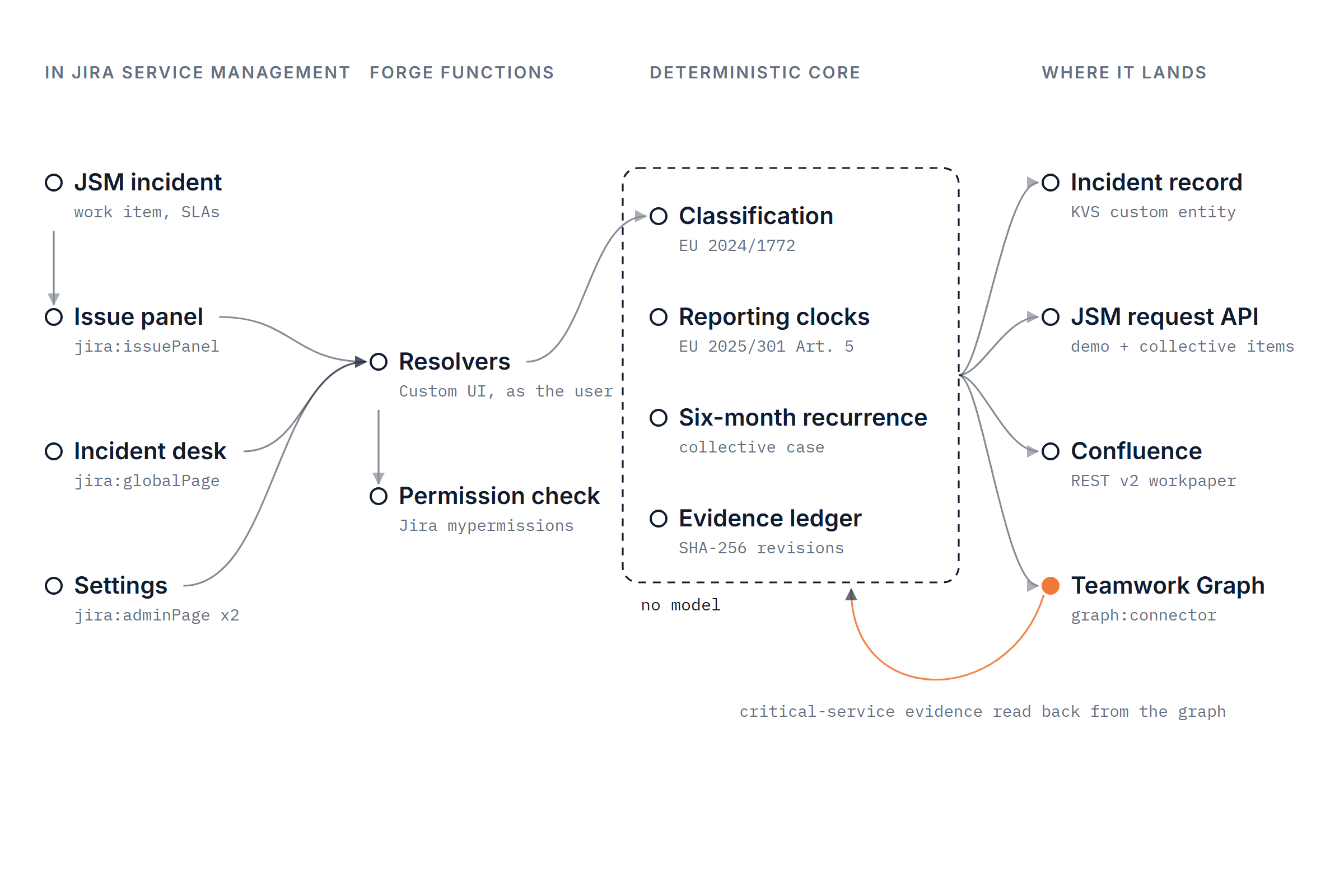
Jira modules call Forge resolvers as the user; one deterministic core writes to KVS, JSM, Confluence and Teamwork Graph.
-
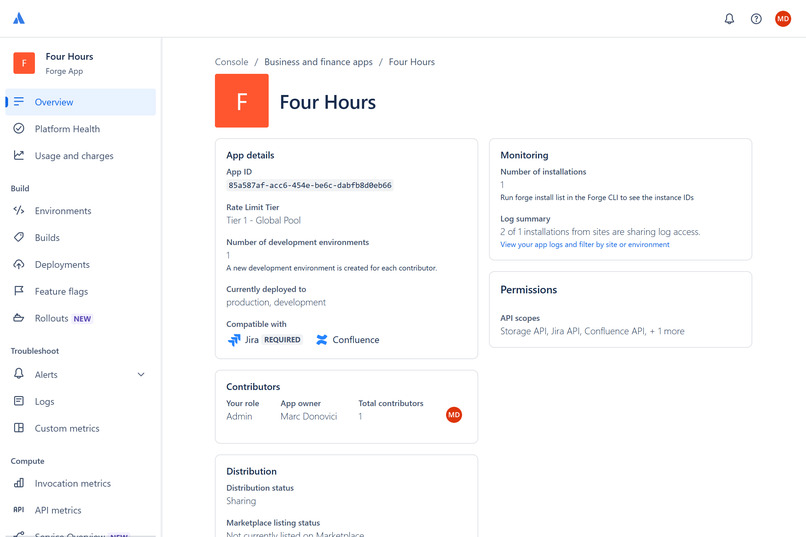
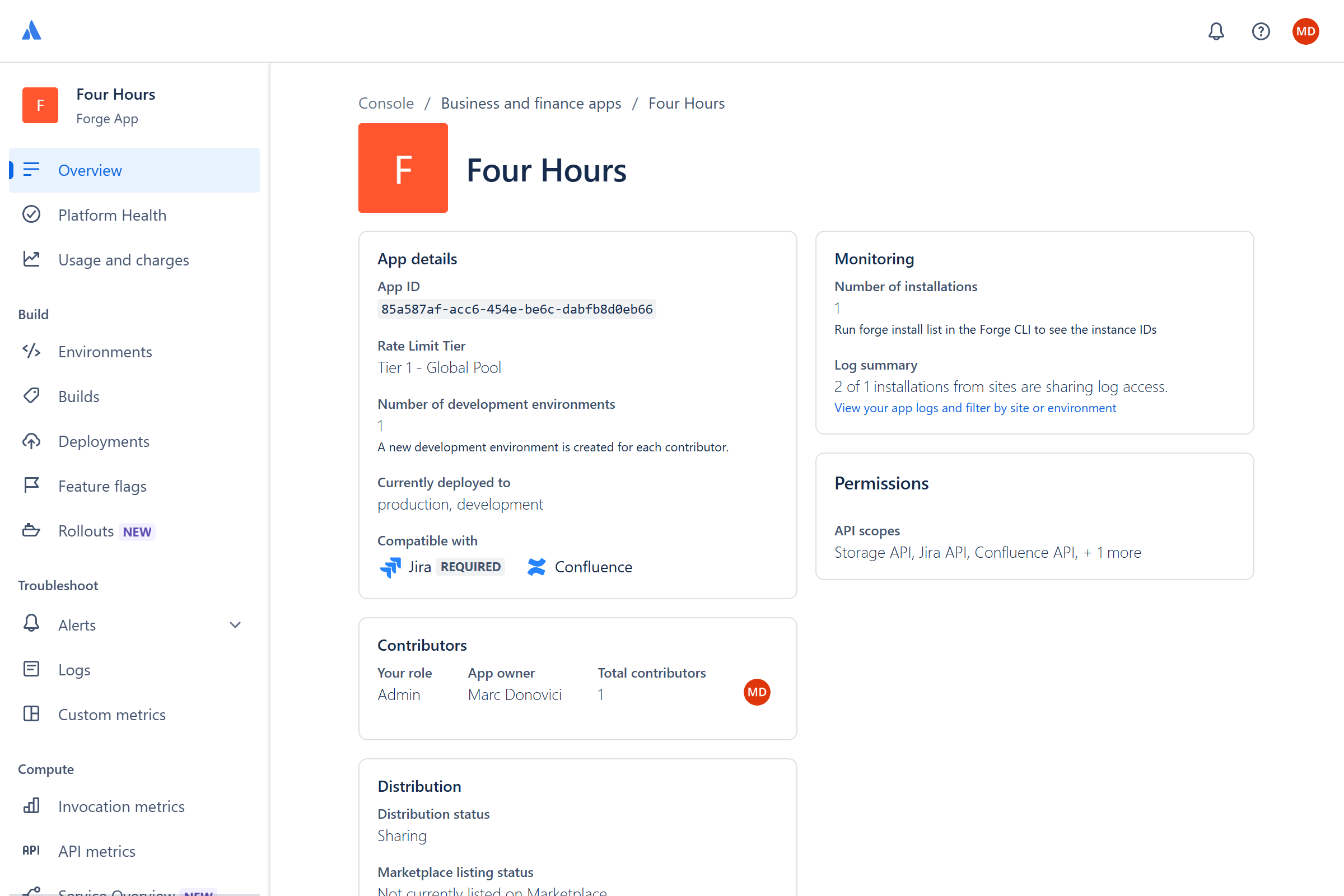
The Forge app in the Atlassian developer console: deployed to production, compatible with Jira and Confluence, sharing on.
Four Hours: DORA incident classification inside Jira Service Management
Four Hours decides whether an ICT incident is major under DORA, from sourced evidence, inside the Jira Service Management incident, and starts the four-hour reporting clock when the bank's ICT risk officer signs. It runs on Forge across Jira Service Management, Jira, Confluence and Teamwork Graph. A deterministic engine matches 38 of 38 labelled legal-boundary cases and agrees with an independent oracle on all 6,561 three-valued combinations. On the live site, signing a classification takes 2.1 seconds and the six-month recurrence check 0.8 seconds.
Inspiration
On 27 February 2025, at 10:15 CET, T2 went down. T2 is the Eurosystem's real-time gross settlement system for urgent euro payments. The ECB traced the outage to a hardware defect and ruled out malicious activity; Reuters put the disruption at roughly seven hours (FX News Group, PaymentsJournal).
That morning, in every bank connected to T2, two people faced the same question. The incident manager knew which service was down. The ICT risk officer had to decide whether the incident was major under DORA. That decision starts a legal clock: the initial notification is due within four hours of classifying the incident as major, and normally capped at 24 hours after awareness. Article 5(2) provides a separate four-hour window when major classification occurs more than 24 hours after awareness (Delegated Regulation 2025/301, Article 5).
The decision is frequent. In 2025, EU financial entities reported 3,383 major ICT-related incidents, and nearly one third originated from third-party failures (ESAs 2025 report on major ICT-related incidents, summary). Each of those reports began with an officer classifying an incident against seven criteria in Delegated Regulation 2024/1772, while some of the facts were still unknown.
I tested change-management controls in IT audits at a bank's technology practice, and every audit asked the same three questions: which evidence supported the decision, who made it, and when? I built Four Hours so the answers are written down at the moment the decision is made, in the incident itself.
What it does
In the incident: the verdict next to the SLAs
The incident manager already works in Jira Service Management. The Four Hours panel sits on the incident work item, beside the JSM SLAs, and shows the verdict, the officer's signature and the time left before the initial notification is due.
For the officer: seven criteria, one decision
The incident desk is a Jira global page. Each criterion of the classification standard has its own row: the critical-services gateway (Article 6) and the six materiality groups (clients and transactions, reputational impact, duration and downtime, geographical spread, data losses, economic impact). Every row shows its threshold, its article and the facts behind it, and every fact keeps its value, source, observation time and quality. Client and transaction sub-thresholds count once, as one group, as the standard requires.
Unknowns stay visible
The engine returns MAJOR, NOT MAJOR or INCOMPLETE. INCOMPLETE means a fact is still unknown and its value could change the outcome. On the card-authorisation incident, the number of affected clients was never recorded, and that number decides whether a second materiality group is met. The verdict stays INCOMPLETE and Sign classification is refused until the fact is recorded with its source. An unknown that cannot change the outcome does not block the officer.
Critical services from Teamwork Graph
Whether a service supports a critical or important function is an organisation-wide fact, held once, outside any incident. Four Hours syncs the technical service register into Teamwork Graph through a Forge connector, then reads the affected service back and records its critical-function tag as a cited fact in the Critical services row: "Teamwork Graph · Urgent payments". The read creates a new hashed evidence revision, so the officer signs over the graph fact too. Regulated impact figures (clients, transactions, costs) stay in the incident store; only technical service metadata enters the graph.
The signature starts the clock
The officer records the actual classification time and a rationale. The signature binds the SHA-256 of that exact evidence version, and the signer is taken from the Forge context, never from the request. The initial deadline follows the four-hour rule, the 24-hour awareness cap and the late-classification case. When the officer records the submission time and the authority's reference, the intermediate report falls due 72 hours later, and the final report one calendar month after the latest intermediate, in the bank's reporting timezone. A later evidence change needs a new signature and keeps the first major-classification deadline. The GDPR Article 33 clock runs separately, from the officer's own personal-data-breach assessment.
The Reports tab prepares each stage's fields for the forms in Implementing Regulation 2025/302, every field linked to its source, and exports them as a working draft. The officer submits through the competent authority's channel and records the receipt in Four Hours.
The six-month check
Small incidents can be major together. The classification standard treats recurring incidents with the same apparent root cause within six months as one. Check recurring incidents finds earlier incidents with the same root cause across services; when they meet the major thresholds together, Create collective incident raises a separate collective record as a new work item in the same JSM project. The source incidents stay unchanged, distinct costs are combined, and client counts stay unknown until they can be deduplicated.
The workpaper in Confluence
Publish current workpaper writes the signed decision to Confluence as headings and tables: the criteria, the signature, the evidence hash and every source, under the user's own Confluence permissions. A reviewer can re-perform the classification from the page.
How I built it
Deterministic first
Every verdict, deadline and hash comes from a rule engine in plain TypeScript, with no model in the decision. I wrote 38 labelled legal-boundary cases before the rules: 17 major, 17 below the threshold and 4 incomplete. The engine's three-valued logic is then checked against an independently written truth-completion oracle, which fills every unknown both ways and confirms the verdict on all 6,561 combinations of the criteria.
How Atlassian is used
| Surface | What it does here |
|---|---|
| Jira Service Management | Demo incidents are raised through the JSM request API with the "Report a system problem" request type, so they carry SLAs; the collective record is a new work item in the same project |
jira:issuePanel |
A compact view bound to the incident: verdict, signature, countdown, criteria |
jira:globalPage |
The incident desk: register, criteria, service context, reports, evidence trail |
jira:adminPage |
Load the demo bank, reset the demo, risk officers, Confluence space |
| Jira REST | mypermissions checks on every read and edit; an issue property for structured observations |
| Forge KVS custom entity | One incident entity with versioned writes inside a transaction |
graph:connector |
Syncs atlassian:software-service objects with setObjects; reads the affected service back with getObjectByExternalId |
| Confluence REST v2 | The workpaper page and a content property that links it to the incident |
Results
| What | Result |
|---|---|
| Labelled legal-boundary cases | 38 of 38 (17 major, 17 not major, 4 incomplete) |
| Independent oracle | 6,561 of 6,561 three-valued combinations agree |
| Unit tests (rules, clocks, ledger, access, graph, Confluence, recurrence) | 166 passing, in random order |
| Decision core coverage | 91.2 % of lines; the classifier 100 % |
| Browser workflows, from signature to evidence export | 14 passing |
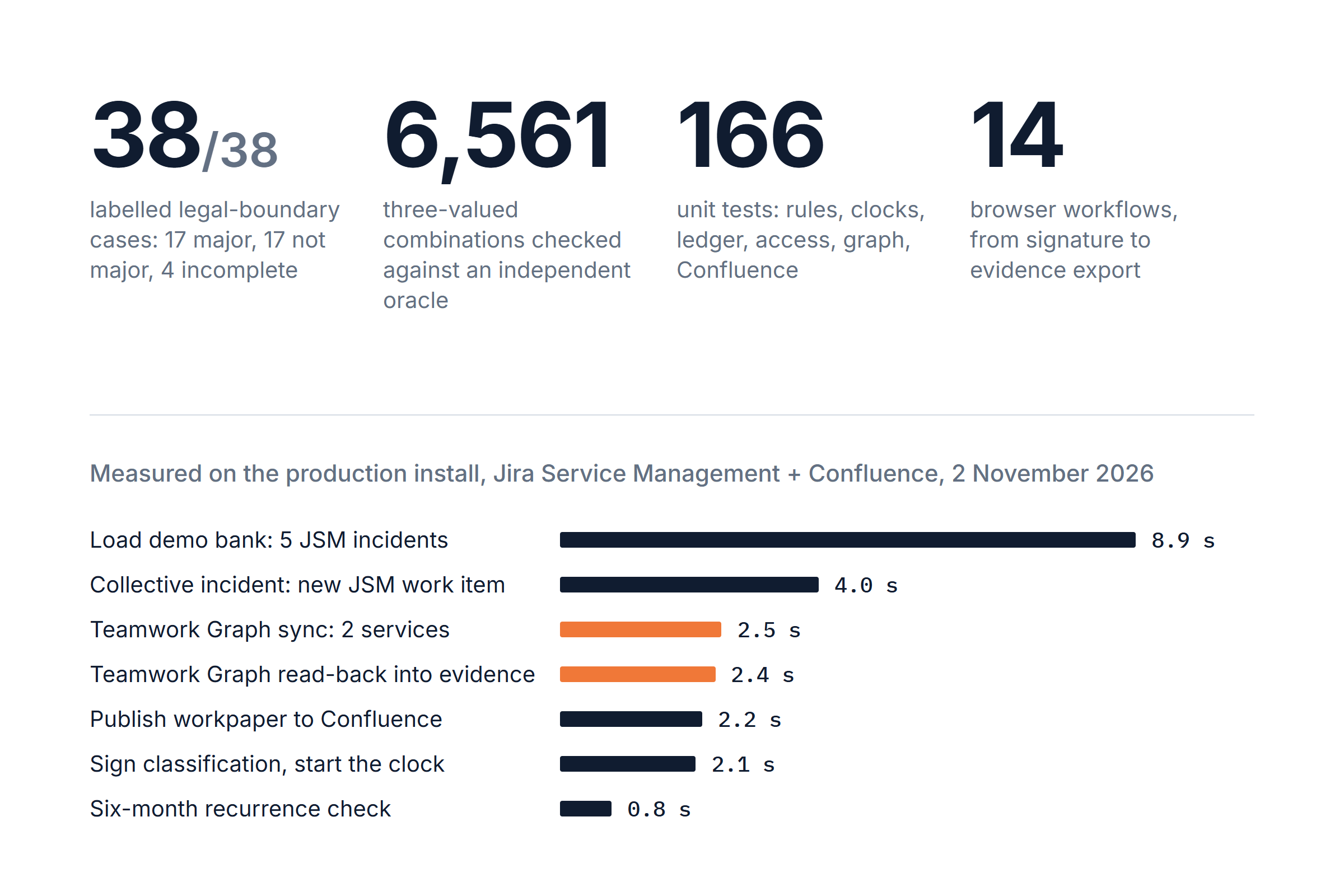
On the live site, with the app on the production environment and the incidents in a Jira Service Management project, loading the demo bank raised 5 incidents in 8.9 seconds. The Teamwork Graph sync took 2.5 seconds and the read-back into the evidence 2.4 seconds. Signing the classification took 2.1 seconds, the six-month check 0.8 seconds, creating the collective incident 4.0 seconds, and publishing the workpaper to Confluence 2.2 seconds.
Challenges I ran into
- The law has sharp edges. An exact threshold differs from one exceeded by a single client, several client triggers still make one group, and a successful malicious access to critical systems is its own route. I wrote the cases at those edges first and let the engine follow.
- An unknown is a result. A missing figure must block the decision only when it can change it. Three-valued logic, checked against an oracle that tries both values, made that rule exact.
- Deadlines follow events. The intermediate clock starts from the recorded submission, the final clock from the latest intermediate, by calendar month with month-end clamping and daylight-saving changes. A re-signed assessment must keep the first major-classification time.
- The incident has to be a JSM incident. Raising the demo through the JSM request API, with the request type mapped to the Incident work type, puts the Four Hours panel next to real SLAs.
- The graph holds facts for the whole organisation. I kept regulated impact data out of Teamwork Graph and sent only the technical service register, then read one fact back with its source so the officer can see where it came from.
Accomplishments that I'm proud of
- An officer cannot sign an assessment that a missing fact could overturn, and the screen names that fact.
- Every signature binds an evidence hash, and every deadline can be traced to the event that set it.
- The decision lives where the incident lives: the same clock runs in the JSM incident, the desk and the Confluence workpaper.
- A judge needs one Jira Service Management site and a few minutes: load the demo bank, open the incident, read the criteria, refresh the graph evidence, sign, run the six-month check and publish the workpaper. Reset the demo plays it again.
What I learned
- The hardest moment in an incident is the classification, and the evidence for it is usually rebuilt afterwards. Recording it at the moment of decision changes what an auditor can test.
- INCOMPLETE is the most useful verdict in the first hour. It tells the officer exactly which fact to chase.
- Teamwork Graph is the right home for organisation-wide facts such as which services are critical, and the incident is the right home for regulated figures. Keeping them apart made the evidence clearer.
What's next for Four Hours
- Read the affected services directly from the JSM incident's Affected services field.
- Turn monitoring alerts into sourced observations, so the client and transaction counts arrive with their timestamps.
- List Four Hours on the Atlassian Marketplace, free.
Built With
- confluence
- forge
- forge-custom-ui
- forge-kvs
- jira
- jira-service-management
- node.js
- playwright
- react
- teamwork-graph
- typescript
- vite
- vitest