-
-
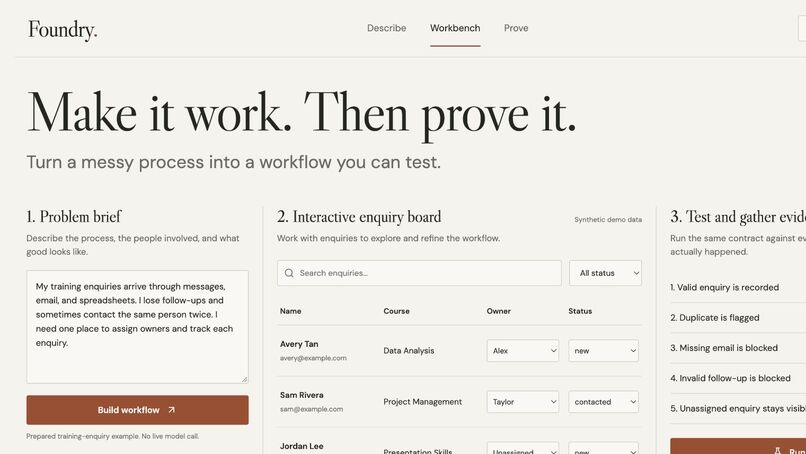
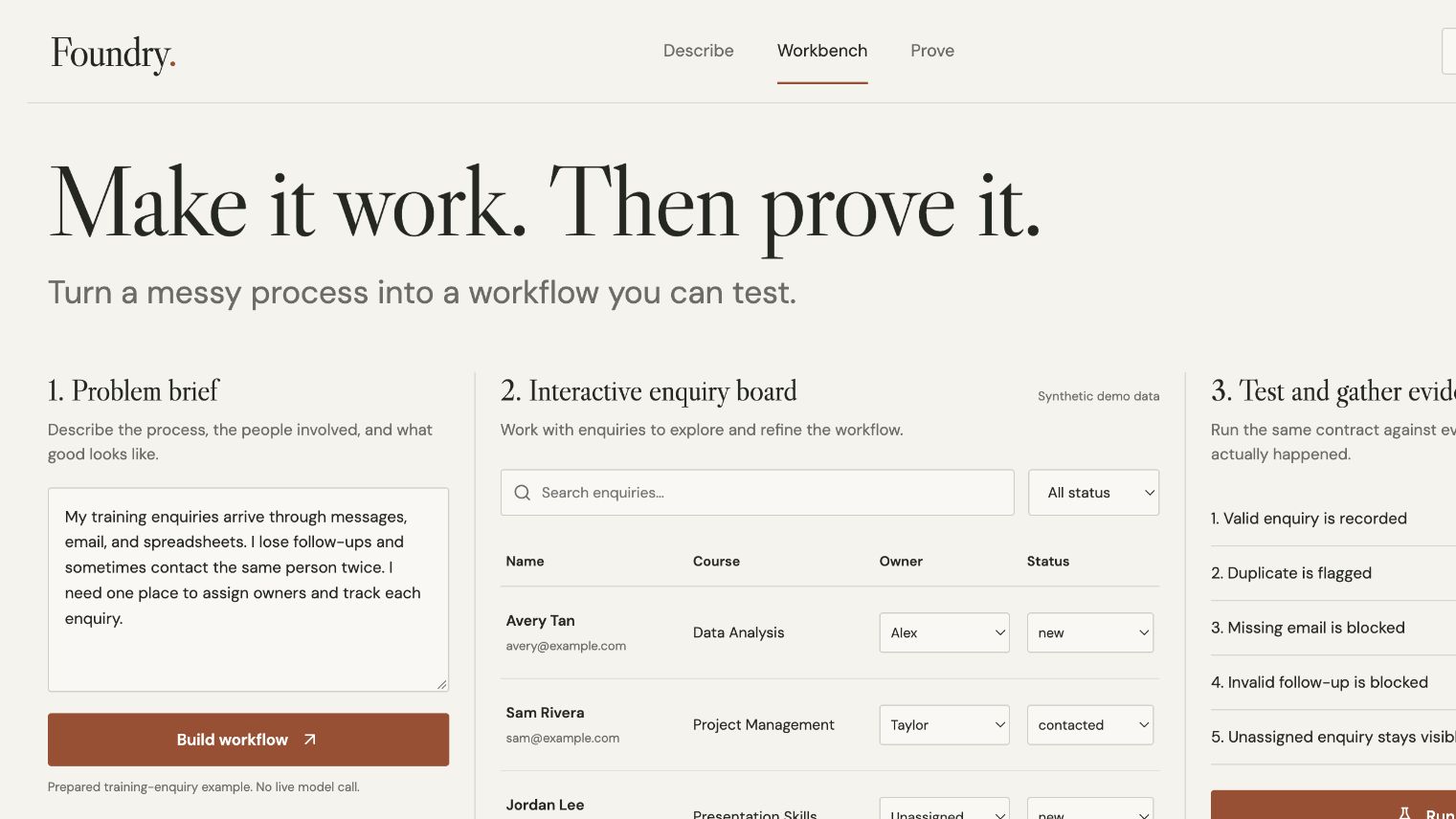
Actual Foundry workbench using synthetic demo data. Prepared sample mode; live NVIDIA inference pending.
Inspiration
A working-looking tool can still lose an enquiry, accept a duplicate, or schedule a follow-up before the enquiry arrived. Small service businesses need to see whether a workflow survives everyday problems before relying on it. Foundry makes those failures visible and turns improvement into something people can inspect.
What it does
Foundry is a workflow laboratory for training providers. Describe an enquiry-handling problem, create a constrained interactive board, run five executable scenarios, inspect expected versus observed behaviour, and apply a reviewed repair. Every version faces the same tests. Previously passing tests must stay passing.
The prepared example starts with an intentionally incomplete configuration. It passes two of five scenarios. After enabling duplicate review, chronological date validation, and the unassigned queue, all five pass. These are measured local test results on synthetic fixtures, not claims about customer outcomes.
Try it in one minute
Open the public sample, leave Sample mode selected, and click Build workflow, then Run tests. Inspect the three failures. Click Propose repair, review the changed rules, then Apply repair & rerun. The same five scenarios improve from 2/5 to 5/5. Add an enquiry to try the actual form validation, then download the evidence JSON.
The public MIT-licensed source repository includes setup instructions, tests, and integration limitations. No login or API key is needed for the sample.
How it is built
The React and TypeScript interface uses one shared workflow engine for both real form actions and the test runner. A Node backend supports structured configuration proposals through Nebius Token Factory. Zod validates model output against an allowlisted schema; no model-generated code is executed. A regression gate protects already-passing scenarios, and users can export the evidence as JSON.
Prototype status: The sample workflow is verified. Live NVIDIA model inference on Nebius is not yet verified.
Challenges
The core design challenge was separating a convincing proposal from evidence that it works. Tests therefore keep fixed expectations and execute against the same functions as the enquiry board. A second challenge is demonstrating a repair honestly: sample mode clearly labels its prepared baseline and repair rather than presenting them as live inference.
Accomplishments
A complete local interaction loop, five inspectable scenarios, regression protection, browser persistence, editable enquiries, desktop and mobile layouts, and downloadable evidence. All 14 automated checks pass, covering workflow rules, configuration validation, regression rejection, and a local fixture-backed HTTP adapter. The fixture checks are not evidence of live Nebius inference.
What we learned
A modest workflow with a clear test contract makes improvement easier to judge than a broad promise of autonomous application generation. Visible assumptions, reviewable changes, and expected-versus-observed evidence make model proposals more useful.
What's next
Validate the workflow with training providers, add customer-defined scenarios, support additional constrained templates, and evaluate secure multi-user storage. These are future plans, not shipped features.

Log in or sign up for Devpost to join the conversation.