Inspiration
My grandmother is always looking for something she just put down. Her purse, her glasses, her keys. Sometimes the search ends quickly. Other times, it becomes stressful for everyone around her.
That made me wonder: what if the room could remember for her?
Not just recognise what a camera sees right now, but keep enough visual evidence to answer a simple question later: “Where was this object last seen?”
That question became FoundIt, a supportive concept for families and caregivers, demonstrated through a working mobile prototype.
Theme
FoundIt fits primarily under Healthcare & Wellbeing because it aims to reduce the everyday stress of finding misplaced belongings.
It also connects to Social Impact & Community Innovation through its focus on family support, and Product & Industrial Design through its emphasis on accessible interaction and a possible future wearable.
FoundIt purpose is to practically support with everyday task.
The problem
Misplacing an everyday object can interrupt someone’s routine and become frustrating for both the person searching and the family members helping them.
The problem is not simply that an object is missing. It is that nobody remembers where it was last seen.
Fixed storage places and reminders can help, but they depend on someone remembering to follow a routine. Tracking tags are useful for tagged belongings, but they require individual objects to be equipped in advance.
FoundIt explores another approach: remembering visual evidence of ordinary objects without requiring a tag on each one.
The intended users are older adults who frequently misplace belongings, family members, and caregivers. The initial design places setup and memory preparation with a family member or caregiver, while keeping search simple.
The proposed solution
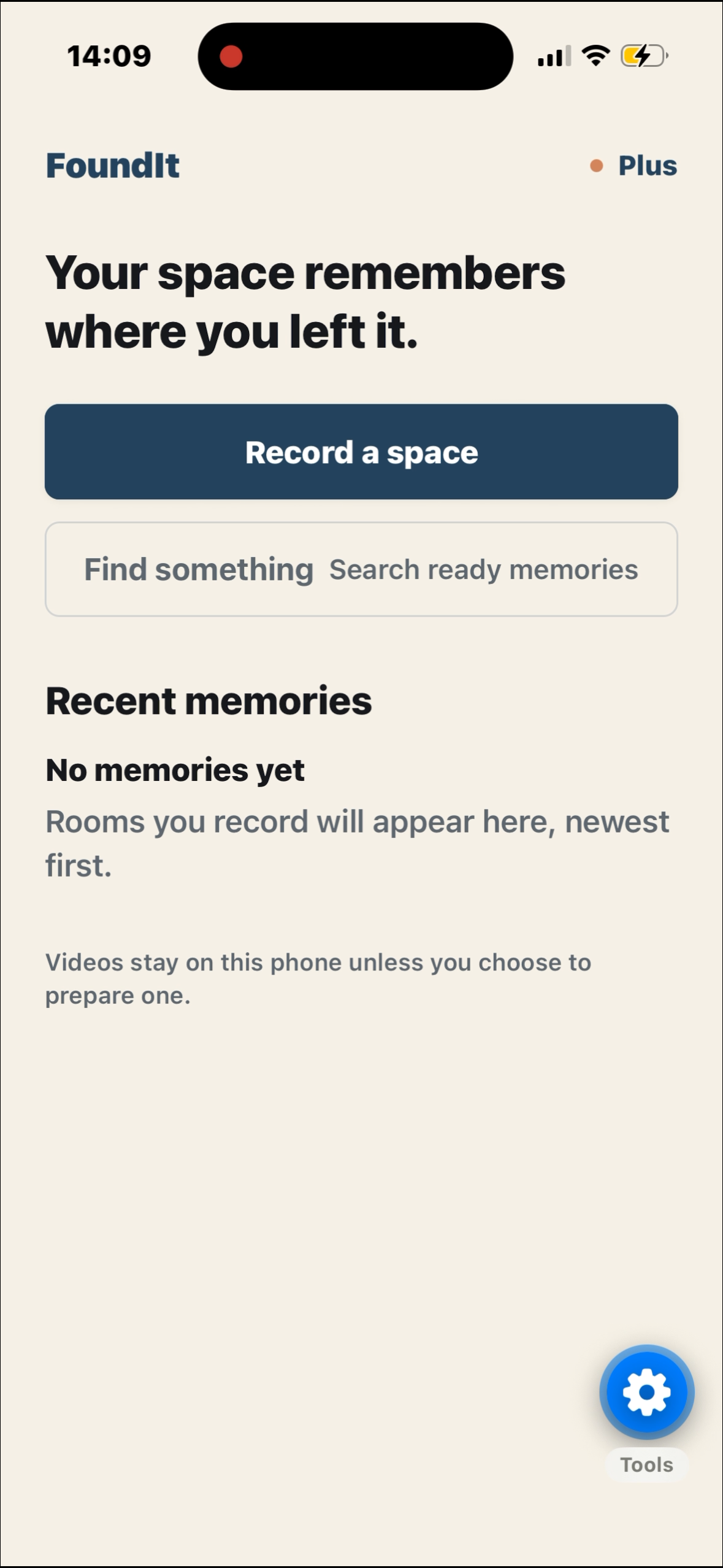
FoundIt turns a short recording of a room into a searchable visual memory.
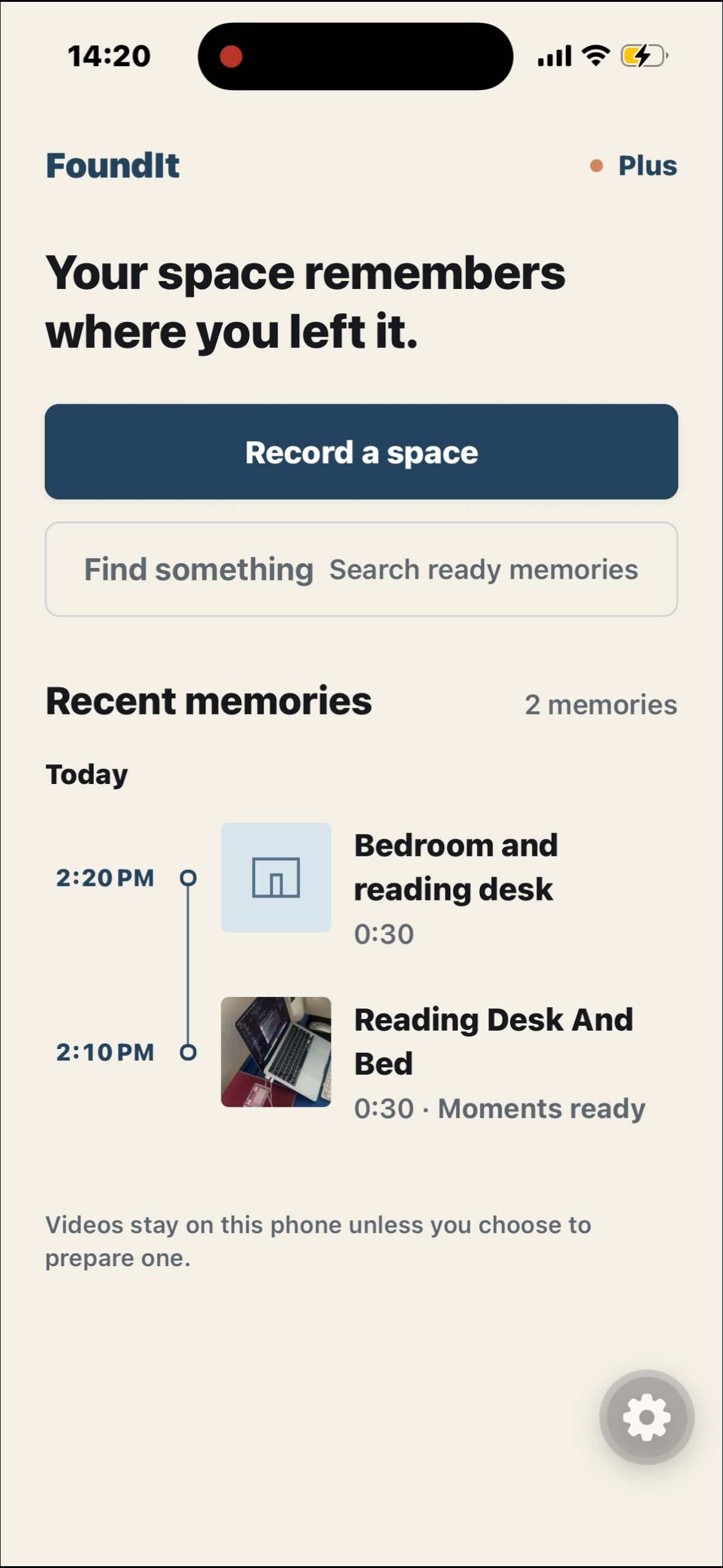
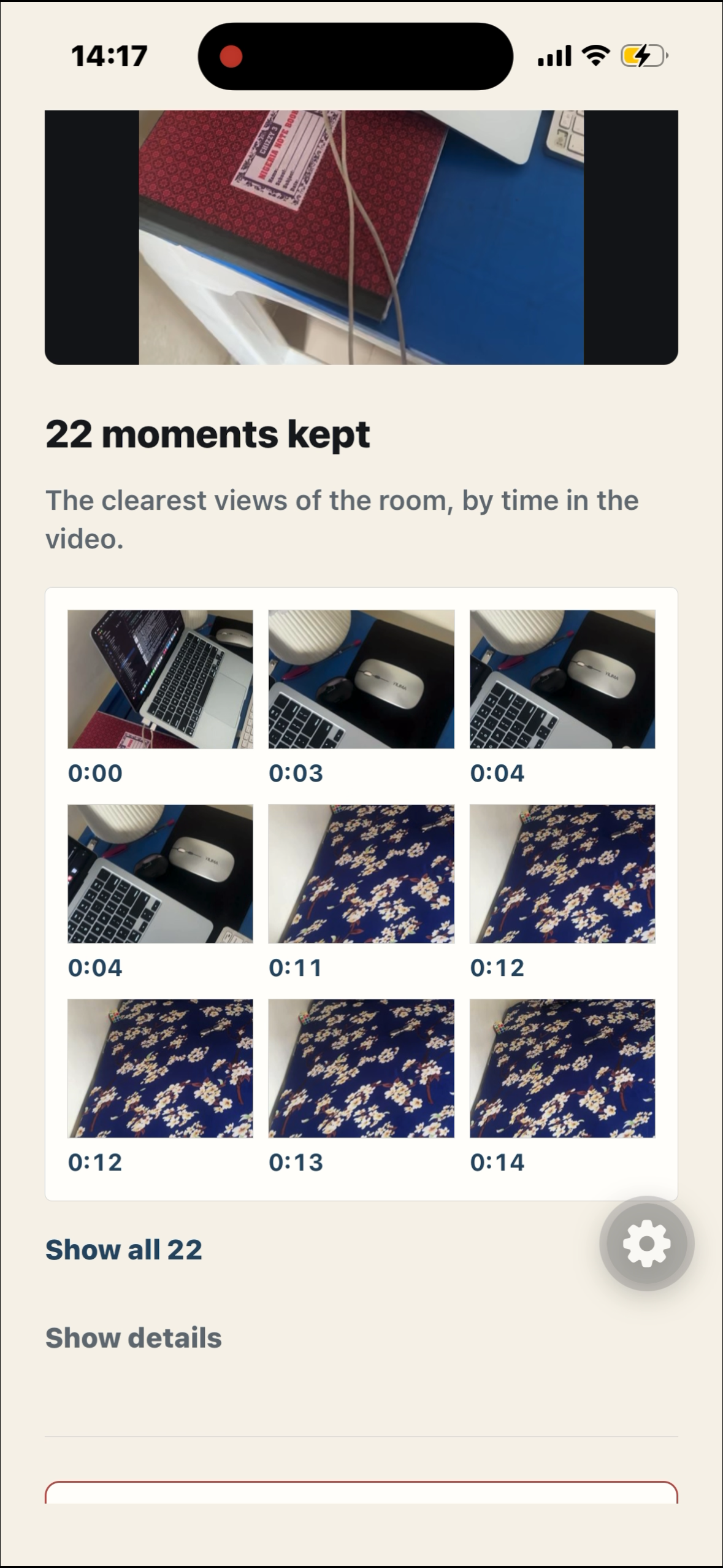
A user records a room sweep, gives the room a name, and chooses to prepare the recording for search. The system selects clear moments and builds a visual index.
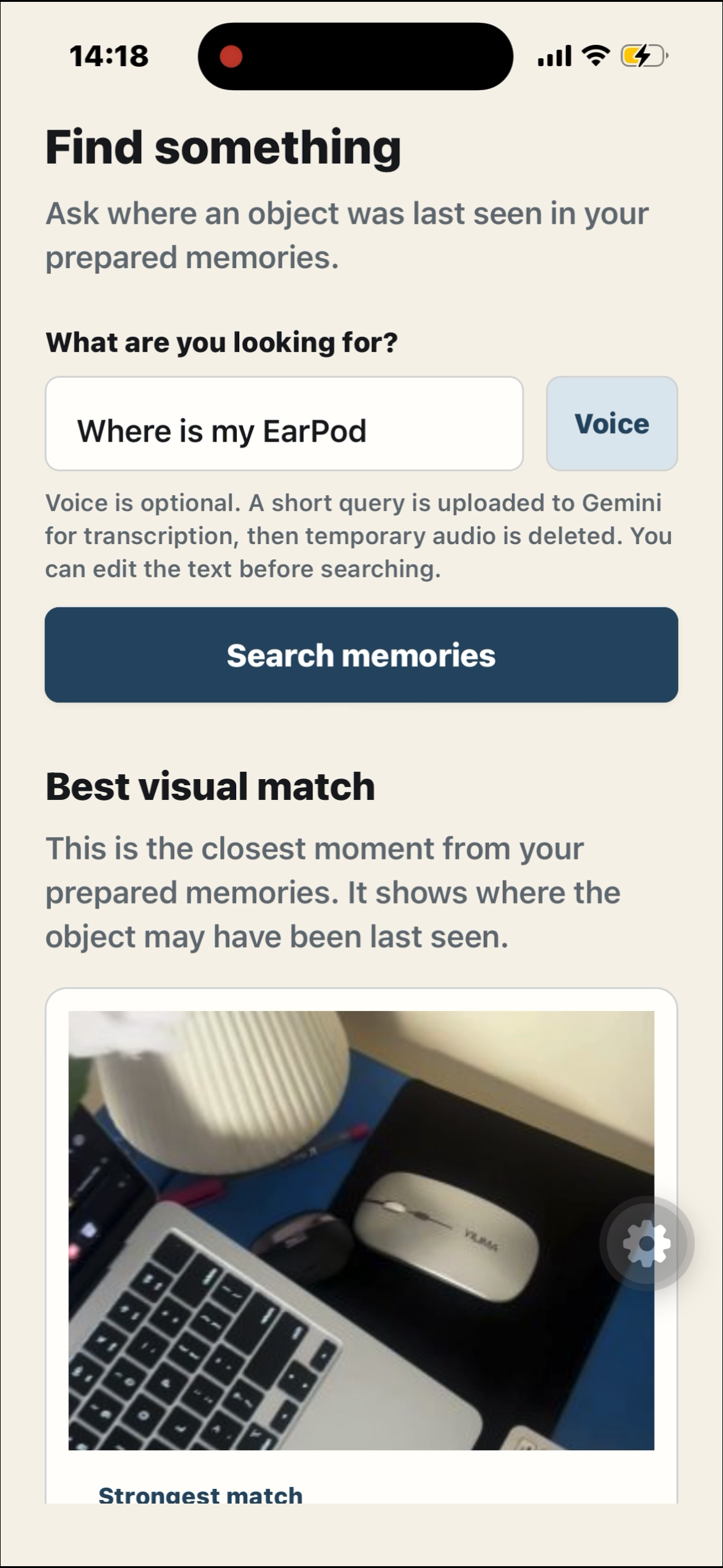
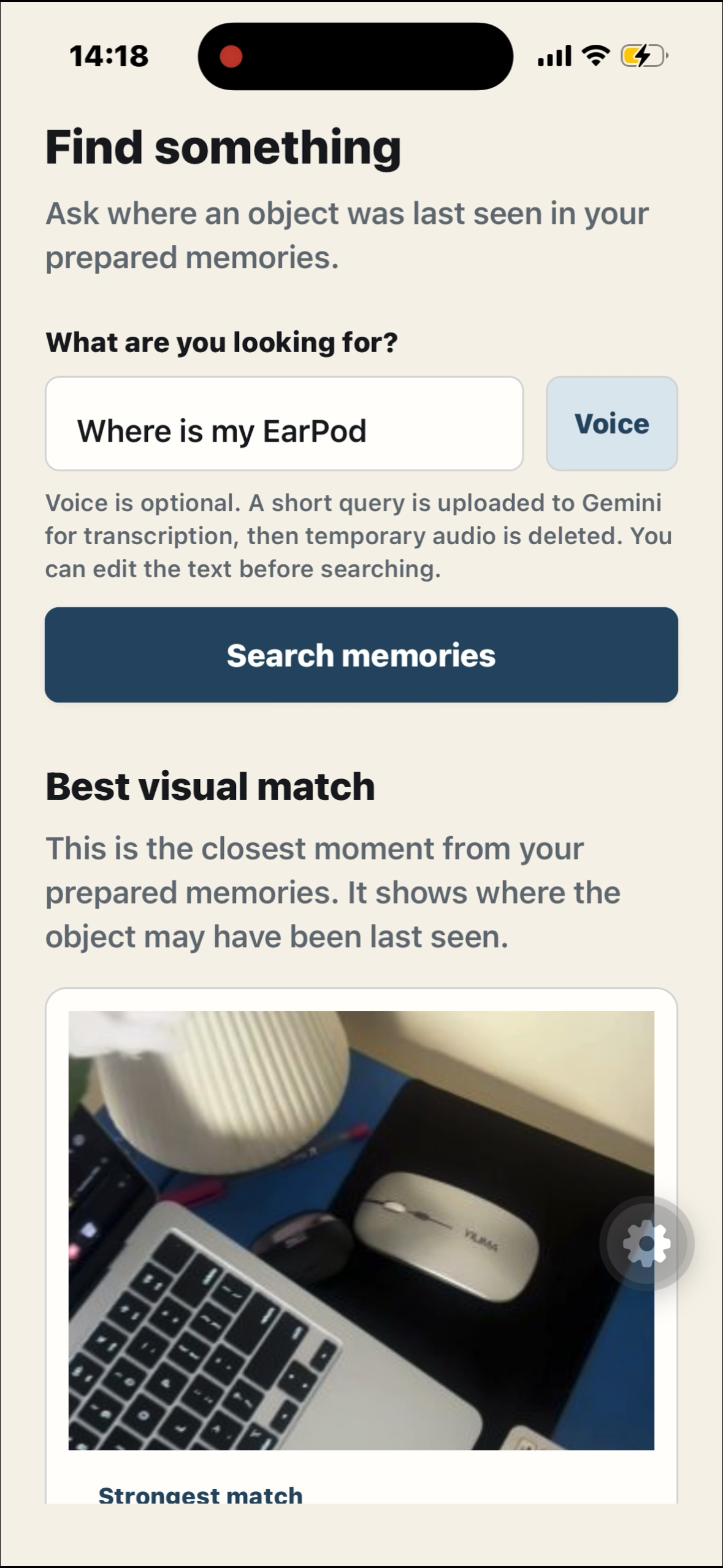
Later, someone can type or speak a question such as: “Where are my EarPods?”
FoundIt returns up to three visual candidates. Each result includes the room, when the memory was saved, and the moment in the recording where the object may have appeared.
The wording matters. FoundIt reports where an object may have been seen in a recorded memory. It does not claim the object is still there or that it has monitored everything since that recording.
Voice input becomes editable text before a search begins, allowing the user to check and correct the transcription.
Innovation and uniqueness
FoundIt’s central design choice is to make the surroundings searchable, rather than asking the user to remember every object’s location.
It combines three ideas:
Visual evidence: Results point back to an actual moment in a recording.
Caregiver-supported setup: A family member can prepare the spaces where belongings most often go missing.
Uncertainty-aware answers: Weaker matches appear as candidates to inspect, rather than definite claims.
The concept brings these ideas together around one focused task: helping someone find a misplaced belonging with less frustration.
Prototype and feasibility
I built a working mobile prototype to test whether this interaction could be practical.
The app uses Expo and React Native. Room recordings are saved locally, while SQLite stores room names, memory records, and processing information.
When the user explicitly chooses to prepare a memory, a Python processing service samples the video, filters blurry and near-duplicate frames, and creates visual embeddings. A search compares the question with those stored representations and retrieves matching frames.
Optional voice input uses Gemini for transcription.
In my testing, the prototype retrieved visual matches for EarPods, and a mouse. It missed a pair of glasses that occupied only a small part of the image.
The prototype demonstrates the core workflow: record a space, prepare its visual memory, ask a question, and inspect the evidence.
Implementation plan and resources
The next stage would focus on improving the current phone-based experience before developing additional hardware.
First, I would improve small-object retrieval by searching smaller image regions and evaluating object-level detection.
Second, I would conduct a small, consent-based pilot with families and caregivers. This would test whether recording a room is manageable, whether results are understandable, and whether the tool makes searches easier.
Third, I would evaluate on-device processing so that visual search and transcription could work without sending private room footage to an external service.
The immediate resources required are development time, test phones, processing capacity, and willing pilot participants. Accessibility feedback would help refine the interface and setup process.
Business model
FoundIt uses a family-oriented freemium model.
The prototype allows free users to prepare one physical space. FoundIt Plus unlocks unlimited prepared spaces and searches across prepared memories.
One free space lets a family try the concept in the room where belongings most often go missing. Paid access expands coverage across the home.
RevenueCat manages subscription access in the prototype. I tested its Test Store purchase flow on a physical iPhone and verified that access depended on an active entitlement.
The likely paying customer is a caregiver or family member. Pricing, willingness to pay, and operating costs still need validation.
Challenges and responsible design
The main technical limitation is that whole-frame search can miss small or visually ambiguous objects. The interface therefore presents uncertain results honestly.
Another limitation is freshness. A recorded room sweep cannot show changes that happened afterward. Every result needs a visible timestamp and clear wording.
Privacy is equally central. Processing requires an explicit user action. The development backend deletes the uploaded video after processing, while extracted frames and embeddings remain available for search. Voice recordings are sent for transcription and then deleted from the app.
The backend does not yet have production authentication. Secure access and clear deletion controls are necessary before deployment in private homes or care settings.
Expected impact and evaluation
FoundIt aims to shorten searches, reduce frustration, and make it easier for family members to help.
A pilot would evaluate:
How long users take to find selected belongings with and without FoundIt.
How often search results contain useful evidence.
Whether users understand that an object may have moved.
How much effort recording and preparing a room requires.
Whether participants report a calmer search experience.
These are intended outcomes to test, rather than benefits already proven.
What’s next
The immediate priority is better small-object search and a simpler caregiver-supported workflow.
The longer-term concept is a lightweight wearable that could capture selected visual observations as someone moves through their day. This could reduce the need to deliberately record room sweeps.
That wearable is a future direction, not part of the current prototype. It would require separate work on consent, bystander privacy, capture controls, battery life, and secure storage.
FoundIt begins with a modest question: can a recorded space help someone remember where a belonging was seen?
The prototype shows a practical first step toward answering it.
Built With
- expo-camera
- expo-router
- expo.io
- fastapi
- ffmpeg
- ffprobe
- gemini-api
- openclip
- opencv
- python
- react-native
- revenuecat
- sqlite
- typescript

Log in or sign up for Devpost to join the conversation.