-
-
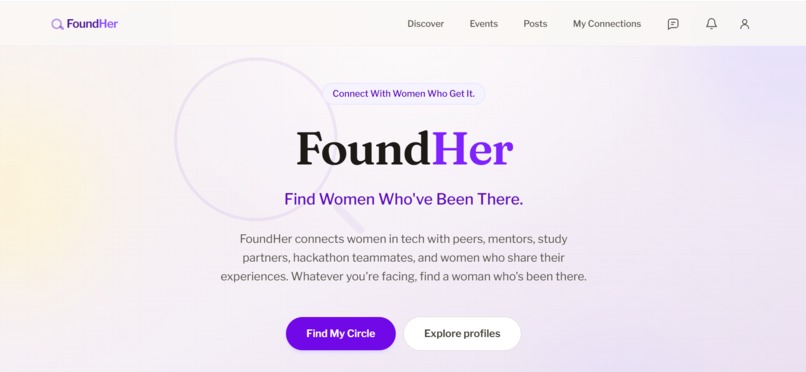
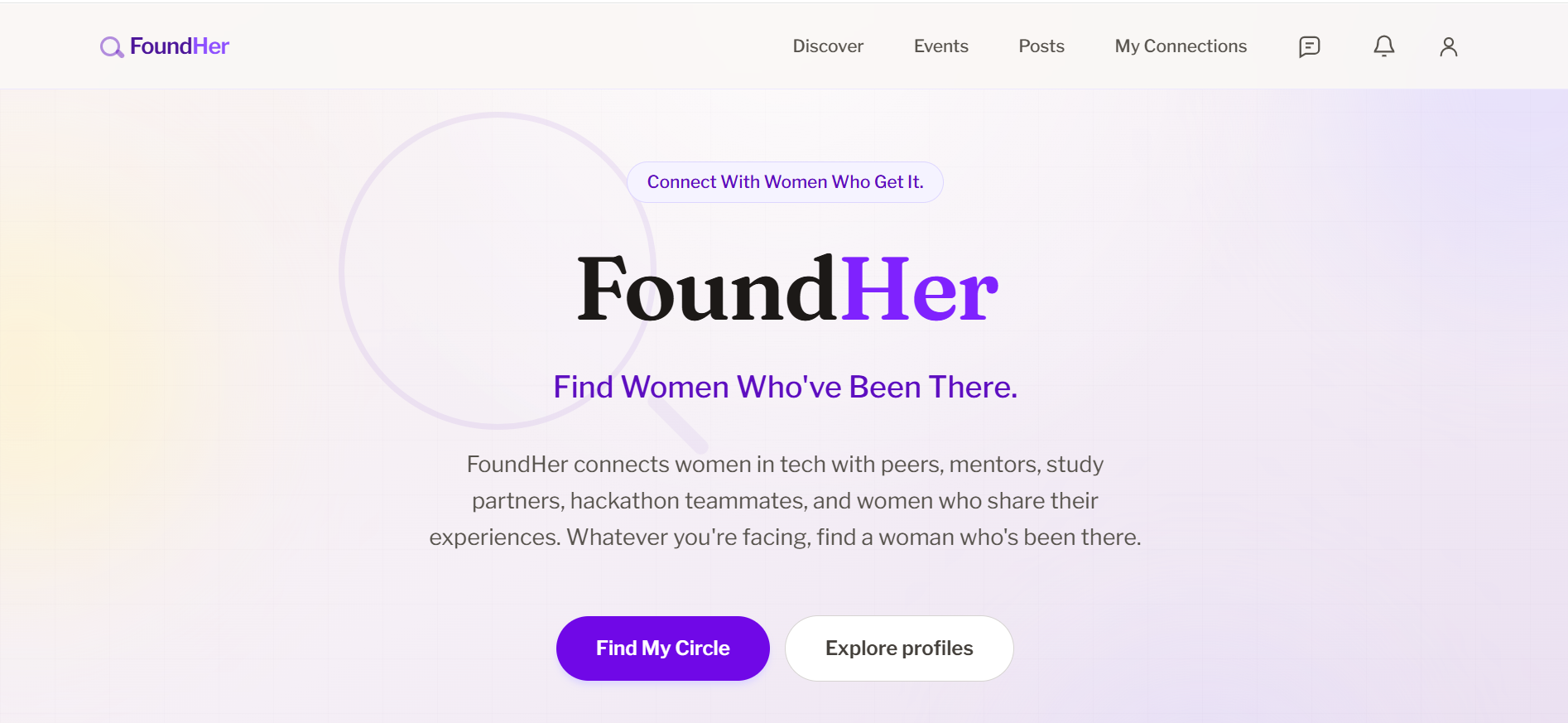
FoundHer Home Page
-
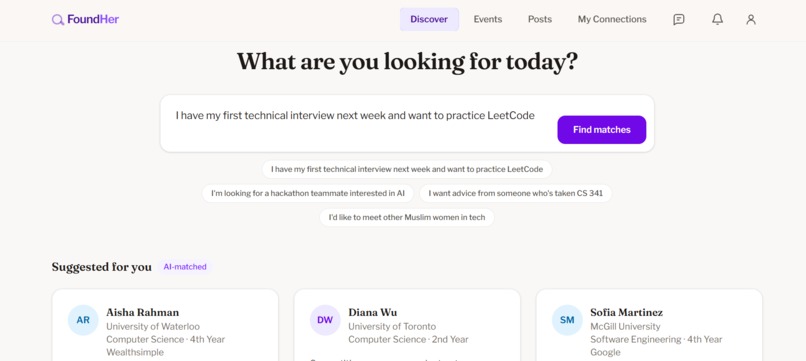
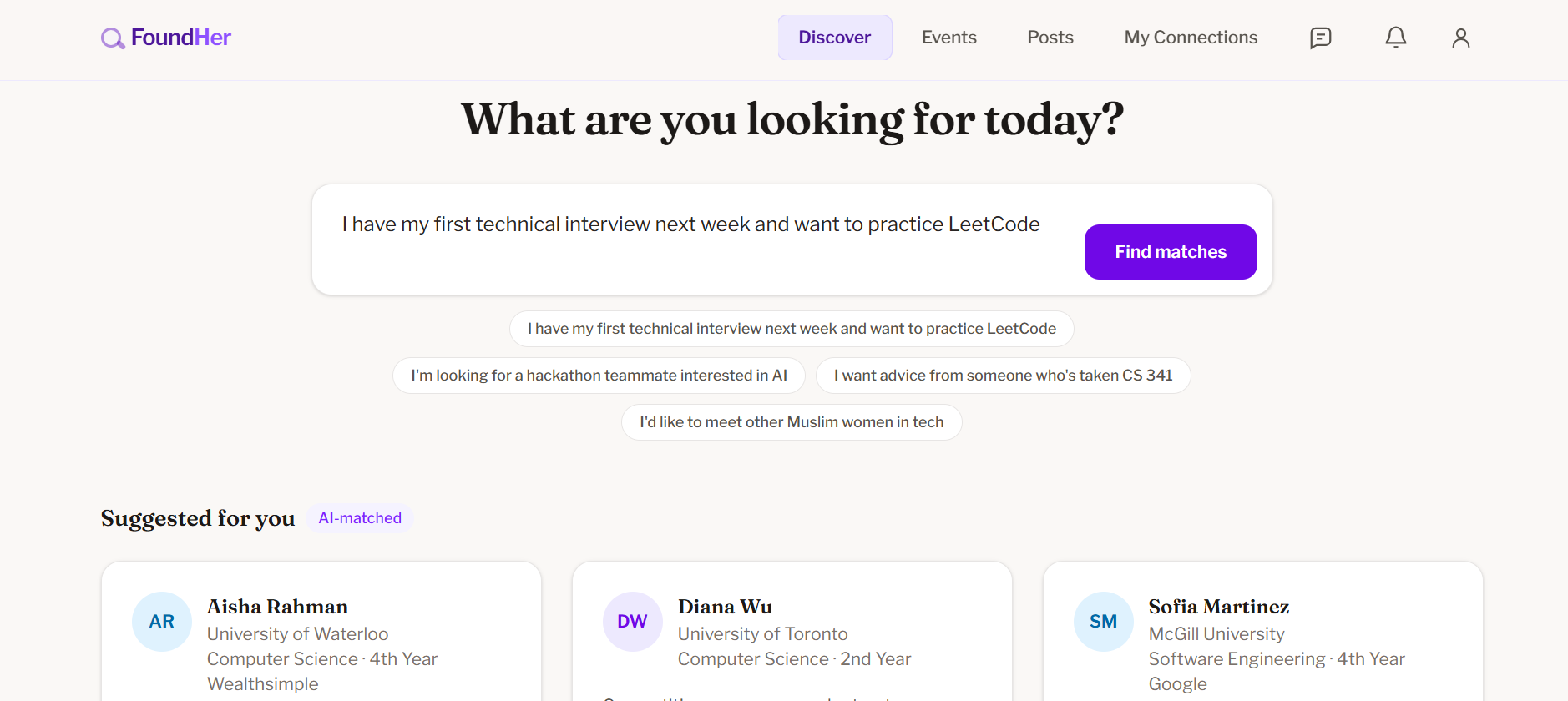
Discover tab: Discover connections using natural language
-
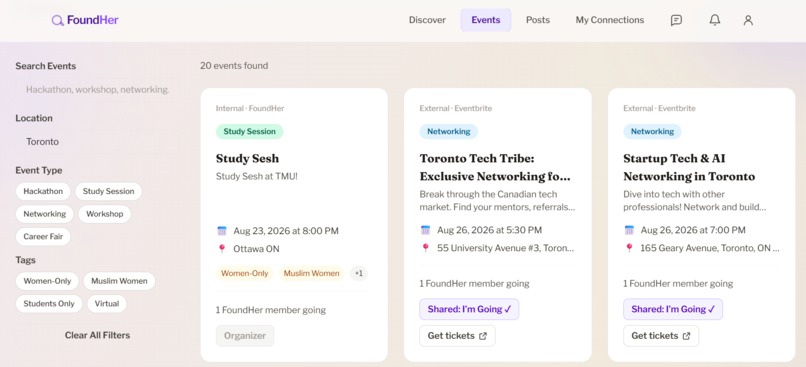
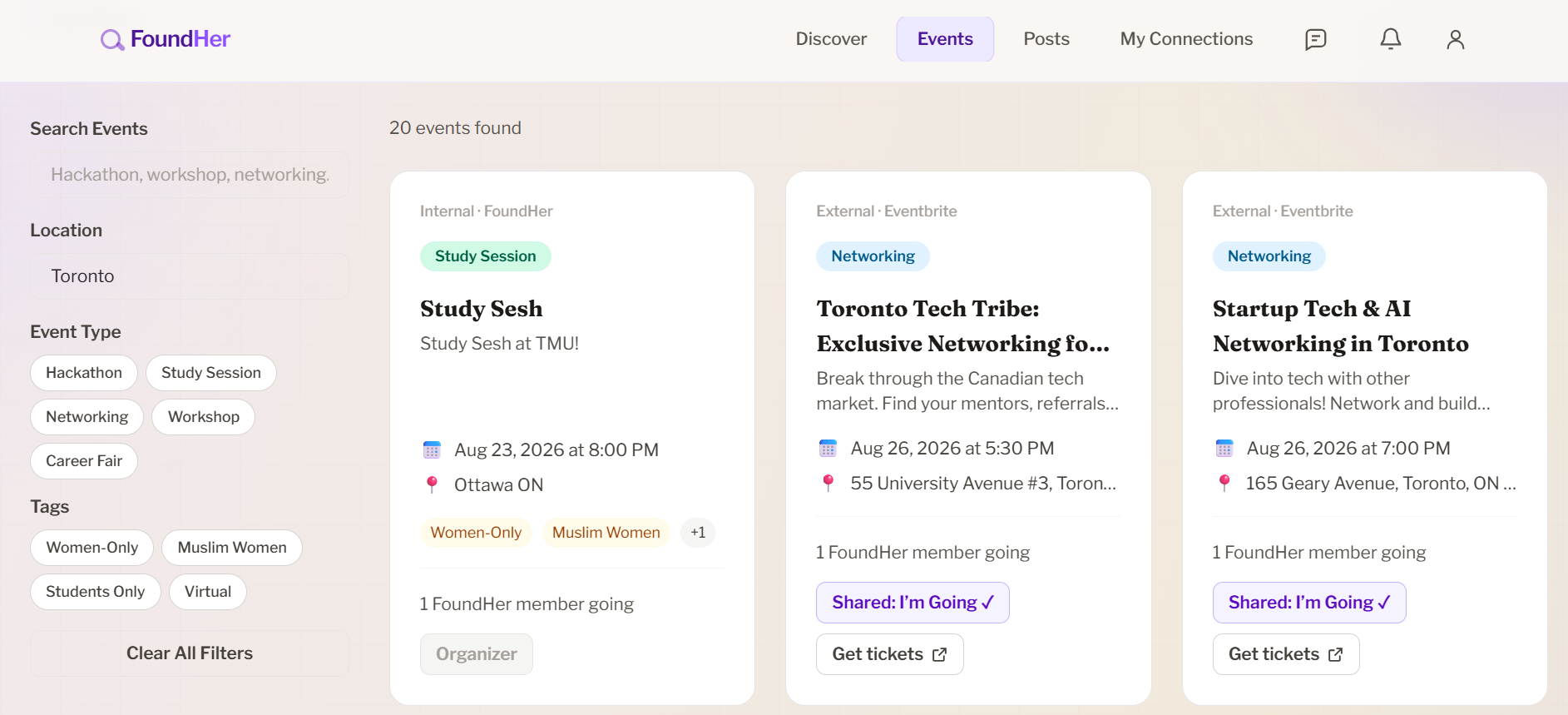
Events tab: Discover events and track FoundHer members attending
-
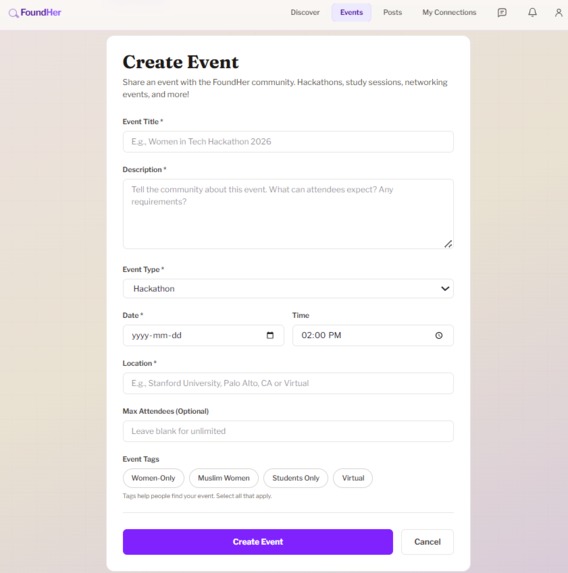
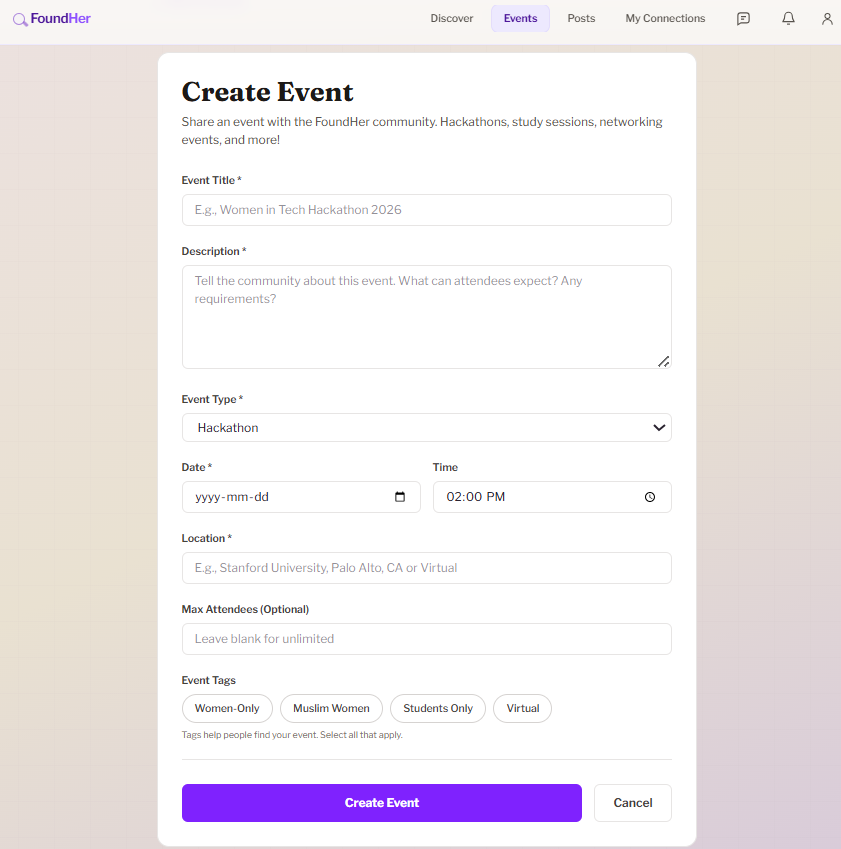
Event tab: Create an event
-
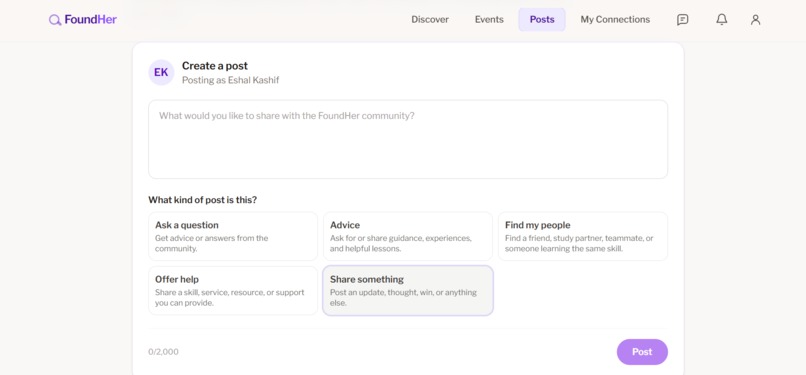
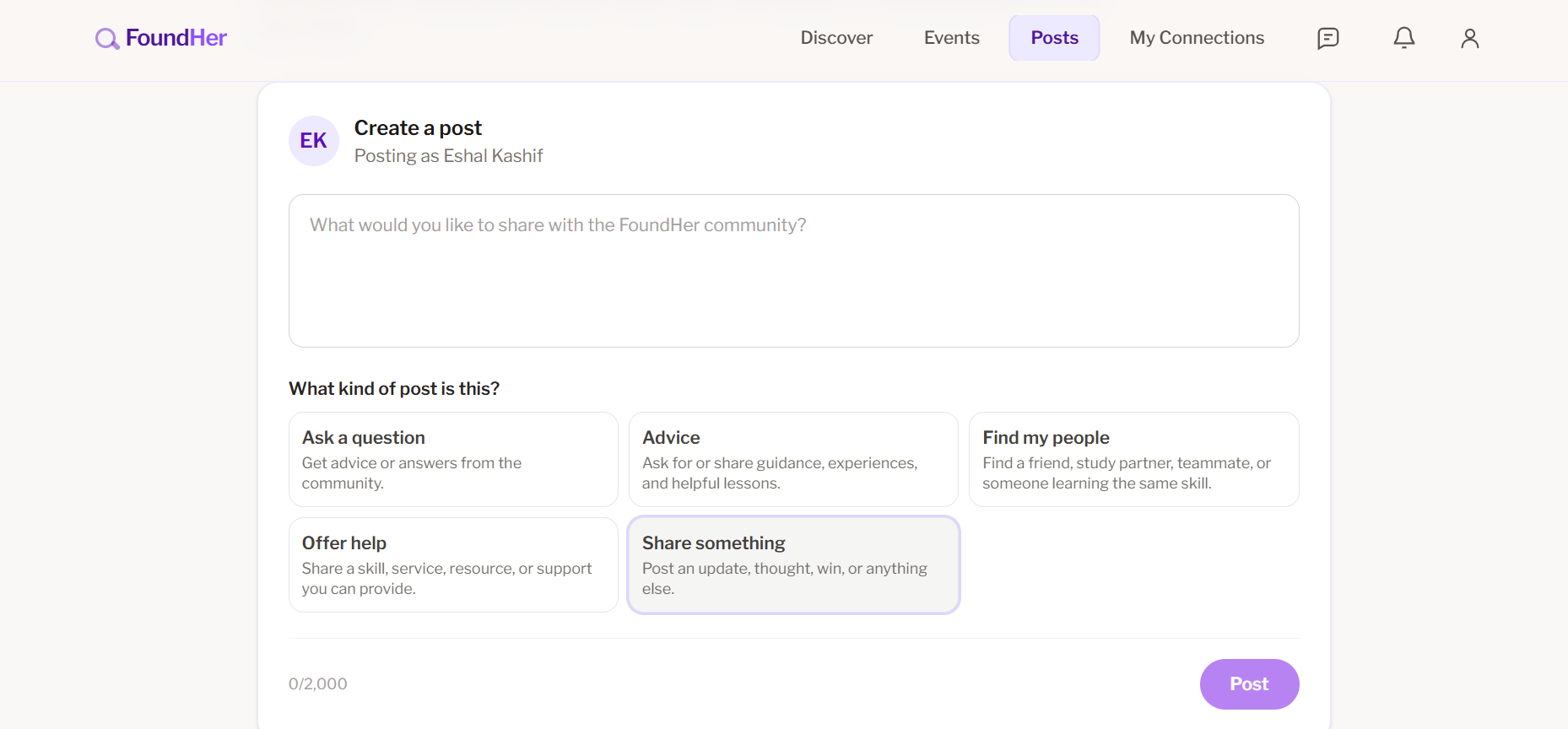
Posts tab: Ask questions, give/receive advice, find project partners, offer help, or just share anything
-
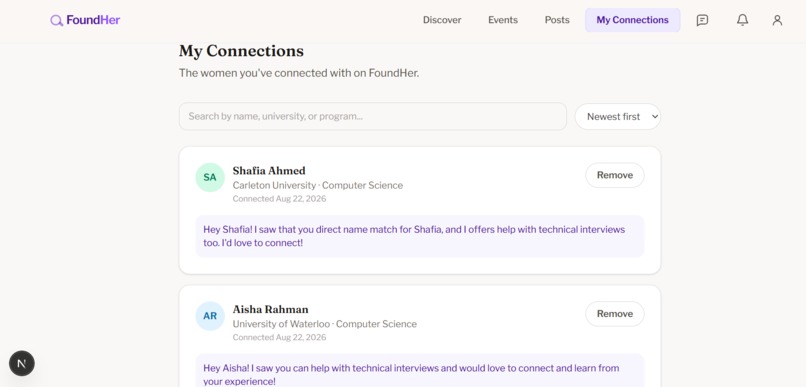
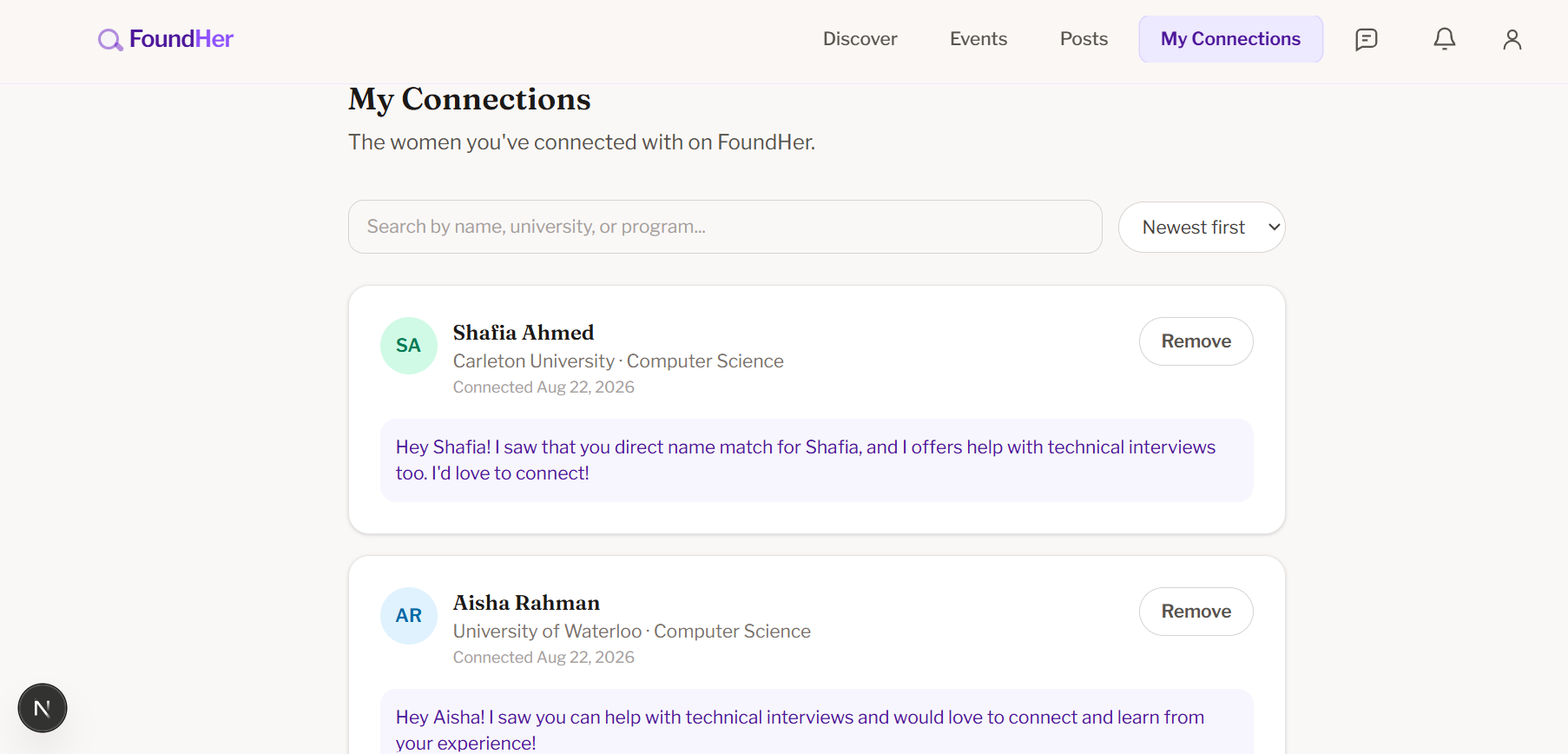
Connections tab: View and manage connections
-
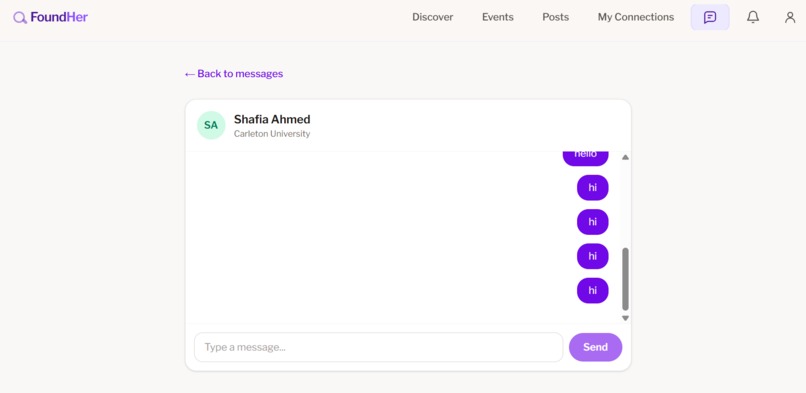
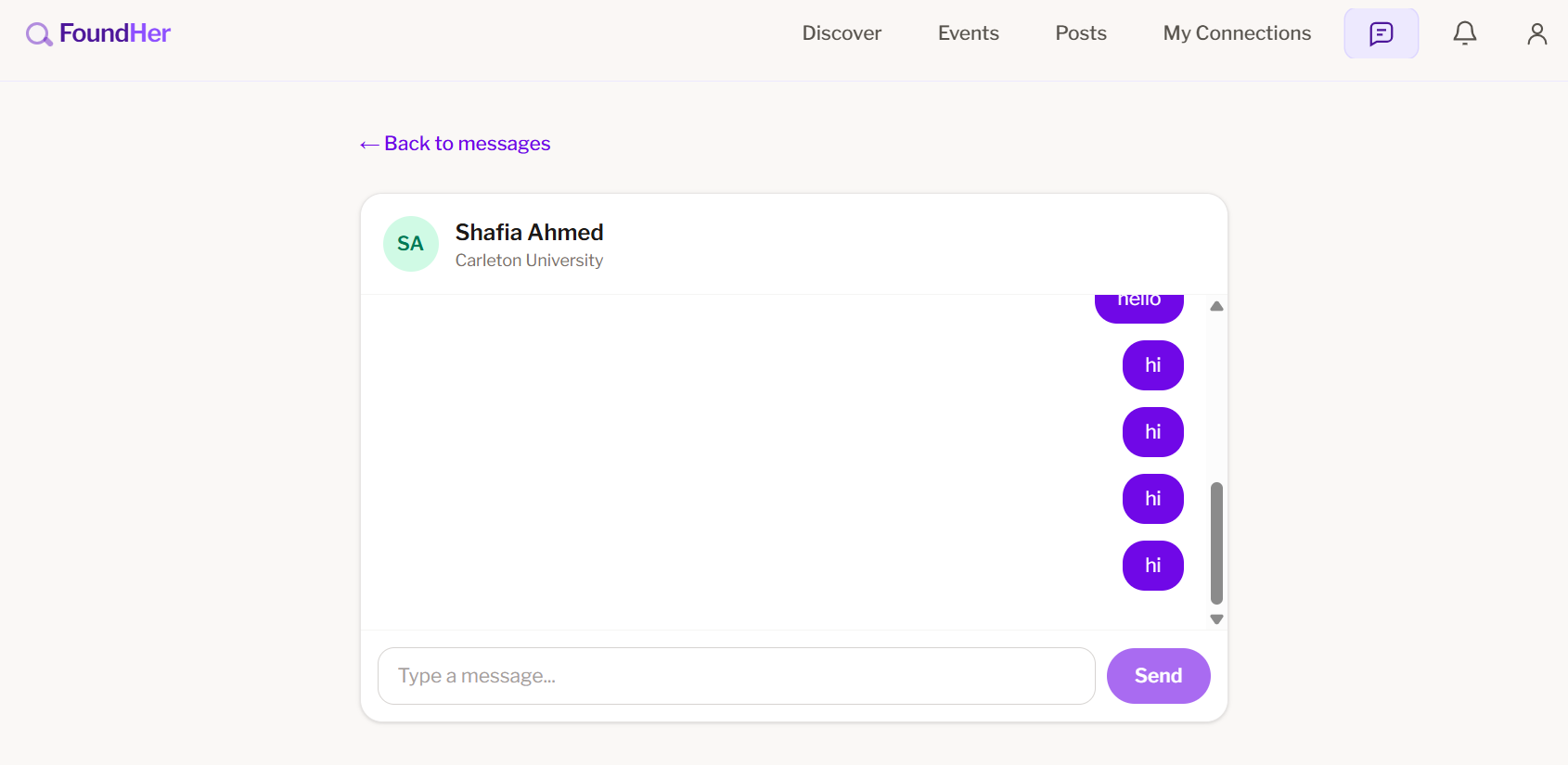
Messages tab: Chat with connections
-
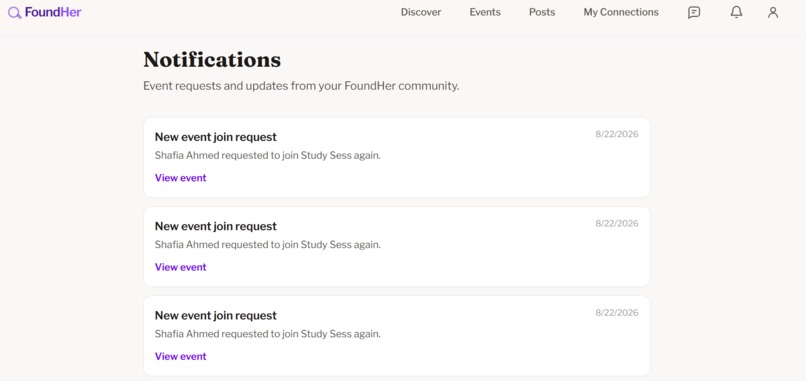
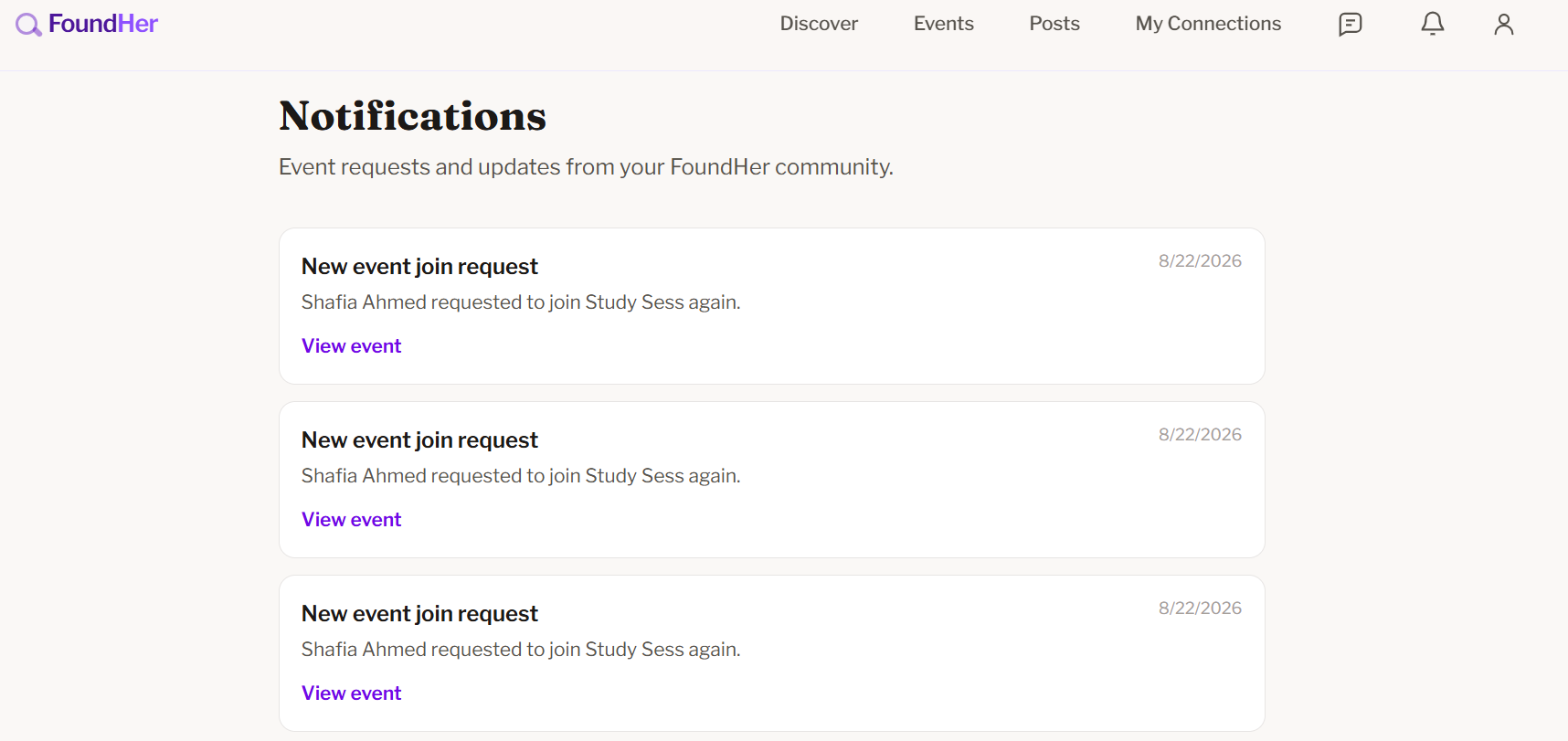
Notifications tab: View and manage event join requests for events you're hosting
-
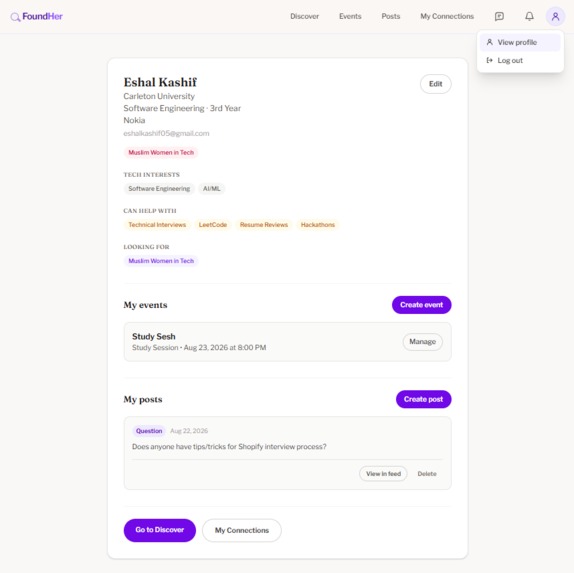
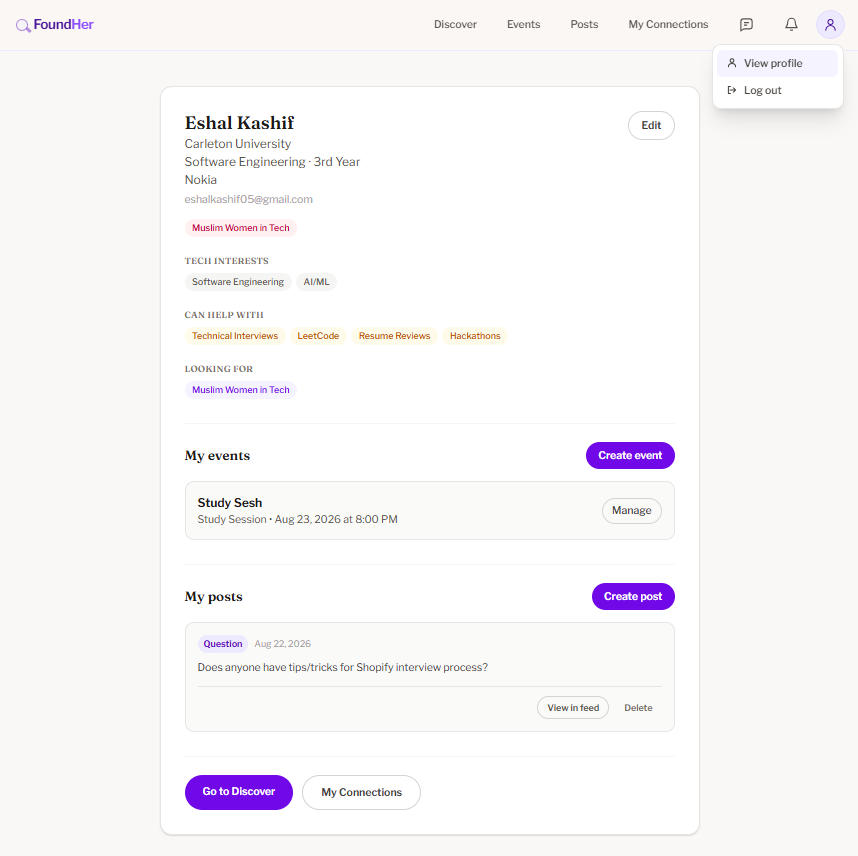
Profile tab: Log out or edit profile, as well as manage your events and posts
Inspiration
Networking works best when you already have a network. But in male-dominated fields, the underrepresentation of women means they often have fewer women around them to turn to for mentorship, advice, opportunities, and shared experiences. This creates a cycle: when women are underrepresented, it becomes harder to find the support and community that can help them enter, navigate, and stay in these spaces, further reinforcing the imbalance.
The problem isn't that women aren't willing to support one another. The problem is that this support can be difficult to find. Valuable connections are scattered across workplaces, schools, professional platforms, clubs, group chats, and events, often leaving women to find the right people through luck or an existing network.
We created FoundHer to break this cycle by bringing these connections into one dedicated space. FoundHer makes it easier to discover women based on their skills, schools, workplaces, and experiences, exchange advice and opportunities, and find events where online connections can become real ones.
By making women's professional networks more visible and accessible, FoundHer aims to give women the connections and community they need to enter, stay, and grow in spaces where they are underrepresented, while helping close the gender gap.
What it does
FoundHer is a community and intelligent networking platform that helps women find the people, support, and opportunities they need to grow in spaces where they are underrepresented. Rather than focusing on collecting connections, FoundHer is designed to make networking more intentional, helping users discover people based on shared experiences, goals, and what they can offer each other.
Discover
The Discover tab makes finding the right person easier. Users can search and filter women based on their skills, school, workplace, field, interests, experience, and communities.
FoundHer also uses AI-powered matching to make discovery more intuitive. Instead of knowing exactly who or what to search for, users can describe what they're looking for in their own words, whether that's interview support, a project collaborator, or someone with a similar background. FoundHer analyzes their needs and recommends relevant women, providing a recommendation.
Events
The Events tab helps turn online networking into real-world connections. Users can discover professional events, workshops, and networking opportunities, while seeing how many other FoundHer members are planning to attend. This gives users the opportunity to connect beforehand and attend knowing there will already be familiar faces in the room.
FoundHer members can also create their own events and meetups, with other users able to request to join, making it easier for communities to create opportunities to connect themselves.
Posts
The Posts tab creates a space for women to share the knowledge and opportunities that are often passed through informal networks. Users can ask career or interview questions, share advice and experiences, look for collaborators, post what they're working on, or offer their own skills and support to others.
Connect
Every FoundHer profile represents both who someone is and how they can contribute to the community, including their experience, skills, interests, and areas where they can offer support. Users can send connection requests, message one another directly, and receive notifications when others interact with them.
Together, Discover, Events, Posts, and Messaging turn FoundHer into more than a directory of professional profiles. A user can discover someone with the experience they're looking for, connect over a shared interest, find an event they're both attending, and turn that first interaction into a meaningful professional relationship.
FoundHer turns networking from something you are expected to already know how to do into a clear, accessible way to find your community.
How we built it
We built FoundHer as a full-stack web application using Next.js, React, TypeScript, and Tailwind CSS, with Supabase powering our backend. Supabase handles authentication, user profiles, connections, messages, posts, event attendance, and database security. We implemented Row Level Security (RLS) policies to ensure users can only access or modify information they are authorized to manage.
Intelligent Matching
To make networking more intentional, we integrated Google Gemini into our Discover experience. Users can describe who they are looking for in natural language, and Gemini analyzes available profiles based on factors like skills, experience, interests, background, and the support they can offer. It then ranks relevant connections and provides a match score with an explanation of why each person may be a good fit.
We also built a local keyword-based matching system that works alongside the AI-powered experience. It provides immediate results and acts as a fallback if Gemini or its API is unavailable, keeping discovery responsive and reliable instead of depending entirely on an external AI service.
Real-World Event Discovery
We wanted FoundHer to connect women beyond the platform, so we built an event discovery system that brings real tech and professional events directly into the app. Using the Eventbrite API alongside web scraping, we collect relevant events and surface them within FoundHer, with filtering by location and event type to help users find opportunities that are actually relevant to them.
We then connect this external event data with the FoundHer community by allowing users to indicate that they are attending. This means users aren't just discovering an event; they can also see how many other FoundHer members are going, creating an opportunity to connect before attending.
Users can also create events directly within FoundHer, allowing the community to organize its own meetups and networking opportunities.
Designing for Approachable Networking
Throughout development, we designed the experience around reducing the friction and uncertainty that often comes with networking. Guided onboarding helps users communicate both what they need and what they can offer, suggested searches make discovery easier to start, AI match explanations make recommendations transparent, and profile filters give users direct control over who they discover.
By combining a full-stack social platform, AI-powered matching, real-world event aggregation, and community features, we built FoundHer to bridge the gap between finding the right people online and forming meaningful connections in the real world.
Challenges we ran into
Turning natural language into meaningful connections
One of our biggest challenges was designing the natural-language matching system. Users can describe what they need in many different ways, but those requests need to be compared against structured profile information such as skills, interests, experiences, communities, and areas of support.
We used Google Gemini to interpret each user's intent and evaluate profiles holistically, returning relevant matches. To make this core feature more resilient, we also built a keyword-based fallback matching system. It recognizes phrases related to needs such as mentorship, course advice, interview preparation, hackathon teammates, and shared communities, then maps those needs to relevant profile tags and shows potential matches. This ensures users can still receive meaningful recommendations without depending entirely on an external AI service.
Building the complete connection journey
Our second challenge was building a complete networking experience within the hackathon timeline. Finding the right person only matters if a user can actually act on that match, so we needed to connect onboarding, profile discovery, connection requests, notifications, and messaging into one functional journey.
We prioritized this core flow first and structured our Supabase data around relationships between users. From there, we connected features like posts and events back to the same profiles, allowing a user to go from discovering someone to actually starting a conversation and building a connection.
Accomplishments that we're proud of
We're most proud that FoundHer became more than a directory of profiles. We built a complete path from recognizing that you need support to finding the right person and actually starting a meaningful connection. Instead of measuring success by how many connections someone collects, we designed FoundHer around whether those connections are relevant and useful.
We're especially proud of our matching system, which turns something as open-ended as "I need someone to practice technical interviews with" into relevant, filtering and recommendations.
More importantly, we designed FoundHer around reciprocity rather than just asking for help. Profiles capture both what someone is looking for and what they can offer, recognizing that every member, from a first-year student to an experienced professional, has knowledge or experience that could help someone else.
What we're proudest of, however, is the larger purpose behind what we built. FoundHer addresses underrepresentation by focusing on the support systems that help women stay and grow in these spaces. Rather than waiting until someone feels isolated or unsupported, we want to make mentorship, community, shared knowledge, and meaningful connections easier to access from the beginning.
For us, closing the gender gap isn't only about helping more women enter male-dominated fields. It's also about building an environment that makes them want and feel supported enough to stay.
What we learned
One of our biggest takeaways was that networking isn't about meeting more people. It's about finding the right person at the right time. A large network means very little if you still don't know who to turn to when you need advice, support, or someone who understands your experience.
From a product perspective, we realized that a strong community can't be built around asking for help alone. Asking users what they can offer as well as what they need allows every member to contribute, regardless of where she is in her career. Someone looking for internship advice might still be able to help another person with a course, a technical skill, or their first hackathon. Building that sense of reciprocity was an important part of making FoundHer feel like a community rather than simply another professional platform.
From a technical perspective, we learned how challenging it is to build a social platform where every feature is interconnected. Profiles aren't isolated from posts, events, connections, notifications, or messages, so decisions about authentication, database structure, permissions, and user relationships affected the entire application. Building these workflows with Supabase and Row Level Security gave us valuable experience designing a system that remains connected while protecting user data.
Most importantly, we learned that closing the gender gap is about more than bringing women into underrepresented fields. The communities, relationships, and support systems available once they get there matter too. FoundHer showed us how technology can help make those networks more visible and accessible.
What's next for FoundHer
Our next step is to make FoundHer even more personalized, accessible, and useful beyond the first connection.
We want to expand discovery with optional filters for shared identities and experiences, giving users more control over finding people who may understand both their professional goals and personal experiences. These would be entirely optional, allowing users to choose what they are comfortable sharing and how they want to be discovered.
We also want to introduce mentor scheduling, where experienced members can offer dedicated time slots for coffee chats, career advice, resume reviews, or interview preparation. This would make mentorship easier to access while giving mentors control over their availability.
Another feature we're excited about is Skill Swaps. Every member has something to learn and something to offer, so users could exchange skills with one another, whether that's practicing technical interviews in return for design feedback or learning a new framework while helping someone with their resume. This would further build the culture of reciprocity at the heart of FoundHer.
Finally, we want to bring FoundHer to a mobile app, making it easier for users to stay connected, discover people nearby, receive event updates, and continue conversations wherever they are.
Ultimately, we want FoundHer to grow from a place where women find connections into a platform where those connections develop into mentorship, collaboration, community, and opportunity.
Built With
- css
- eventbrite
- git
- google-gemini-api
- google-genai-sdk
- html
- javascript
- next.js
- node.js
- npm
- postcss
- postgresql
- react
- rest
- rest-apis
- supabase
- supabase-auth
- tailwind-css
- typescript

Log in or sign up for Devpost to join the conversation.