-
-
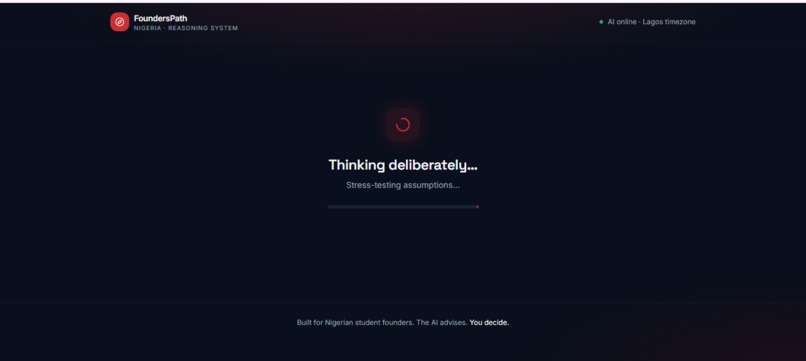
AI Reasoning
-
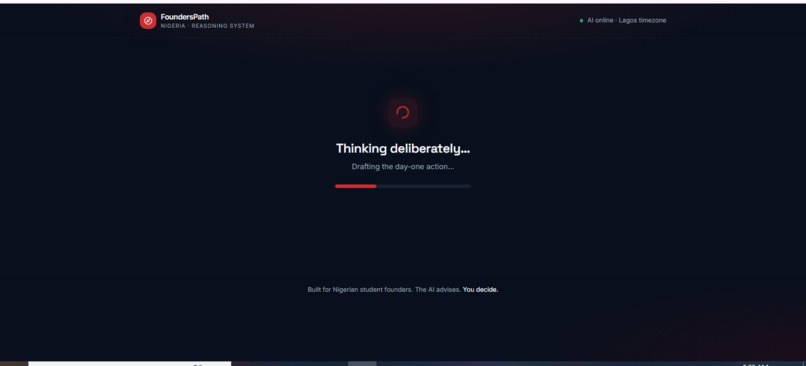
AI Reasoning 2
-
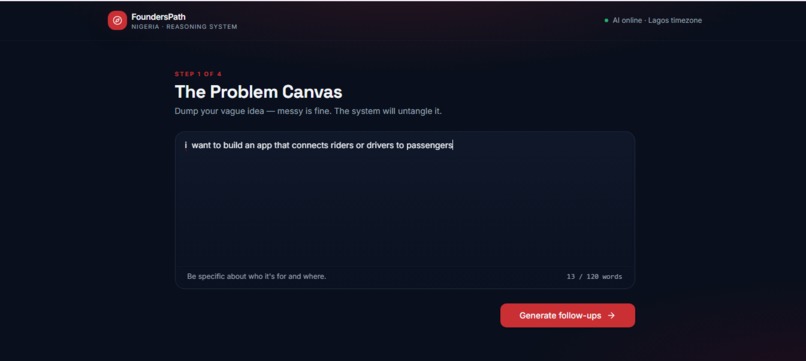
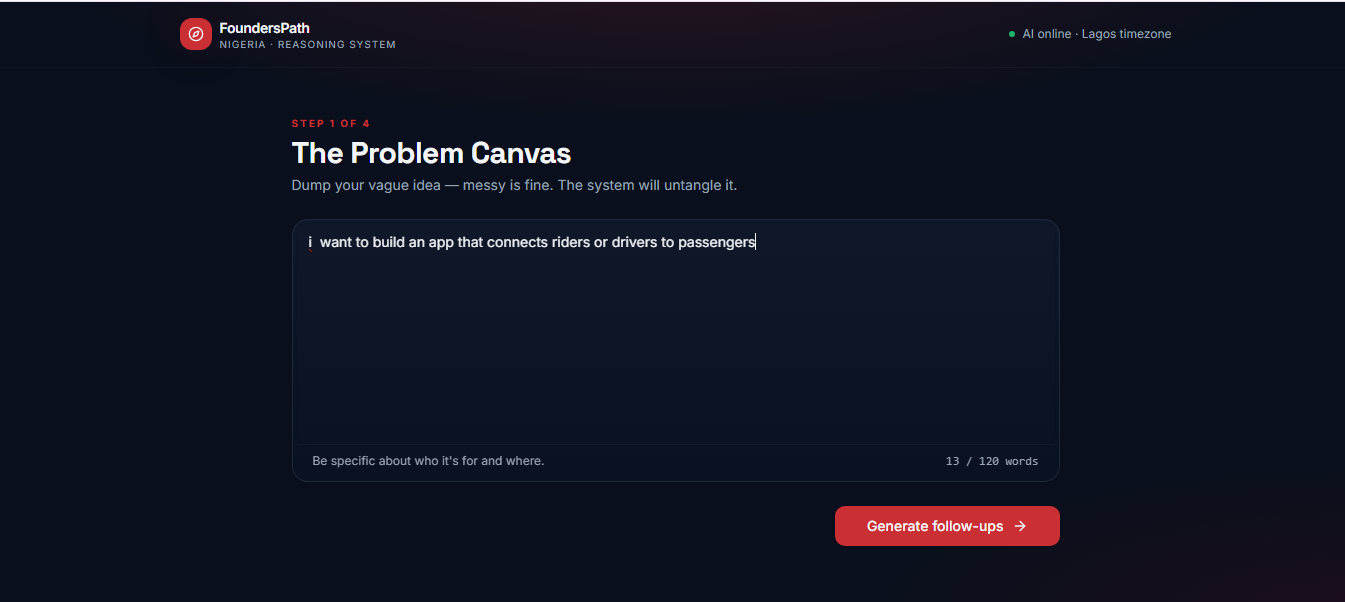
Problem Canvas
-
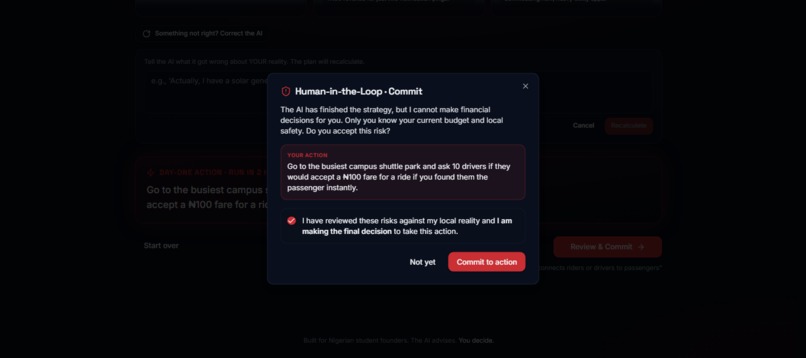
Human in the loop box
-
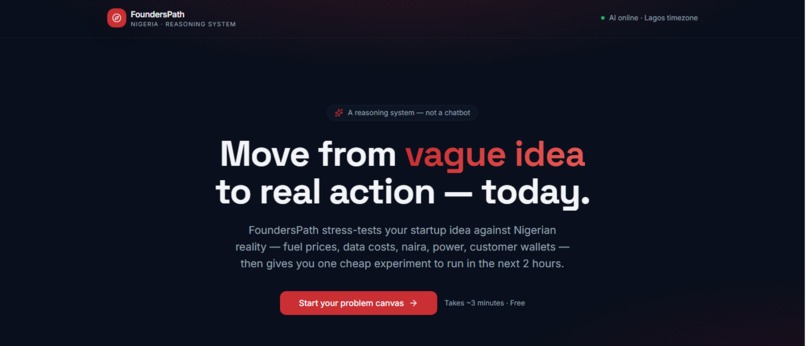
Dashboard
-
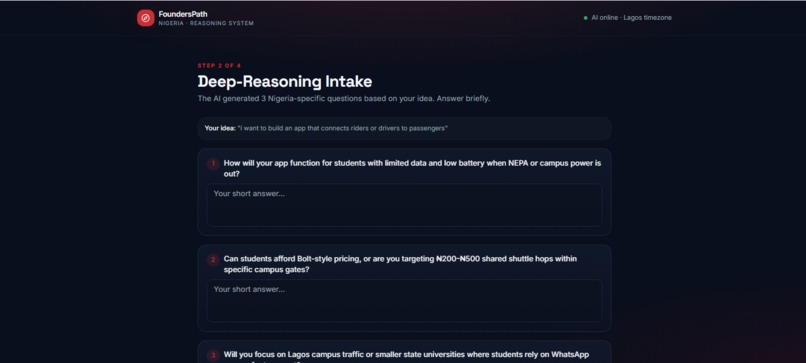
AI Questions
-
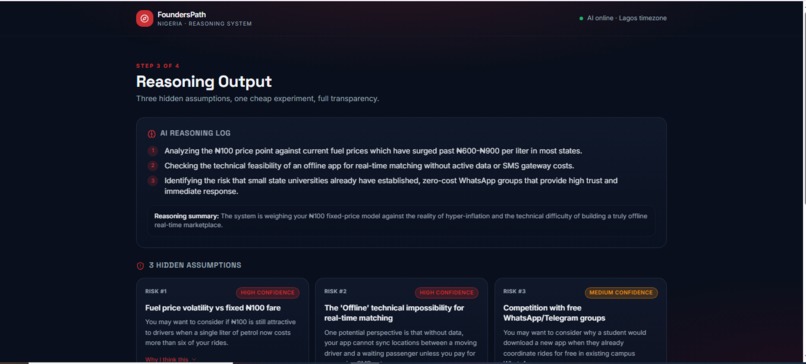
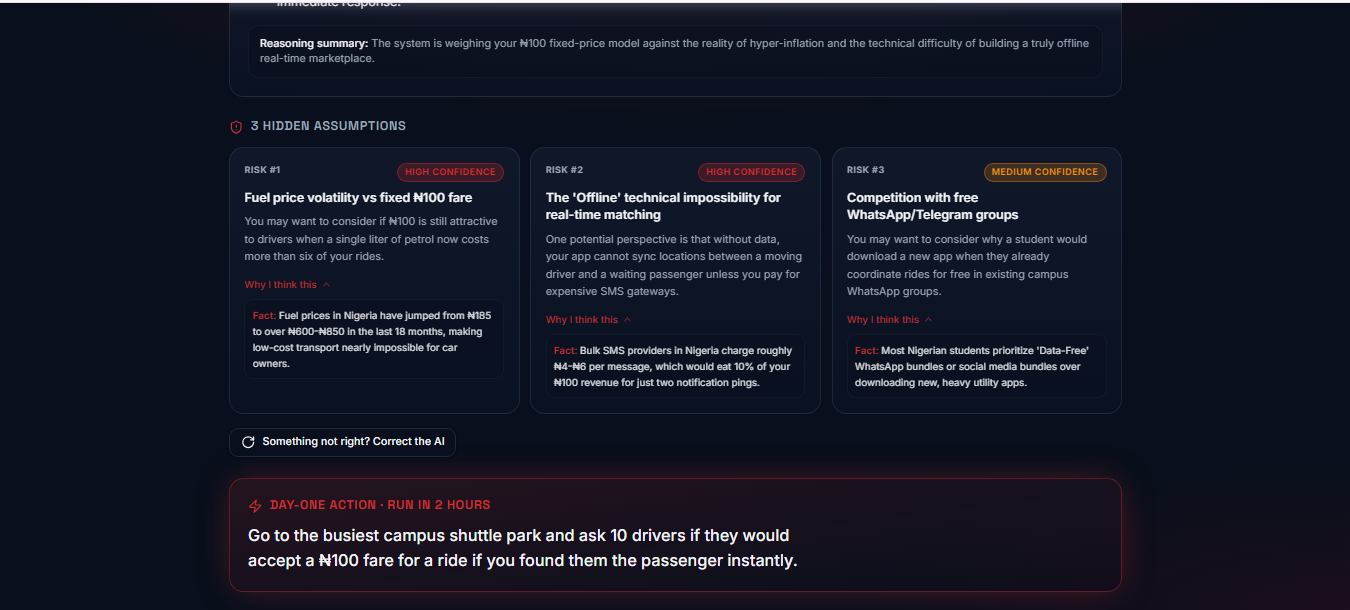
AI output
-
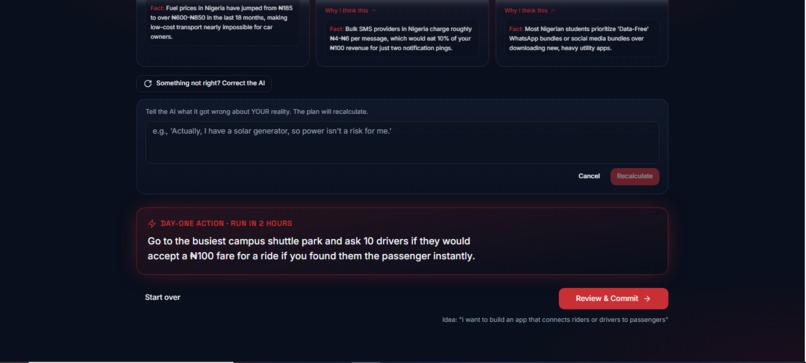
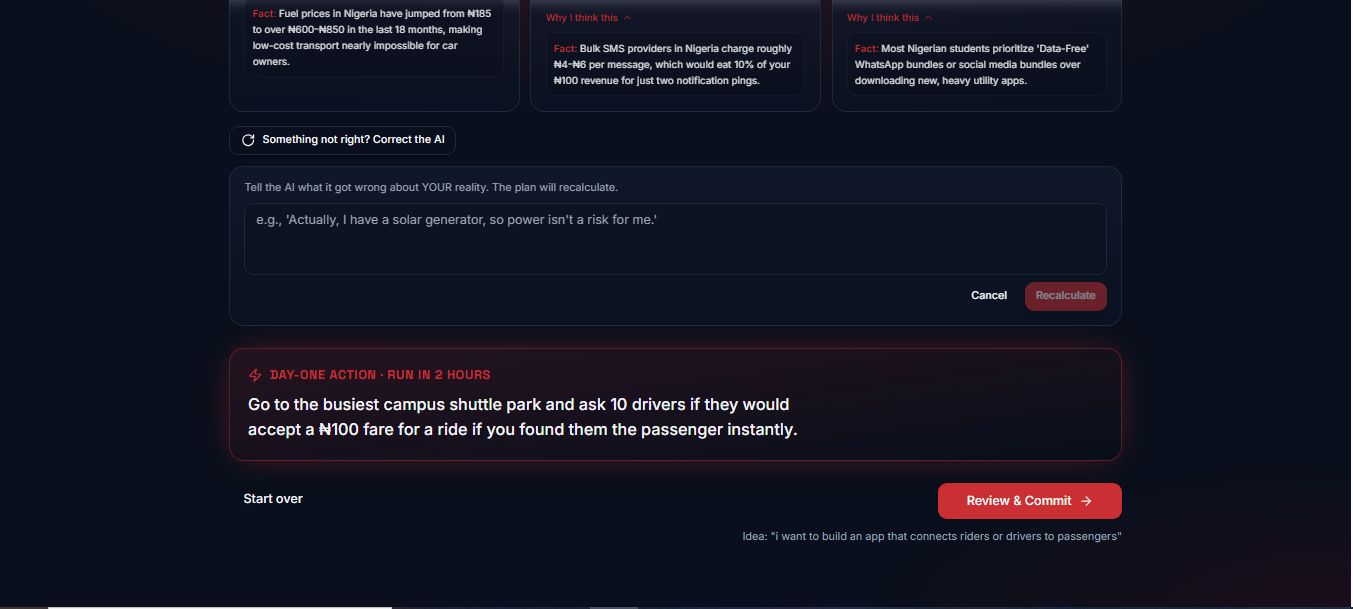
correct the AI box
-
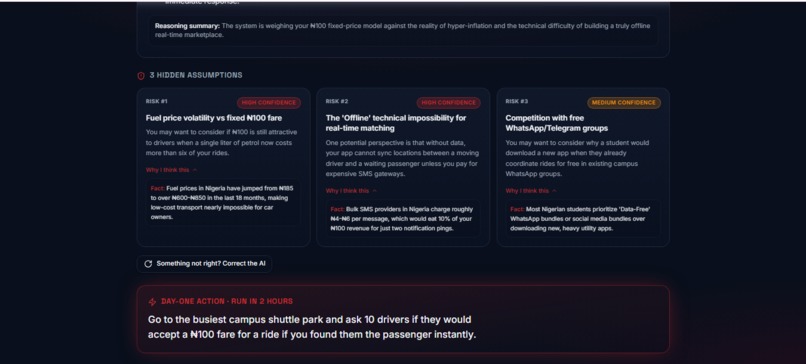
AI output
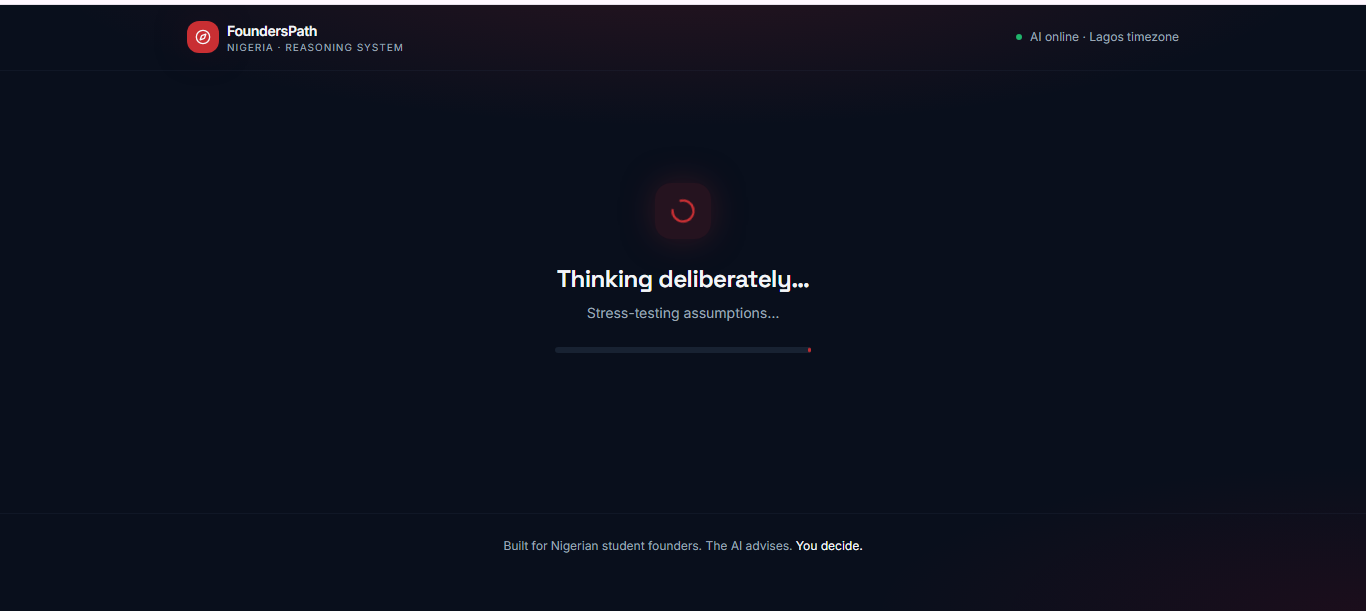
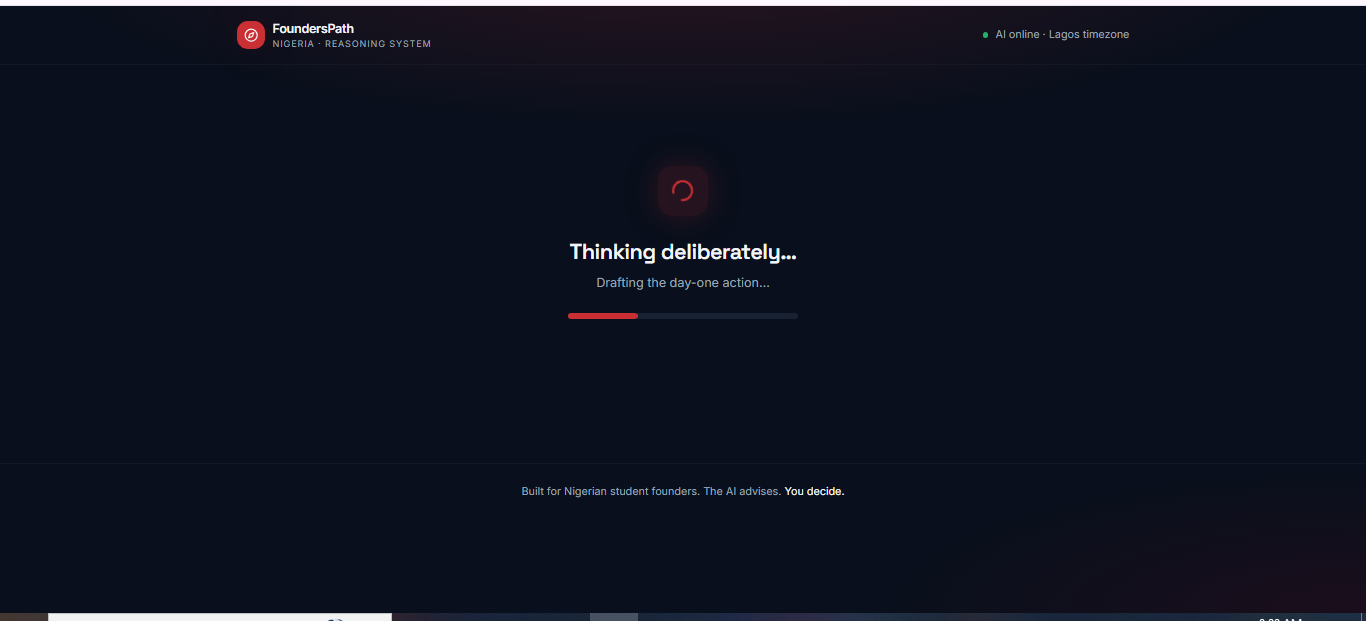
Inspiration
Nigerian university students have startup ideas. They don't have mentors.
In Lagos, Abuja, Ibadan across the country thousands of students are sitting on business ideas with no way to validate them. They can't afford accelerators. They don't know investors. They have no senior founder to call and say, "Is this idea crazy?"
So they do one of two things:
- Build blindly. They waste months and money building the wrong thing because they didn't stress-test their assumptions against Nigerian market reality (fuel costs, data prices, power reliability, trust patterns).
- Give up. They convince themselves the idea is too risky and never try.
FoundersPath Nigeria exists to break this cycle.
What it Does
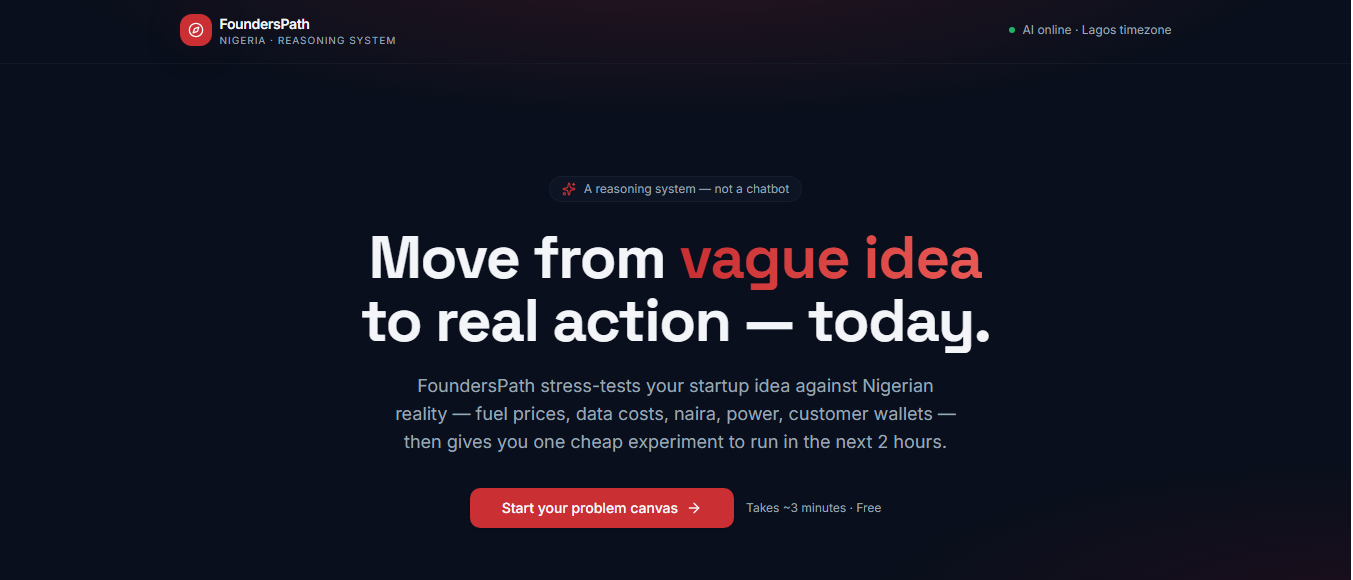
FoundersPath is an AI reasoning system not a chatbot. It guides a Nigerian student from confusion to action in under 10 minutes.
The User Journey:
Step 1: The Problem Canvas The student types their vague startup idea in plain language. Example: "I want to build a tutoring app for students who can't afford private lessons."
Messy? Good. That's realistic. The AI is built to interpret messiness, not forms.
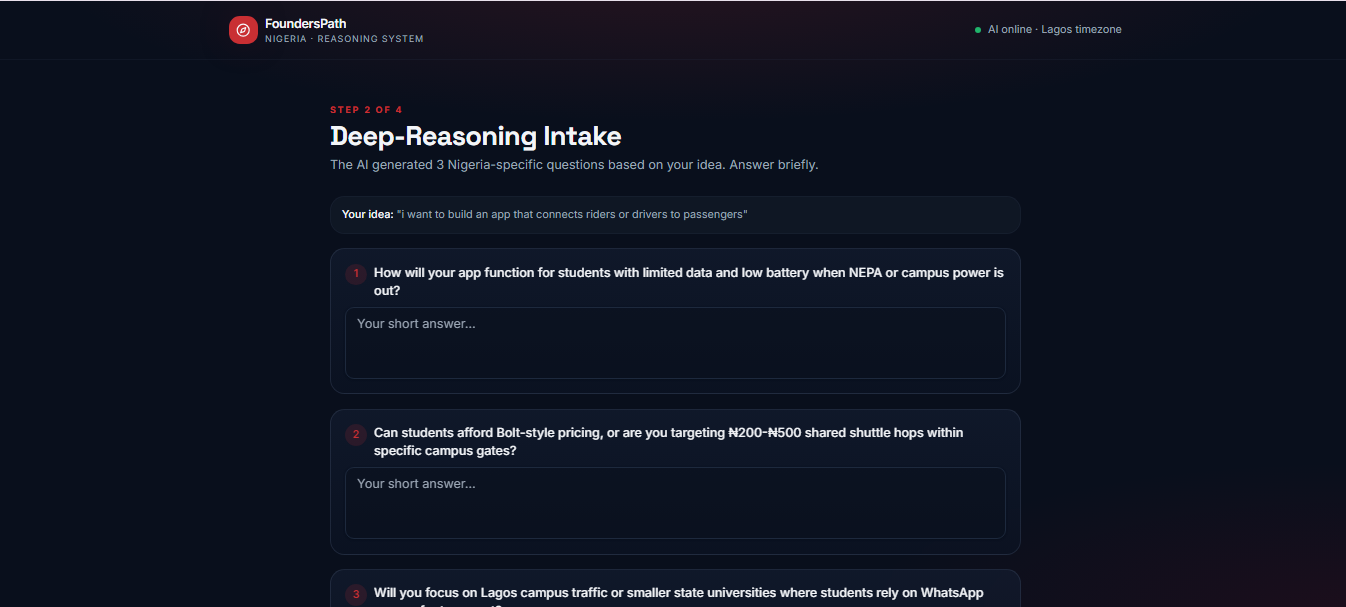
Step 2: Deep-Reasoning Intake The AI generates 3 Nigeria-specific follow-up questions tailored to the student's unique idea:
- "Will tutors work virtually or meet students in person, given high data costs and constant power outages?"
- "Can students afford ₦3,000+ per hour, or will you target wealthy parents in estates like Magodo?"
- "How will you verify tutor credentials and prevent them from bypassing your app to collect payment directly?"
These questions change based on the specific idea. This proves the AI is reasoning through the student's unique situation, not following a script.
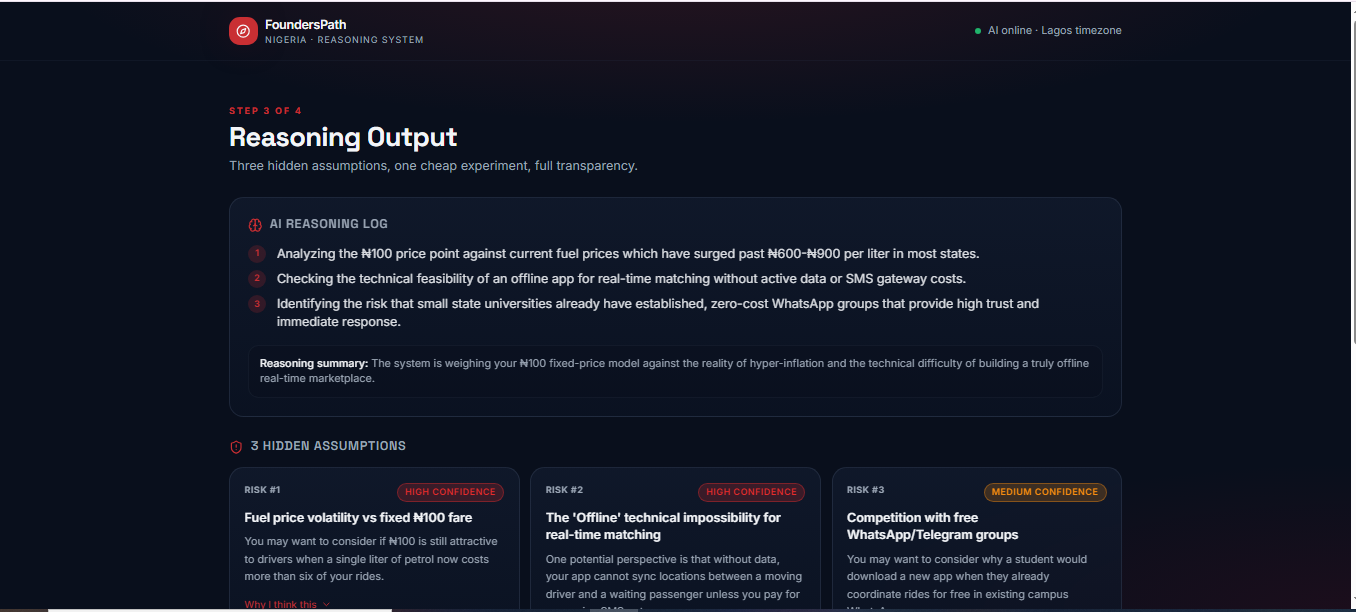
Step 3: Reasoning Output The AI performs multi-step situational reasoning:
- Analyzes how the student's answers interact with Nigerian market constraints (fuel volatility, data costs, inflation, local trust patterns)
- Identifies 3 hidden assumptions that could kill the idea specific to this market, not generic
- Generates an AI Reasoning Log showing HOW it arrived at those risks
- Assigns a confidence level (Low/Medium/High) to each risk to represent uncertainty honestly
- Includes real-world "Why I think this" facts tied to Nigeria (data cost increases, inflation rates, trust concerns)
Why this is not a spreadsheet or search engine: A spreadsheet lists "20 Common Startup Risks" (generic). A search engine returns articles about "startup validation" (generic). Only an LLM can interpret a vague, messy idea and extract the 3 risks SPECIFIC to this student's market, budget, and target customer.
Step 4: Day One Action The AI suggests one specific, cheap experiment the student can run in 2 hours:
- "Post a 'Home Tutor Available' flyer on 5 Lekki/Magodo community WhatsApp groups and ask parents if they'd pay ₦3,000/hour for virtual sessions."
This is concrete. It's testable. It's doable today without any budget.
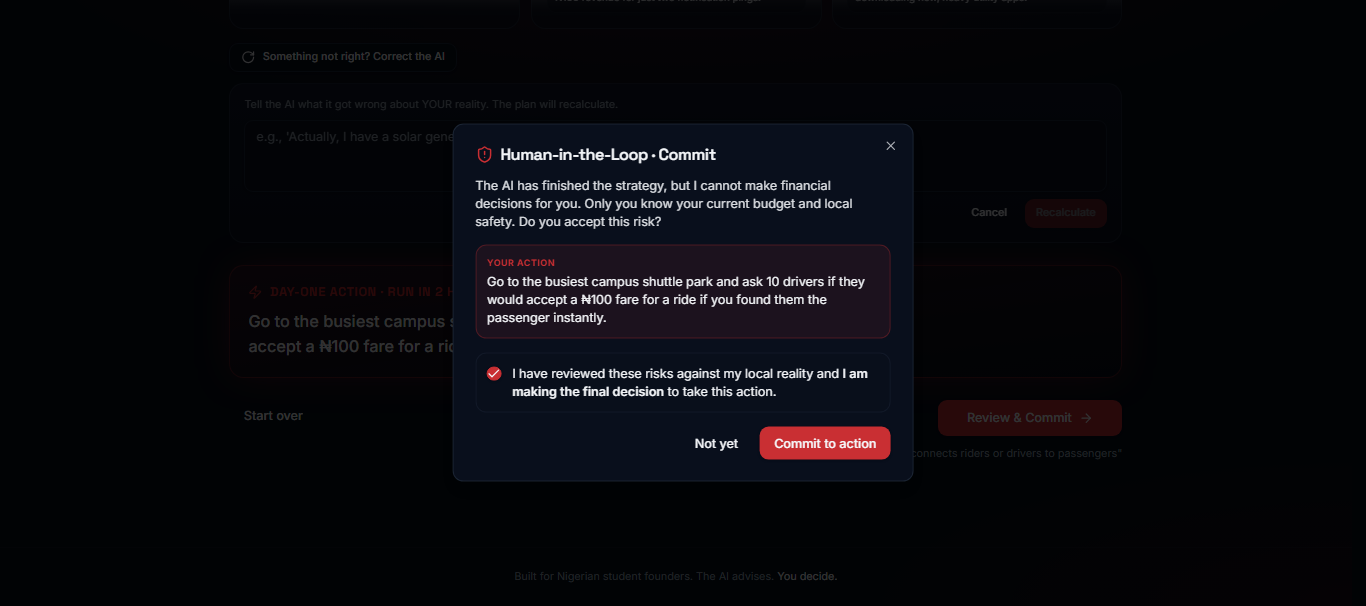
Step 5: Human-in-the-Loop Commit Before the student can commit, a modal appears where they must check a box: "I have reviewed these risks against my local reality and I am making the final decision to take this action."
The student must actively confirm. The AI cannot commit resources on behalf of the student. The human stays in control.
How We Built It
Frontend: Lovable (AI-powered web app builder)
- Built a 4-step interactive journey with dark Navy + Deep Red branding
- Integrated word counters, progress indicators, and confidence badges
- Designed the HITL confirmation modal to enforce human agency
Backend: FastAPI + OpenRouter
- POST
/generate-questionsendpoint: Takes a vague idea → returns 3 Nigeria-specific questions - POST
/analyzeendpoint: Takes idea + 3 answers → returns reasoning log + 3 risks + day one action
AI Model: Claude via OpenRouter
- Prompted to reason through Nigerian market constraints (fuel, data, inflation, trust)
- Configured to generate explanations (Reasoning Log) showing its thought process
- Set to use uncertainty framing ("You may want to consider..." not "This is the answer")
Challenges We Ran Into
Challenge 1: Making the Questions Dynamic Static questions don't prove AI reasoning. We solved this by prompting the AI to analyze the vague idea and generate 3 unique questions per idea. Each iteration tests something different about the student's situation.
Challenge 2: Representing Uncertainty Honestly Overconfident AI is dangerous. We built in confidence levels (Low/Medium/High), uncertainty language ("You may want to consider..."), a reasoning log showing assumptions, and a feedback loop so students can correct the AI.
Challenge 3: Proving Why AI is Needed The hardest part: "Why can't a form do this?" We realized: A form asks the same 3 questions to everyone. Our AI generates 3 UNIQUE questions per person. That difference is everything.
Accomplishments That We're Proud Of
Dynamic Question Generation — Proved that an LLM can interpret a vague, messy startup idea and ask contextual follow-up questions. This is not a rules engine. This is reasoning.
Explainable AI (Reasoning Log) — Built transparency into the output. Users see HOW the AI arrived at risks, not just WHAT the risks are. This builds trust and allows correction.
Situated Thinking — Hard-coded Nigerian market constraints (fuel prices, data costs, inflation, trust patterns) so advice is grounded in local reality, not generic Silicon Valley assumptions.
Human-in-the-Loop Architecture — The confirmation modal isn't just a legal waiver. It's a moment of active reflection where the student confirms they've thought through risks against their local reality.
From Confusion to Action in 10 Minutes — A student can move from "I have a vague idea" to "I have a grounded experiment to run today" without a mentor, investor, or accelerator.
What We Learned
Specificity beats generality. A tool for "Nigerian students" beats a tool for "students." A question about "data costs in Lagos" beats "What's your market?"
Explainability is trust. When users see the AI's reasoning ("The system is weighing..."), they trust the output more and spot errors so they can correct the AI.
Human-in-the-loop isn't just a checkbox. The modal confirmation forces active reflection. It ensures the student remains the decision-maker.
Reasoning > Content Generation. The difference between a chatbot ("Here are 10 tips for startups") and our tool ("Here's why YOUR specific idea might fail in YOUR specific market") is multi-step situational interpretation.
What's Next for FoundersPath
Expand to Other African Markets — Adapt the reasoning engine for Kenya, Ghana, South Africa (different constraints, different risks).
Add Historical Tracking — Let students track their journey: idea → assumptions → day one action → results → next iteration.
Mentor Matching — Once a student validates their first assumption, connect them with a relevant mentor or investor.
Market Data Integration — Use RAG (Retrieval-Augmented Generation) to ground the AI in real-time Nigerian market data (current fuel prices, inflation, data costs).
Community Learning — Build a repository where students can learn from others' validated (or invalidated) assumptions.


Log in or sign up for Devpost to join the conversation.