Inspiration
Ideas are cheap to have but expensive to start. Founders with a network can ask a mentor whether an idea is any good, get a developer friend to scope the MVP, or join an incubator that tells them what to do in week one. Most first-time founders, including most students around us, have none of that, so good ideas stay in Notes apps.
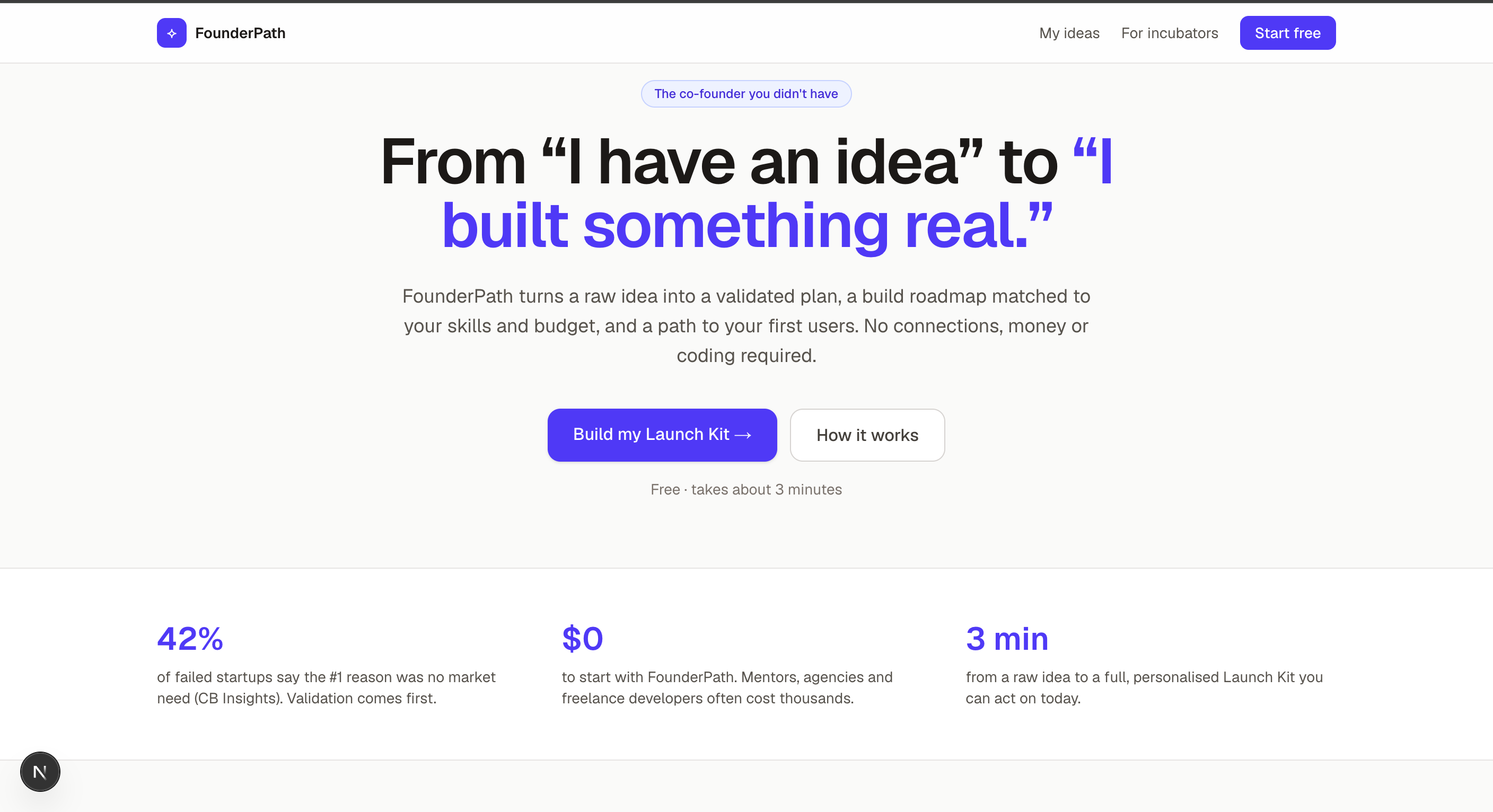
According to CB Insights, 42% of startups fail because there was no market need. Founders build first and talk to customers later. What's missing isn't motivation. It's an experienced co-founder who says "talk to 10 bakers before you write any code, and here's what to ask them."
So I built that co-founder, and made it free to start.
What it does
FounderPath takes a founder from "I have an idea" to a concrete plan in about three minutes.
- Describe the idea and yourself. You enter your skill level (no-code, some code, developer), hours per week, budget ($0, under $100, under $1,000) and goal (side project, startup, school project).
- Answer 4 sharp follow-up questions. The AI asks the questions that would most change the plan: who exactly has this problem, how they solve it today, what your unfair advantage is.
- Get your Launch Kit. It includes:
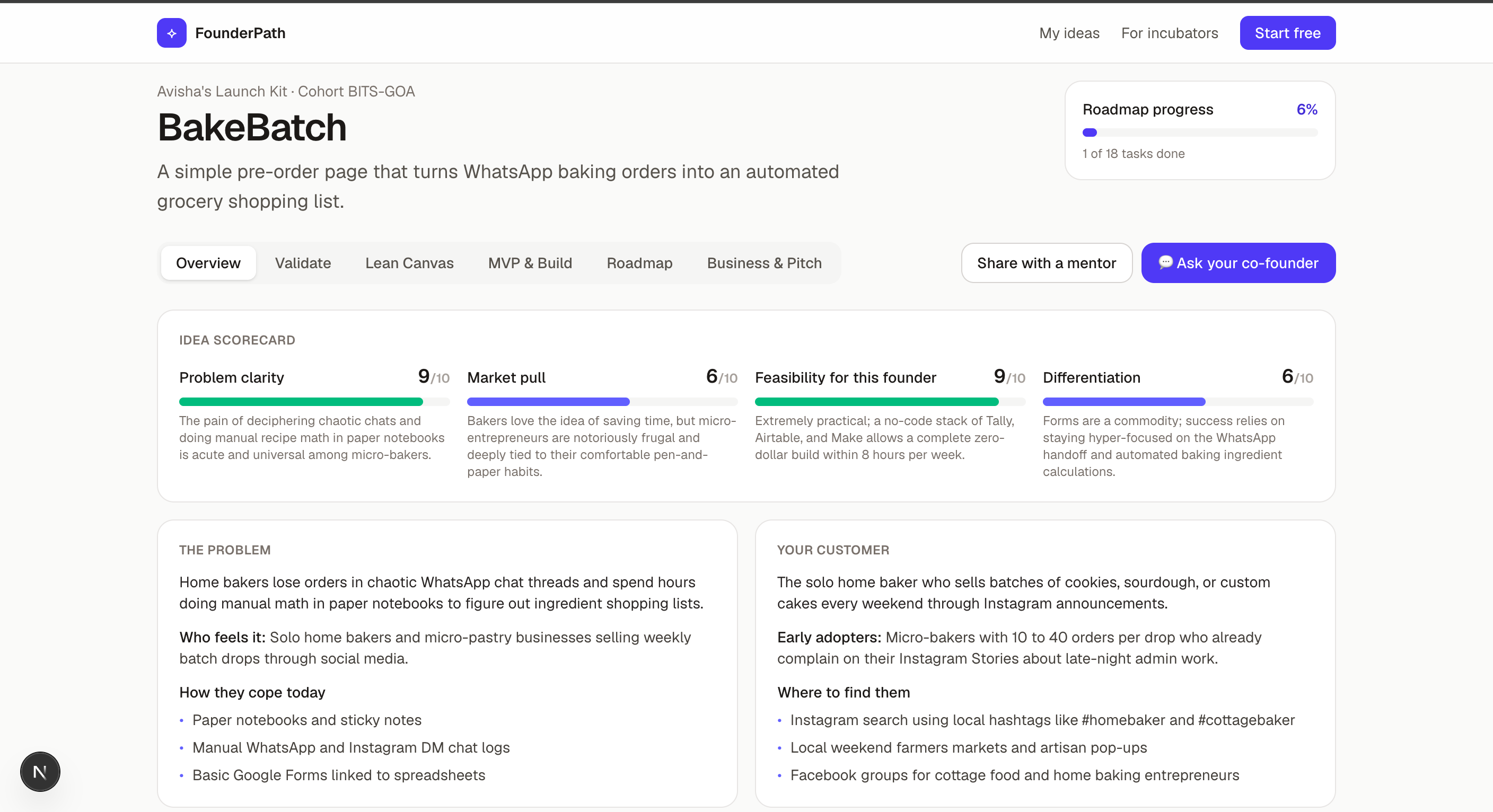
- Idea scorecard: honest 1–10 scores for problem clarity, market pull, feasibility for you and differentiation
- Real competitors and the gap each one leaves
- Lean Canvas
- MVP scope: must-haves, what to cut, and a success metric
- Build plan: named tools with real prices, matched to your skill and budget. A no-code founder gets Softr and Airtable; a developer gets Next.js and Supabase.
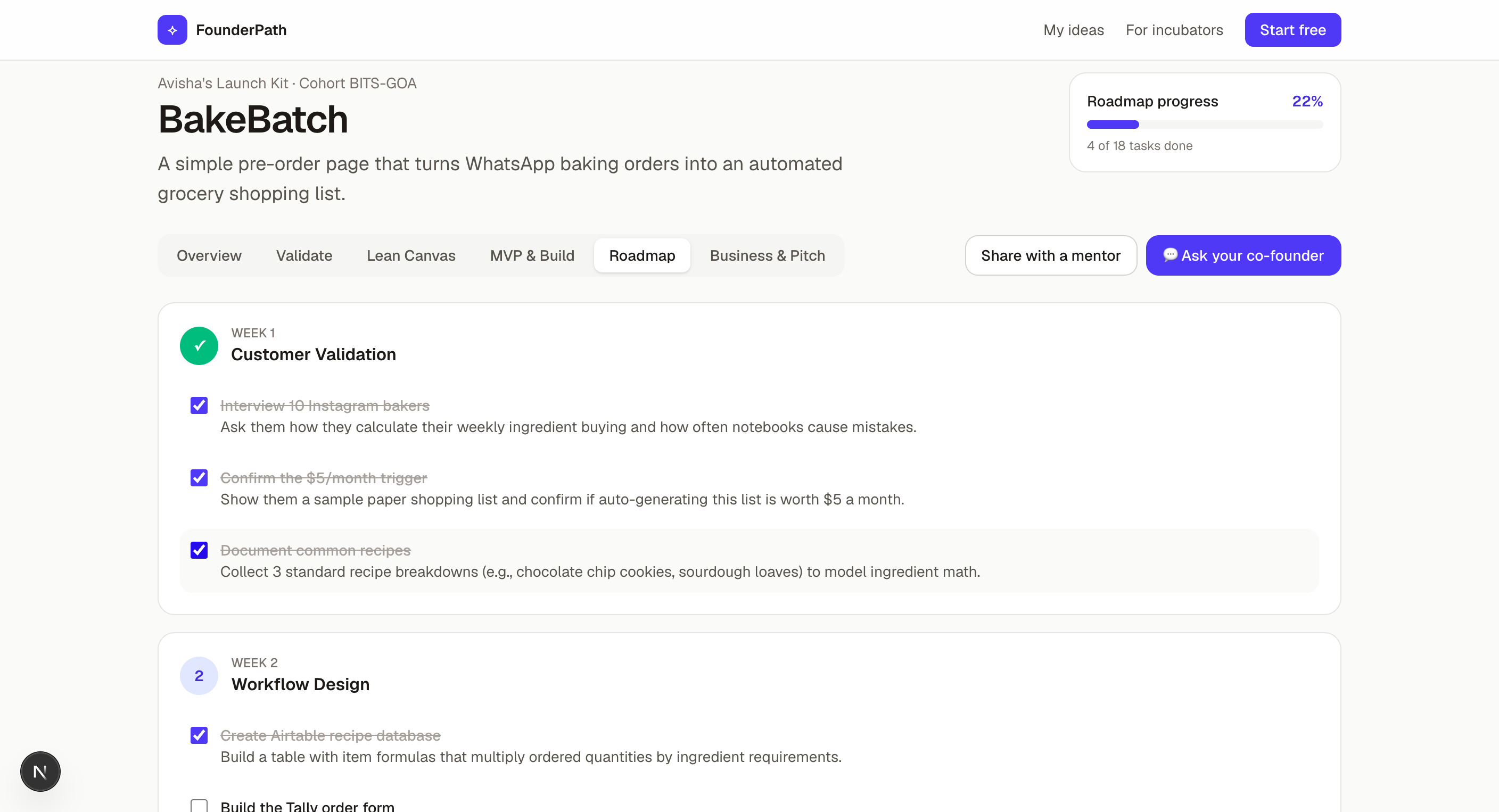
- 6-week roadmap, starting with customer validation, with tasks you tick off as you go
- Validation kit: the riskiest assumption, interview questions, a cheap experiment and a clear go/no-go signal
- Business model, first-10-customers plan and elevator pitch
- Risks with mitigations
- Keep going with a co-founder chat. The chat knows your plan and progress. Ask it to write your customer-outreach DM or landing-page copy, or what to do this week.
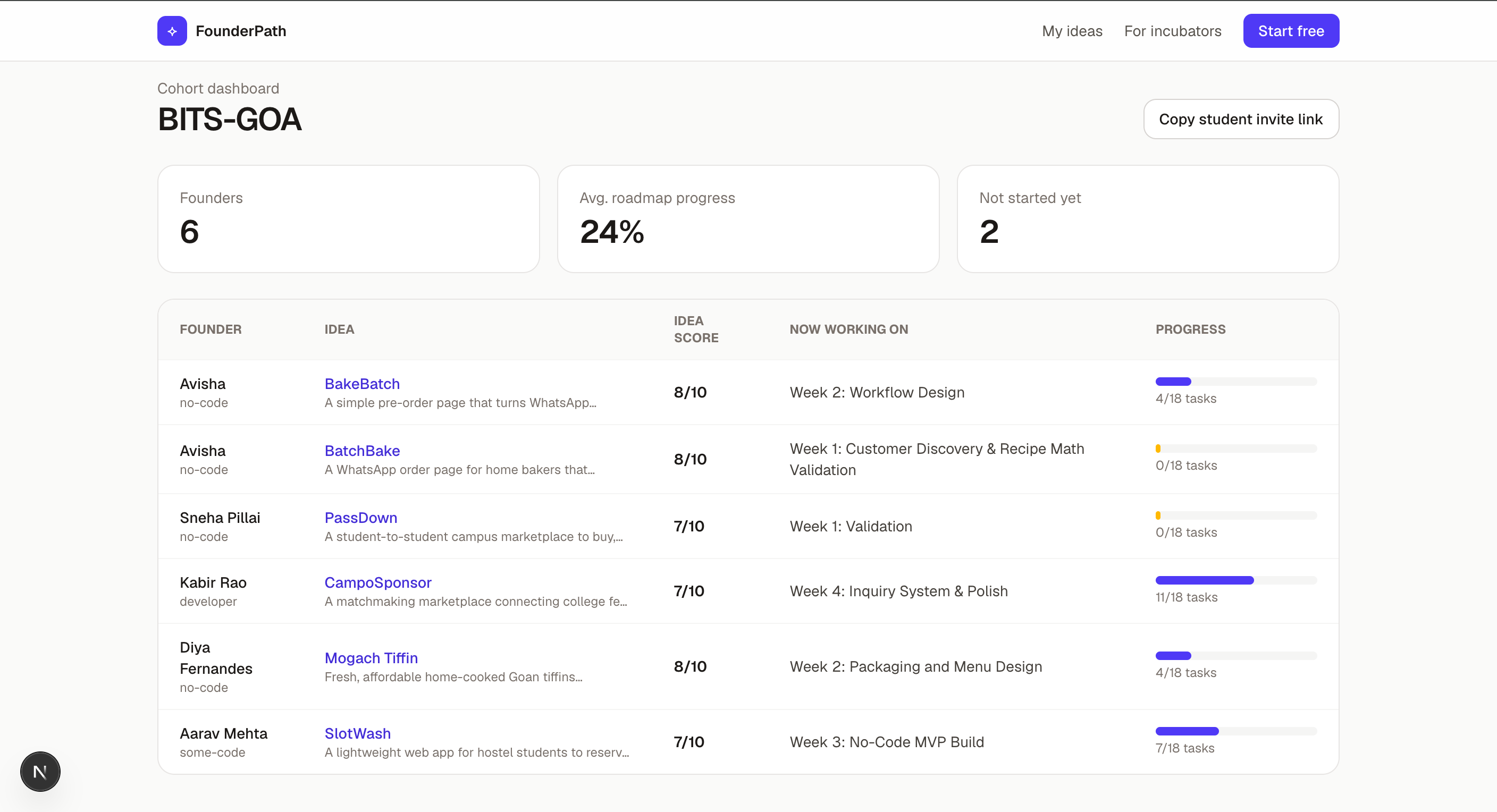
- Cohort dashboard for schools and incubators. Founders who join with a cohort code (e.g.
BITS-GOA) appear on a mentor dashboard showing each idea's score, current week and roadmap progress, so mentors can see who's stuck.
How I built it
- Next.js 16 (App Router), React 19, Tailwind CSS 4 for the app and API routes.
- Structured AI output validated with Zod. One Zod schema (
KitSchema) defines the whole Launch Kit. It's sent to the model as a JSON schema, so the model must return exactly that shape, and the response is validated again before it's saved. The UI never parses free text. - Provider-agnostic AI layer. Prompts live in one file (
ai.ts), and each provider is a thin adapter. FounderPath runs on Google Gemini's free tier (Flash, falling back to Flash-Lite) and has a Claude adapter with prompt caching. Switching is one environment variable, so I haven't locked into one vendor's pricing. - Personalisation by constraint. Skill, hours and budget are injected into every prompt, and the model is told that every recommendation must be doable by this founder.
- Streaming chat. Replies stream token by token. History is capped at 20 turns, so cost per message stays flat.
- SQLite via
node:sqlite. Zero-config storage, isolated in a singledb.tsfile, so moving to Postgres means swapping one module. - Demo mode. With no API key, the app generates template-based kits, so anyone can clone the repo and run the full flow.
Challenges I ran into
- Free-tier reliability. Gemini's free model sometimes returns 503 "high demand" or 429 rate-limit errors. I added automatic retries with backoff, a fallback to a lighter model, and a friendly message instead of a stack trace.
- Generation time. A full Launch Kit is a big, structured response that takes 1–3 minutes on the free tier. I made the wait visible with progress steps and asked the model for concise, bullet-sized fields.
- Getting specific, not generic, advice. Generic AI advice is easy to get anywhere. To make plans concrete, the prompt includes the founder's constraints and their answers to the follow-up questions, and requires real named competitors, tools with prices, and honest (not inflated) scores.
- Keeping the schema compatible with two providers. Each model accepts a slightly different JSON-schema dialect, so I convert the single Zod schema per provider.
Accomplishments that I'm proud of
- In real testing, an idea for a tool helping home bakers manage orders produced a kit named "BakeQueue" with real competitors (Castiron, Hotplate, WhatsApp Business), free no-code tools, and a week-1 plan whose first step is talking to bakers, not building.
- The whole product runs at $0: free AI tier, SQLite, and a demo mode that needs no key at all.
- The cohort dashboard gives FounderPath a B2B business model, not just a consumer app.
What I learned
- Structured outputs plus schema validation turn an LLM from a chatbot into a reliable product component.
- The most valuable thing an AI mentor can do is tell founders to validate before they build.
- Designing for free-tier limits (retries, fallbacks, honest wait times) matters as much as prompt quality.
What's next for FounderPath
- Real accounts (today an anonymous browser ID owns each idea) and Postgres (Supabase/Neon) for hosting at scale.
- A job queue for kit generation, so long generations survive page reloads and spikes in traffic.
- Weekly check-ins: the co-founder nudges you on this week's roadmap tasks.
- Exports to PDF and Notion, and pitch-deck generation.
- Campus pilots, starting with entrepreneurship cells and incubators.
Business model:
| Plan | Price | For |
|---|---|---|
| Free | $0 | 1 idea, full Launch Kit, limited chat |
| Pro | $9/month | Unlimited ideas and chat, exports, weekly check-ins |
| Campus | $499/year per cohort | Schools, incubators and hackathons: mentor dashboard, unlimited students |
Campus licences are the main revenue engine. One sale brings in dozens of students, who then become the free-to-Pro funnel. AI cost per kit is a few cents at most, so margins stay high.
Built With
- claude
- google-gemini
- next.js
- node.js
- react
- sqlite
- tailwindcss
- typescript
- zod

Log in or sign up for Devpost to join the conversation.