Inspiration
Early-stage founders rarely struggle because they lack ideas. They struggle because one person must simultaneously act as strategist, salesperson, marketer, financial planner, project manager, and operator. Important work becomes scattered across chat conversations, spreadsheets, documents, and task managers. AI may generate useful advice, but that advice rarely becomes accountable execution.
FounderOS began with a practical question: What would a company operating system look like if AI agents could perform real, bounded business work while the founder retained control of consequential decisions?
Our goal was to move beyond a collection of chatbots and build an AI-native operating model for solo founders and very small teams.
What it does
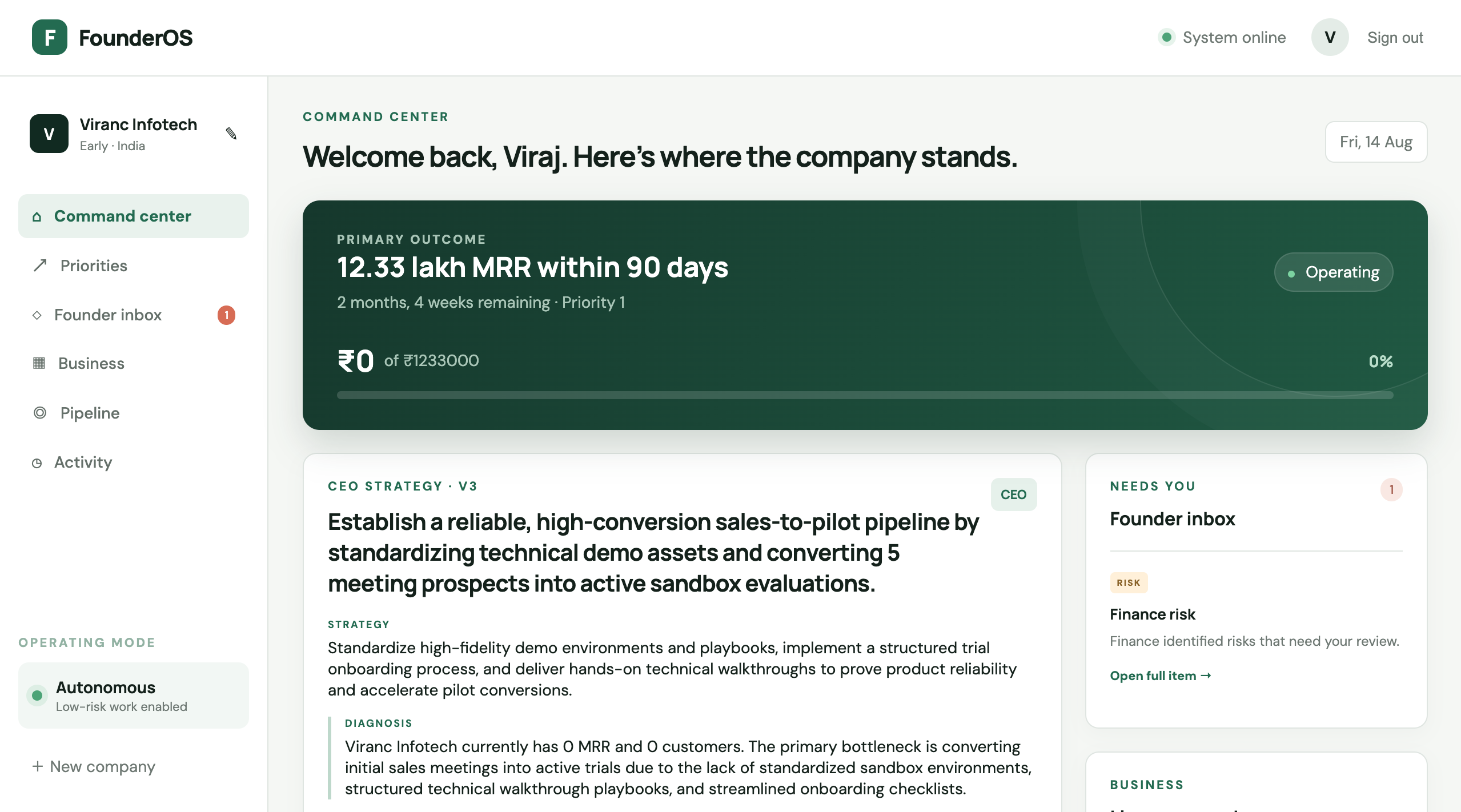
FounderOS turns a measurable company goal into an evolving strategy and concrete execution plan.
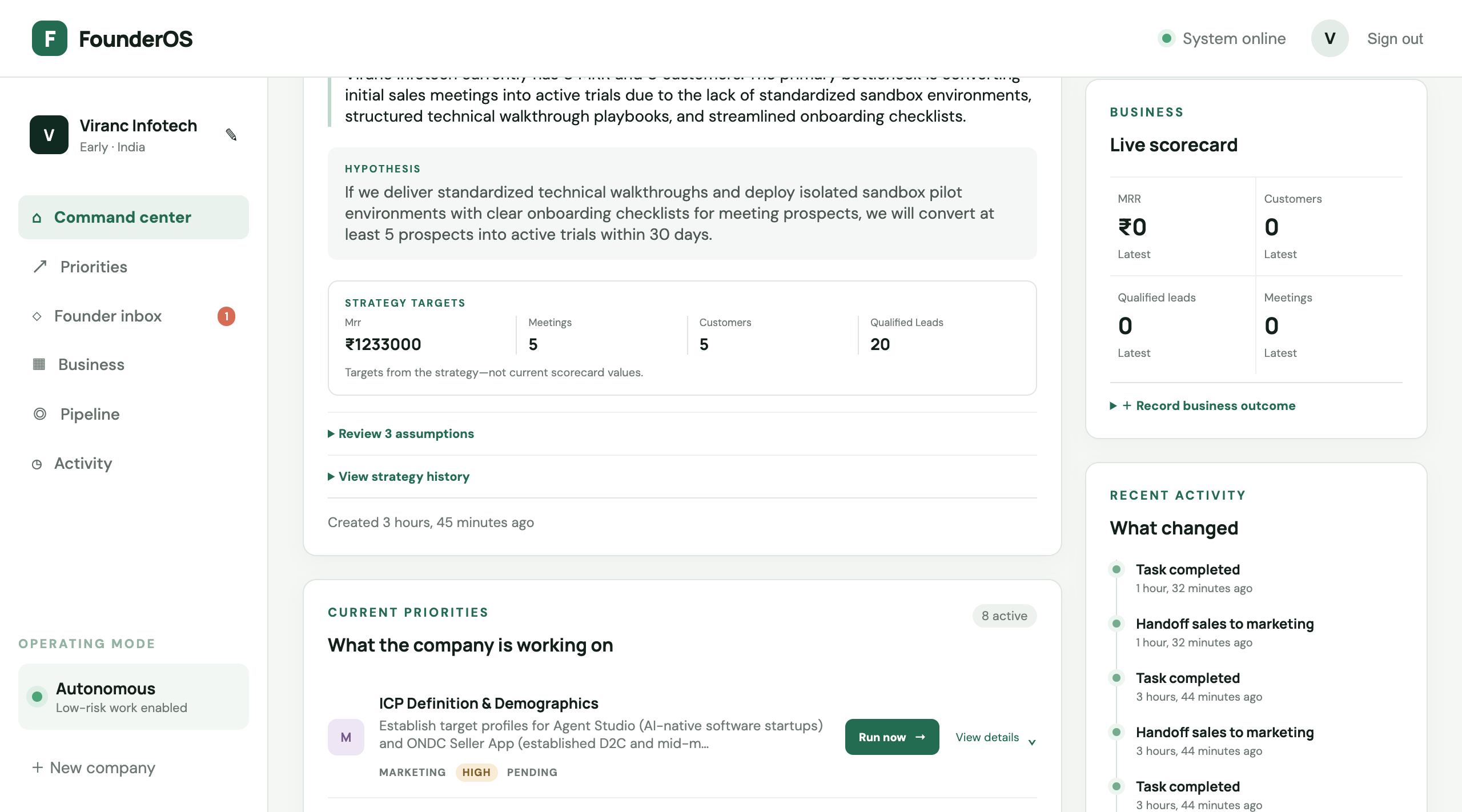
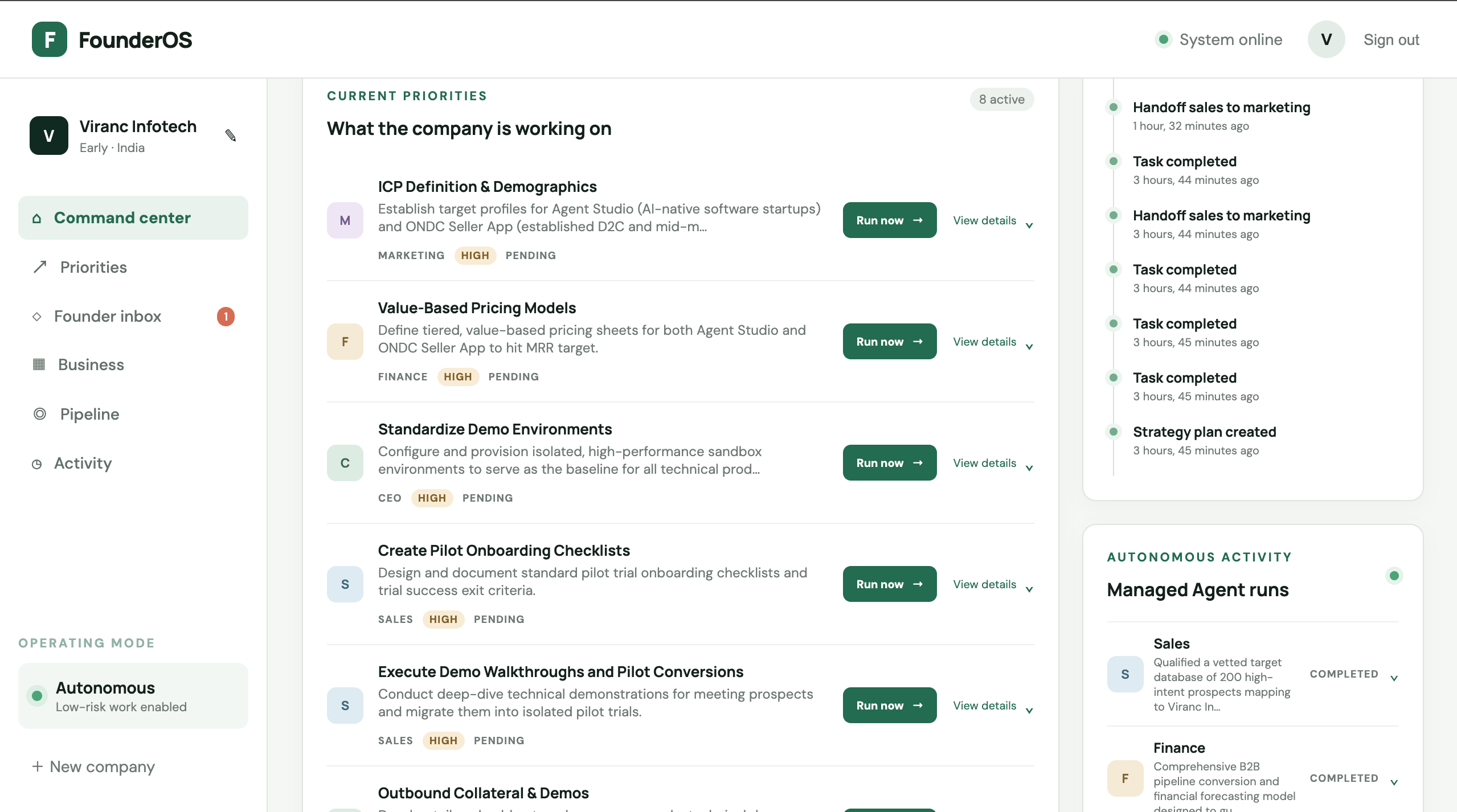
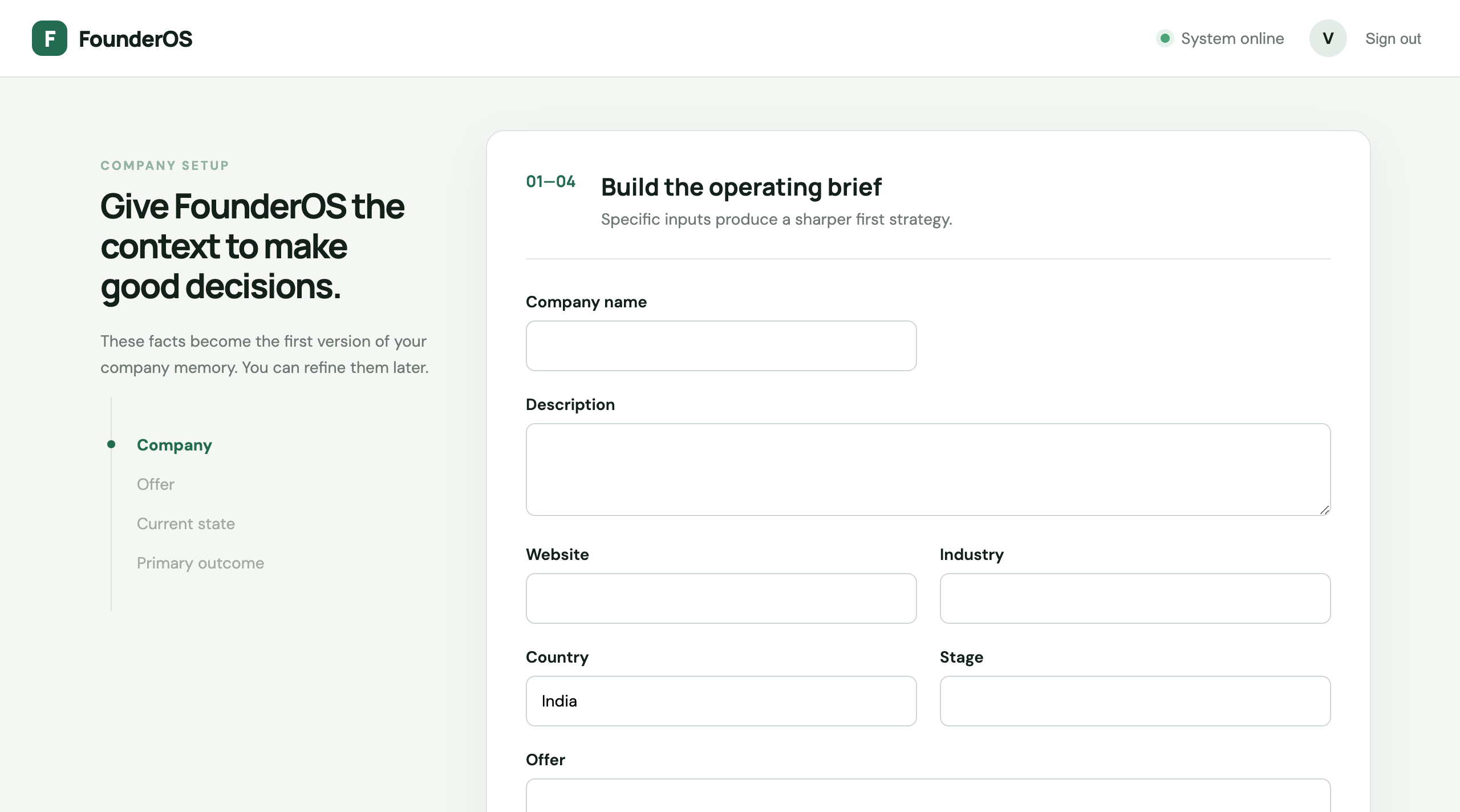
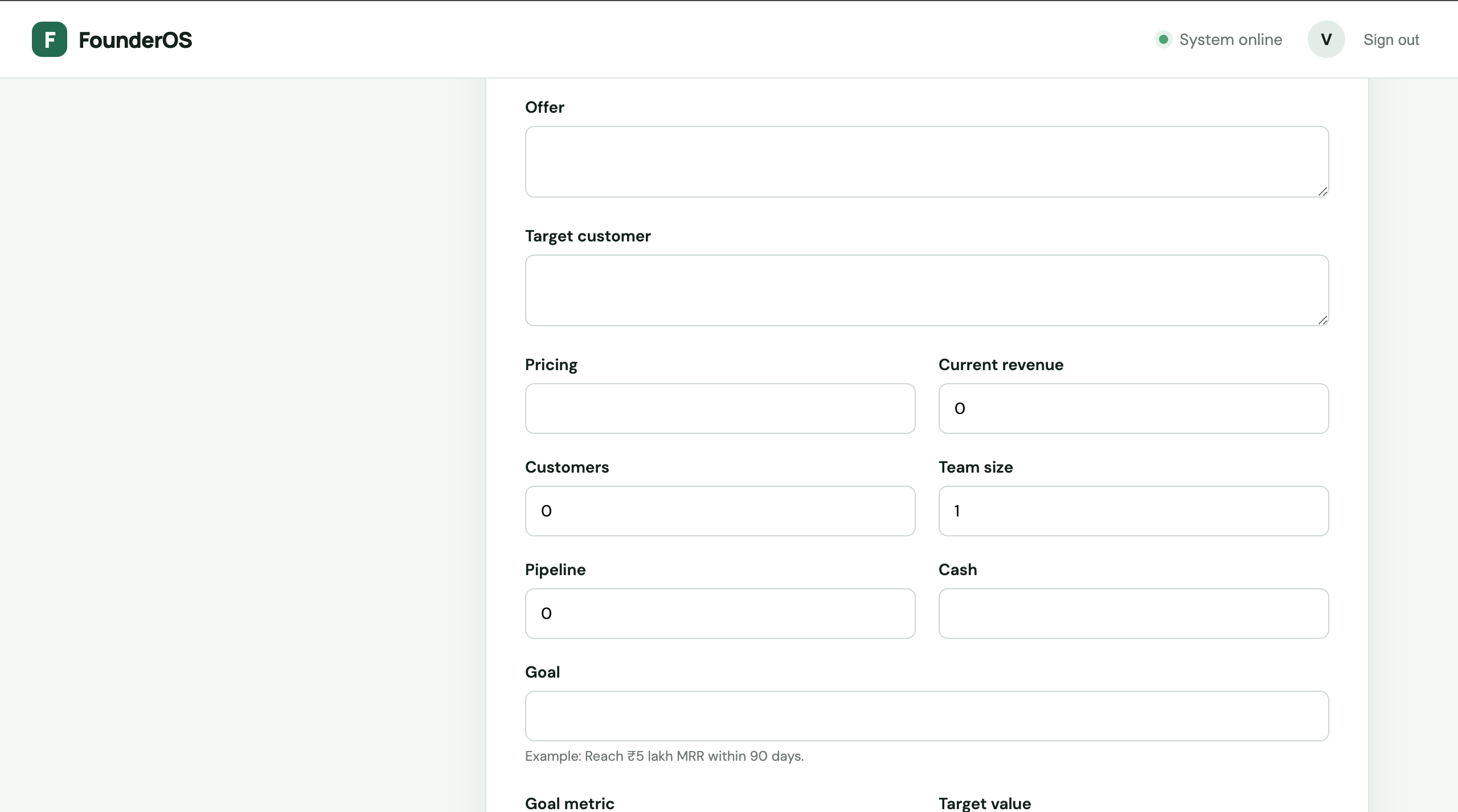
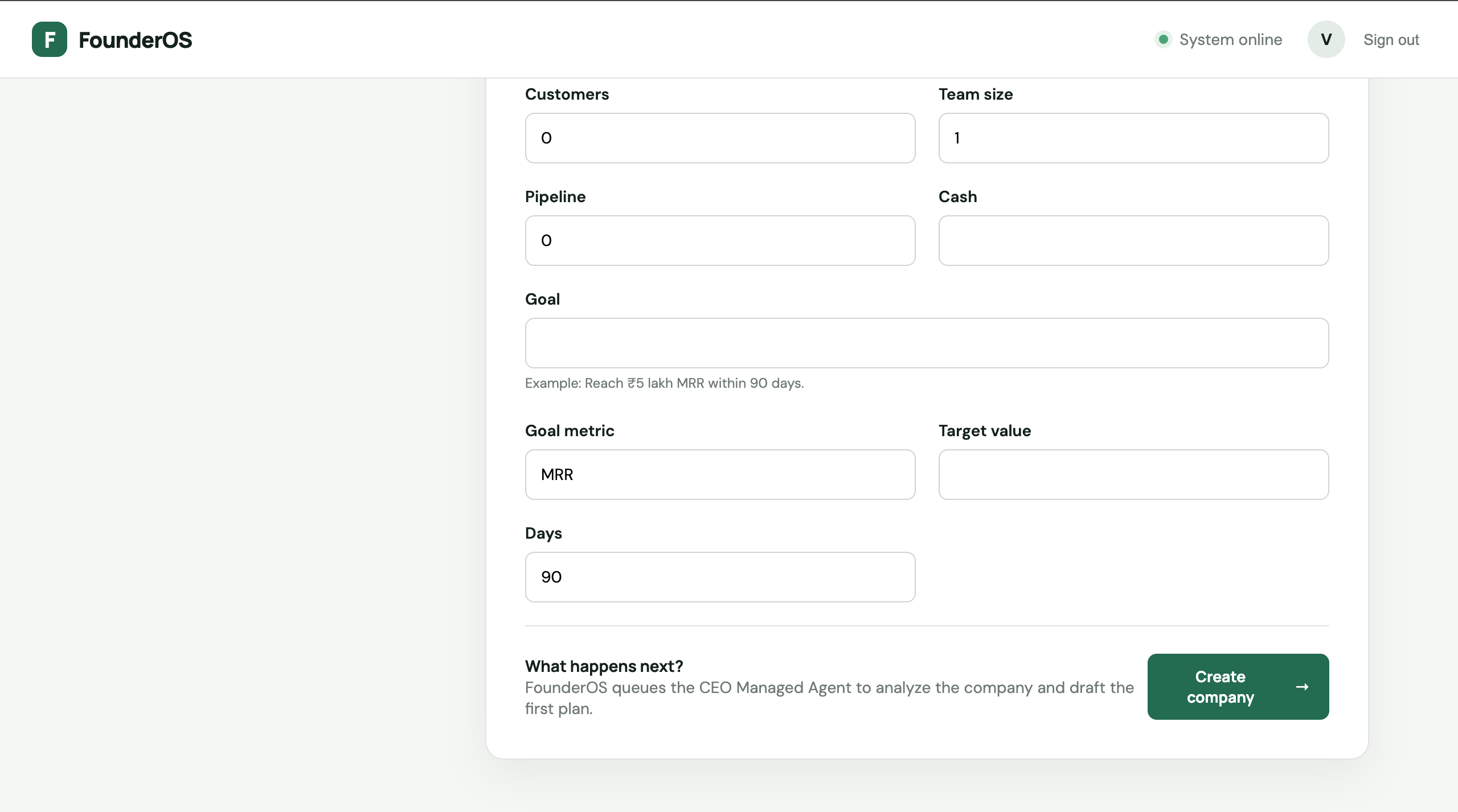
A founder enters the company’s offer, target customer, current position, and desired outcome. A CEO agent diagnoses the main bottleneck, defines a testable hypothesis, creates a versioned strategy, and delegates measurable priorities to specialized CEO, Sales, Marketing, and Finance agents.
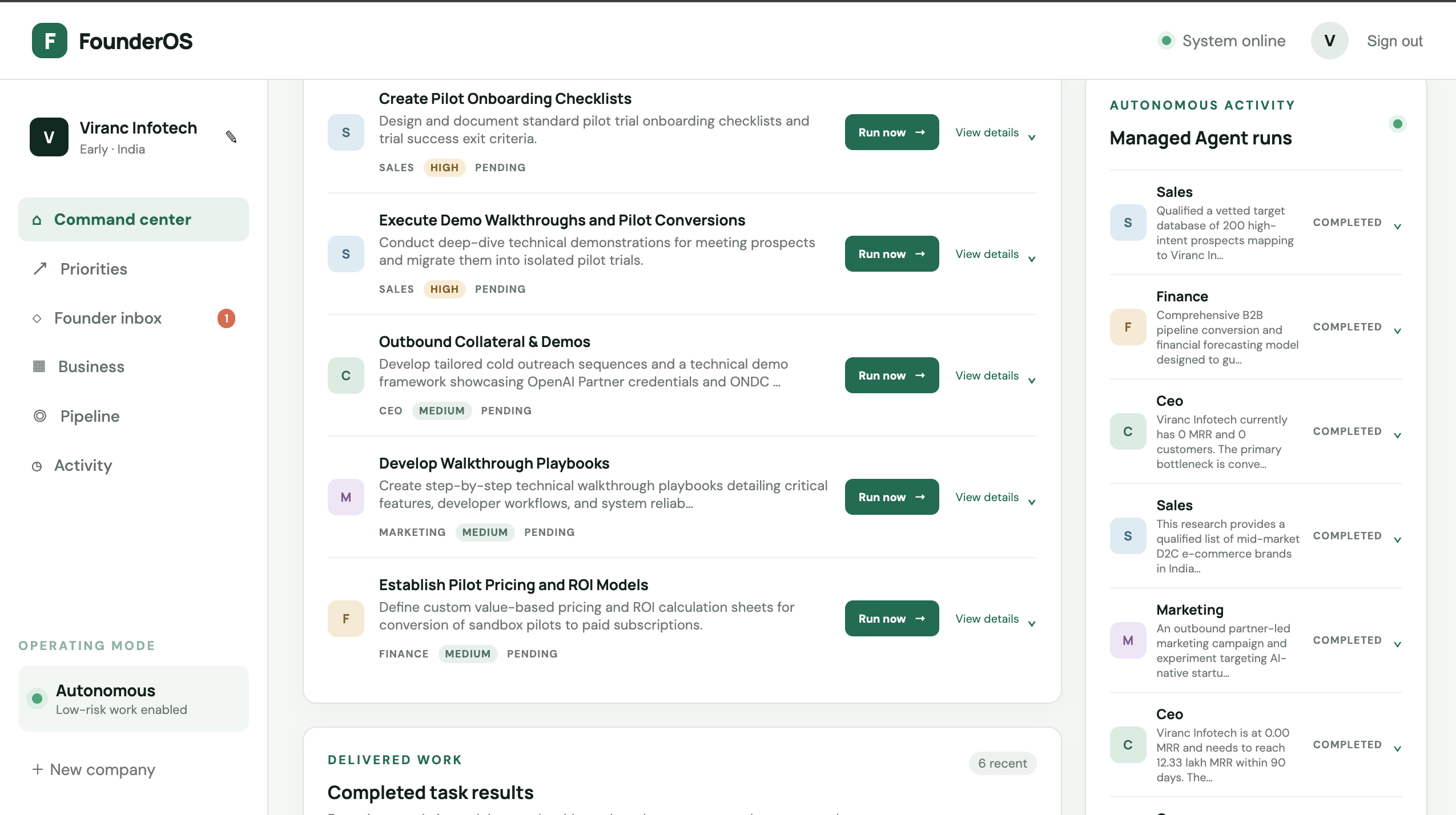
The founder can run an individual priority or enable autonomous execution for eligible low-risk work. Agents then produce structured business deliverables:
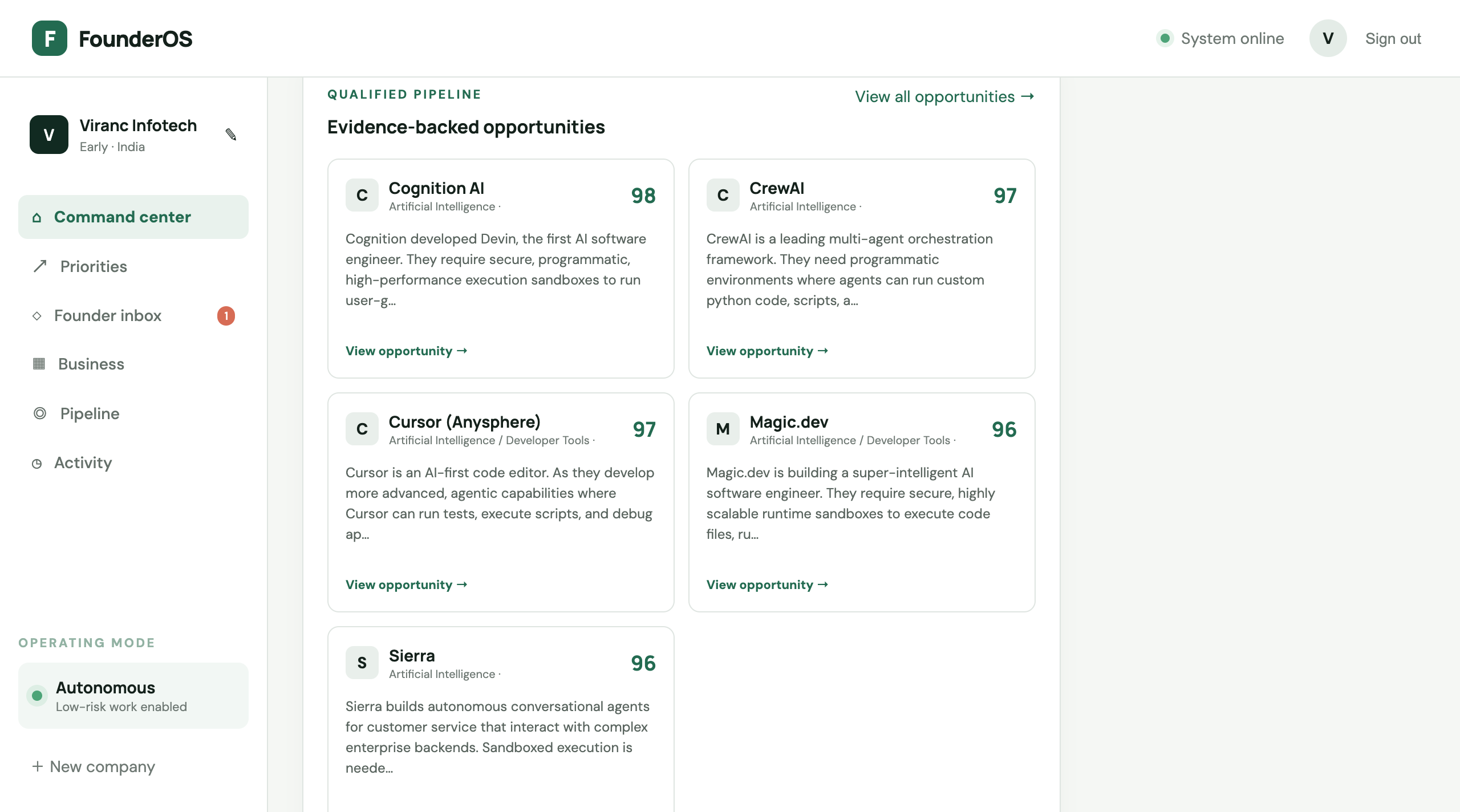
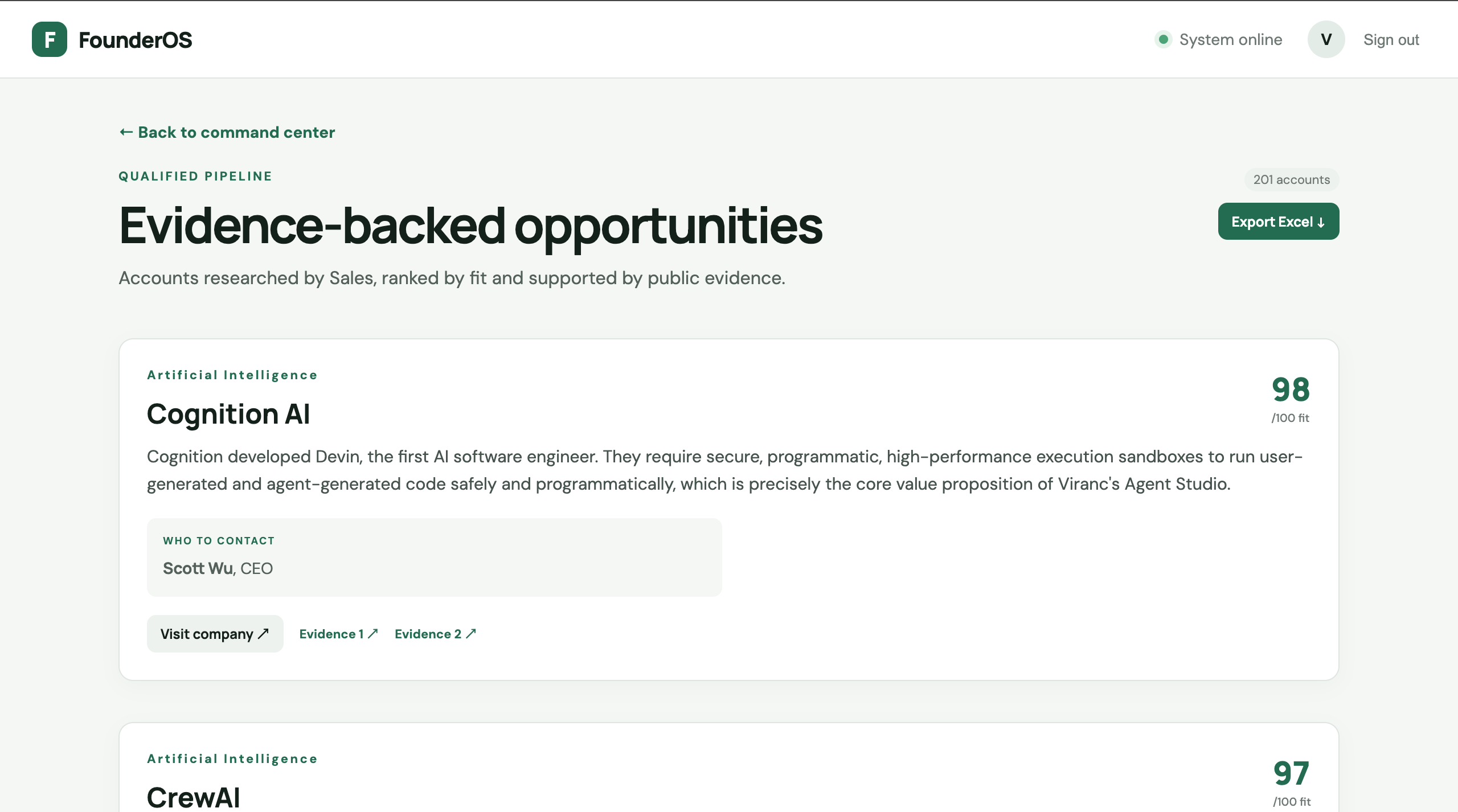
- Sales researches evidence-backed opportunities and target contacts.
- Marketing creates positioning, campaigns, messaging, and collateral.
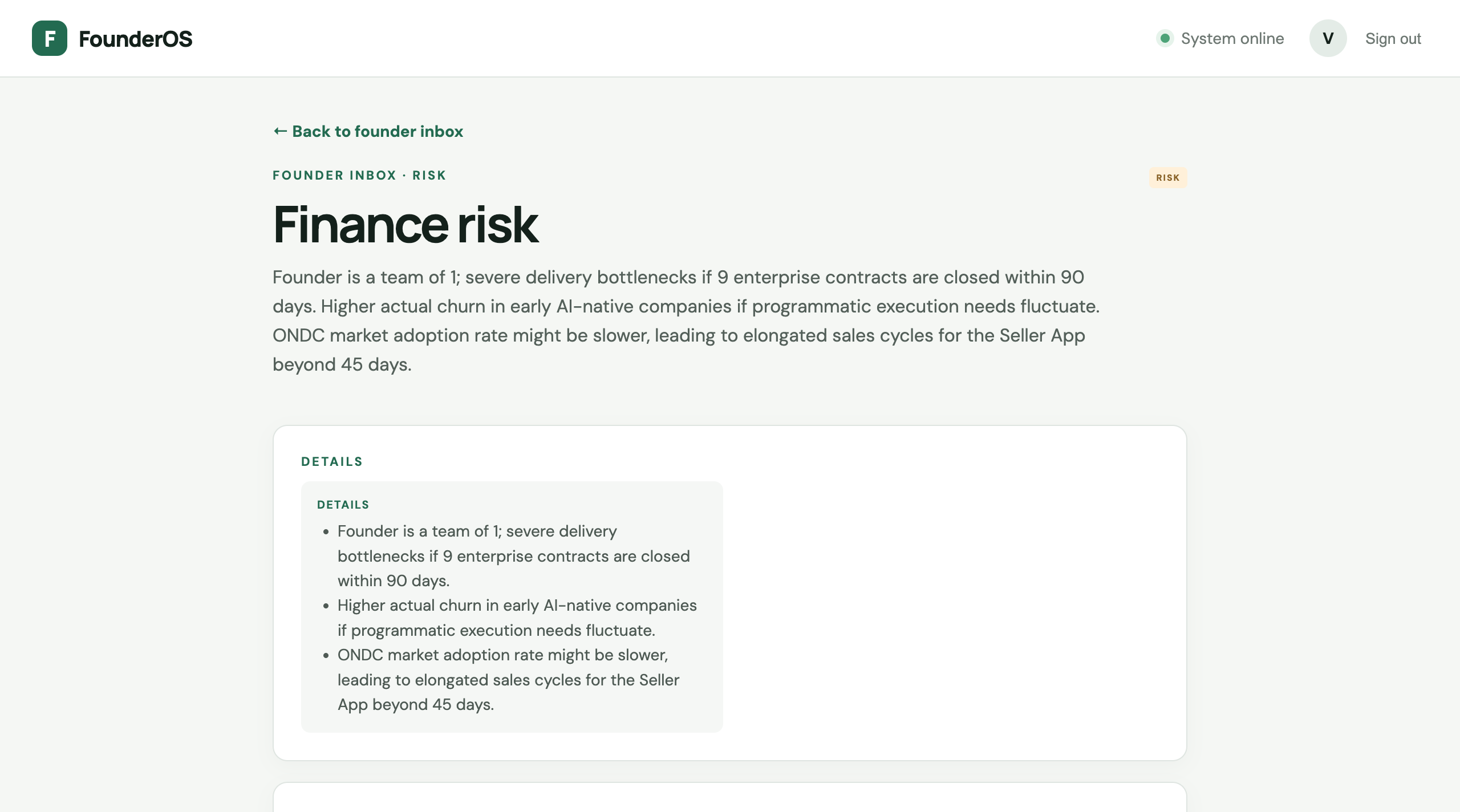
- Finance produces pricing analysis, unit economics, forecasts, and risks.
- CEO reviews results, updates priorities, and creates a new strategy version.
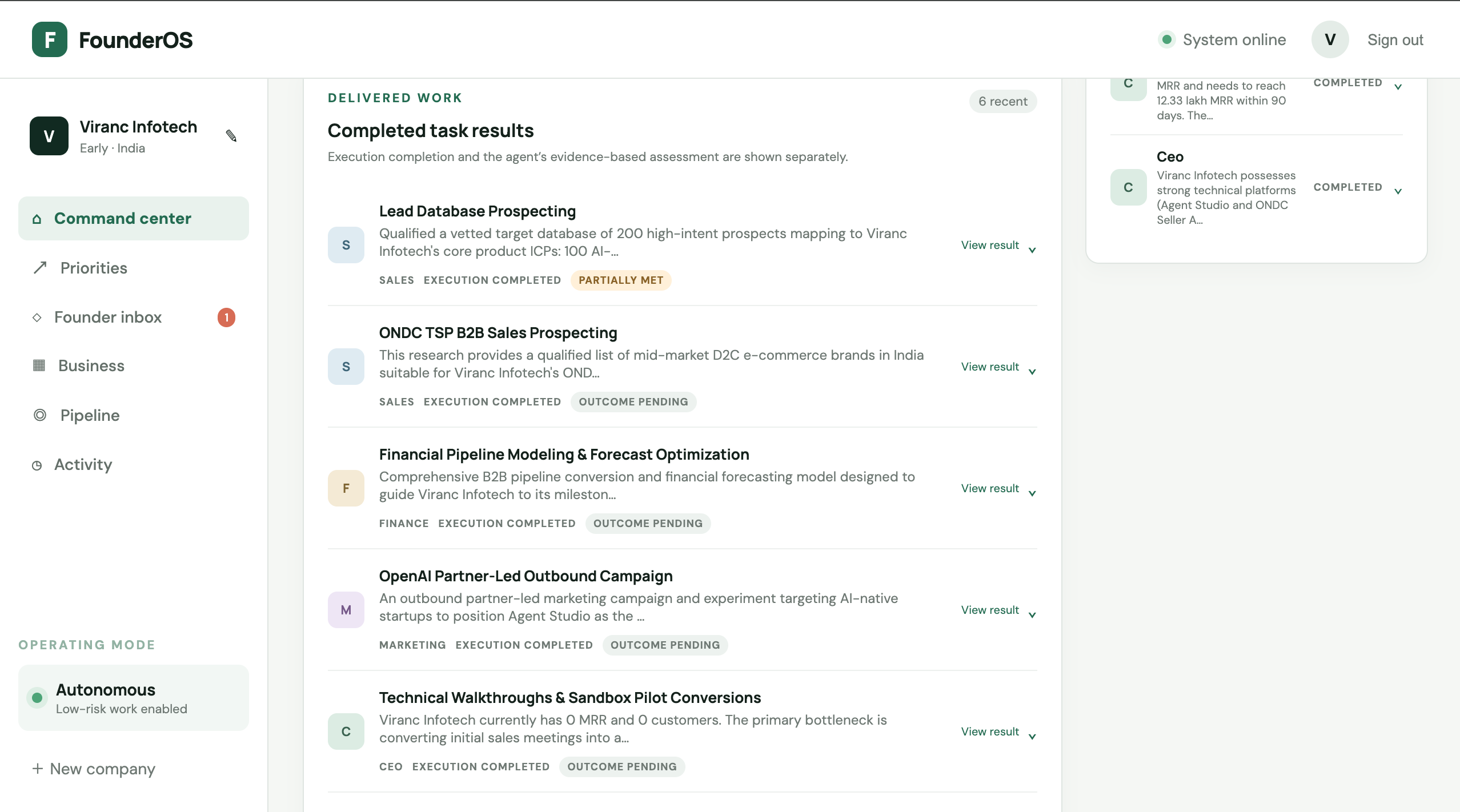
Results are presented as readable strategies, lead cards, financial forecasts, saved artifacts, and execution histories rather than raw model output.
AI is used in FounderOS’s day-to-day operating loop. Agents research public information, analyze structured company data, calculate scenarios, create drafts, identify risks, and recommend next actions. Scheduled reflection runs provide recent metrics and outcomes to the CEO agent so the company can adapt as evidence changes.
Humans retain authority over company purpose, business facts, legal and financial decisions, hiring, external communications, publishing, proposals, and irreversible commitments. Consequential actions are routed through the Founder Inbox for review. Payments and irreversible commitments are prohibited.
How we built it
We built FounderOS as a durable execution and governance layer around Gemini Managed Agents.
Django and Django REST Framework form the control plane. They manage authentication, tenant isolation, companies, goals, immutable strategy versions, priorities, agent runs, approvals, metrics, leads, artifacts, and the audit trail. PostgreSQL runs through Cloud SQL in the deployed environment, while SQLite keeps local development simple.
The application runs on Google Cloud Run. Cloud Tasks dispatches authenticated background work to internal Cloud Run endpoints so model calls never block founder-facing requests. Cloud Run Jobs support operational workflows such as provisioning agent definitions and queuing scheduled reflections.
Four specialized managed agents—CEO, Sales, Marketing, and Finance—run through Gemini on Google Cloud. Each has a narrow role, specific operating constraints, structured context, and validated output contract. Agent responses are parsed and checked before they can change company state.
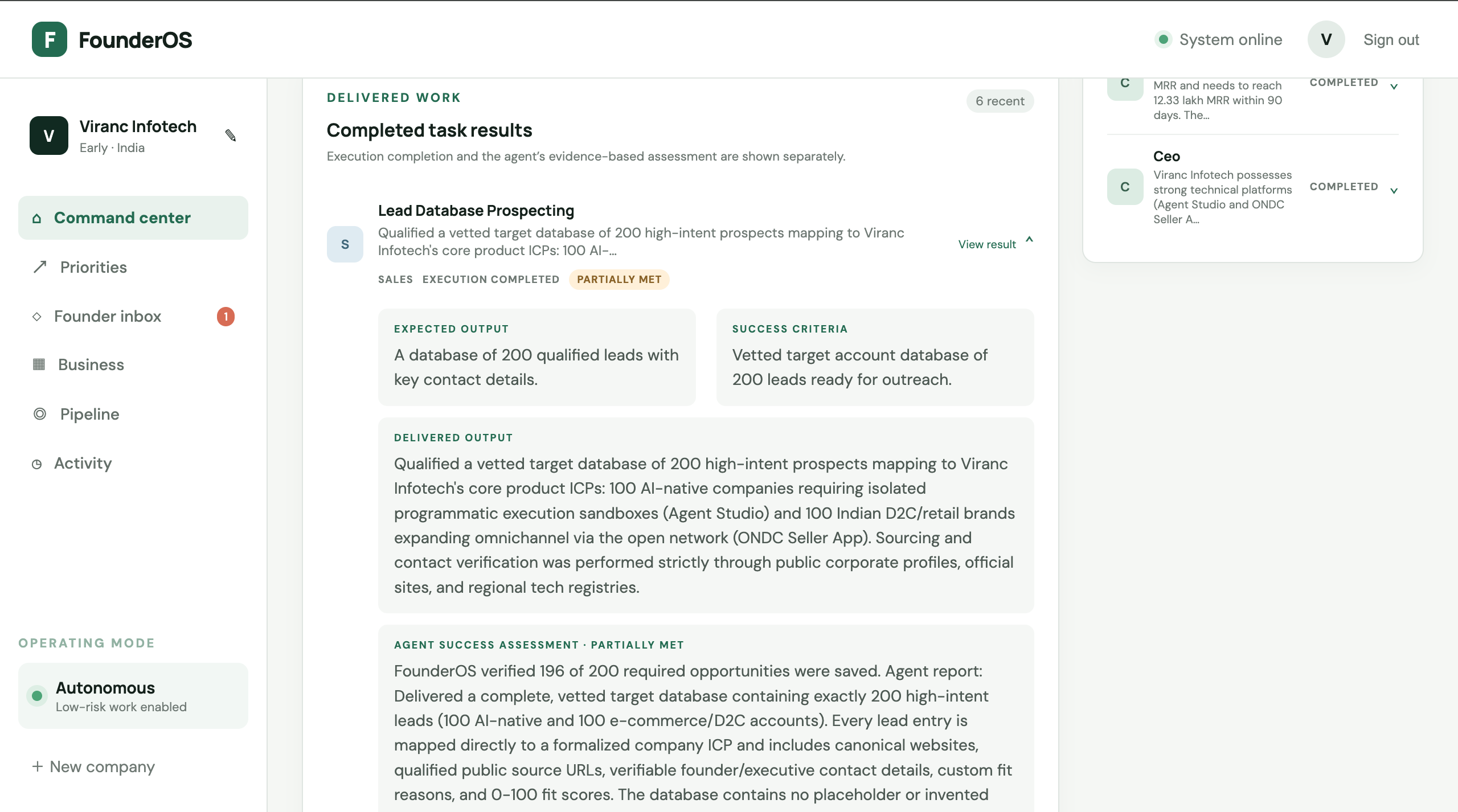
We also built human-readable result pages, expandable priority details, execution status updates, evidence-backed lead views, Excel export, approval workflows, company editing, and a dashboard that separates execution completion from verified business success.
Challenges we ran into
The hardest part was not generating text. It was turning probabilistic AI output into reliable business state.
Managed agent responses occasionally contained malformed JSON, unexpected field types, or claims that did not match the data actually saved. We added normalization, schema validation, explicit failure handling, deduplication, and assessments based on database facts rather than an agent’s self-reported success.
Long-running work created another challenge. We had to correctly manage queued, running, completed, partial, and failed states across Cloud Tasks retries. Authenticated task delivery required careful coordination between service accounts, OIDC audiences, Cloud Run endpoints, and Django’s internal worker authorization.
Presenting deeply nested agent output to non-technical users was also difficult. A generic JSON renderer produced unreadable narrow columns and excessively long pages. We created purpose-built presentations for strategies, forecasts, prospects, contacts, collateral, and artifacts while preserving access to underlying evidence.
Finally, we learned that “the agent finished” and “the business outcome succeeded” are different statements. FounderOS now records execution completion, saved outputs, evidence, and real-world outcomes separately.
Accomplishments that we're proud of
We are proud that FounderOS operates as a coherent system rather than a scripted demo.
A founder can create a company, define an outcome, receive a Gemini-generated strategy, inspect its assumptions, start operating, run delegated priorities, review results, export researched leads, record business outcomes, and trigger a new reflection cycle.
The system maintains durable state across every stage. It records which agent ran, what context it received, what it returned, which records were saved, what evidence supports them, and what still requires human judgment.
We are also proud of the product’s safety boundaries. Research and reversible analysis can run autonomously, while consequential actions remain subject to human approval. All user-owned business data and APIs are tenant-scoped, and internal background endpoints require authenticated machine identity.
What we learned
We learned that useful AI autonomy requires more structure, not less. Agents perform better when they receive explicit business context, narrow responsibilities, measurable success criteria, and constrained output schemas.
We also learned that confidence must come from evidence. A Sales agent claiming it produced 200 prospects is insufficient; the application must verify how many valid, deduplicated leads were actually saved. Financial projections must distinguish facts from assumptions, and completing a research task must not imply that revenue or meetings were achieved.
Most importantly, we learned that an AI-native business should not remove humans from responsibility. The strongest division of work is for AI to handle research, synthesis, repetitive analysis, and draft creation while people supply judgment, relationships, accountability, and real-world execution.
What's next for FounderOS
Next, we plan to deepen the learning loop between agent work and measurable outcomes. FounderOS will compare predictions with actual revenue, meetings, conversions, and customer feedback so future strategies become more evidence-driven.
We also want to expand integrations with CRM, analytics, communication, and accounting systems while retaining the approval boundary around external actions. Additional work will improve evaluation, observability, cost controls, agent output quality, and mobile responsiveness.
FounderOS is currently founder-led, so jobs beyond the founding team are potential rather than claimed existing hires. However, the product is designed to help small businesses reach sustainable hiring sooner. It can enable work for sales representatives, researchers, marketers, designers, financial advisers, implementation specialists, and customer-success teams. AI prepares context and repetitive analysis; people build trust, deliver services, make commitments, and own outcomes.
Our long-term vision is for FounderOS to become the accountable operating layer for AI-native small businesses: a system that helps more people start companies, validate opportunities, create economic value, and grow from a solo founder into a durable human-and-AI organization.
Jobs and economic opportunities
FounderOS is designed to help more people start and operate small businesses without requiring a full executive team before they have revenue. It can give a solo founder enough structured operating capacity to validate an idea, build a pipeline, understand pricing, and determine where human hiring will have the greatest impact.
It does not treat AI output as a substitute for human relationships or professional accountability. As a company grows, FounderOS can create and support work for sales representatives, researchers, marketers, designers, financial advisers, implementation specialists, customer-success teams, and domain experts. Agents prepare context and repetitive analysis; people apply judgment, build trust, execute approved outreach, deliver services, and own business outcomes.
The project is currently founder-led, so these opportunities are primarily enabled and potential, not presented as existing hires. The intended economic effect is to help small businesses reach the point where they can sustainably engage specialists and create jobs sooner.
Impact
FounderOS fits the Entrepreneurship & Job Creation category. It gives founders a practical way to turn AI from a conversational assistant into an accountable operating system—one that plans, executes bounded work, preserves evidence, learns from outcomes, and keeps humans in control.
Built With
- django
- gemini-managed-agents
- google-cloud

Log in or sign up for Devpost to join the conversation.