Inspiration
Small-business owners spend too much time handling repetitive operational work: answering customer questions, preparing quotes, negotiating discounts, generating invoices, tracking payments, and remembering follow-ups. Most AI assistants can draft a response, but the owner still has to move the business process forward manually.
FounderOps was built for the Professional Agents track of the Agents for Humans Hackathon. Its goal is simple: let an agent handle routine work in the background while involving the owner only when judgment or authorization is genuinely required.
What it does
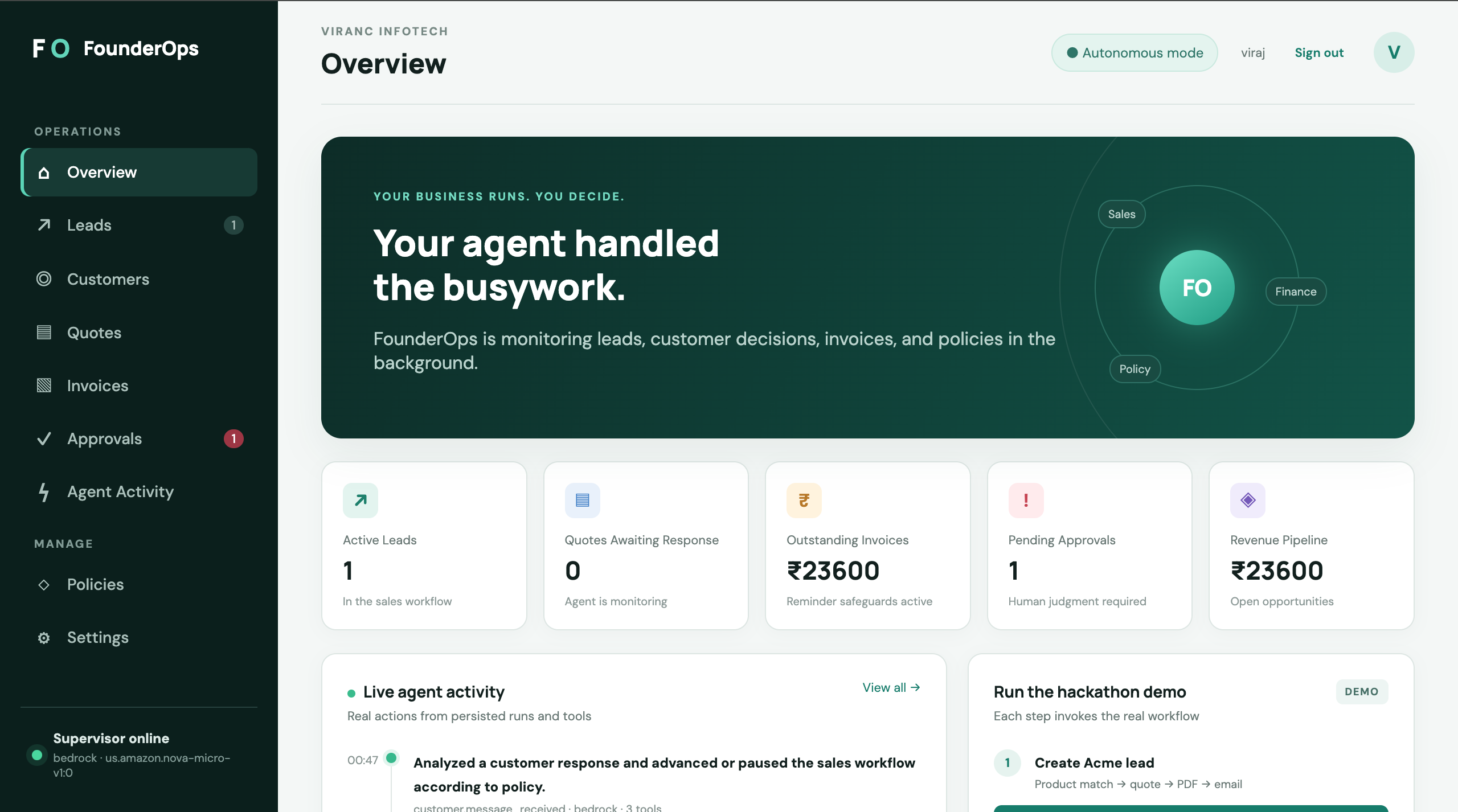
FounderOps is an AI operations supervisor that manages a customer conversation from first contact to payment.
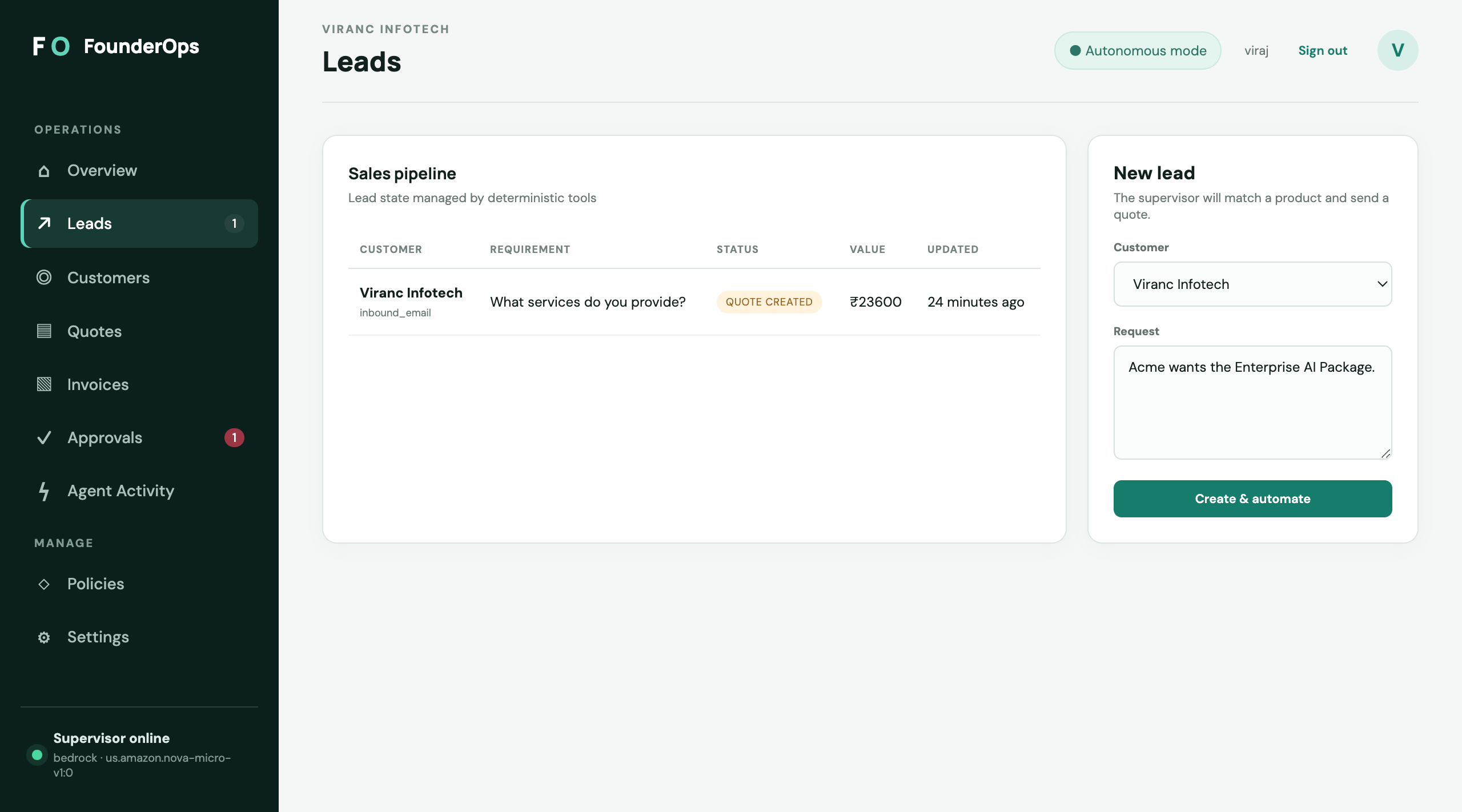
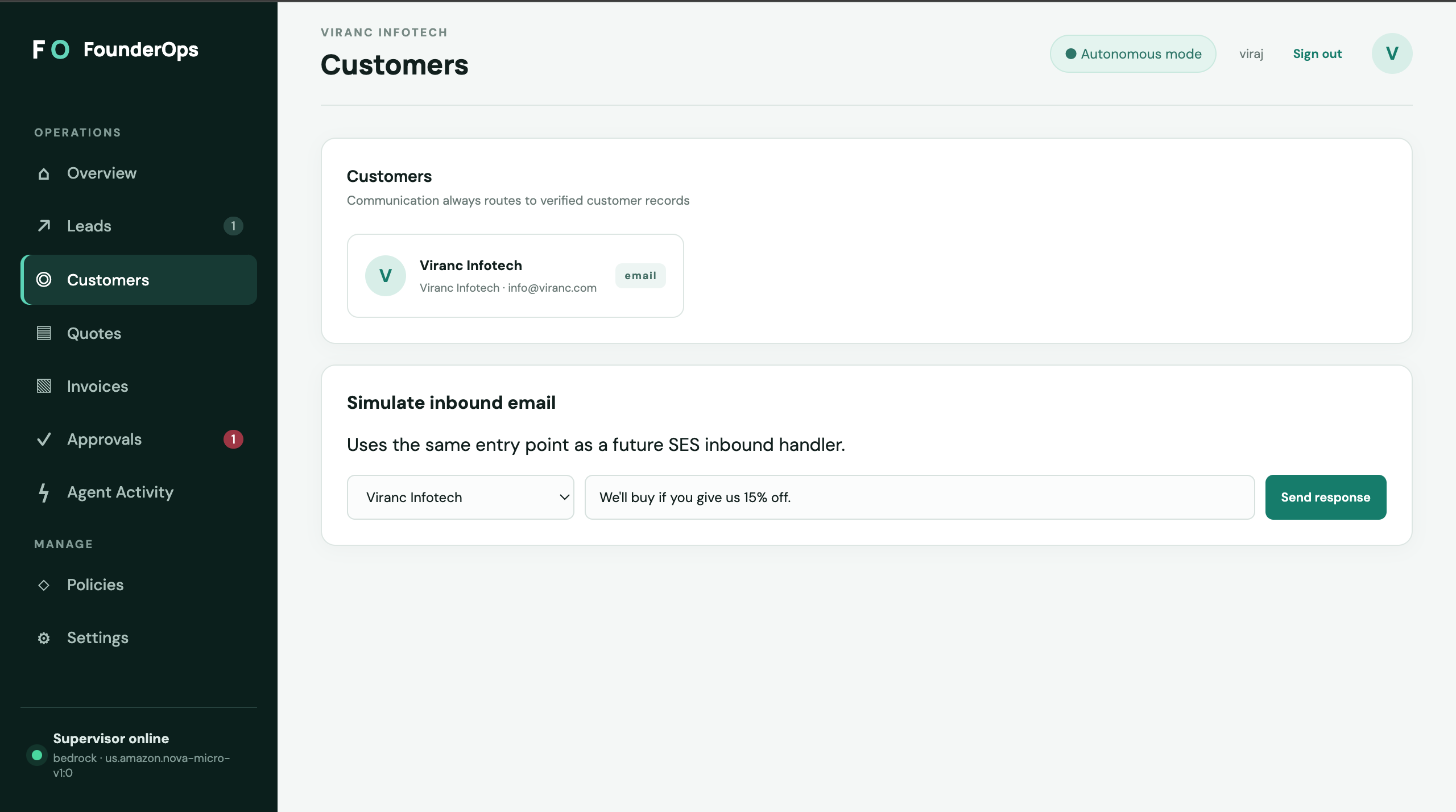
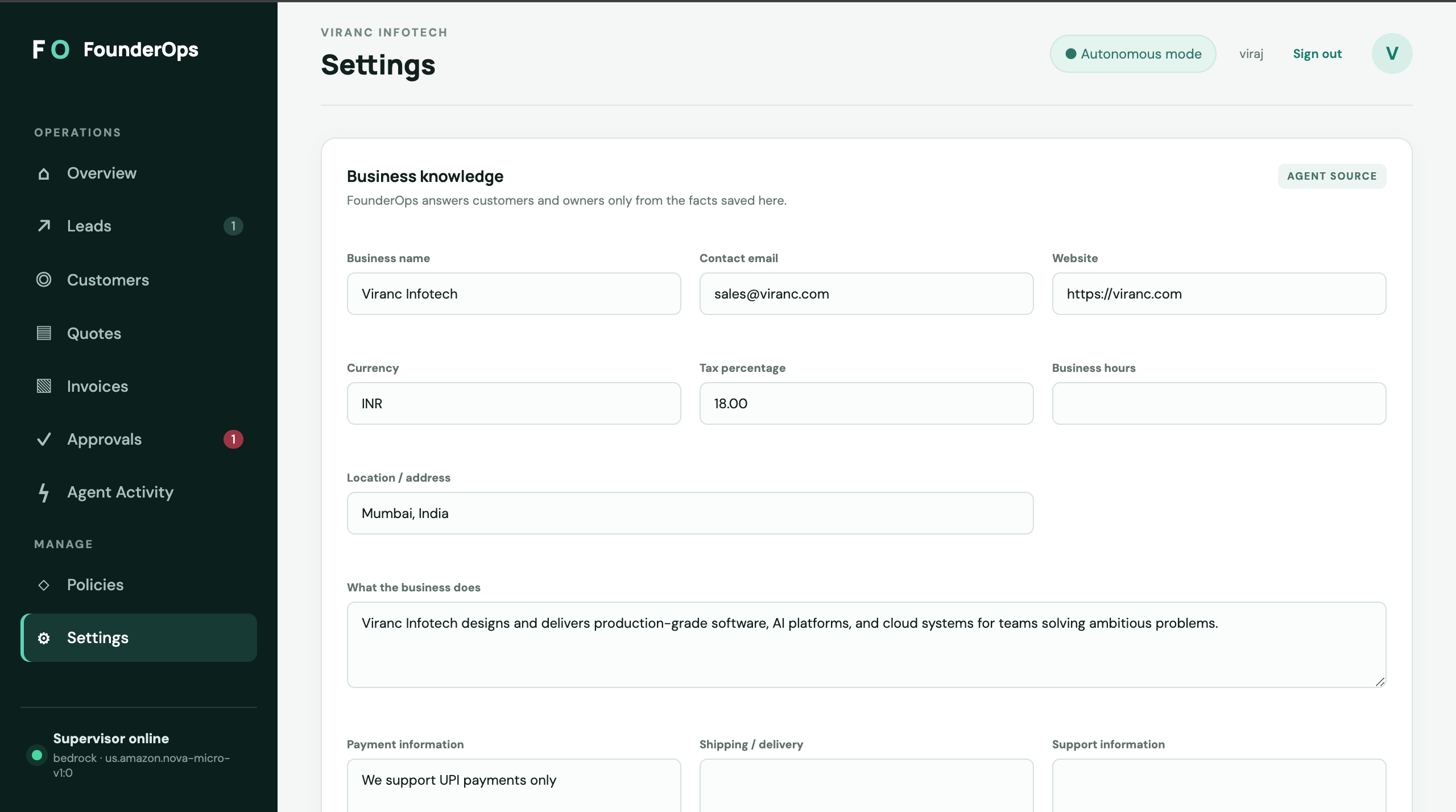
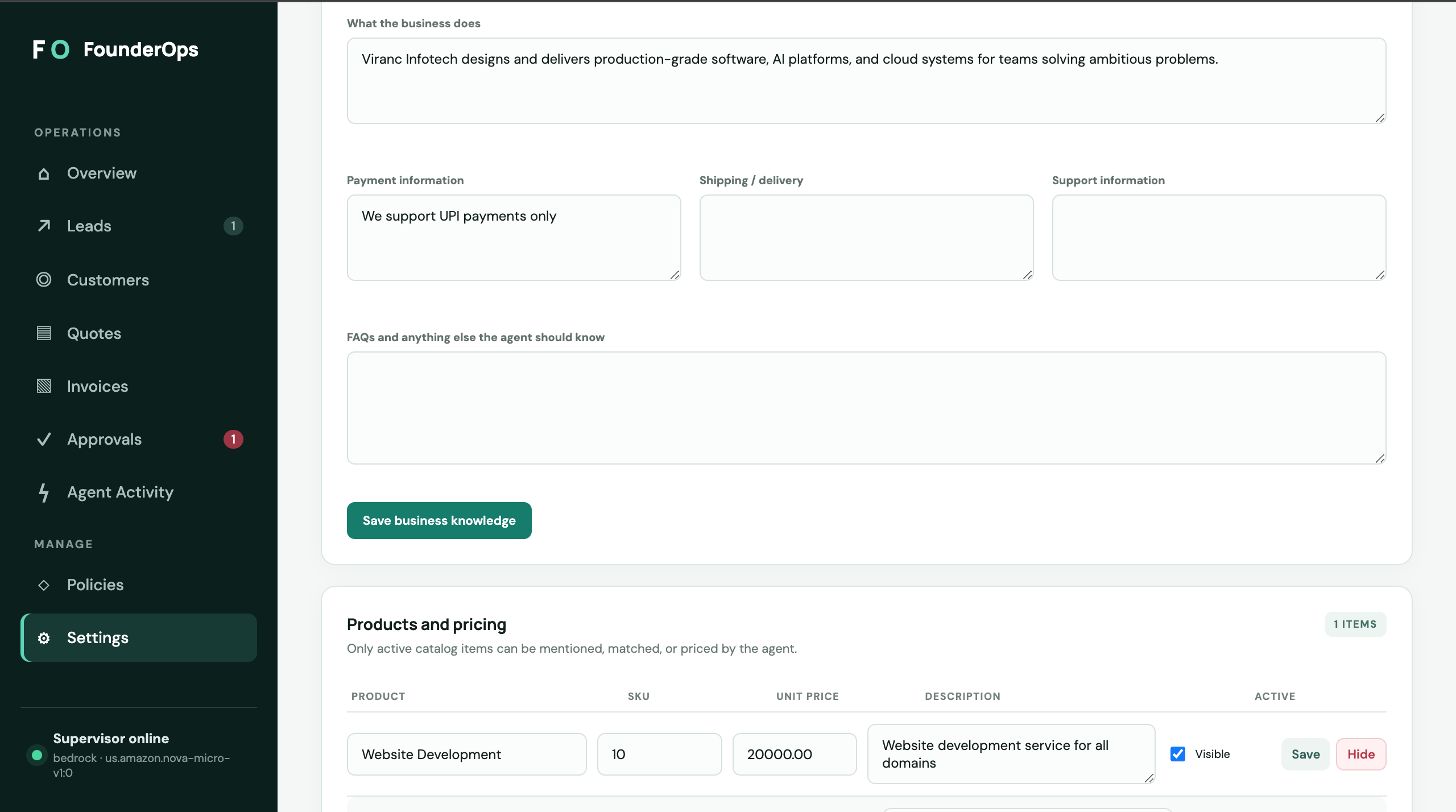
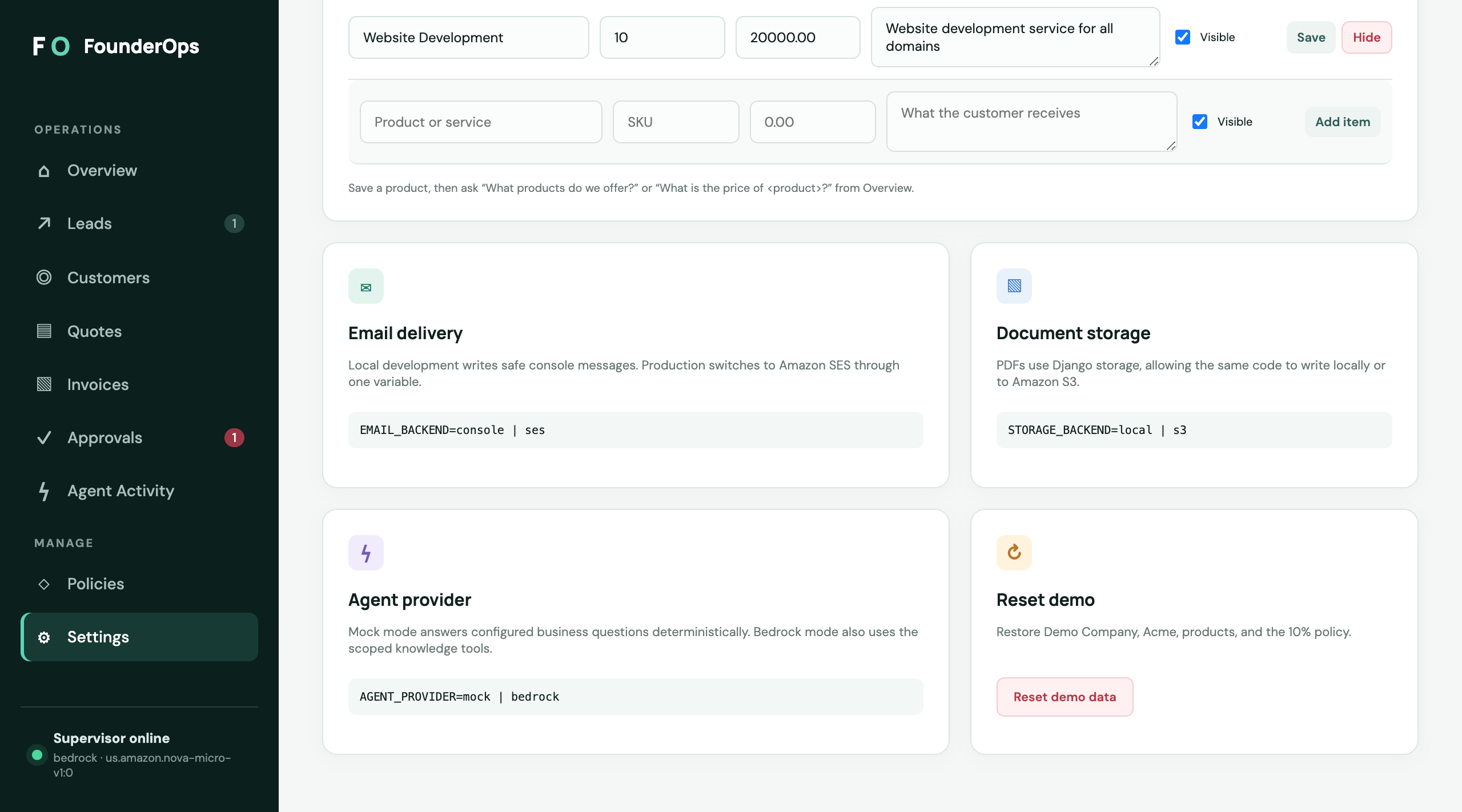
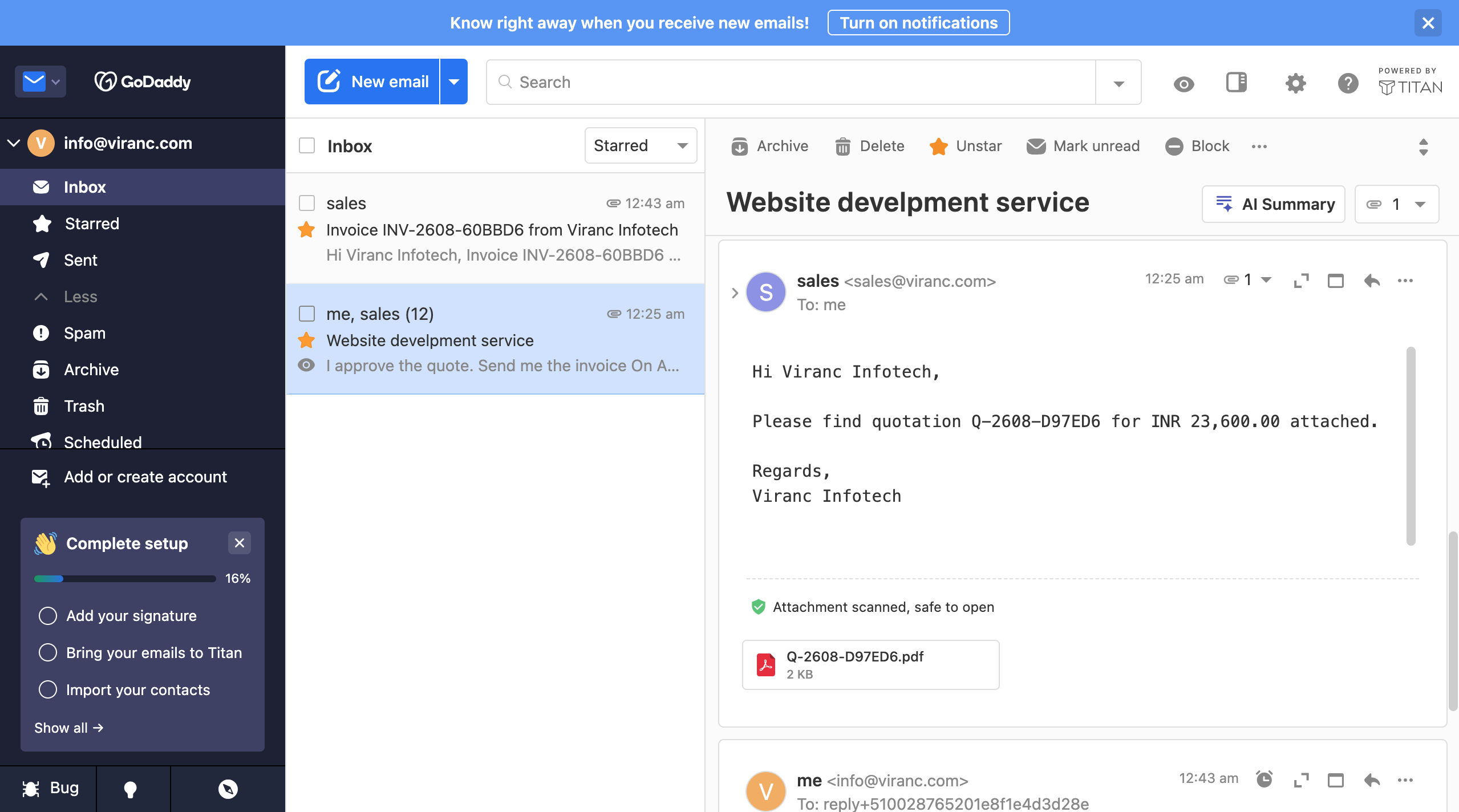
A customer can begin by emailing the business. FounderOps identifies the customer, creates a lead, understands the request, and answers using the business profile, product catalog, pricing, FAQs, and policies configured by the owner.
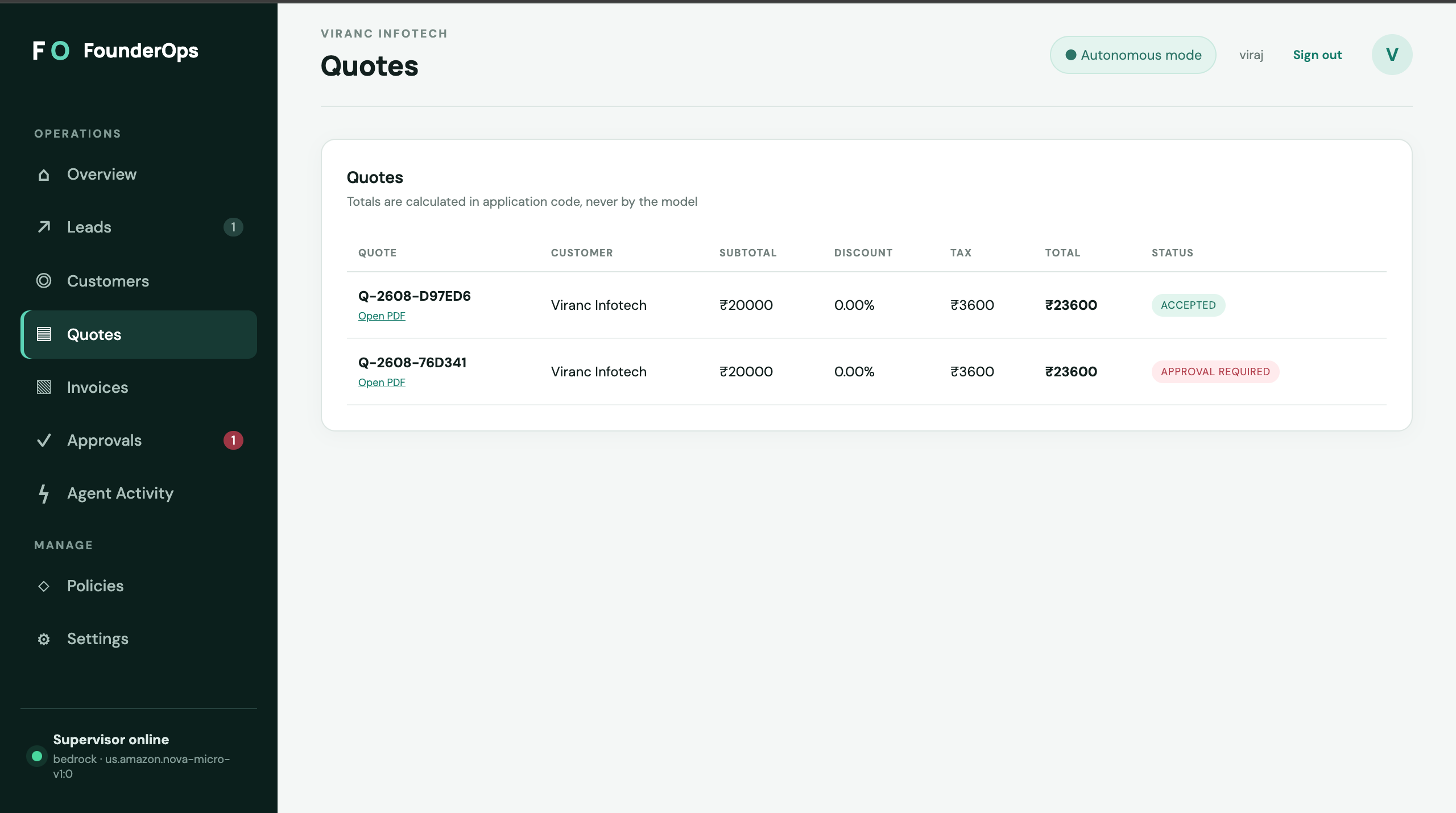
When the customer requests a quote, FounderOps:
- Matches the request to an active product or service
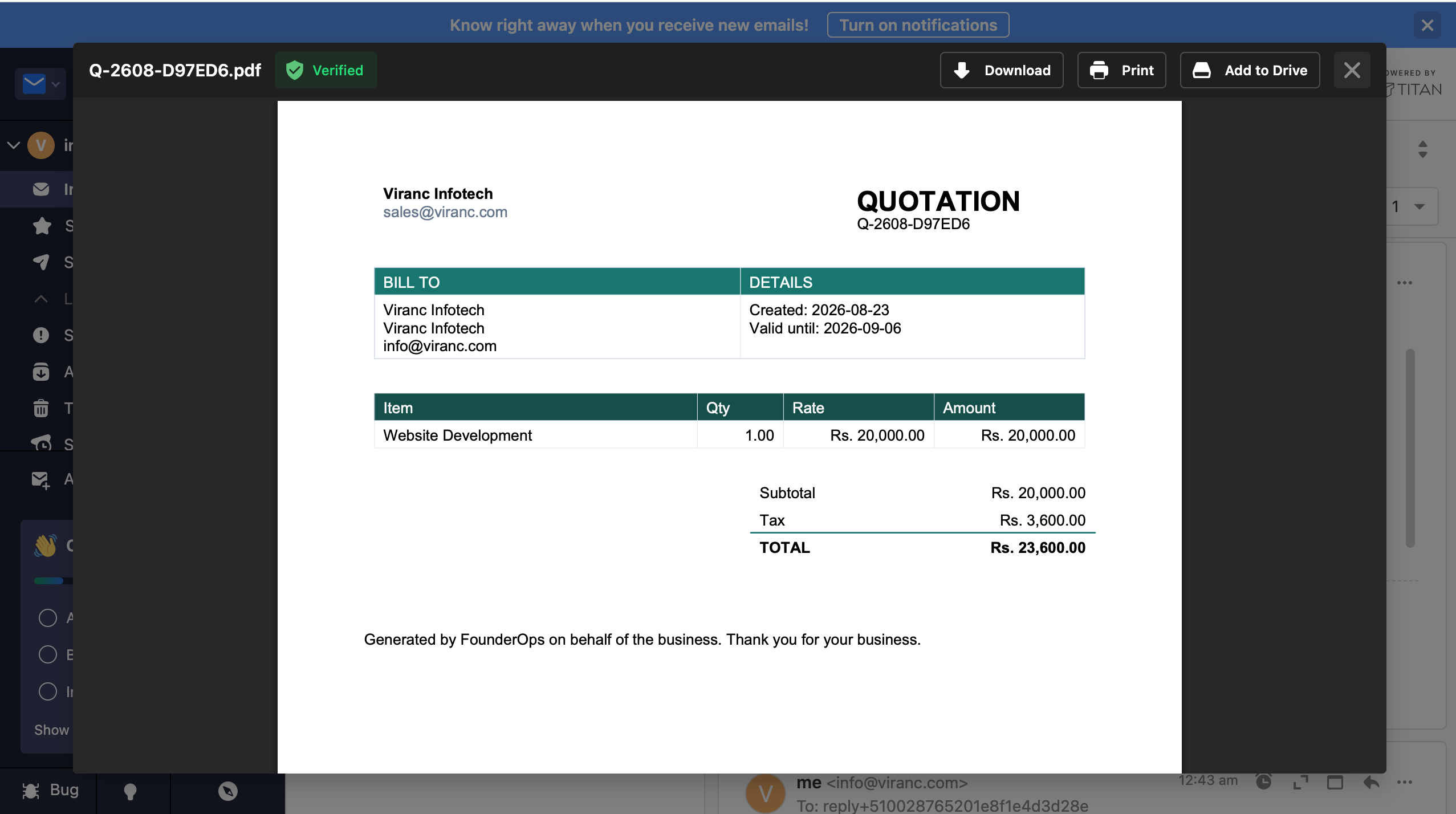
- Calculates pricing and taxes deterministically
- Generates a quotation PDF
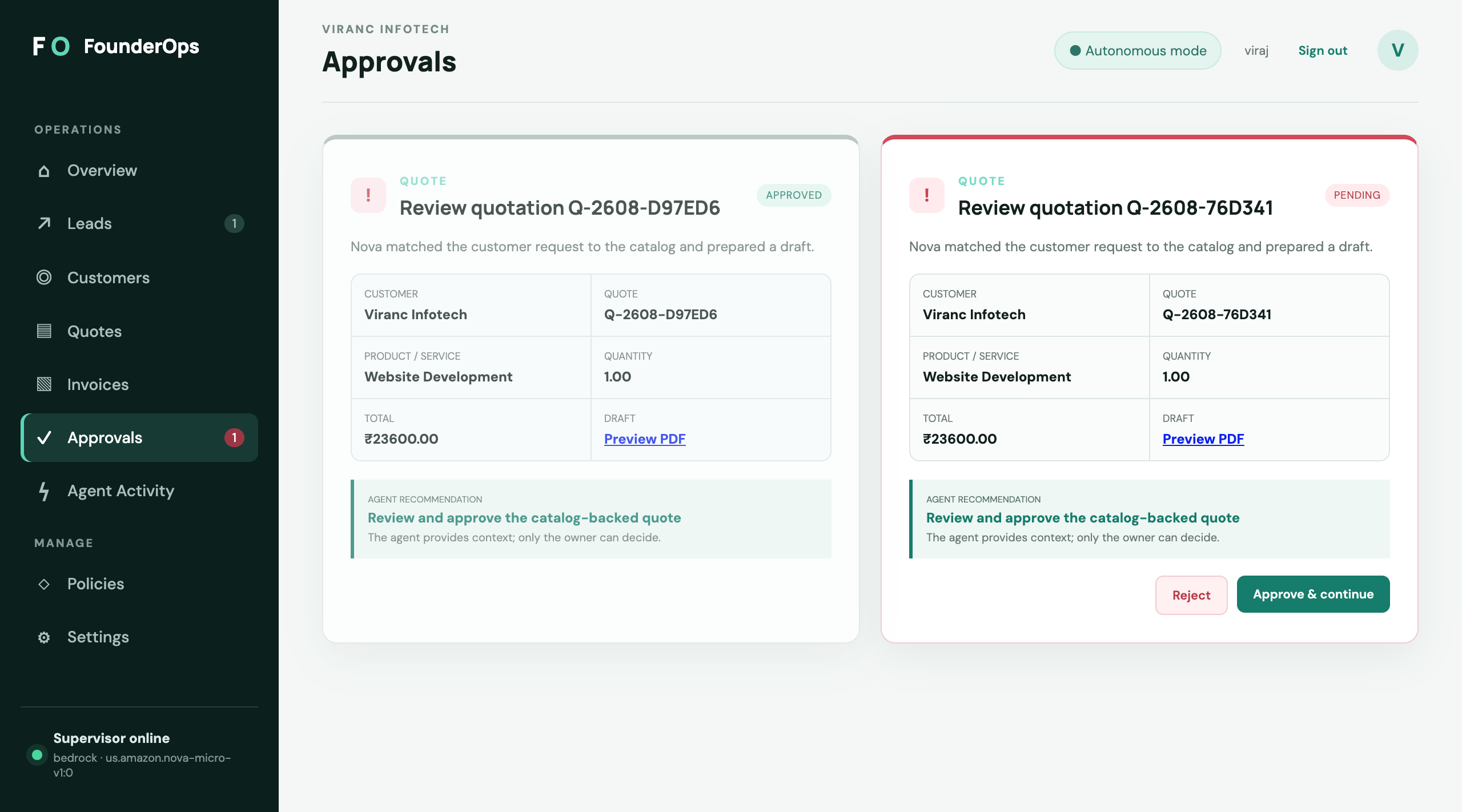
- Requests owner approval when required
- Sends the approved quote in the original email thread
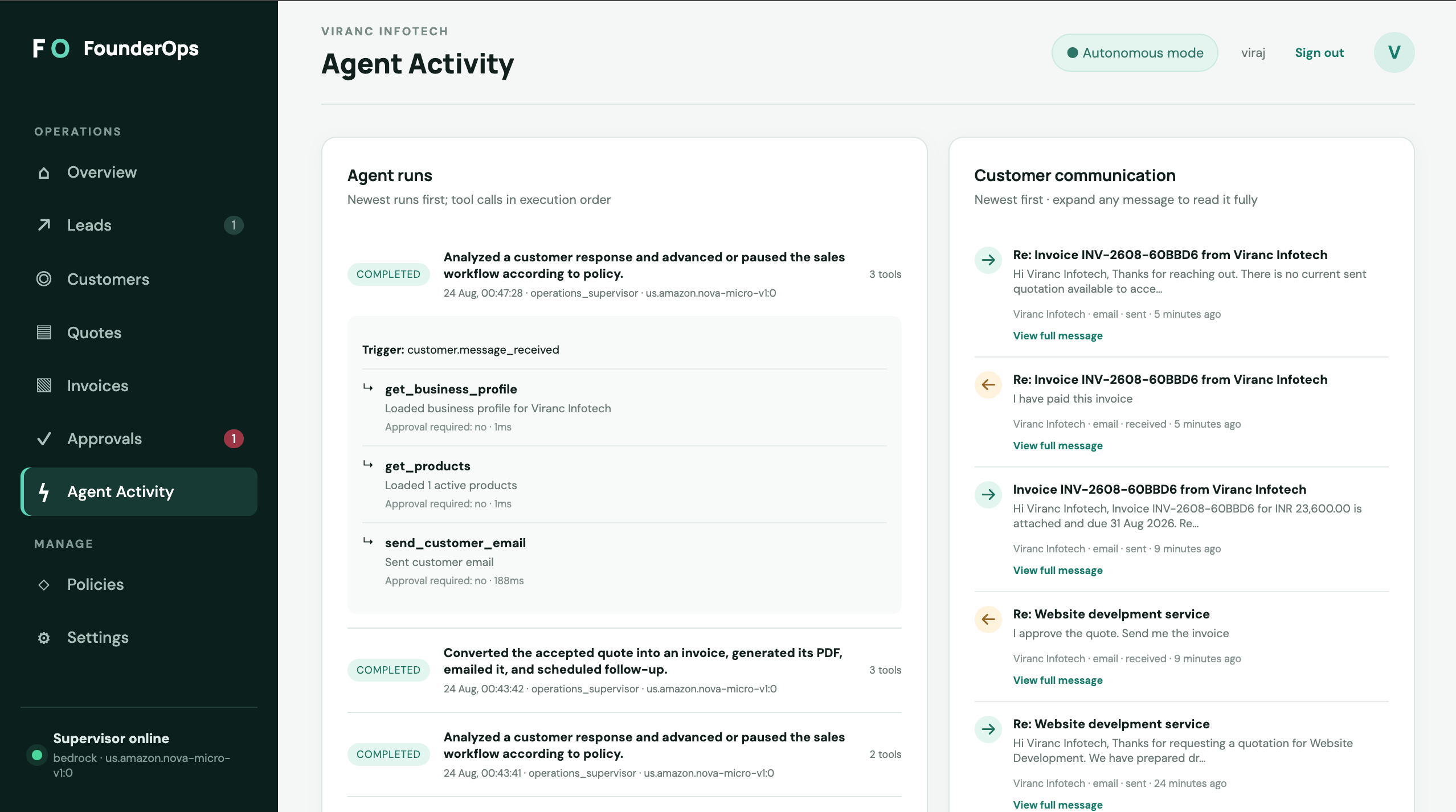
- Detects customer acceptance without creating duplicate quotations
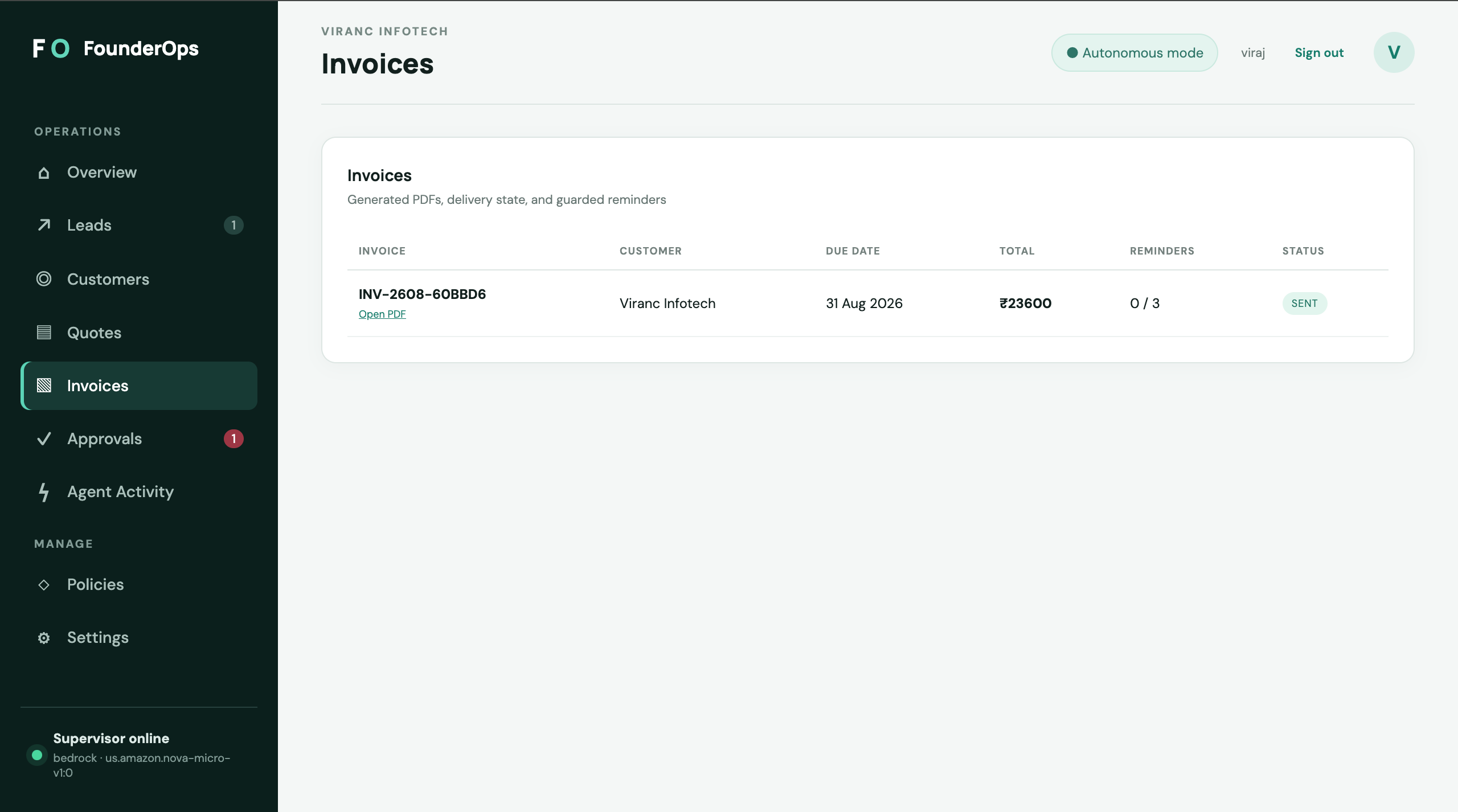
- Converts the accepted quote into an invoice
- Generates and emails the invoice PDF
- Schedules guarded payment follow-ups
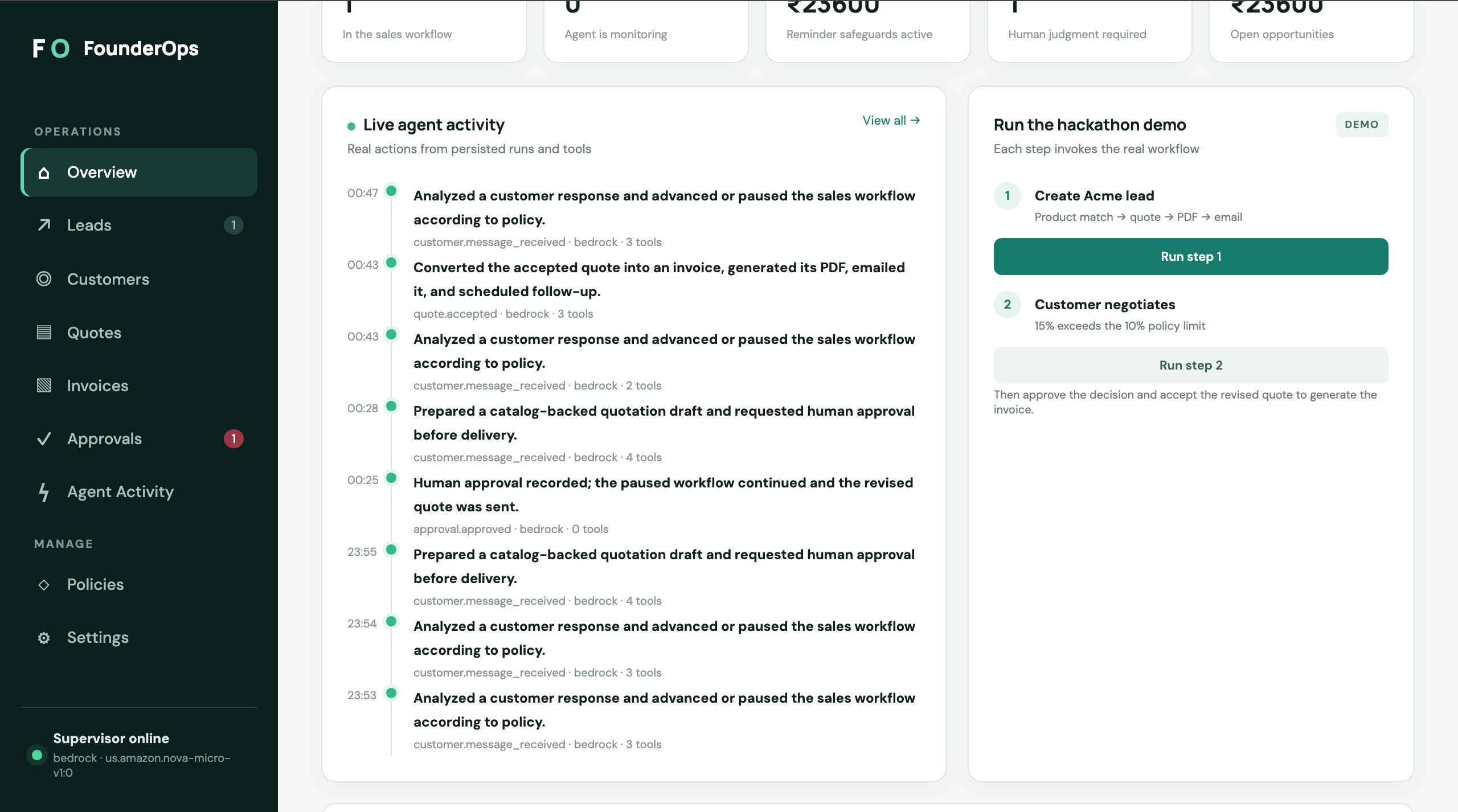
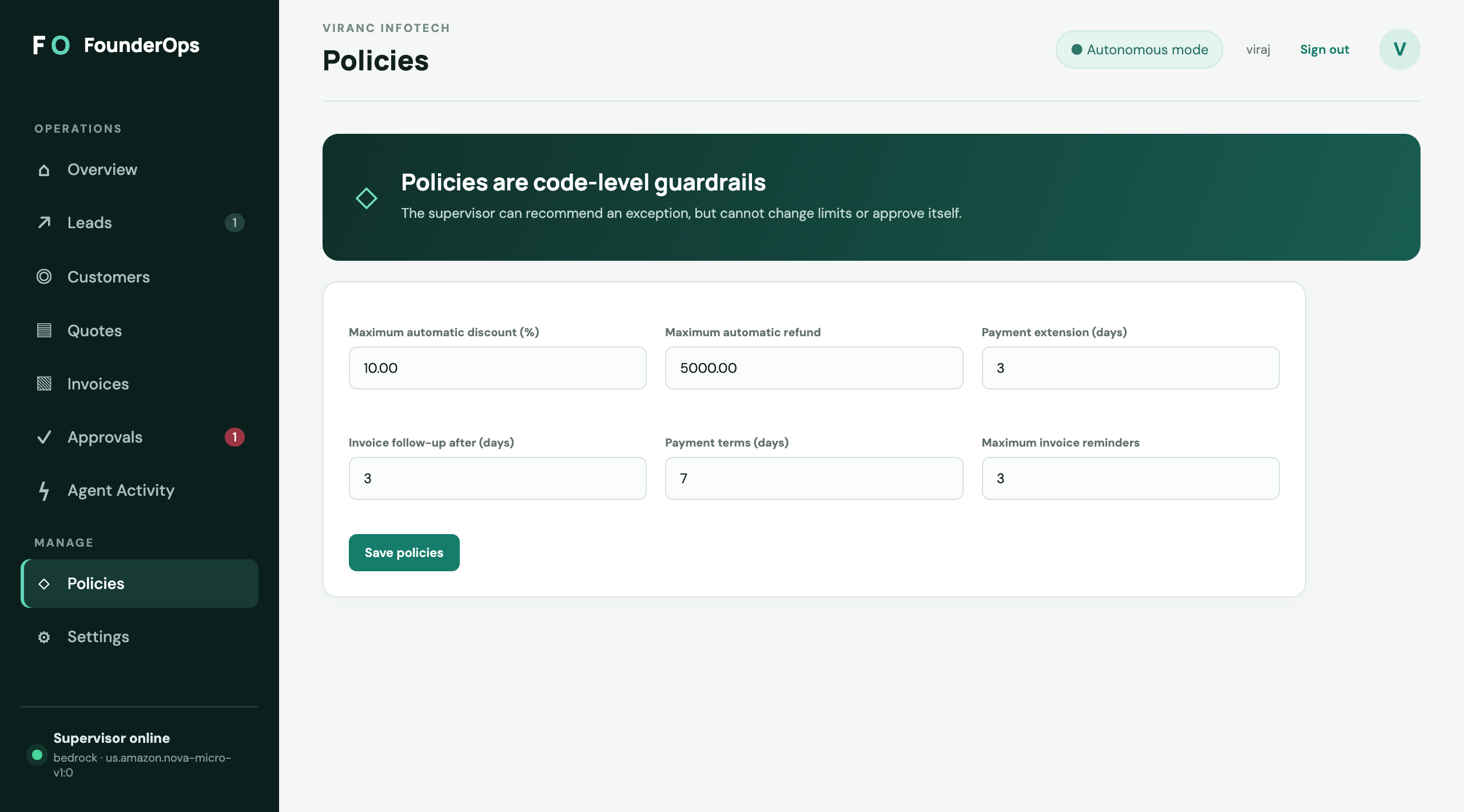
If a customer requests a discount beyond the configured policy limit, the workflow pauses and presents the owner with the requested discount, policy threshold, and revenue impact. Approving the request resumes the paused workflow automatically.
Customer payment claims are also handled safely. FounderOps records the notification and asks the owner to verify it instead of immediately marking the invoice as paid.
How we built it
FounderOps uses Django for the complete web application, including authentication, onboarding, business configuration, approvals, customer records, and the operational dashboard.
The Operations Supervisor is built with the Strands Agents SDK and uses Amazon Nova Micro through Amazon Bedrock to understand customer intent and generate grounded responses. In AWS, the supervisor runs inside Amazon Bedrock AgentCore Runtime.
The model decides what the customer is asking for, but it does not control financial calculations or authorization. Prices, taxes, discounts, workflow transitions, and record updates are performed by deterministic, business-scoped tools. Model-generated actions are validated against an allow-list before execution.
The AWS architecture uses:
- Amazon ECS Fargate for Django
- Amazon Bedrock AgentCore for managed agent execution
- Amazon Bedrock with Nova Micro
- Amazon RDS for PostgreSQL
- Amazon SES for inbound and outbound email
- AWS Lambda for the signed inbound-email bridge
- Amazon S3 for raw email and generated documents
- Amazon EventBridge Scheduler for periodic follow-ups
- Amazon ECR for container images
- AWS Systems Manager Parameter Store for secrets
- Amazon CloudWatch and AWS CloudTrail for observability and auditing
The AWS deployment was validated for the recorded demonstration. The repository also supports a safe local mode using SQLite, a deterministic mock agent, console email, and local document storage.
Challenges we ran into
One major challenge was balancing useful autonomy with financial safety. Letting an LLM directly calculate prices, approve discounts, or mark invoices as paid would be dangerous. We solved this by separating language understanding from business authority.
Another challenge was maintaining context across real email threads. FounderOps supplies Nova with a bounded history containing the latest customer and agent messages, along with active quotes, invoices, and lead state. This allows it to understand replies such as “I approve the quote” or “I have paid the invoice” without treating every email as a new request.
Deploying across ECS, AgentCore, RDS, SES, Lambda, S3, and private AWS networking also required careful IAM permissions, email threading, security-group rules, and failure handling.
Accomplishments that we are proud of
FounderOps is more than a chatbot or prompt demonstration. It implements a durable lead-to-cash workflow with:
- Customer-first inbound email
- Grounded business and product answers
- Catalog-backed quotation generation
- Human approval with resumable workflows
- Quote acceptance and invoice generation
- Payment-verification safeguards
- Automated follow-up scheduling
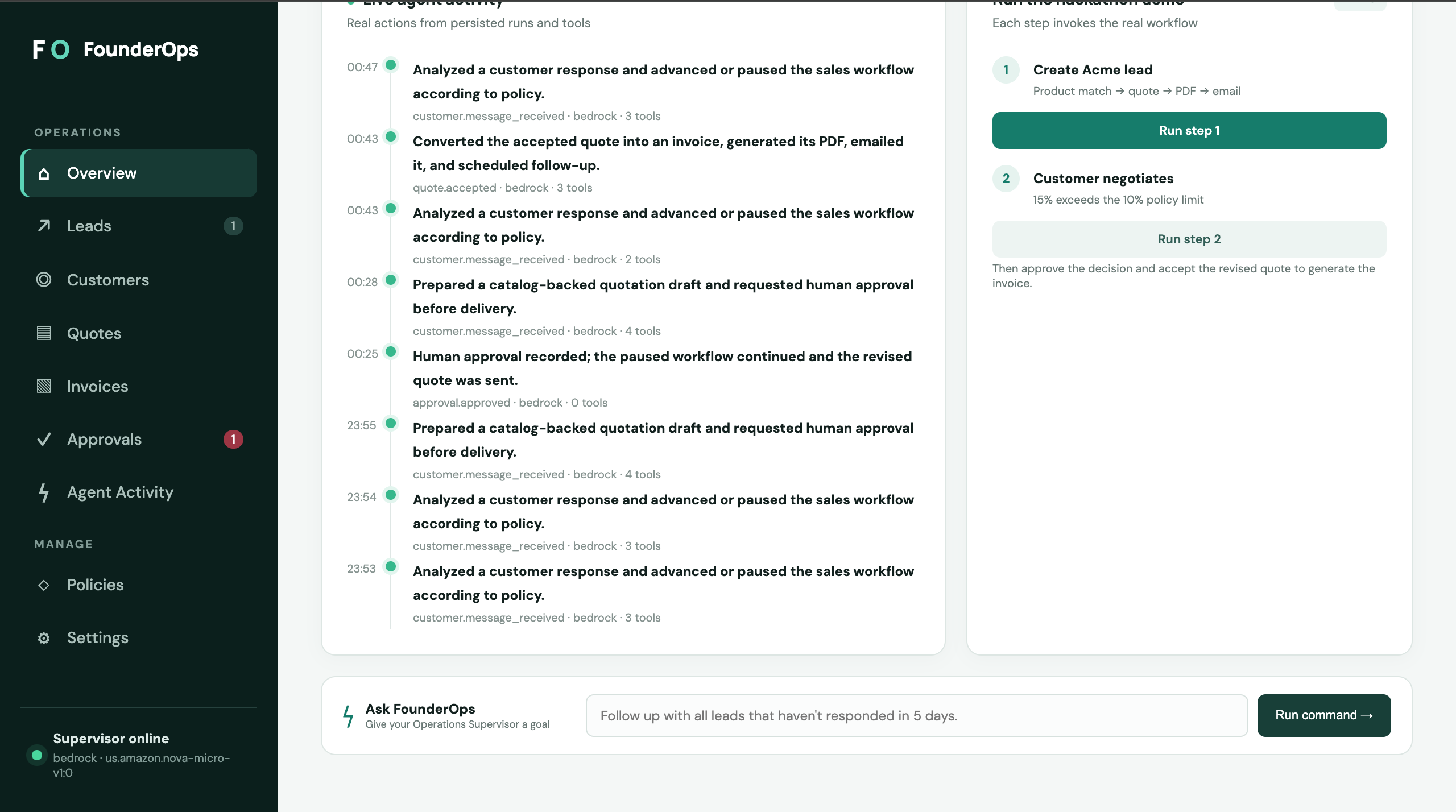
- Full agent and tool activity history
- Business-scoped security controls
- Local and AWS execution paths
Every agent run and tool invocation is persisted, making it possible to inspect what happened, which policy was evaluated, whether approval was required, and what action occurred next.
What we learned
We learned that a trustworthy business agent needs more than a capable model. The most important architectural decisions were limiting the model’s authority, keeping financial calculations deterministic, preserving durable workflow state, and making human approval a real continuation mechanism instead of a notification.
We also learned that email is a powerful interface for autonomous agents because customers do not need to install or learn another application.
What’s next for FounderOps
Future versions of FounderOps could add payment-provider verification, accounting integrations, WhatsApp and SMS communication, multi-user business teams, richer analytics, and specialized sales and finance agents coordinated by the Operations Supervisor.
Built with
- Django
- Python
- Strands Agents SDK
- Amazon Bedrock AgentCore
- Amazon Nova Micro
- Amazon ECS Fargate
- Amazon RDS for PostgreSQL
- Amazon SES
- AWS Lambda
- Amazon S3
- Amazon EventBridge
- Amazon ECR
- AWS Systems Manager Parameter Store
- Amazon CloudWatch
- AWS CloudTrail
- Docker
- Gunicorn
- ReportLab
Built With
- agent-core
- amazon-web-services
- bedrock
- django
- ecs
- python
- rds
- strands-agents-sdk

Log in or sign up for Devpost to join the conversation.