-
-
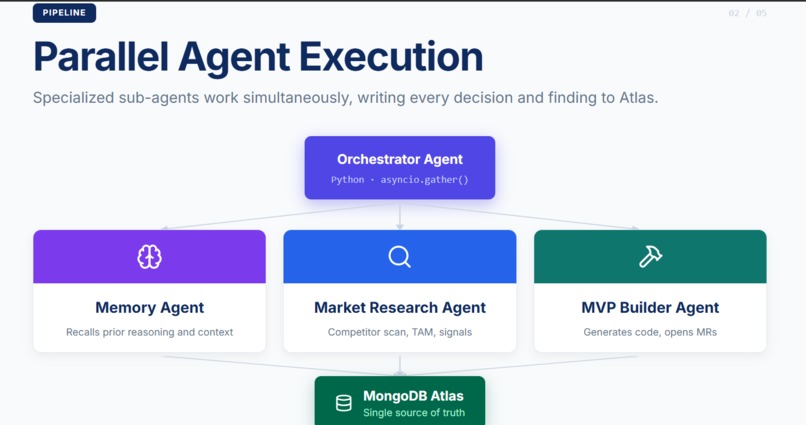
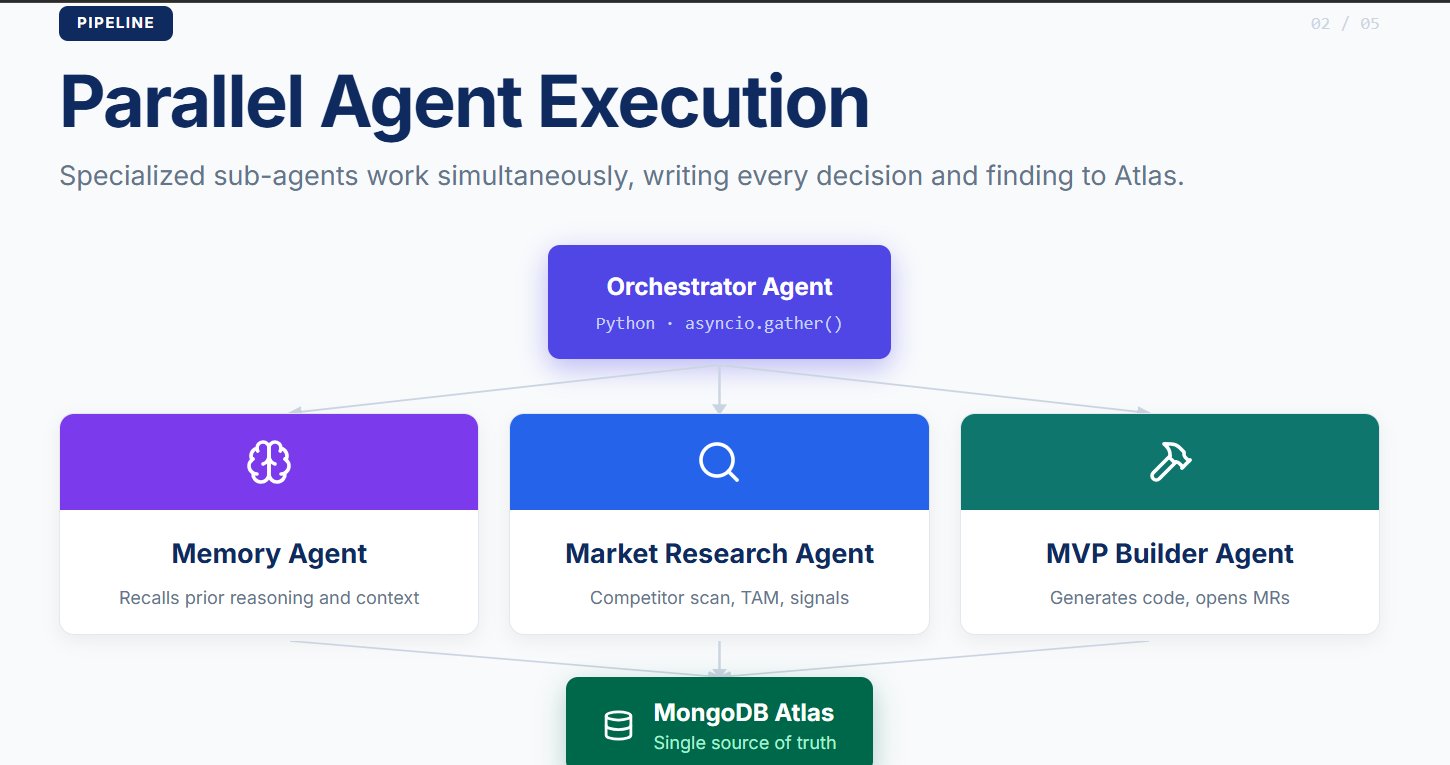
Parallel Agent Execution Specialized sub-agents work simultaneously, writing every decision and finding to Atlas.
-
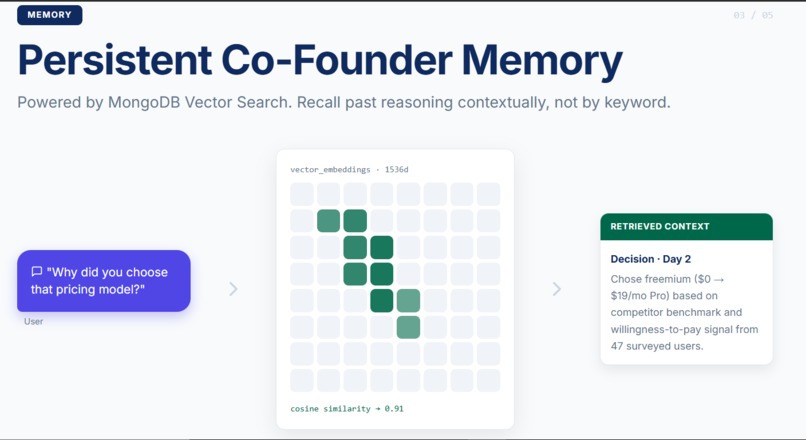
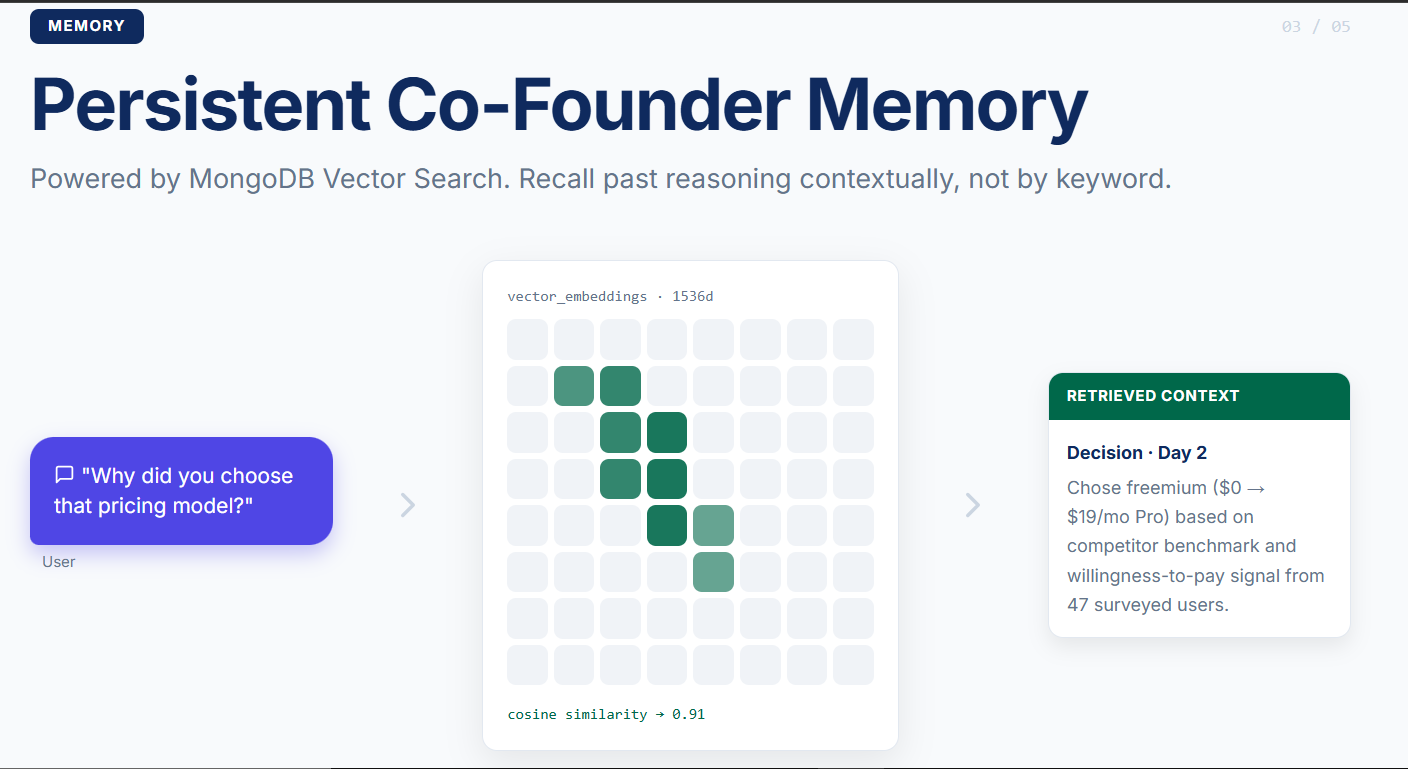
Persistent Co-Founder Memory Powered by MongoDB Vector Search. Recall past reasoning contextually, not by keyword
-
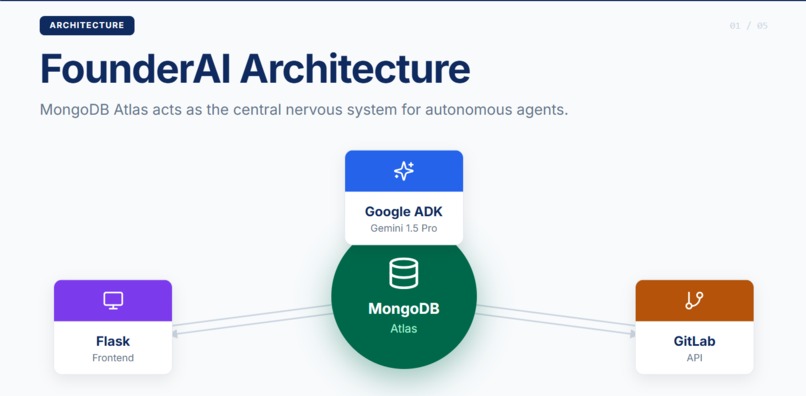
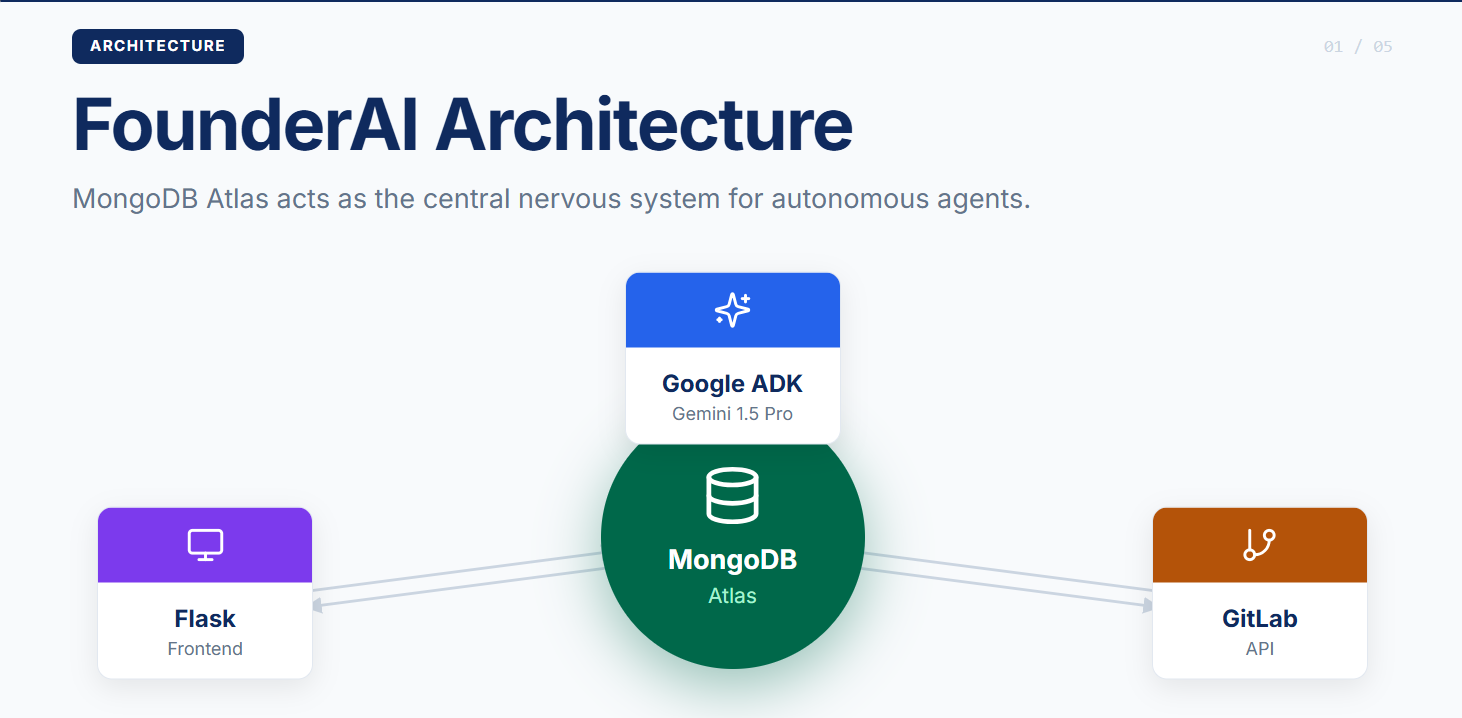
FounderAI Architecture MongoDB Atlas acts as the central nervous system for autonomous agents.
-
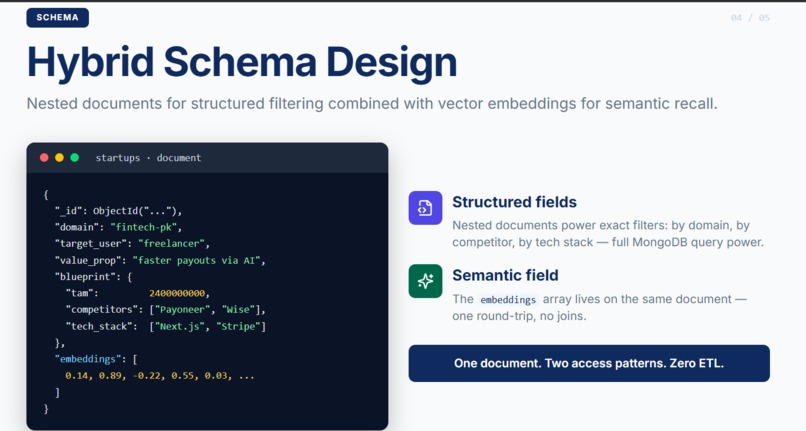
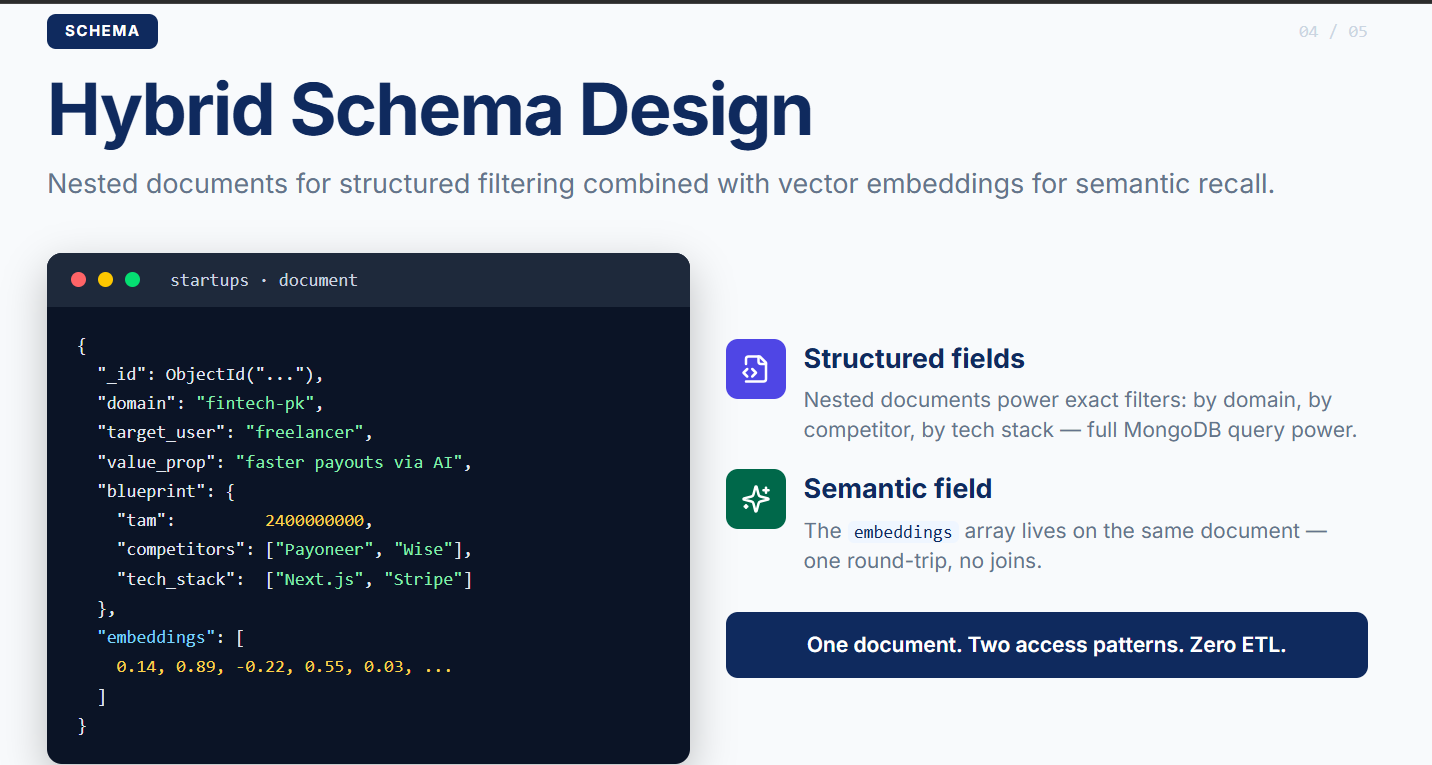
Hybrid Schema Design Nested documents for structured filtering combined with vector embeddings for semantic recall.
-
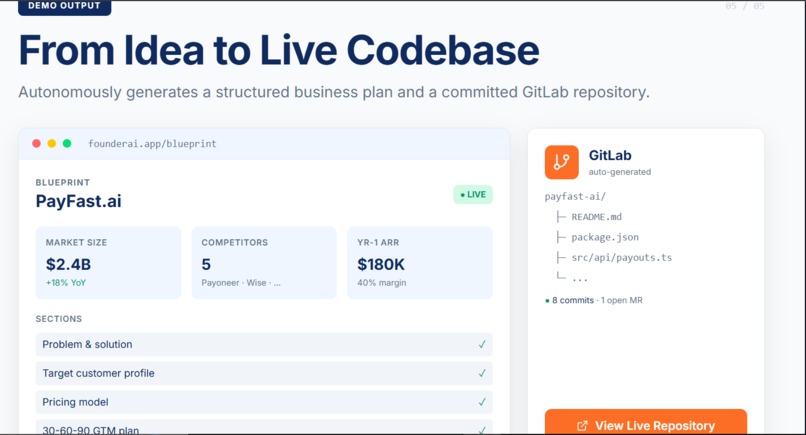
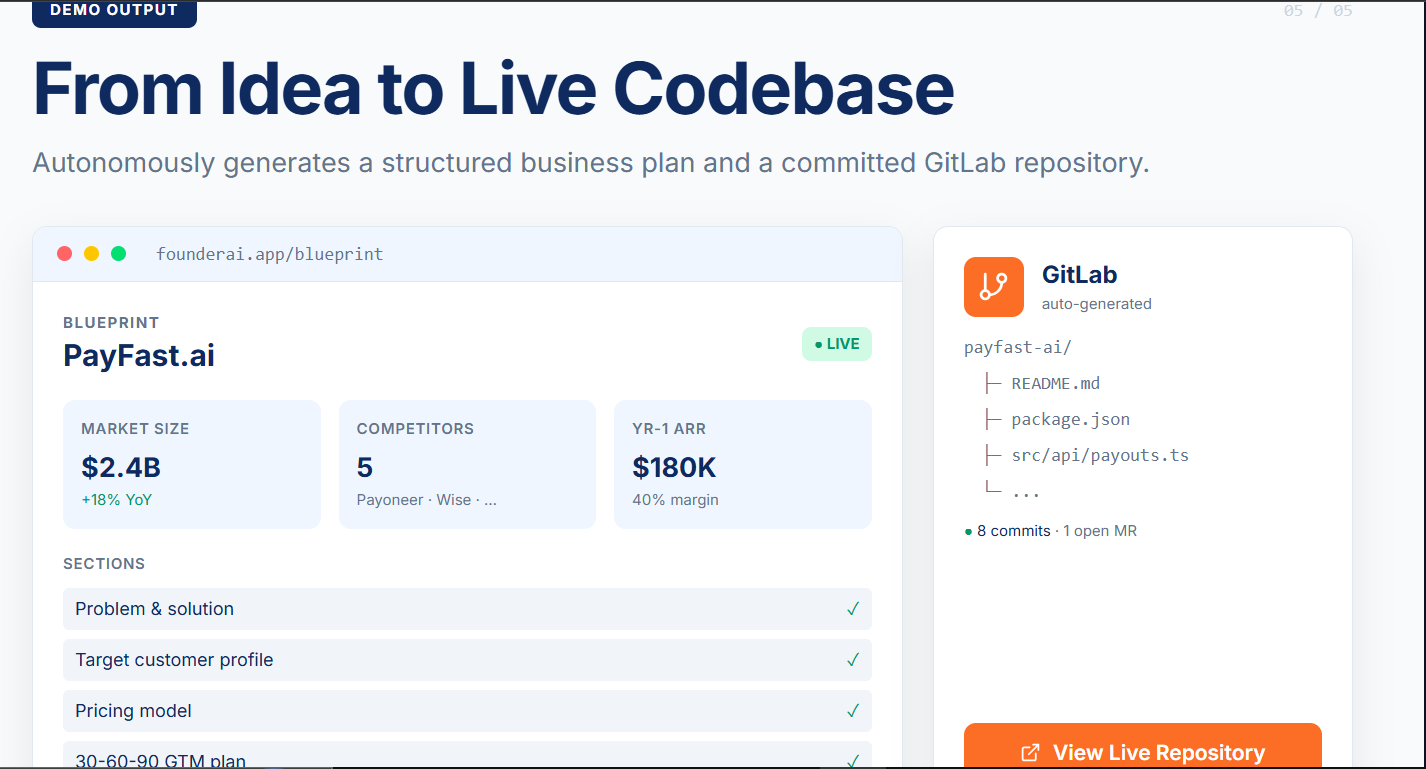
From Idea to Live CodebaseAutonomously generates a structured business plan and a committed GitLab repository.
Inspiration Most startup ideas never get past the shower. Not because they are bad — but because the founder faces an immediate wall of work before they can even test whether the idea is worth pursuing. You need market research, a financial model, a technical plan, and some kind of working prototype — all before you have validated anything. Most people give up here. I kept thinking about this problem while working on my final year research project in ML. The research process itself taught me something: the hardest part is not the technical work. It is keeping track of everything you learn, every decision you make, and every assumption you are building on — so that when something changes, you know exactly why you did what you did. That is a memory problem as much as a productivity problem. That is what pushed me toward MongoDB as the foundation for FounderAI. I did not want an agent that answers questions and forgets. I wanted an agent that builds a permanent, searchable knowledge base about your startup — one that gets more useful the more you interact with it. MongoDB Atlas, with its document storage and vector search, made that possible in a way a relational database never could.
What it does FounderAI is a multi-agent system that takes one sentence describing a startup idea and autonomously generates a complete startup blueprint — stored and recalled through MongoDB Atlas. You type something like: "Build a platform that helps Pakistani freelancers get paid faster using AI." Within minutes the system produces a market analysis with competitor research, a structured business plan, a working MVP codebase committed to a live GitLab repository, and a financial projection for Year 1. Every output — every agent decision, every research finding, every assumption — is stored in MongoDB Atlas as a structured document with vector embeddings. The part that makes it genuinely different from a one-shot prompt: you can come back later and ask follow-up questions. "What competitors did you find?" or "Why did you choose that pricing model?" — and the agent retrieves the answer from MongoDB using semantic vector search, not keyword matching. It knows what it did and why. That persistent memory is what turns a one-time tool into an actual co-founder.
How we built it The core runtime is built on Google ADK (Agent Development Kit) with Gemini 1.5 Pro as the reasoning model. The Orchestrator Agent parses the user's startup idea, decomposes it into structured JSON containing the domain, target user, value proposition, and tech stack, then coordinates three specialized sub-agents running in parallel via Python's asyncio. MongoDB Atlas is the central nervous system of the entire application. Every agent writes to and reads from MongoDB throughout the pipeline: The Memory Agent connects to MongoDB Atlas through pymongo and stores each session as a rich document — startup idea, agent outputs, decisions, timestamps, and rationale. Before storing, each text chunk is embedded using the Gemini embedding API and saved alongside the document. This enables vector search recall: when you ask a follow-up question, the agent runs a semantic search against your session history and retrieves the most relevant context, not just the most recent one. The Market Research Agent uses Gemini to analyze the startup domain, identify competitor archetypes, and estimate market size. Its findings are saved to a dedicated MongoDB collection with metadata tags so they can be retrieved and compared across multiple startup sessions. The MVP Builder Agent calls the GitLab API to create a real repository, generate core application files using Gemini, and commit them with proper branch structure and a merge request. The repo URL is stored back in MongoDB alongside the session, so the entire startup's technical foundation is traceable. The frontend is a minimal Flask application that streams agent status updates in real time, showing which agent is working and what it has found. The final output renders as a formatted blueprint with links to the live GitLab repo and a session ID the user can return to later.
Challenges we ran into The hardest problem was designing MongoDB's document schema in a way that supported both structured retrieval and semantic search simultaneously. Early versions stored agent outputs as flat strings, which meant vector search worked but structured queries did not. We rebuilt the schema to store outputs as nested documents — structured fields for filtering, combined with a separate embeddings field for semantic recall. Getting that balance right took most of Day 3. The second challenge was managing Gemini API rate limits under parallel agent execution. When three agents fire simultaneously and each makes multiple Gemini calls, it is easy to hit the free tier limit within seconds. We implemented a token-aware retry queue with exponential backoff, which slowed the pipeline slightly but made it reliable enough to demo without failures. The third challenge was making the GitLab integration feel real rather than cosmetic. Early versions created an empty repo with a README — which looked fine but would not impress a technical judge. We rewrote the MVP Agent to generate actual application scaffolding: a project structure, a core logic file, a requirements.txt, and a README with real setup instructions. That took an extra day but the demo is now something a judge can actually clone and run.
Accomplishments that we're proud of The MongoDB vector search recall actually works in a way that surprises people. You can describe a startup, get a blueprint, then come back three sessions later and ask "what did I learn about the payments market?" — and it retrieves the relevant findings from the right session, not just the last one. That is not a demo trick; it is a genuinely useful feature that took real work to build correctly. The GitLab repository created during the demo is real and public. Judges can click the link, clone it, and run it. Most hackathon demos show screenshots of code. Ours creates a live repo with committed files while the judge is watching. The entire core pipeline runs without a paid cloud account. Google ADK, MongoDB Atlas free tier, and the Gemini AI Studio API key are all free. That matters for a student builder in Peshawar — but it also means anyone who wants to try FounderAI can run it without a credit card.
What we learned MongoDB is not just a database in this project — it is the feature. The moment we added vector search and the agent could recall its own past reasoning, the whole product felt different. It stopped being a one-shot generator and started behaving like something that was actually learning about your startup over time. That shift happened entirely because of how MongoDB handles embeddings alongside structured documents in the same collection. We also learned that multi-agent systems fail in boring ways. Not dramatic crashes — just silent wrong outputs when one agent's result contradicts another's. The most important code we wrote was not any single agent. It was the synthesis step where the Orchestrator reads all three outputs, identifies contradictions, and produces a reconciled result. That logic is invisible in the demo but it is what makes the output trustworthy.
What's next for FounderAI — Autonomous Startup Co-Founder Agent The immediate next step is adding a Founder Timeline feature — a MongoDB-backed chronological log of every decision made across all sessions, so a founder can see how their startup idea evolved from first thought to working product. After that: an Investor Match Agent that searches a MongoDB collection of investor profiles and ranks them by portfolio fit. And a Legal Agent that drafts a basic co-founder agreement and IP assignment document based on the startup structure already stored in the database. The longer vision is a subscription product for university entrepreneurship programs and startup incubators — where every student team gets a persistent MongoDB-backed agent that follows their startup from idea to pitch day.


Log in or sign up for Devpost to join the conversation.