Inspiration
One of our team members grew up listening to his father's stories from cargo ships. Another had hands-on experience in the marine industry. But the real spark came during an internship at a glass bottle manufacturing company — watching production lines run 24/7, entirely dependent on uninterrupted raw material flow. A single supply disruption could halt an entire factory.
That question stuck with us: how do founders and operators actually make high-stakes logistics decisions without making expensive, avoidable mistakes? We couldn't find a tool that combined startup decision intelligence with deep logistics domain knowledge. So we built one.
What it does
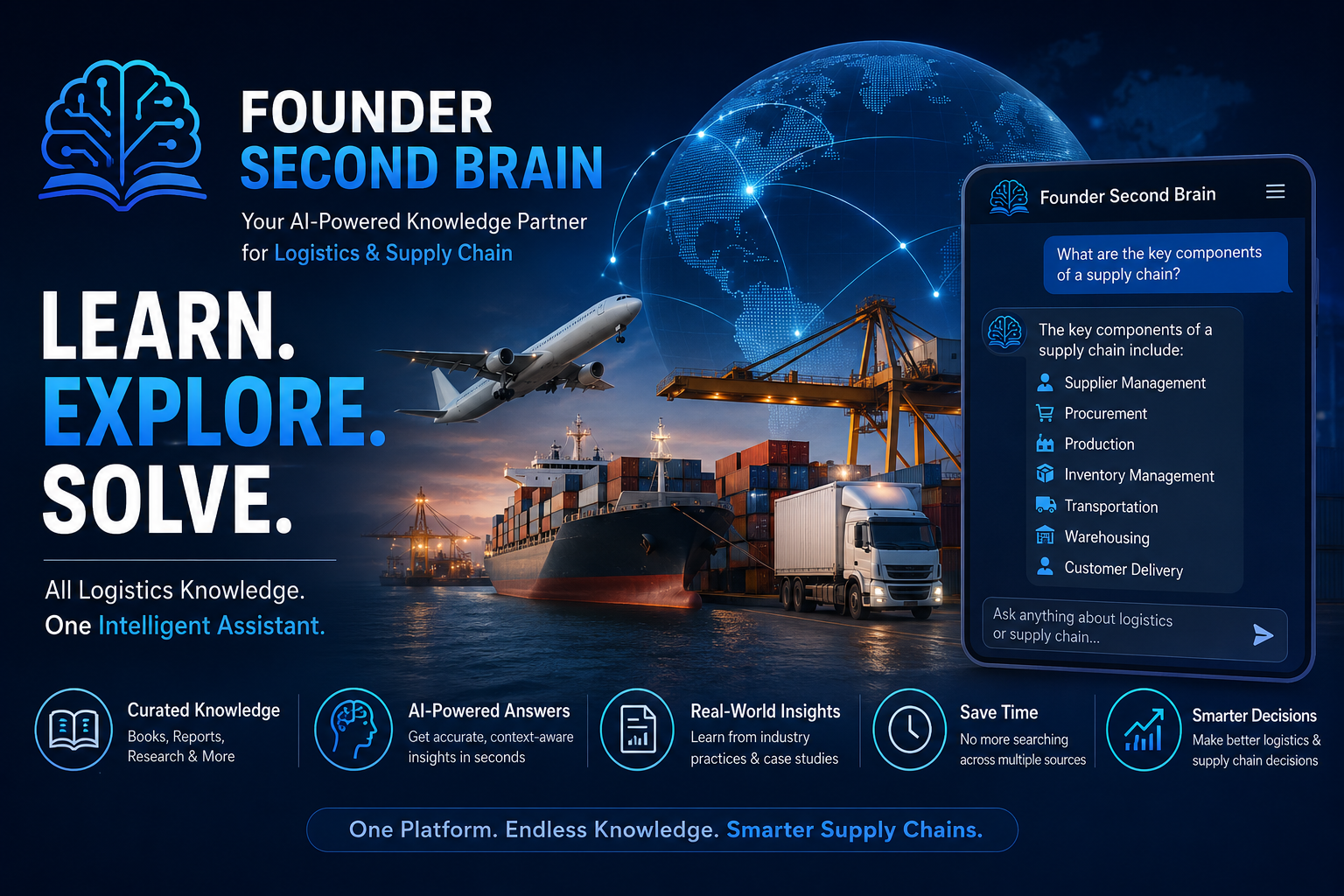
Founder Second Brain is an AI decision-intelligence platform for early-stage logistics startup founders. It's not a chatbot — it's a structured thinking partner.
A founder completes a 3-step input wizard (Idea → Context → Resources) and the system returns a full execution analysis:
- Executive Summary — what the AI sees in your situation
- Hidden Assumptions — blind spots you may not have considered
- Failure Risk — patterns from real startup failures that match your context
- Milestone Timeline — a sequenced roadmap
- First 48h Action — one concrete move to make immediately
The founder then chooses to Proceed (downloads a full execution plan), Pivot (re-analyzes with a new direction), or Pause (saves for later). The AI surfaces the patterns. The human makes the call.
How we built it
We built the system through a 6-stage knowledge synthesis pipeline before writing a single line of product code.
Stage 1 — Source collection: 11 startup books (The Lean Startup, Zero to One, The Hard Thing About Hard Things, The Mom Test, etc.), logistics books and industry reports (Chopra SCM, Christopher SCM, The Box, The Goal, Toyota Way), startup failure/success reports, and entrepreneur interview summaries.
Stage 2 — PDF extraction: A custom extract_pdf.py script, powered by DeepSeek V3, converted all PDFs into structured .txt files preserving chapter and section boundaries.
Stage 3 — Knowledge engineering: Every source was hand-distilled into 7-field structured entries — CATEGORY, SOURCE, PATTERN_NAME, CONTEXT, INSIGHT, WARNING_SIGN, RESOLUTION — with DeepSeek V4 flash accelerating synthesis of dense source material. Decision frameworks got additional fields (FRAMEWORK_TYPE, STEPS, DECISION_POINT, FAILS_WHEN). Logistics entries got LOGISTICS_SEGMENT and APPLIES_TO_FOUNDER_TYPE.
Stage 4 — Tag system: Patterns are tagged inline using [BRACKET] notation — [LOGISTICS_RELEVANT], [FOUNDER_ERROR], [HIGH/MEDIUM/LOW_PRIORITY] — used at query time for domain and urgency scoring.
Stage 5 — RAG gap analysis: After assembling v1, we tested the engine against real founder queries and found 3 blind spots. We authored and inserted: Zero-Budget Marketplace Validation Playbook, Small/Medium Warehouse Data Quality Reality, and Competing Against Free.
Stage 6 — Final assembly: 280 entries, 4,357 lines, 545KB. The backend is FastAPI on Railway. Retrieval uses keyword + bigram + tag + domain scoring — no vector database. DeepSeek generates the structured 5-section response. The frontend is React 18 + TypeScript + Vite + Tailwind, deployed on Vercel.
Challenges we ran into
- Building RAG without a vector database — we wrote a keyword + bigram + tag scoring system from scratch to avoid infrastructure overhead during the hackathon, and it works surprisingly well for domain-constrained retrieval
- Getting DeepSeek to consistently produce parseable 5-section responses required careful prompt engineering and robust regex fallbacks
- Hand-curating 280 patterns with 7 structured fields each was the most time-intensive part — and the most valuable
- Going through 4 design iterations (dark navy → enterprise light → glassmorphism → professional light mode) before landing on something that felt trustworthy for a decision-support tool
- Balancing AI confidence signals with responsible framing so founders don't over-rely on the output
Accomplishments we're proud of
- Built a domain-specific RAG system from scratch — 280 hand-curated patterns across 5 categories — without a vector database
- The Hidden Assumptions section actively challenges the founder to question the AI's output, not just accept it
- Reached the Top 10 in an inter-college innovation competition before this hackathon, validating the core idea
- Shipped a full-stack product (FastAPI + React + RAG + AI) end-to-end during the hackathon window
- The Proceed flow includes a human-verified checklist — the AI never tells you what to do, only what patterns apply
What we learned
Retrieval quality matters more than model quality for domain-specific tools. A well-curated knowledge base of 280 targeted patterns outperforms a general LLM flying blind. Structure in = structure out: the more precisely we defined our 5 output sections, the more actionable the results became.
We also learned that real-world problems make the best starting points. A question about how factories keep running 24/7 eventually became an AI decision platform for logistics founders.
What's next for Founder Second Brain
- Expanding the knowledge base with more industry reports, case studies, and regional logistics data
- Adding multimodal input — founders uploading pitch decks, financials, or market maps for analysis
- Intelligent agent workflows for supply chain risk analysis and scenario planning
- Real-time logistics data integration (shipping rates, carrier reliability, port delays)
- Personalized founder learning paths based on their stage, domain, and past decisions
- Evolving from a single-analysis tool into an ongoing AI co-founder for the full zero-to-one journey
Built With
- api
- canvas-confetti
- deepseek-api
- fastapi
- openai-sdk
- pydantic
- python
- railway
- react-18
- rest
- tailwind-css-3
- typescript
- uvicorn
- vercel
- vite-6


Log in or sign up for Devpost to join the conversation.