Inspiration
As a solo founder, my day was death by a thousand context switches. Code lived in one window, terminals in another, AI chat in a browser tab, my deploy dashboard somewhere else, and "build in public" meant abandoning all of it to go fight the LinkedIn composer. Every switch cost momentum — and momentum is the only real asset a founder has.
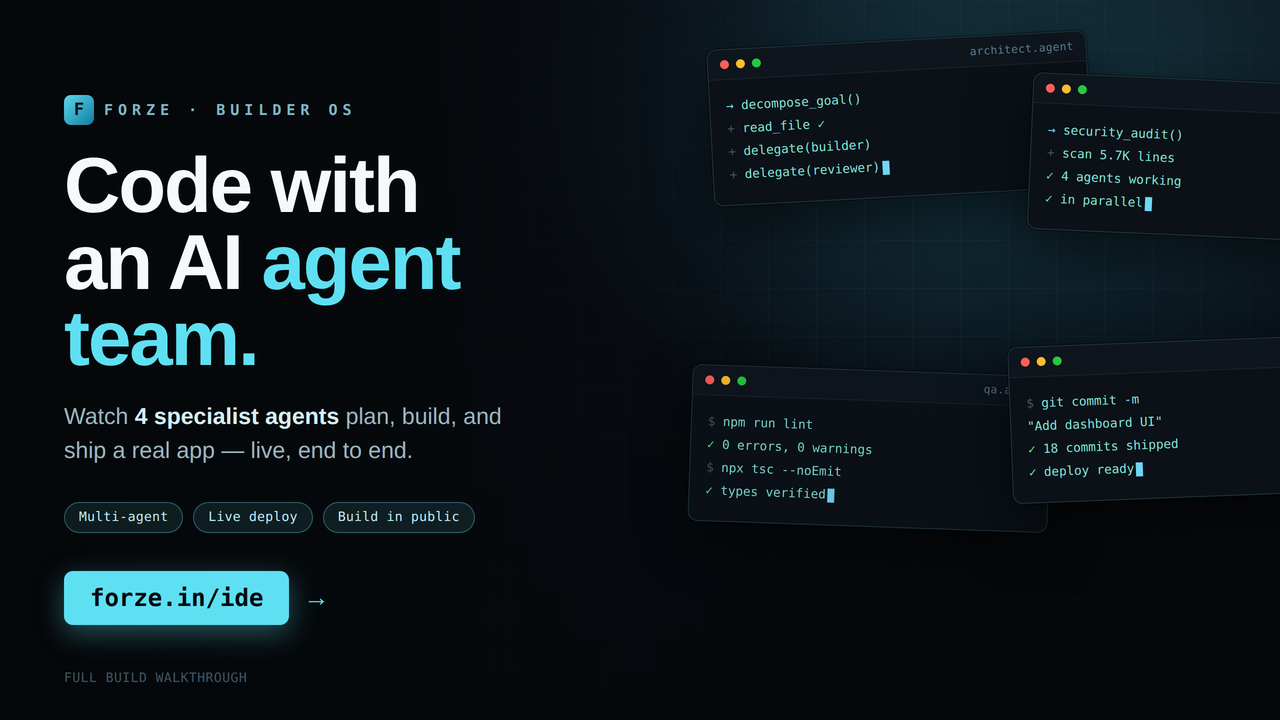
The breaking point was AI agents. We were promised an army of coding agents, but in practice you babysit one chat sidebar at a time. I wanted a cockpit, not a chat box. So I built Forze IDE — a sovereign, offline-first desktop OS where you write code, command a crew of AI agents in parallel, keep secrets from leaking, ship to production, and turn your git log into distribution — all without leaving the workbench.
Everything built within the time limits set by this hackathon.
What it does
Forze is a "Builder OS" for founders. The headline capabilities:
- Vibe Stations — a native grid of real PTY terminals running actual agent CLIs (Claude Code, Codex, Antigravity
agy, OpenCode) side by side. You form an AI Crew: Claude as the Architect that plans once, lane-locked Builders that can't step on each other, and a Reviewer. They coordinate over a shared Agent Bus with server-enforced path-leases, so parallel agents can't collide on the same files. - Scheduled Prompts — cron for your crew. Schedule a prompt and Forze auto-opens the station, boots the shell, launches the CLI, waits for the REPL to settle, and types the prompt for you.
- Commit Guard — every save is tracked; every commit passes a pre-commit security review that scans the staged diff for secrets (API keys, tokens). If it finds one, the commit is blocked before anything ever touches the cloud.
- Build in Public — select the commits you just shipped and Forze turns the diffs into benefit-driven LinkedIn posts, then posts or queues them in the BIP scheduler.
- The rest of the workbench — a full Vercel deployments client, VS Code-style source control with change gutters, a Kanban board, a local-first community feed, and a Dashboard whose metrics derive from real signals (git streaks, workspace stats, task breakdowns) — no dummy data.
How we built it
- Shell: Tauri v2 (Rust core + system WebView) for a small, fast, truly native desktop app.
- Frontend: React 18 + TypeScript, Zustand for state (with debounced persistence so token-by-token AI streaming never thrashes localStorage).
- Terminals: OS-level PTYs spawned from a native Rust crate, streamed over IPC and rendered on a custom canvas/GPU terminal renderer — not mock frames.
- Agent Bus: a dependency-free, single-file, filesystem-based IPC broker living in
.forze/. No network ports — identity, role, and lane are injected via env so each CLI knows who it is in the crew. - AI: a single
aiConfig.tssource of truth — Gemini as the keyless built-in default, Claude as BYOK. - Persistence: offline-first local storage with optional Supabase account sync for the project list and chats (files always stay local).
If $n$ agents run on independent lanes, wall-clock time collapses from the serial sum toward the slowest single agent:
$$ T_{\text{crew}} \;=\; \max_{1 \le i \le n} t_i \quad\ll\quad \sum_{i=1}^{n} t_i \;=\; T_{\text{serial}} $$
That speedup is the entire reason the crew model exists.
Challenges we ran into
- Parallel agents corrupting each other's work. The first crew model let two agents edit the same file. The fix was a server-enforced path-lease system in the Agent Bus that makes collisions structurally impossible, not just discouraged.
- The webview crashing mid-stream. Persisting Zustand on every streamed token blew the localStorage quota and stormed the main thread. Solved with debounced JSON storage on the streaming stores.
- "Empty response" from Gemini — the SSE parser split on
\n\nwhile the stream used CRLF; stripping\rfixed it. AI providers are full of these papercuts. - Windows console flashes — git/npm spawned from the GUI popped terminal windows; every Rust
Commandnow goes through ano_windowhelper withCREATE_NO_WINDOW. - Build & boot performance — Rust builds were swapping the machine to death (capped parallel rustc jobs), and boot eagerly imported all 16 views and the full highlight.js bundle (now lazy-loaded and trimmed to core + 25 langs).
Accomplishments that we're proud of
- Real PTYs, real CLIs, real parallelism — Vibe Stations run genuine agent CLIs concurrently, not chat mock-ups.
- Collision-proof multi-agent coordination over a serverless, portless, single-file bus.
- A security gate that actually stops a leak on stage — paste a token, hit commit, watch it get blocked.
- A genuinely premium feel — matte-black UI, single accent, custom title bar, GPU terminal, and a Dashboard powered entirely by real builder signals.
- It's offline-first and sovereign — your code and your agents stay on your machine.
What we learned
- Orchestration beats raw model power. Three coordinated agents with clear roles and lane-locks out-ship one "smart" agent every time — but only if collisions are impossible by design.
- Streaming is where apps go to die. Most of our hardest bugs (crashes, empty responses, quota blowups) lived in the streaming path. Treat it as a first-class system, not a UI detail.
- Native desktop is unforgiving and worth it. Tauri + Rust gave us speed and real OS access, but every platform (Windows especially) demanded its own polish.
- Founders don't want more tools — they want fewer. The product won when we collapsed five apps into one surface.
What's next for Forze IDE
- Strategic Simulator — model runway, pricing, and roadmap trade-offs right inside the OS.
- Cross-platform crews — agents that coordinate across machines over the same lease model.
- A deeper Build-in-Public engine — multi-platform distribution (X, threads) from a single git event.
- A marketplace of crew "playbooks" — shareable Architect → Builder → Reviewer templates.
- Local model support in Vibe Stations for fully air-gapped, sovereign development.
Built With
- anthropic
- better-sqlite3
- claude-api
- claude-code
- cmdk
- css
- drizzle-orm
- gemini
- google-gemini-api
- google-oauth
- highlight.js
- javascript
- keyring
- linkedin-api
- lucide-react
- model-context-protocol
- node.js
- pnpm
- portable-pty
- prettier
- react
- reqwest
- rust
- serde
- sql
- sqlite
- supabase
- tauri
- tauri-v2
- typescript
- vercel-api
- vite
- xterm.js
- zod
- zustand

Log in or sign up for Devpost to join the conversation.