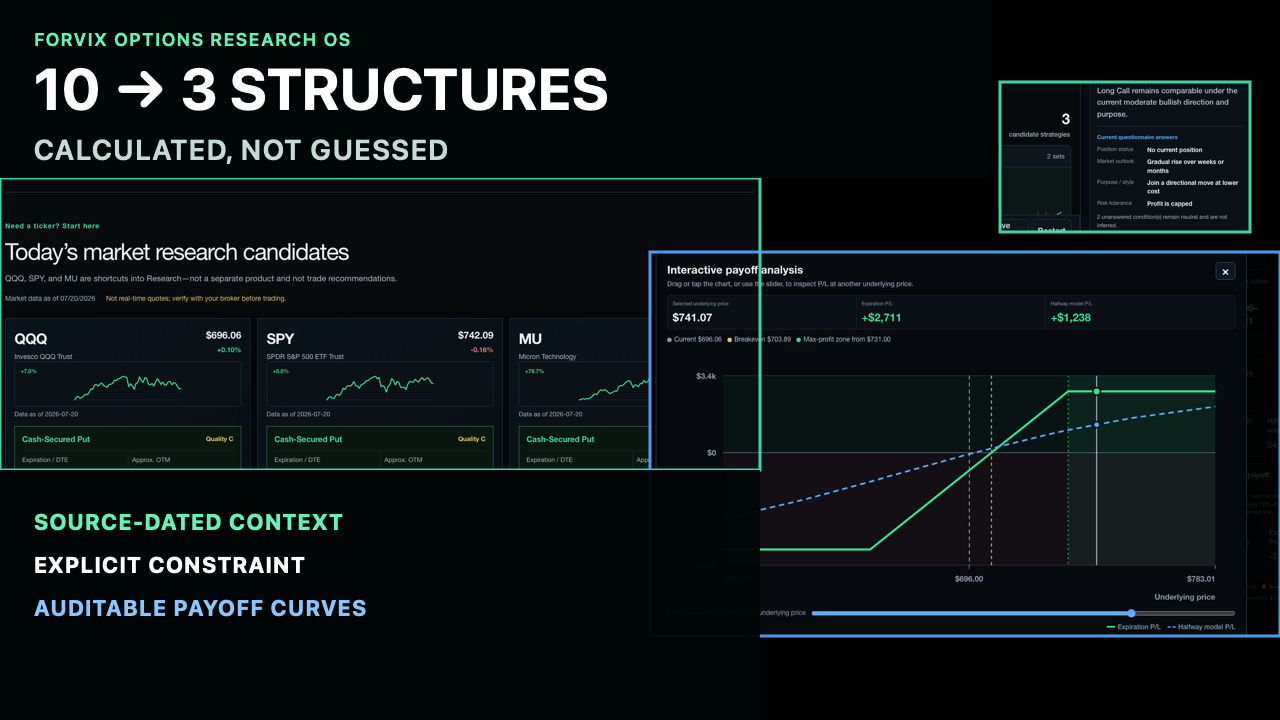
Forvix Options Research OS
Options research often breaks down between a market opinion and a defensible decision. Screeners can surface contracts, but they rarely explain whether a strategy actually fits the investor's position, objective, risk limits, and available data. Forvix turns that gap into a guided, auditable research workflow.
What it does
Forvix connects three production surfaces:
- Portal — source-dated QQQ, SPY, and MU candidates with Cash-Secured Put and Covered Call context, visible data provenance, compact payoff previews, and a clear non-real-time disclosure.
- Research Funnel — a guided questionnaire that captures position state, outlook, objective, and risk constraints. Quality checks and hard exclusions run before compatible strategies are grouped. Changing an assumption deterministically moves, narrows, or excludes results.
- Position Lifecycle Research — starts from the investor's actual holding, confirms the recognized structure, and compares governed Hold, Close, Add, Roll, Restructure, and Protection paths. Hold and Close always remain visible baselines.
Every result exposes the complete position after adjustment, support state, relevant payoff and capital fields, movement or exclusion reasons, data snapshot, rule version, and audit metadata. Interactive payoff analysis lets users inspect expiration and supported halfway scenarios without turning the result into a trading recommendation.
How it works
The product follows one dependency direction:
source-dated provider data
→ normalized schemas
→ Quality
→ hard exclusions and eligibility
→ deterministic construction, payoff, Greeks, probability, and scenarios
→ grouped ranking and audit output
→ Portal / Research Funnel / Position Lifecycle UI
Forvix Core owns every financial calculation. The UI cannot redefine a payoff, probability, eligibility decision, or ranking. Unsupported values remain Not supported, Data unavailable, or Unknown instead of silently becoming zero.
The production application uses Vue 3, TypeScript, Vite, Azure Functions, shared TypeScript packages, and Azure Static Web Apps. MongoDB is modeled as persistent truth, while Redis is limited to cache, lock, and rate-limit responsibilities. Provider adapters keep Moomoo market context and the WhaleQuant option-chain proof of concept outside the financial engines.
Built during OpenAI Build Week
This is a greenfield Build Week implementation, independent from the legacy Forvix codebase. During the week we created the governed contracts and shared schemas, deterministic strategy and lifecycle engines, three connected product surfaces, provider and persistence boundaries, automation workflows, API functions, responsive bilingual UI, accessibility behavior, test suites, CI, and production deployment.
How Codex and GPT-5.6 were used
The product owner set the research-only positioning, financial boundaries, and accepted or rejected product decisions.
GPT-5.6 in Codex challenged the initial natural-language-first direction and helped identify a safer architecture: explicit governed questions, Quality before Strategy, hard exclusions before ranking, and deterministic calculations owned by a testable Core. It also helped review competition requirements, architecture trade-offs, lifecycle contracts, and submission evidence.
Codex then implemented the reviewed decisions across the monorepo: typed contracts and schemas, deterministic engines, provider isolation, Vue workflows, Azure Functions, test coverage, CI/CD, production debugging, responsive verification, and final hardening.
The runtime GPT interface is optional, backend-only, structured-output constrained, auditable, and disabled by default in the deployed golden path. It may explain structured Core results when configured, but it never calculates or selects a financial outcome.
Verification
The final deterministic suite passed:
- 144 unit tests
- 80 golden tests
- 13 mocked collector tests
- 6 automation tests
- no-OpenAI-API guard
- automation prompt verification
GitHub Actions typecheck, production build, complete tests, and Azure deployment are green. Production smoke testing passed all seven documented web and API routes. Portal, Research, and Position Lifecycle were verified in English and Traditional Chinese at 390, 768, 1024, 1440, and 1920 px without document-level horizontal overflow.
Accessibility verification includes dialog focus containment, Escape close, focus restoration, reduced-motion handling, semantic controls, mobile expand/collapse in both directions, and non-empty SVG payoff paths.
Research and data boundaries
Forvix is not a broker, adviser, execution system, order router, wallet, or autonomous trading agent. It provides research comparisons, not buy, sell, hold, close, roll, or restructure recommendations. Displayed values are source-dated and are not represented as executable real-time quotes. Users are instructed to verify executable quotes with a broker. Provider redistribution and commercial authorization remain subject to provider terms.
Try it
- Production: https://forvix.net
- Repository: https://github.com/gogowinners/forvix.net
Start on the Portal, open a QQQ candidate, change a risk assumption in the Research Funnel, inspect the resulting payoff path, and then use Position Lifecycle Research to compare governed alternatives for an existing holding.
Built With
- azure-functions
- azure-static-web-apps
- codex
- github-actions
- gpt-5.6
- mongodb
- moomoo-opend
- python
- redis
- typescript
- vite
- vitest
- vue.js
- whalequant

Log in or sign up for Devpost to join the conversation.