-
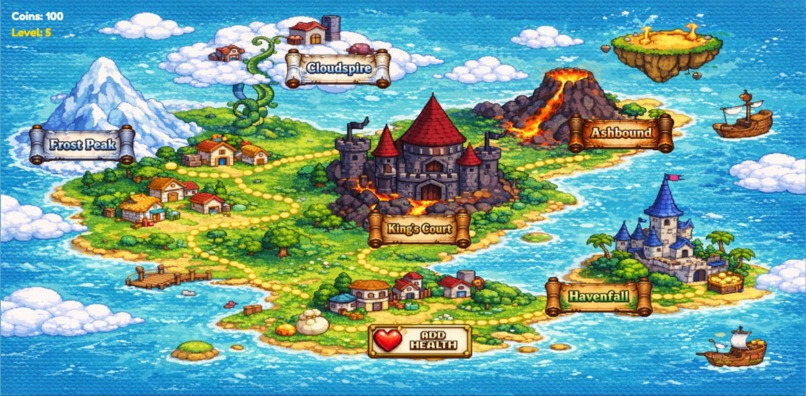
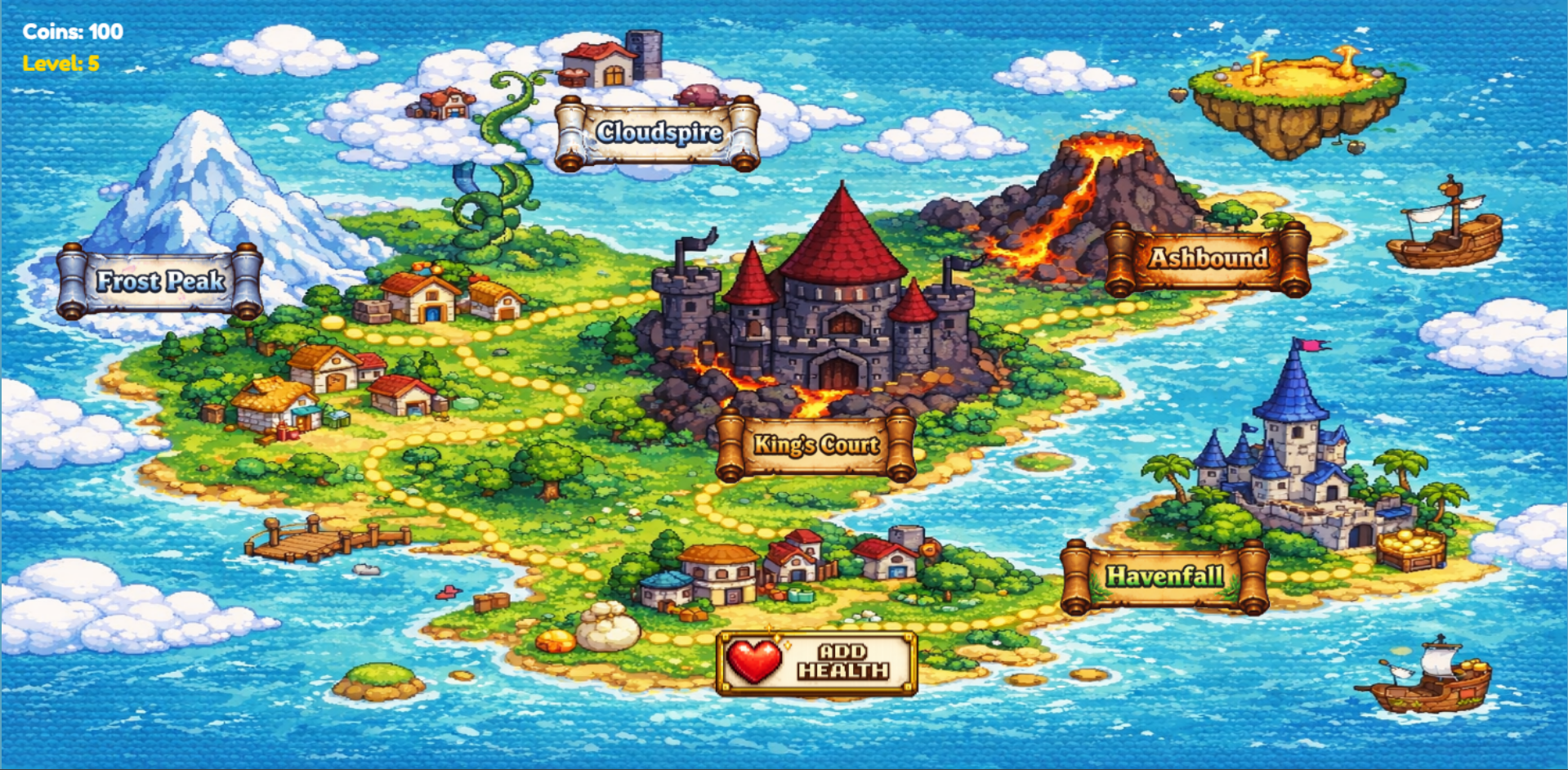
Main Map Screen
Inspiration
The game that became our biggest inspiration was our childhood favourite, "Prodigy". What stuck with us was the way that Prodigy got us hooked and motivated us to learn math through its playful and competitive environment. Even though it was associated to school and work, we remembered it as one of the most fun things that educated us growing up. It made us realise that as children, we loved learning when we are able to experience its rewards first-hand and immediately. Although, Prodigy was limited to mathematical topics, we wanted to create a similar experience with financial literacy, a topic not all children are taught to be mindful of. We thought this was extremely important for kids to understand and what better way than a game that not only uses a currency system, but is entirely based on questions that expose children to scenarios where their financial choices matters.
What it does
Fortune Island is a level-based game where users are able to initiate a battle against a monster, in hopes of defeating it to win rewards. In combat, questions describing a financial scenario pop up, prompting the user to select the multiple choice option that reflects the best course of action. With every correct answer, the monster receives damage, and with ever incorrect answer, the user receives damage. If the battle is won, the user is rewarded with coins that can be used to purchase power-ups.
This teaches children how to rationally handle real-life decisions that involve money. At the same time, it teaches them the value of money and encourages them to work hard for their earnings. It also gives them the freedom to decide what to purchase, boosting their confidence in their spending habits.
How we built it
We built Fortune Island using Phaser.io for front-end, allowing the users to play the game on the web, Django Ninja for back-end, and GitHub for collaboration. The languages we used consisted of JavaScript, HTML, and Python.
Challenges we ran into
One of the challenges we ran into was transferring our project from TypeScript to JavaScript, since we originally started building with TypeScript and had to rework parts of our code. We also had some trouble with our GitHub repositories, especially when trying to merge our branches and dealing with conflicts along the way. On top of that, we faced challenges using the API, as it wasn’t always clear how to implement it properly, which made us unsure at times if we would even be able to include it in our project.
Accomplishments that we're proud of
We are most proud of the technical skills we implemented along the way such as using an SQL database and using Phaser for the frontend animations.
What we learned
This was the first hackathon for three of our teammates, so they learned how to use Git and how it actually works when building something with a team. It was also our first time using a game development framework and working with both the frontend and backend together, which helped us understand how everything connects. Overall, we learned a lot about teamwork, communication, and how important it is to stay organized and help each other out, especially when things don’t go exactly as planned.
What's next for Fortune Island
We plan to add to the bank of questions so the user can continuously play without repetition. Our intention is to create parent profiles in the future so parents can watch their children's progress and also have the ability to flag any questions they seem unsuitable within the question bank. We also would like to implement a demo test to reflect how children would actually play and adjust the difficulty by changing the health/power strengths to keep the game challenging but motivating.


Log in or sign up for Devpost to join the conversation.