-
-
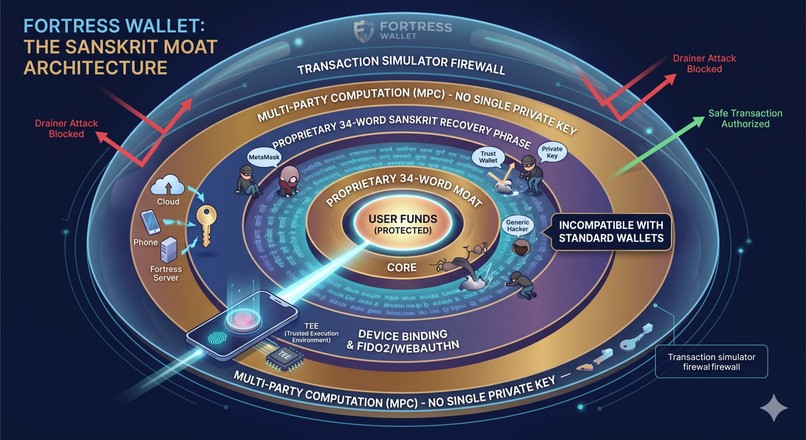
A 34-word Sanskrit MPC moat and active pre-execution firewall that physically blocks drainers from user funds.
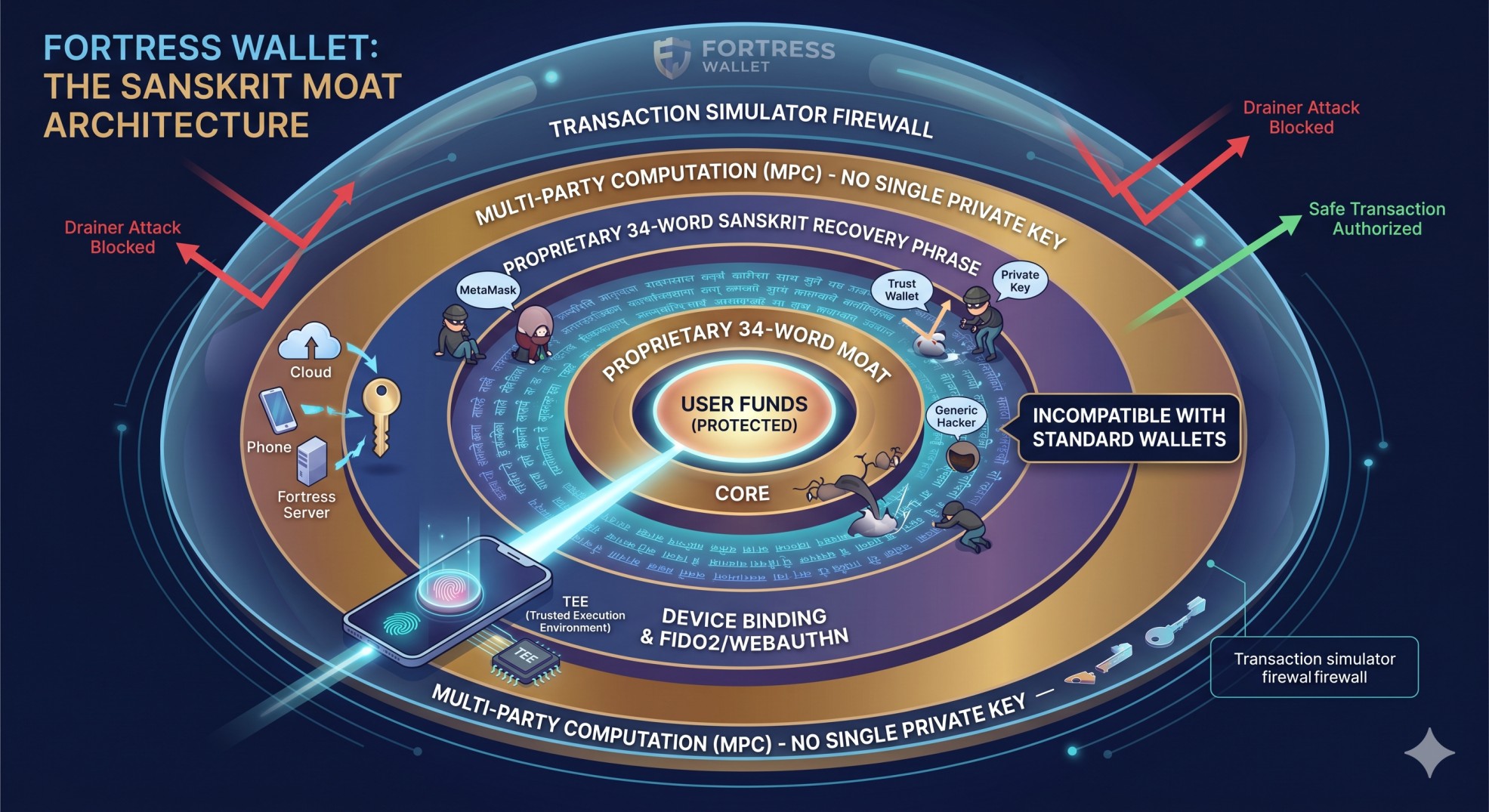
🛑 The Inspiration: A Broken System The current self-custody model in Web3 is a systemic failure. Everyday users are bleeding billions to malicious smart contracts and phishing links simply because standard wallets are built as passive signers. If a user connects to a drainer dApp, one wrong signature wipes out their entire TVL.
Drawing from years of scaling high-volume consumer platforms, I realized that mass adoption will never happen if users are terrified of clicking a button. The ecosystem doesn't need another generic wallet UI—it needs a zero-trust active defense system that operates invisibly in the background.
🛡️ What it does: Fortress Wallet Fortress Wallet is an institutional-grade self-custody wallet that acts as an active firewall for the retail user. We implemented two critical layers of defense:
The MPC Vault: We completely abstracted the vulnerable 12/24-word seed phrase, replacing it with a proprietary 34/35-word Sanskrit entropy matrix distributed via Multi-Party Computation (MPC). No single point of failure exists.
Pre-Execution Simulator: We transformed the wallet from a passive signer into an active firewall. Before any transaction is signed, our localized WASM sandbox intercepts the payload and dry-runs it against live RPC nodes to mathematically verify the state changes. If a drainer is detected, the wallet physically blocks the execution.
🏗️ How I built it I built Fortress Wallet to bridge hardcore cryptography with frictionless Web2 UI/UX. The core simulation logic was compiled into a WebAssembly (WASM) sandbox so it can run entirely client-side without compromising speed. I integrated high-throughput RPC nodes to ensure the dry-run simulations happen in milliseconds, ensuring the retail user never experiences latency during their transaction flow. The frontend is heavily optimized to feel as simple and intuitive as a standard Web2 checkout process.
⚠️ Challenges I ran into The biggest challenge was the "Simulation Latency." Running a pre-execution simulation on every single transaction requires incredibly fast, localized node queries. If the wallet lags for 5 seconds waiting for the simulation to finish, the user will abandon the transaction. I spent a massive amount of time optimizing the WASM sandbox execution and routing RPC calls to ensure the security layer remains entirely frictionless.
🚀 What's next for Fortress Wallet The next immediate step is taking this Alpha UI and fully deploying the MPC sharding architecture to the testnet. Following that, we are seeking an ecosystem grant to fund a comprehensive third-party security audit of the WASM sandbox before our official Mainnet launch.
Built With
- cryptography
- multi-party-computation
- react-native
- rpc-nodes
- rust
- webassembly

Log in or sign up for Devpost to join the conversation.