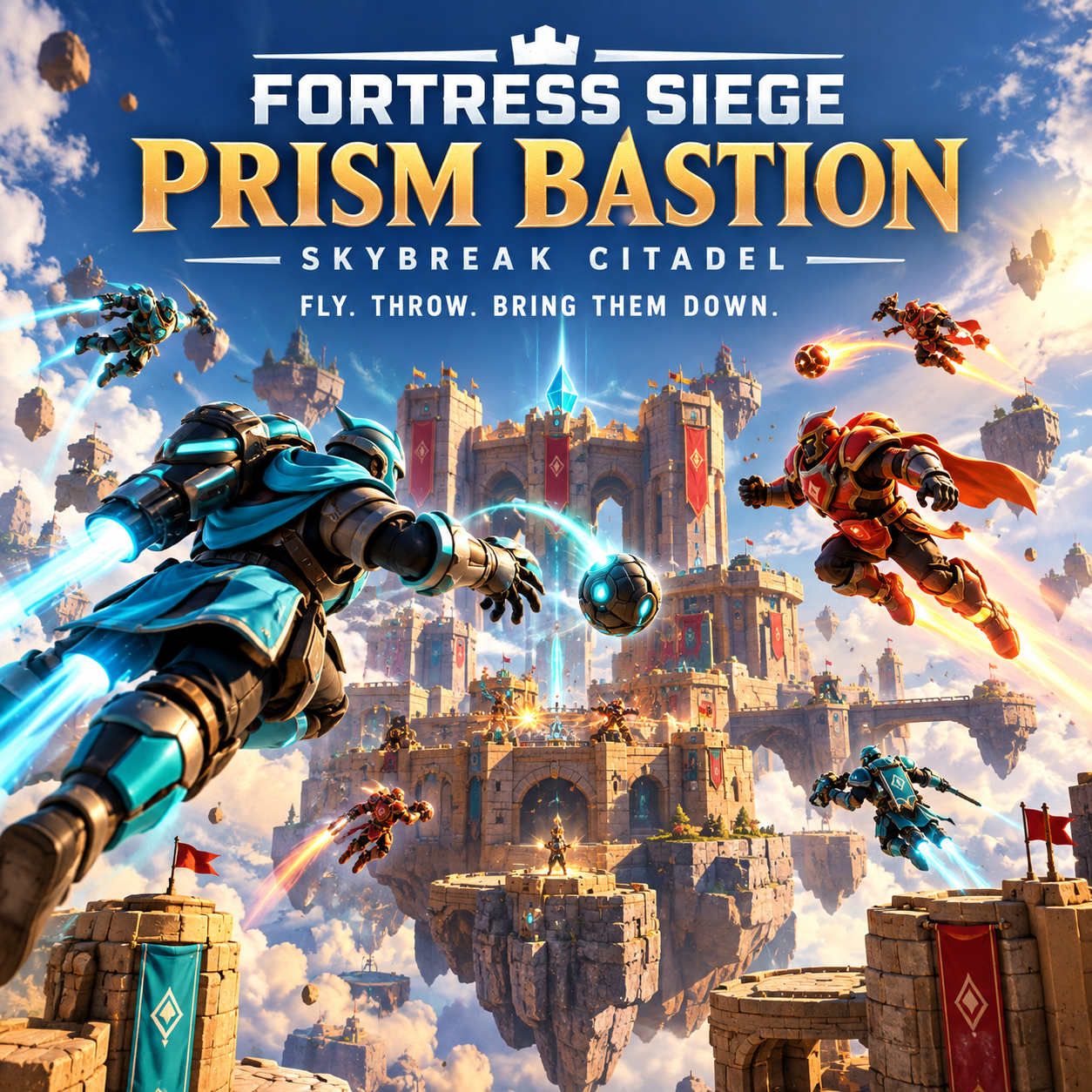
Fortress Siege: Prism Bastion started as an attempt to make tower defense feel more active and physical. I wanted the player to make real strategic decisions about towers, defenders, upgrades and tactical cards while also being able to personally enter the battle.
What it does
Prism Bastion is a single-player action tower-defense game built for a portrait mobile-style viewport.
Each side protects three towers. The player drafts a squad from nine original heroes, assigns one keeper and two field defenders, upgrades towers with mana, uses tactical cards, and controls an attacker directly.
The central objective is physical bomb delivery. Crimson, Azure and Gold bombs must be carried, flown into a valid scoring position and physically thrown into the matching enemy tower. Defenders can intercept carriers, block delivery paths, fight attackers and create openings elsewhere on the battlefield.
The match escalates over three minutes, with stronger pressure and faster mana regeneration near the end.
How I built it
The prototype was developed with AI assistance through an iterative prompt-build-test workflow.
The game uses Three.js / HTML5 with readable game code packaged directly into the submission. The nine original hero models and animations were authored through Blender-based workflows. The arena, towers, combat systems, bomb physics, AI behavior, cards, progression, visual effects and interface were repeatedly tested and revised through automated simulations and browser playtesting.
Challenges
The largest challenge was combining direct action combat with a strategy game without making either side feel unnecessary.
AI defenders had to protect towers intelligently while still being beatable. Bomb deliveries needed to remain physical rather than becoming automatic scoring events. The camera also had to keep combat readable inside a fixed portrait layout.
A large amount of development went into navigation, flight, physical interceptions, defender positioning, CPU siege behavior, tower destruction and keeping the complete game self-contained with no external runtime network requests.
What I learned
The biggest lesson was that a working mechanic is not enough. The game improved most when I repeatedly played it, rejected interactions that were technically correct but not enjoyable, and used AI to iterate on the actual player experience.
The result became a hybrid of tower defense, tactical squad management and arena action that I genuinely enjoy playing.
What’s Next
Fortress Siege: Prism Bastion is designed to grow beyond the original mobile prototype into a cross-platform mixed-reality strategy game.
The next evolution is a tabletop AR/MR experience where the fortress is placed directly onto a player’s real-world table through Meta Quest. Players could see the battlefield around them, interact with heroes, defenders, towers, cards, and bombs using controllers or their hands, and physically move around the battlefield as the battle unfolds.
From there, the battlefield can expand from tabletop scale to room scale. The fortress, objectives, and combat could occupy a larger physical play space, turning the room itself into part of the game.
The long-term vision is also to connect these experiences with mobile players. A player on a phone could manage their fortress, deploy units, play cards, and compete against a player experiencing the battlefield in AR/MR or VR.
That creates a single game world with multiple ways to play:
Mobile → Tabletop MR → Room-Scale MR → Full VR
The original Prism Bastion prototype is the foundation for that larger experience: keeping the fast tower-defense strategy, direct bomb-delivery combat, heroes, cards, progression, and fortress warfare while expanding how players physically experience the battlefield.
If selected for Meta’s rebuild program, the immediate focus would be adapting the core Prism Bastion experience to Meta’s Early Access creation tools while preserving this longer-term direction. The competition’s rebuild is specifically intended to turn a winning prototype into a playable game on Meta’s creation platform.
Built With
- ai
- blender
- codex
- game
- html5
- javascript
- openai
- three.js
- webgl


Log in or sign up for Devpost to join the conversation.