Problem Statement
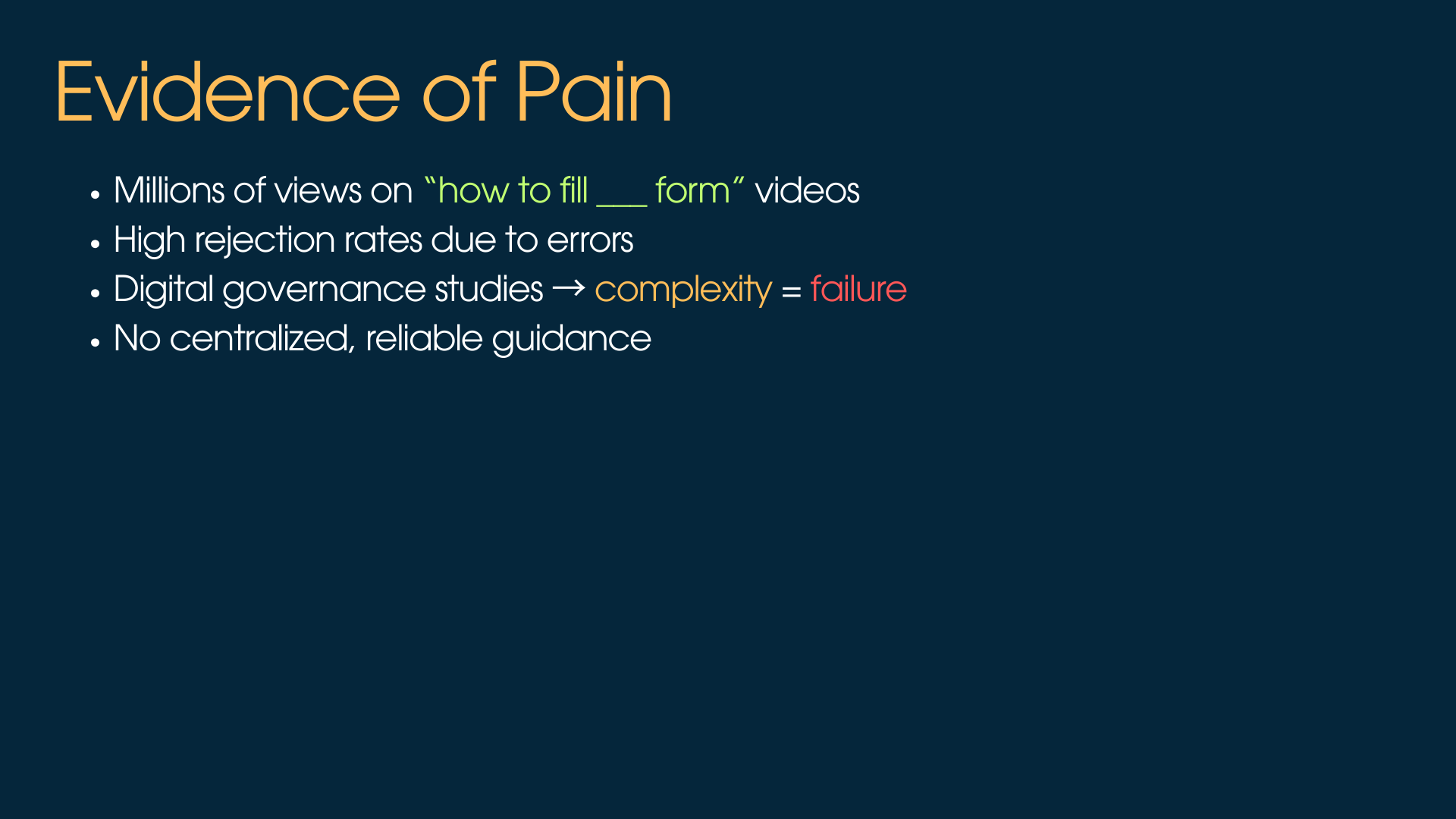
The idea started from a simple but familiar frustration at home: my brother often had to watch multiple YouTube videos just to understand how to fill out basic government forms. That made us realize the real issue wasn’t the forms themselves, but the absence of clear, reliable explanations. Millions of people rely on scattered tutorials because official instructions are confusing or outdated.
Government systems expect citizens to interpret dense, inconsistent, and often outdated forms on their own. Users routinely turn to YouTube videos, Reddit threads, and informal guides to understand basic fields in critical workflows like identity updates, address changes, and certificate applications. These instructions are scattered, unverified, and frequently obsolete. The result: wasted time, errors, repeat submissions, and anxiety, especially for people navigating high-stakes or unfamiliar processes.
Purpose
We aim to solve the missing layer in government digital services: a reliable interpretation layer that explains what forms actually mean. By turning fragmented crowd knowledge into structured guidance, we reduce friction, errors, and uncertainty across essential workflows.
Solution
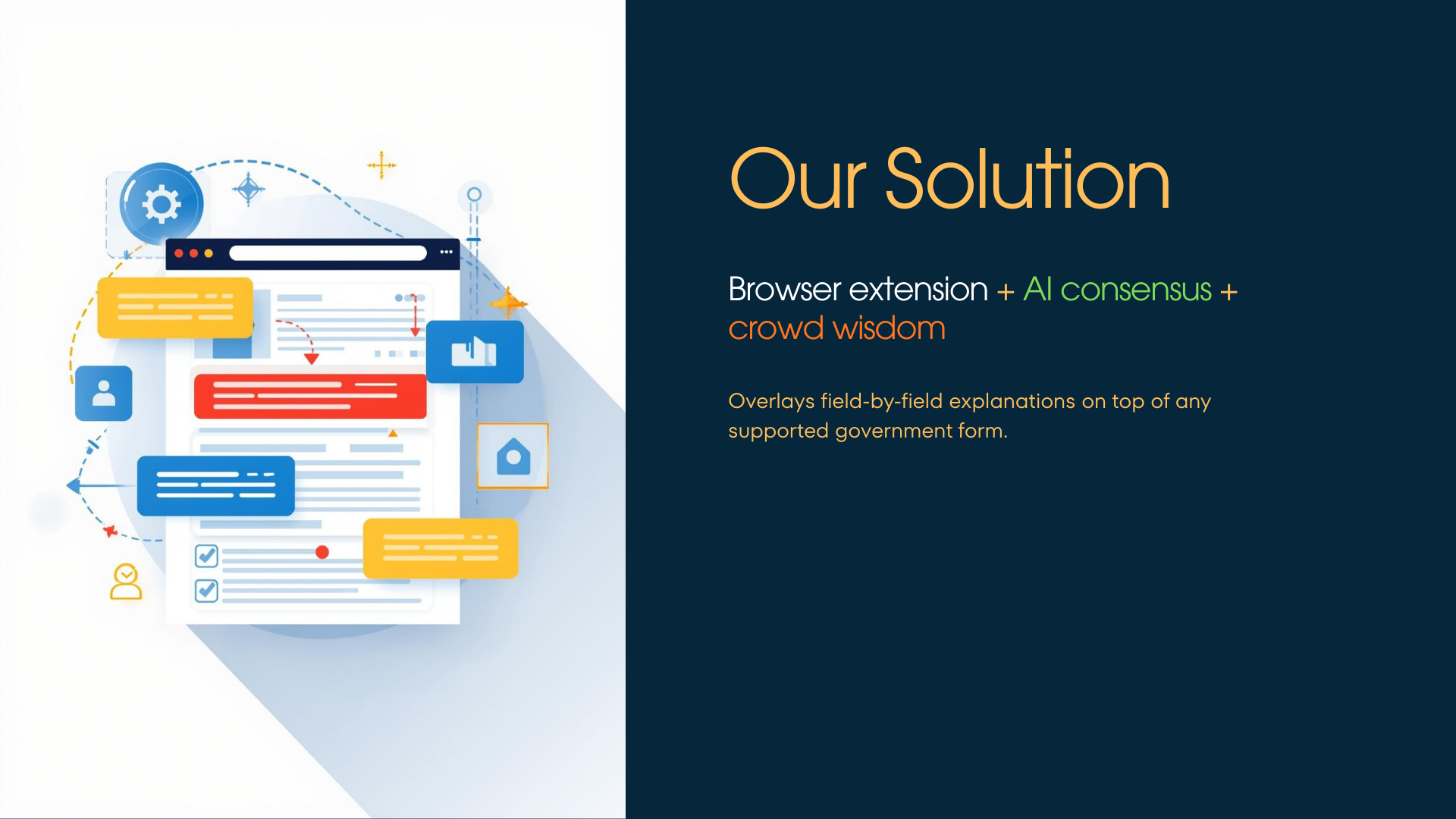
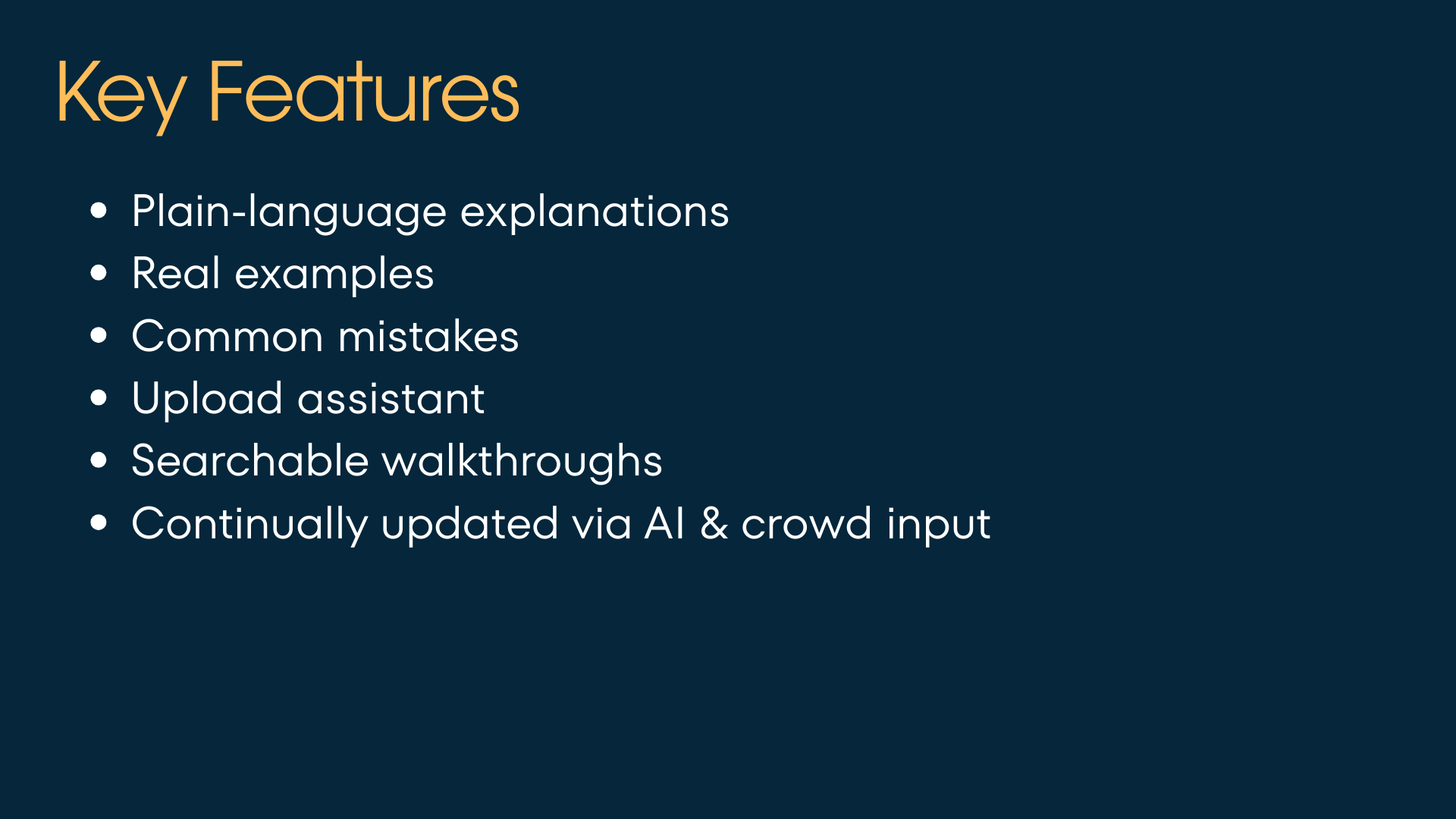
We are building a crowdsourced, AI-curated interpretation layer for government forms. A browser extension overlays plain-language, field-by-field guidance directly on top of official portals. Users see explanations, real examples, common mistakes, and validated upload requirements. Behind the UI, an AI consensus engine aggregates community input, public resources, and official instructions to maintain accurate, up-to-date guidance.
What’s New
Instead of redesigning government systems, we augment them. We convert scattered, informal human knowledge into structured, reliable interpretations that improve any form without requiring institutional integration. This is a high-leverage model: “Honey for bureaucracy.”
MVP
Our MVP focuses on the three most universal friction domains:
- Identity updates
- Address changes
- Certificates (birth, domicile, income)
We will support 1–2 of these forms with:
- A functioning browser overlay
- A lightweight crowdsourcing interface
- An AI consensus model
- An upload assistant
A 30–50 user pilot will measure time savings, error rates, and reduction in reliance on external sources.
Risks & Mitigation
- Incorrect guidance → consensus scoring, expert validation, official references
- Scaling complexity → form-agnostic architecture, automated change detection
- Legal sensitivity → clarify meaning; do not autofill legally binding fields
Success Metrics
Primary: 80% of users complete a form without external sources (YouTube, Reddit). Secondary: 50% reduction in time-to-completion; reduced errors; increased user confidence.
Vision
Once validated, the interpretation layer expands naturally to scholarships, taxes, welfare applications, healthcare access, licensing, and immigration. Each new form strengthens the shared knowledge base. Over time, we create a universal civic infrastructure that decodes bureaucracy for everyone, locally and globally.
Built With
- next.js
- node.js
- openai
- postgresql
- typescript

Log in or sign up for Devpost to join the conversation.