-
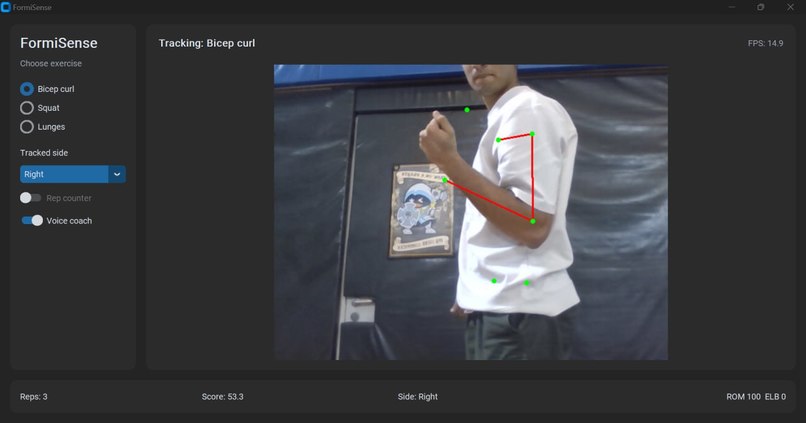
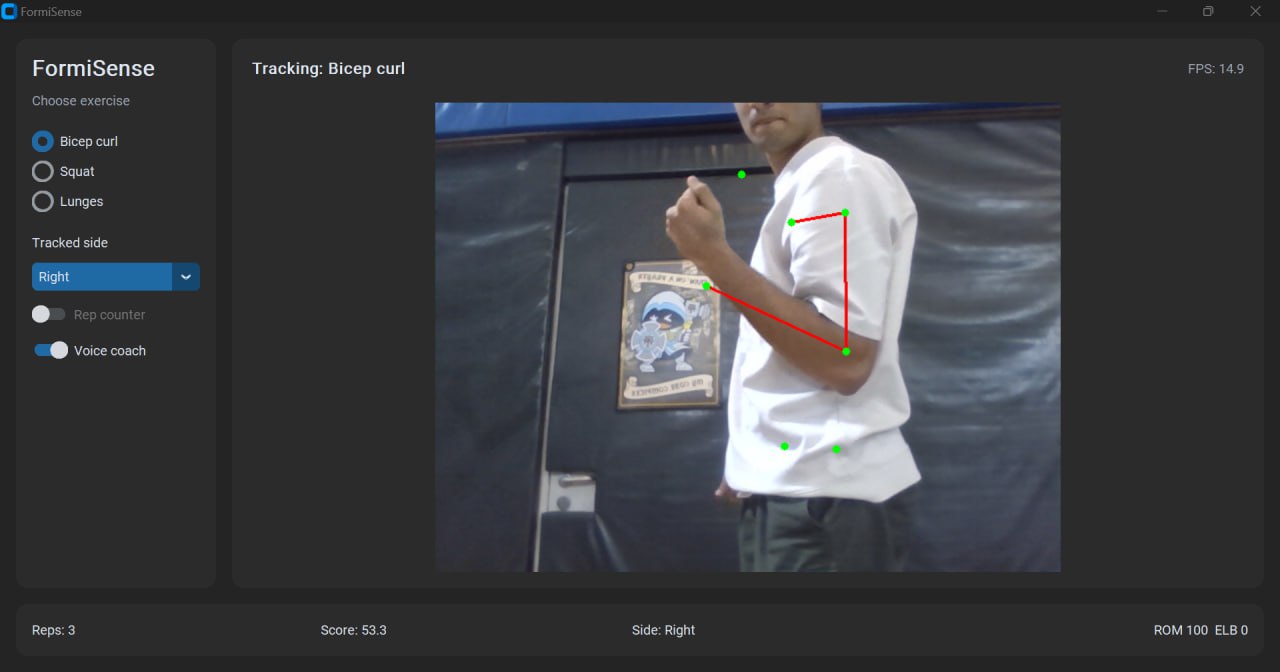
Anish does a bicep curl
Inspiration
we were inspired to build FormiSense from our own experience training and coaching others in fitness. Many people struggle with maintaining correct form during exercises like squats, lunges, and bicep curls, which can lead to injuries or reduce the effectiveness of workouts. we wanted to create a tool that provides real-time guidance and feedback, almost like having a personal trainer , without needing expensive equipment or wearable sensors.
What it does
FormiSense is an AI-powered fitness application that tracks and analyzes exercise form in real-time. It monitors key exercises such as bicep curls, squats, and lunges, calculating joint angles, range of motion, and symmetry to evaluate form. The app counts repetitions and displays scores and visual feedback on a live video feed with a skeleton overlay, helping users train safely and effectively at home.
How we built it
We built FormiSense using Python, OpenCV, and TensorFlow Lite for pose estimation. The model detects 17 body keypoints per frame, which are used to calculate angles and track motion. We implemented rep counting and form scoring algorithms for each exercise, and designed a CustomTkinter GUI to display the live feed, overlays, counts, and scores. Data smoothing and confidence thresholds ensure stable and accurate feedback.
Challenges we ran into
Noisy keypoints: Pose estimation predictions fluctuated frame-to-frame, which we solved using temporal smoothing.
Accurate rep counting: Partial or incomplete movements could be miscounted; we implemented stage detection with hysteresis thresholds to improve accuracy.
GUI scaling: Ensuring the live camera feed resized correctly while keeping skeleton overlays aligned.
Accomplishments that we're proud of
Developed a fully functional real-time exercise tracker for multiple exercises.
Implemented form scoring and visual feedback that provides actionable insights to users.
Built a responsive and user-friendly GUI for seamless interaction.
What we learned
How to work with pose estimation models and process keypoints for real-time applications.
Methods for calculating joint angles, range of motion, and symmetry to quantify exercise form.
Challenges of real-time data smoothing, GUI design, and user interaction.
What's next for FormiSense
Adding more exercises and personalized training programs.
Incorporating performance tracking over time and visual progress charts.
Potentially integrating voice guidance or wearable device data for richer feedback.

Log in or sign up for Devpost to join the conversation.