⏱ Note for reviewers: a live upload runs the
▎ full pipeline on Cloud Run (cold start +
▎ Gemini multi-agent debate) and takes ~2-3
▎ minutes, with progress streaming live. For an
▎ instant, no-wait walkthrough, append ?demo=1
## Inspiration Most AI form-check apps give you a single, confident verdict — and confidence is exactly the problem. Real coaching is a negotiation between encouragement and rigor: a good PT keeps you motivated, while a sharp physiologist won't let a dangerous habit slide. We wanted that tension to be visible, not flattened into one bland answer.
And we wanted to prove a harder claim: that an agent can genuinely learn an individual user's coaching style — not just say it does, but show it with numbers.
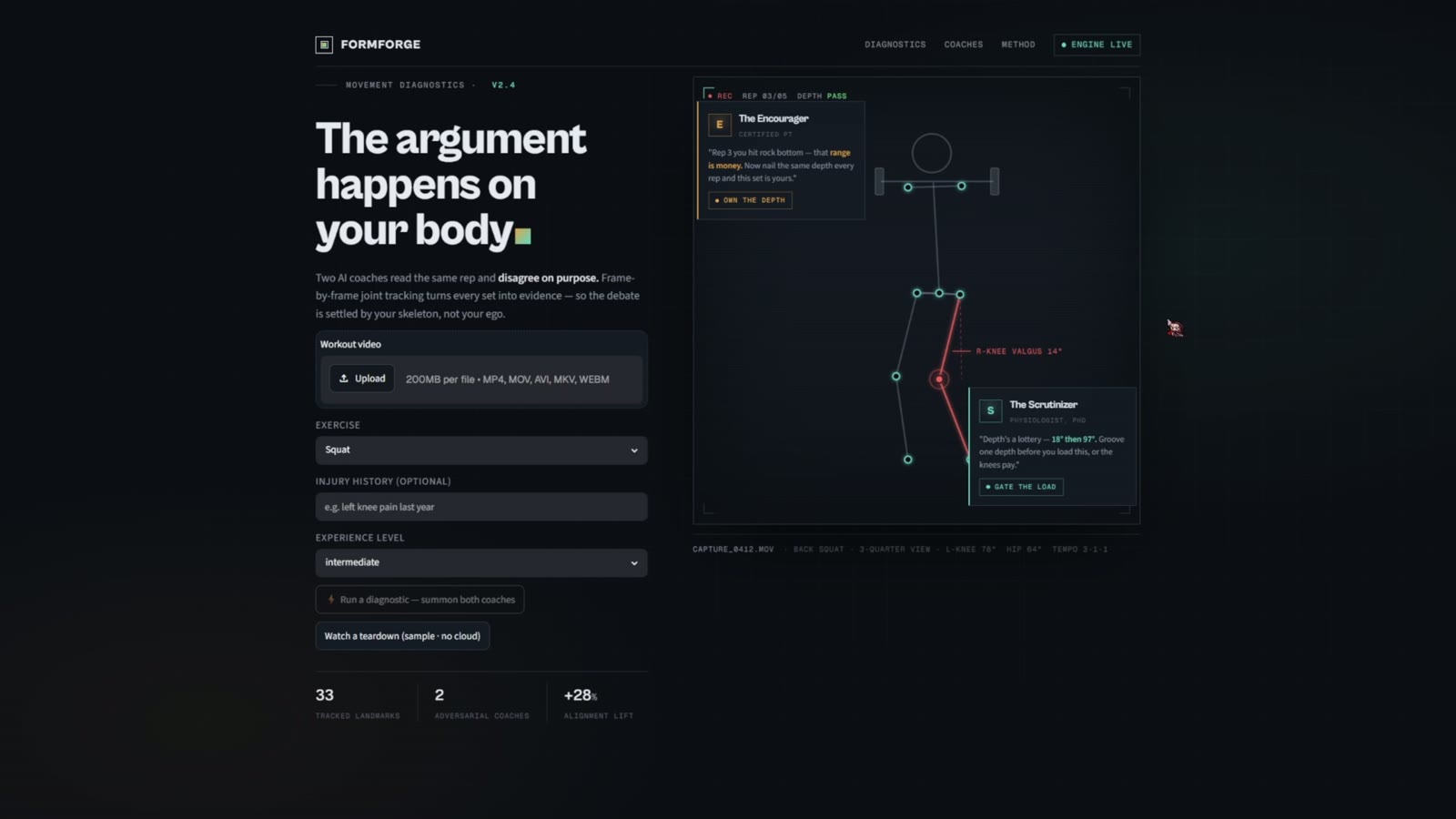
## What it does You upload a short workout video. FormForge runs a multi-agent debate:
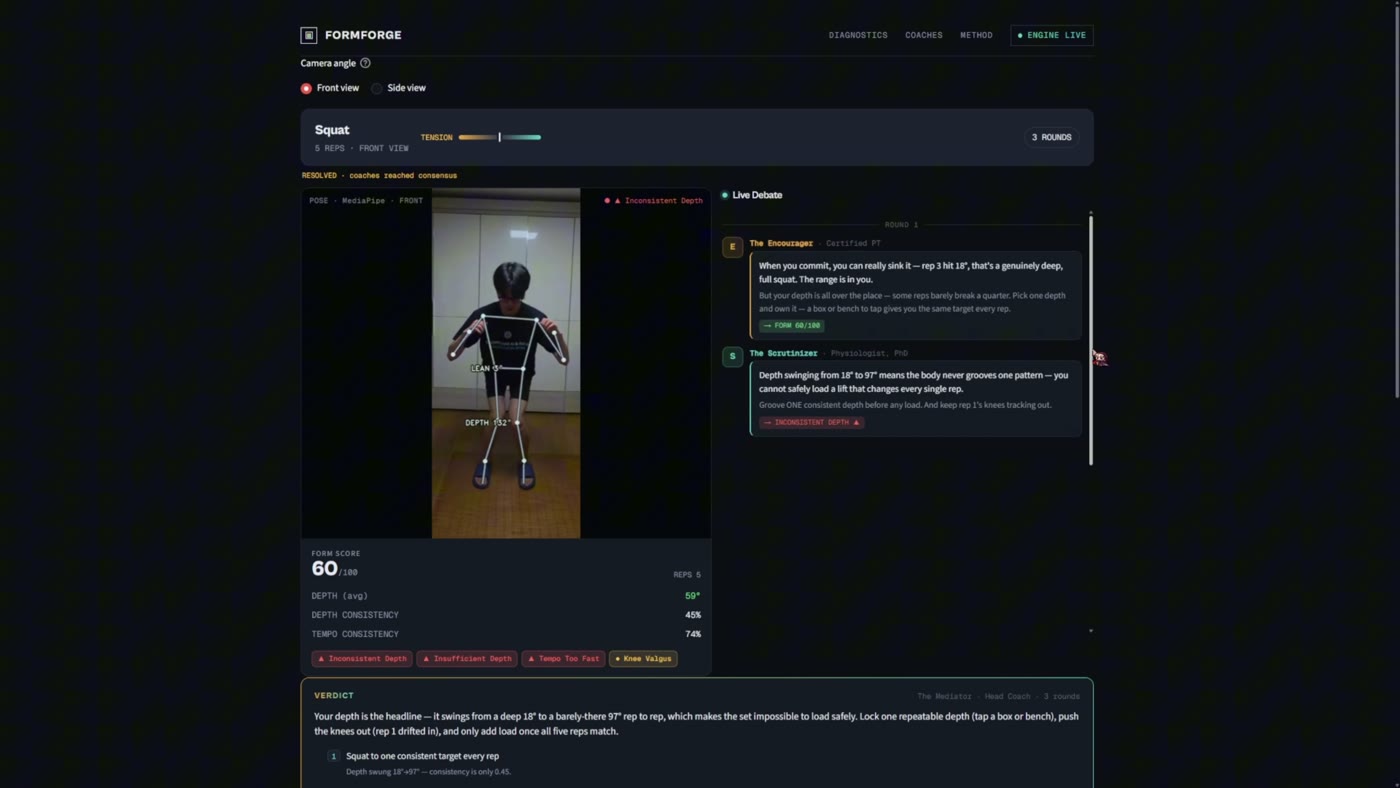
- The Encourager (warm certified PT, 10 years) finds what you did well and proposes one next step.
- The Scrutinizer (rigorous exercise physiologist, PhD) hunts for injury risk and biomechanical flaws, grounded in measured joint angles and tempo.
- The two debate in real time — agreeing, pushing back, standing their ground.
- The Mediator (Head Coach) synthesizes both sides with your past training context, retrieved at runtime through the Arize Phoenix MCP server, into a balanced
verdict with prioritized action items.
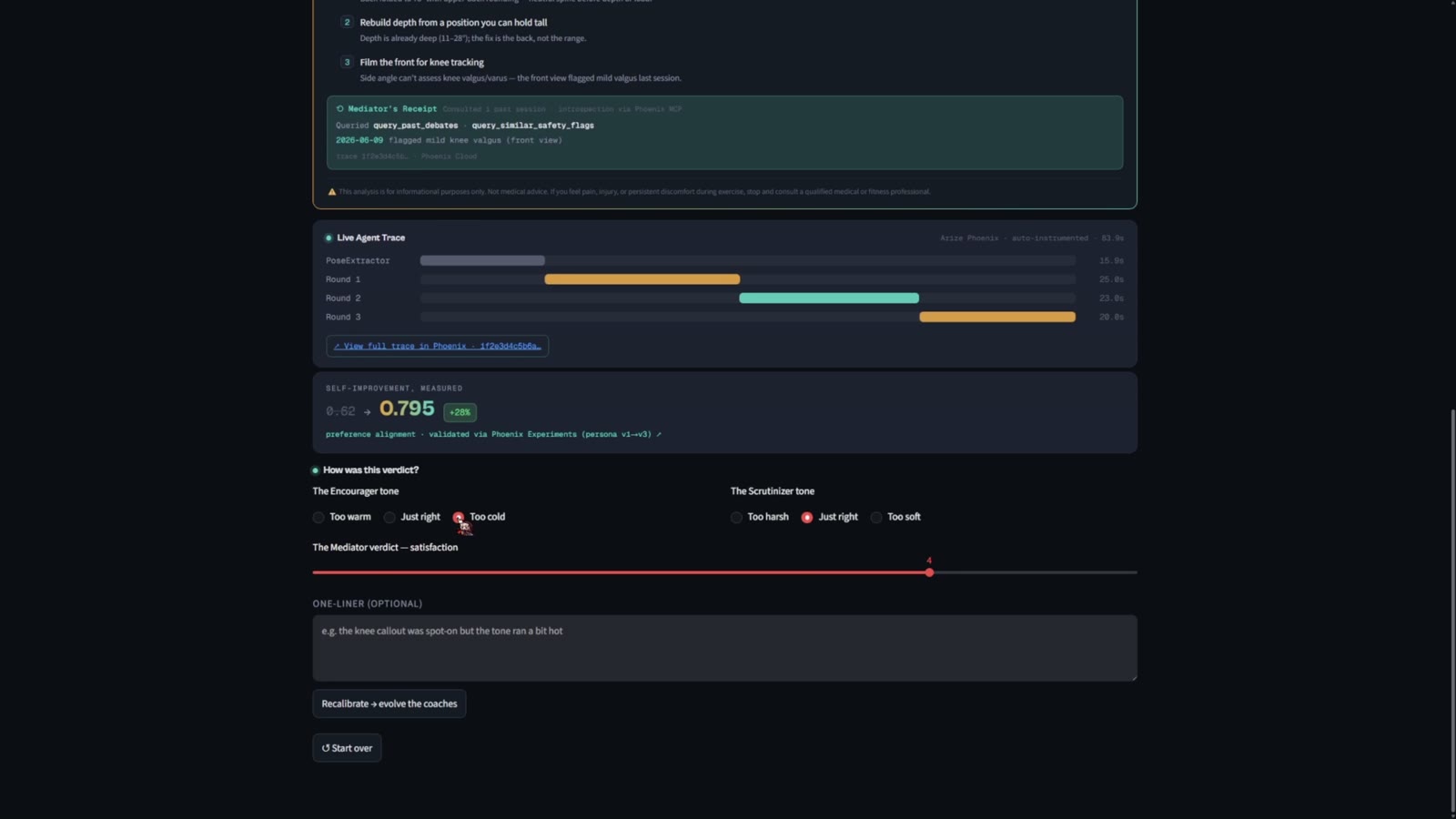
Then you react (too harsh, too soft, perfect, or free text). An LLM-as-a-Judge evaluates the debate and the personas evolve bidirectionally. Over time, the
two coaches become your personal critic pair.
## How we built it
Built with Google ADK (the official open-source framework of Google Cloud Agent Builder) and deployed on Cloud Run (an Agent Builder-supported runtime), powered
by Gemini 2.5 Pro / 2.5 Flash and Gemini 3.5 Flash, with the Arize Phoenix MCP partner server for agent self-introspection.
- Orchestration: ADK hierarchical multi-agent (parallel debate rounds + convergence detection + mediator synthesis).
- Multi-modal × multi-agent: one video, multiple lenses — a 2-stage PoseExtractor uses MediaPipe to measure joint angles/tempo and Gemini 2.5 Pro to
interpret them, so the LLM never fabricates precise numbers. - Self-introspection (MCP): a custom FastMCP server wraps the Phoenix REST API + Firestore; the Mediator autonomously calls
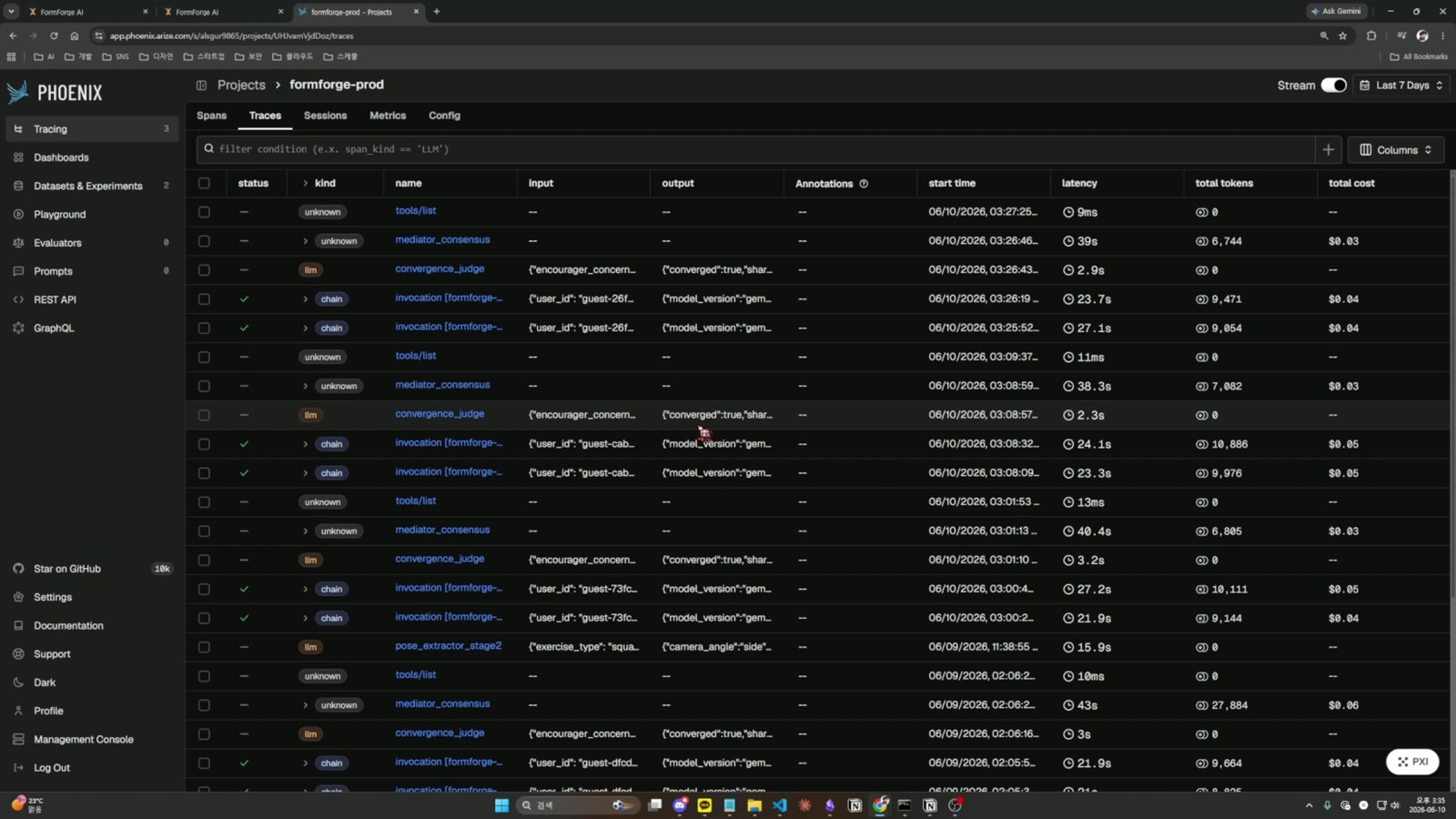
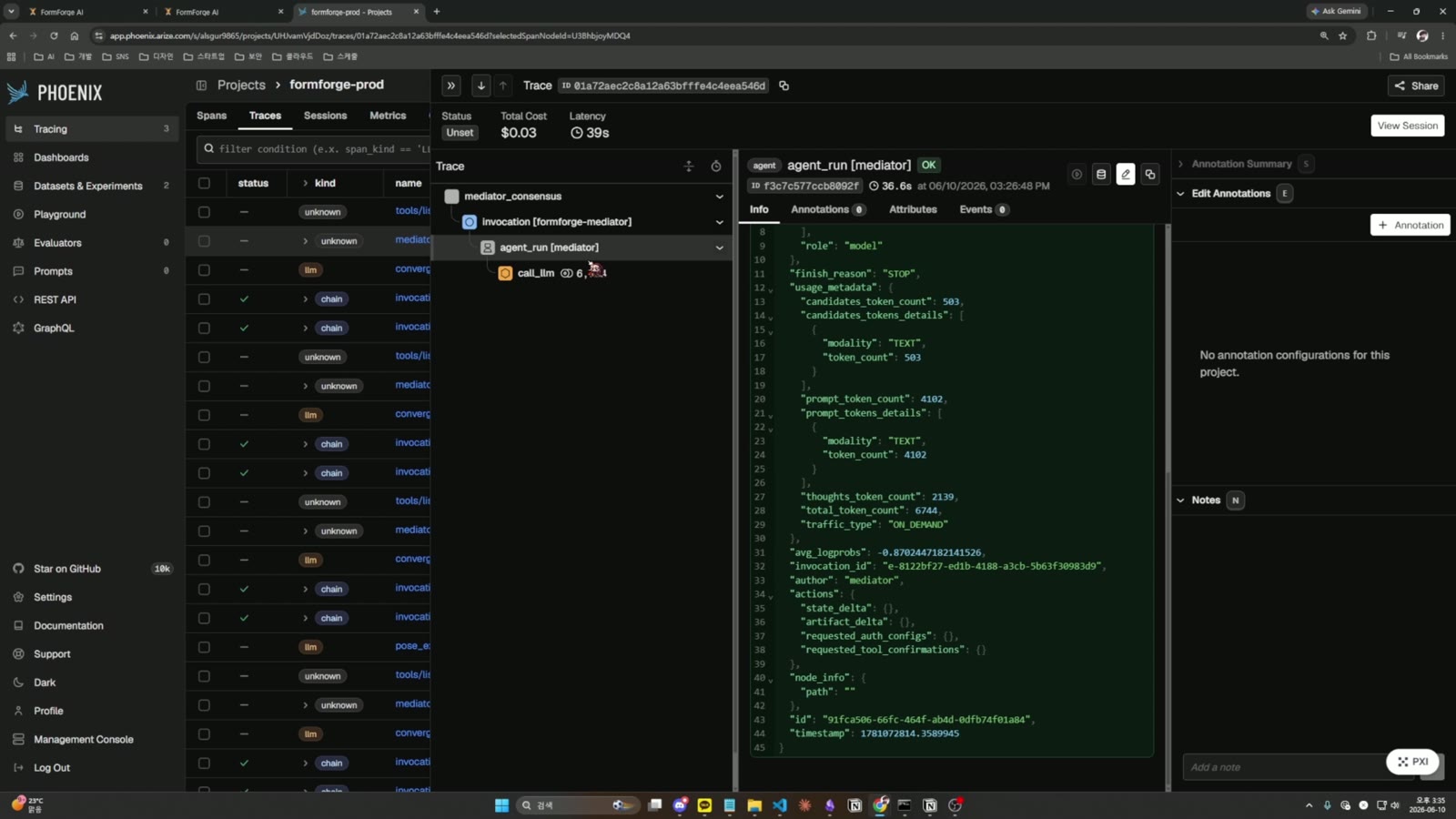
query_past_debatesandquery_similar_safety_flagsto pull the user's own history. - Observability: Arize Phoenix Cloud auto-instruments every agent — the full debate, the convergence judge, and the MCP tool calls all show up as a traced tree.
- Self-improvement, measured: a Phoenix Datasets & Experiments pipeline runs the same debate scenarios under the baseline persona (v1) vs. the evolved persona
(v3) and scores them with two evaluators.
## Accomplishments that we're proud of
We didn't claim personalization — we measured it. Using Phoenix Experiments on a fixed dataset, holding everything constant and changing only the persona version
(after 3 rounds of user feedback):
- Preference alignment (matches this user's style): 0.62 → 0.795 — +28% ↑
- Debate quality (coverage / evidence / actionability): 0.75 → 0.765 — held ✓
The coaching became yours — without degrading its substance. The whole comparison lives in Phoenix, timestamped and reproducible. We also shipped a genuinely
adversarial agent pair, runtime trace introspection via MCP, and a full video→pose→debate→consensus pipeline verified end-to-end on Cloud Run.
## Challenges we ran into
- A package-shadowing trap: our project
mcp/folder silently shadowed the PyPImcppackage, quietly killing the Mediator's MCP introspection. Fixed with import-path hardening. - Bugs that only appeared on Cloud Run: missing GLES libs for MediaPipe, MCP
stdoutpollution corrupting the JSON-RPC channel, and a Phoenix401(the auth header neededBearer, and the collector endpoint needed the space path). Each was invisible locally. - Avoiding false precision: letting an LLM "eyeball" joint angles produces confident nonsense, so we split measurement (MediaPipe) from interpretation (Gemini).
## What we learned Observability isn't a dashboard you bolt on at the end — it's how you debug agents at all. Phoenix traces were how we found the silently-dying MCP path. And evals turn "it feels better" into "it's 28% better, here's the experiment" — the difference between a claim and a result.
## What's next
- Bad-form detection across more lifts (deadlift, bench, overhead press) with larger labeled eval datasets.
- Online evals + continuous persona tuning from live feedback.
- Reference architecture: the adversarial-pair + self-improvement loop generalizes well beyond fitness.
## Medical Disclaimer
This tool provides informational analysis only. It is not medical advice. If you experience pain, injury, or persistent discomfort during exercise, consult a
qualified healthcare or fitness professional before continuing.
Built With
- arize-phoenix
- cloud-storage
- fastmcp
- firestore
- gemini-2.5-flash
- gemini-2.5-pro
- gemini-3.5-flash
- google-adk
- google-cloud-run
- mediapipe
- model-context-protocol
- python
- streamlit
- vertex-ai
- vertex-ai-vector-search


Log in or sign up for Devpost to join the conversation.