-
-
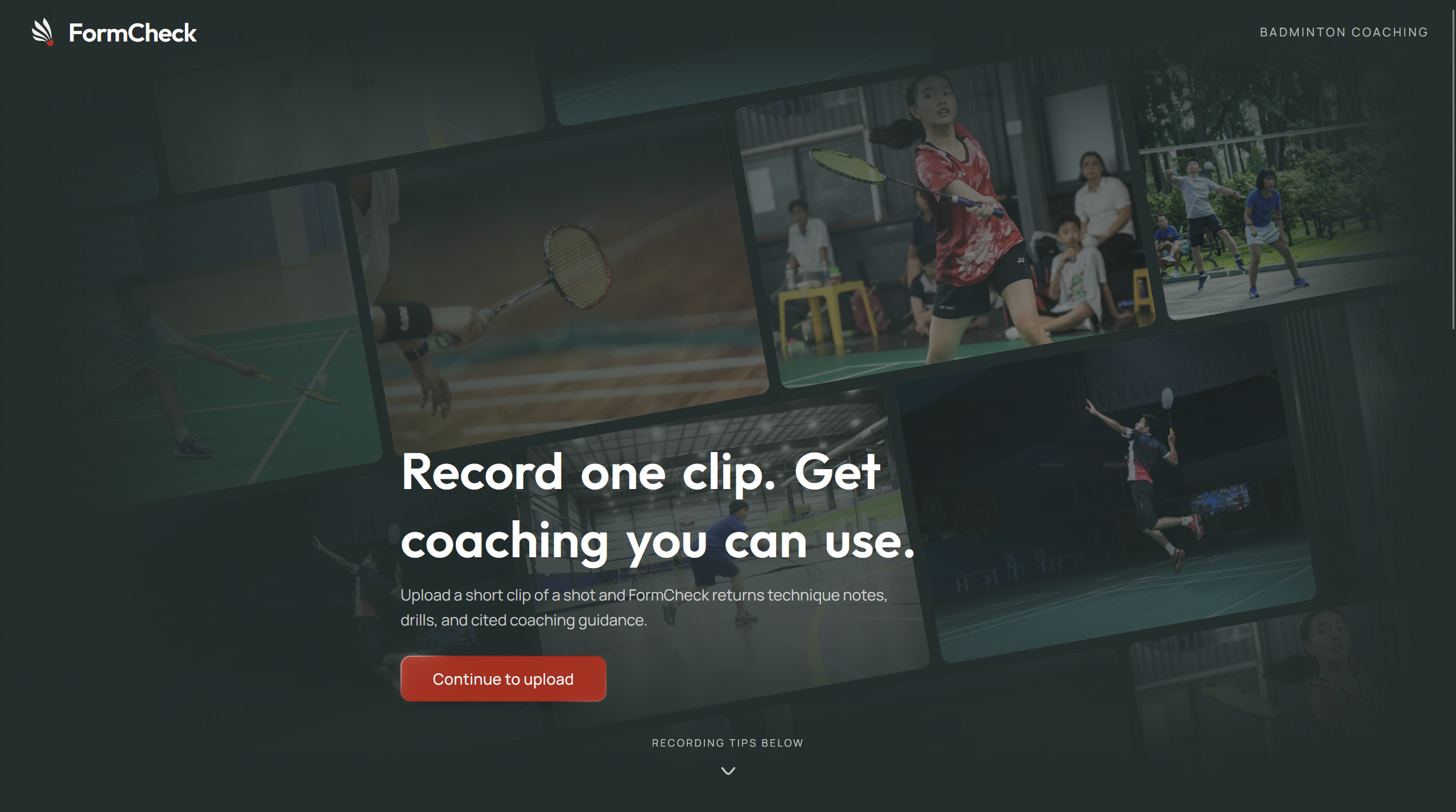
landing page
-
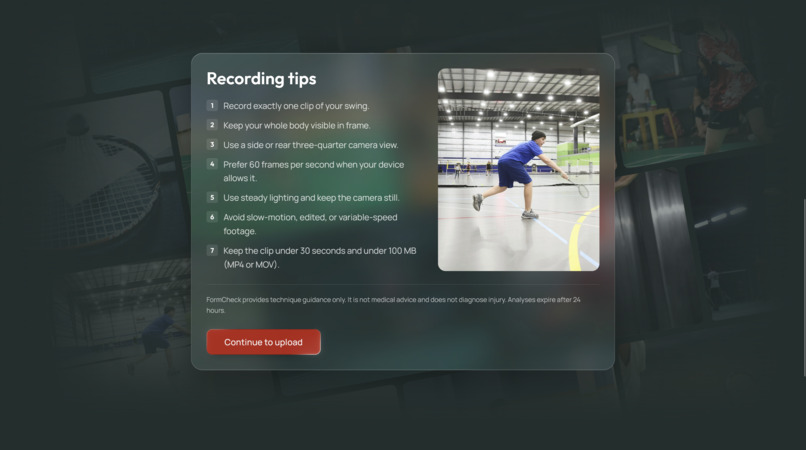
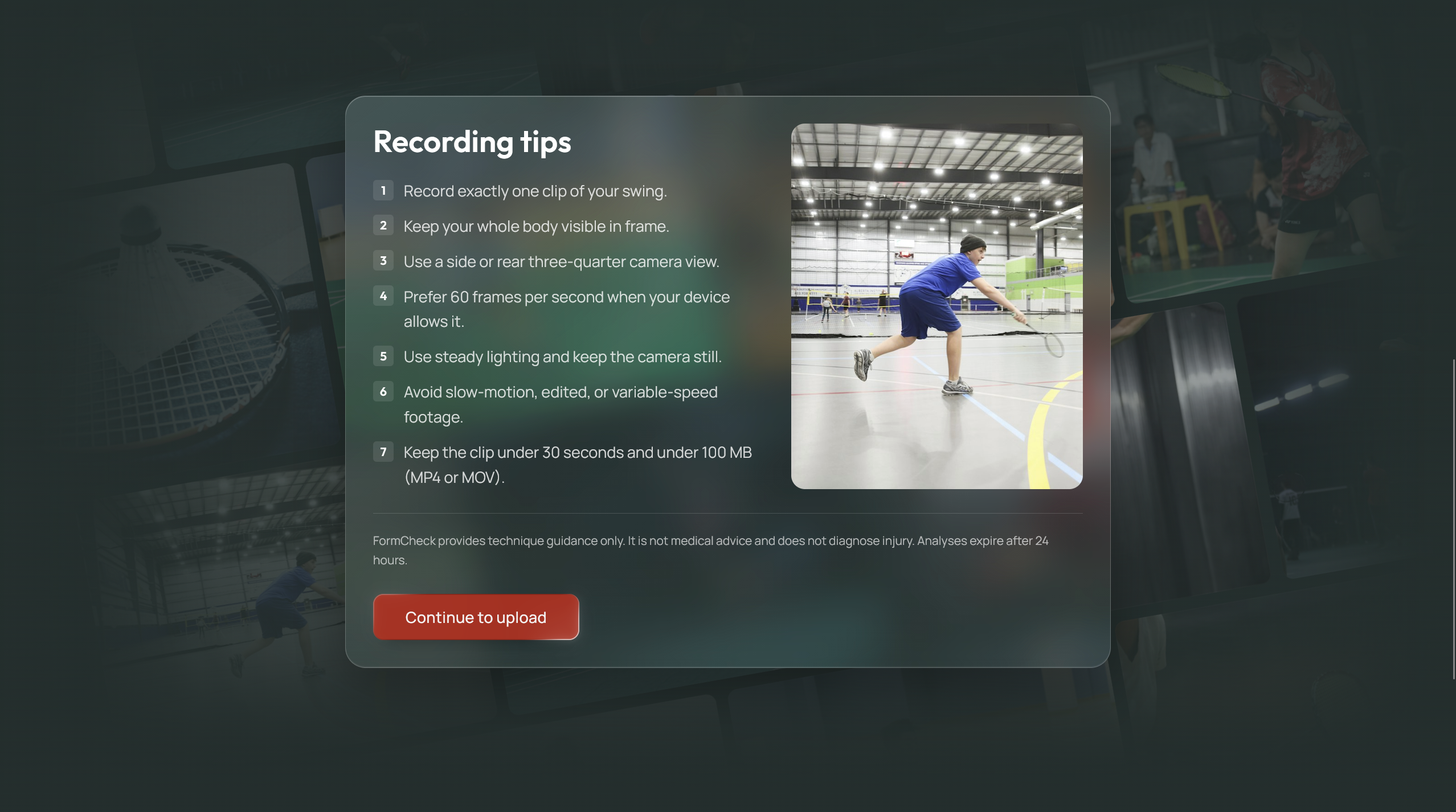
recording instructions
-
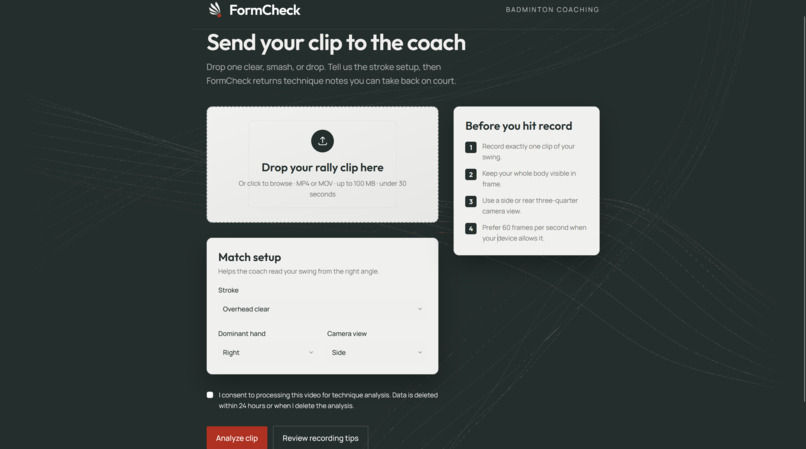
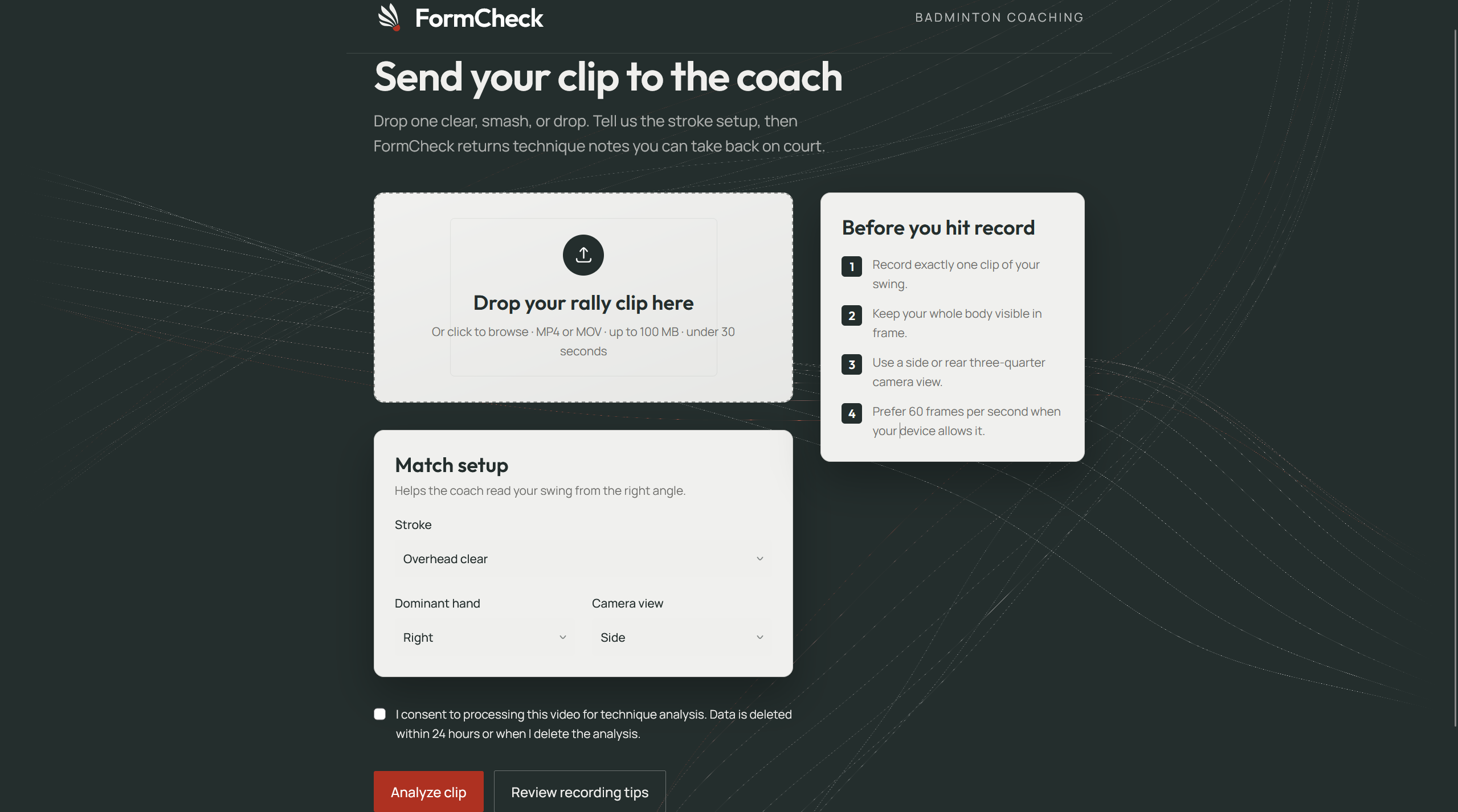
upload page
-
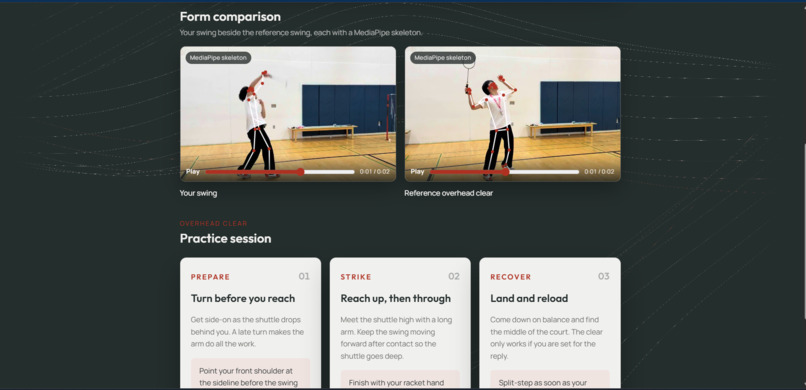
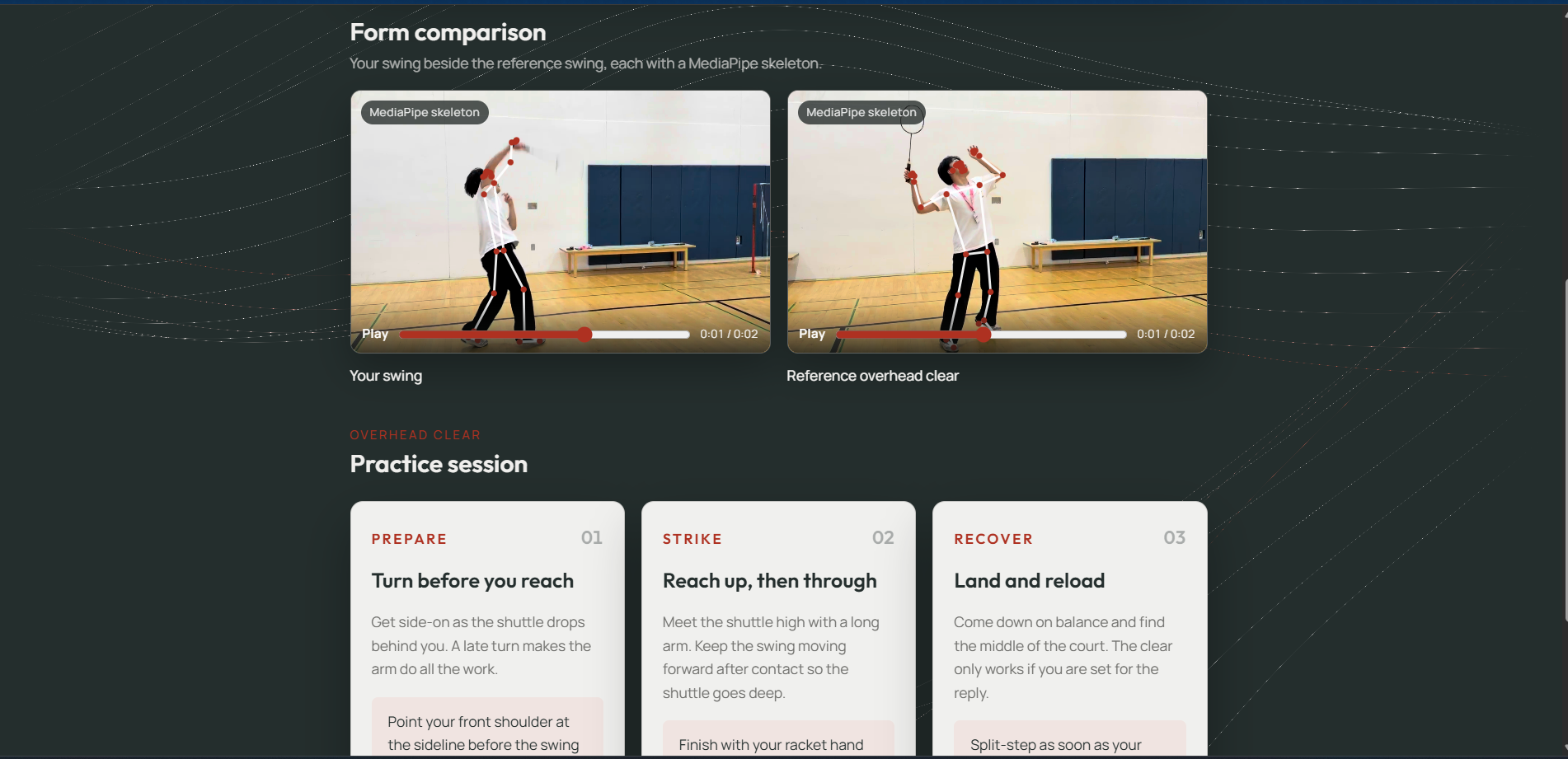
result page
FormCheck
Inspiration
Learning badminton should not require choosing between unreliable online advice and expensive private lessons. Tutorials often contradict one another, while one-on-one coaching can cost $100 or more per hour. This makes personalized, trustworthy feedback inaccessible to many casual players.
We wanted to build a coach that could examine how someone actually moves, identify specific differences in their technique, and recommend improvements supported by credible badminton resources.
What it does
Our project analyzes a video of a badminton swing and produces personalized, evidence-backed coaching feedback.
Instead of sending raw footage directly to a large language model and asking it to interpret the movement, we use MediaPipe Pose to track 33 body landmarks across the video. This captures detailed information about the player’s shoulders, elbows, wrists, hips, knees, ankles, and overall body position throughout the swing.
The system compares the player’s skeleton movement with a professional or textbook reference swing. It can identify differences such as:
- A low elbow during preparation
- Insufficient shoulder or hip rotation
- Late arm extension
- An inconsistent contact position
- Poor balance during recovery
These measured differences are then passed to a retrieval-augmented generation system. The RAG searches a specialized collection of badminton coaching manuals, training guides, and biomechanics papers for information relevant to the detected problem.
The player receives:
- A clear explanation of what happened
- Specific technique corrections
- Relevant practice drills
- Source citations for the recommendations
How we built it
Our pipeline has four main stages:
- Pose extraction: MediaPipe Pose processes the video and tracks 33 body landmarks frame by frame.
- Movement comparison: The player’s pose data is normalized and compared with a professional or textbook reference swing.
- Difference detection: The system identifies meaningful differences in joint position, body alignment, timing, and movement sequence.
- Evidence-based coaching: Those differences become queries for our badminton-specific RAG, which retrieves relevant guidance and helps the AI agent generate a personalized training plan.
We created the RAG knowledge base from credible badminton documents and research papers covering forehand and backhand clears, attacking and defensive clears, biomechanics, coaching cues, and training routines. Each document preserves metadata such as its author, URL, license, shot type, and evidence limitations.
This architecture grounds the final feedback in two forms of evidence: measured pose data from the player’s swing and retrieved knowledge from specialized badminton sources.
Challenges we faced
One major challenge was making fair comparisons between videos. Players may have different body proportions, camera angles, distances from the camera, and swing speeds. We had to normalize the pose data and align corresponding phases of each swing before comparing them.
Pose landmarks can also become noisy or temporarily disappear when the racket arm crosses the body. We had to focus on stable movement patterns rather than treating every coordinate as perfectly accurate.
Another challenge was translating numerical differences into advice a player could understand. A joint-angle difference is not useful by itself; the system must connect it to a recognizable technique problem and an appropriate drill.
Building the knowledge base also required careful source selection. Online badminton advice is abundant, but not all of it is reliable. We prioritized federation manuals, university teaching materials, and biomechanics research while preserving citations and licensing information.
Finally, we wanted to reduce hallucinations without pretending they could be eliminated completely. Separating pose measurement, reference comparison, information retrieval, and language generation helped constrain the agent and made its conclusions easier to verify.
What we learned
We learned that AI coaching becomes more useful when language models are grounded in structured measurements instead of being asked to judge an entire video on their own.
We also learned that pose estimation is not simply about locating joints. Meaningful sports analysis requires understanding movement phases, body proportions, timing, camera perspective, and the relationships between different joints.
Most importantly, we learned that good feedback must be actionable and explainable. Players need to know what to change, how to practice it, and why they should trust the recommendation.
What’s next
We currently focus on badminton clear shots, but the same workflow can be extended to smashes, drops, serves, footwork, and other sports.
Future improvements could include:
- Tracking progress across multiple practice sessions
- Supporting different camera angles
- Providing real-time feedback
- Comparing multiple reference athletes
- Automatically identifying the type and phase of each shot
- Creating adaptive training plans based on recurring technique problems
- Can identify flaws in footwork and help you improve
Our goal is to make reliable coaching more accessible and practice more efficient—helping people accomplish more with less cost, friction, and guesswork.
Built With
- mediapipe
- python
- react
- tailwind
- typescript


