-
-
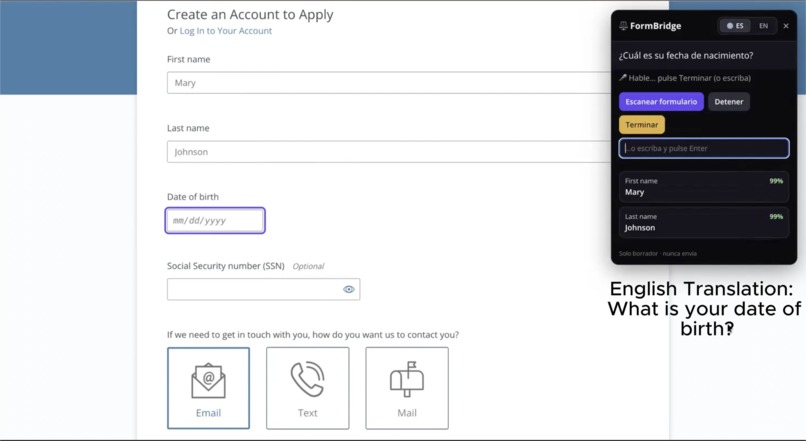
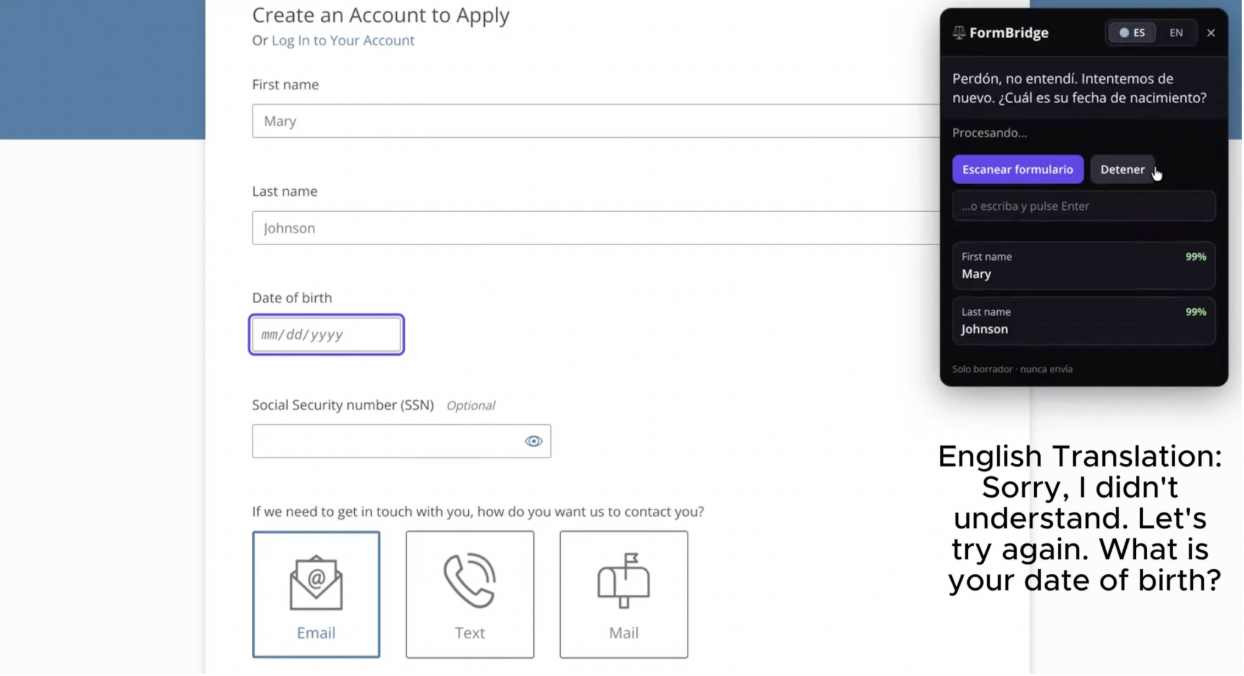
Upon requesting a language switch, the buttons and written/spoken question prompts switch languages.
-
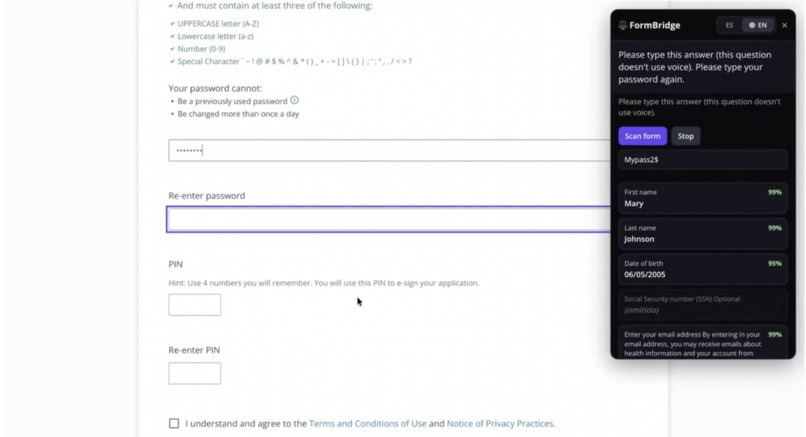
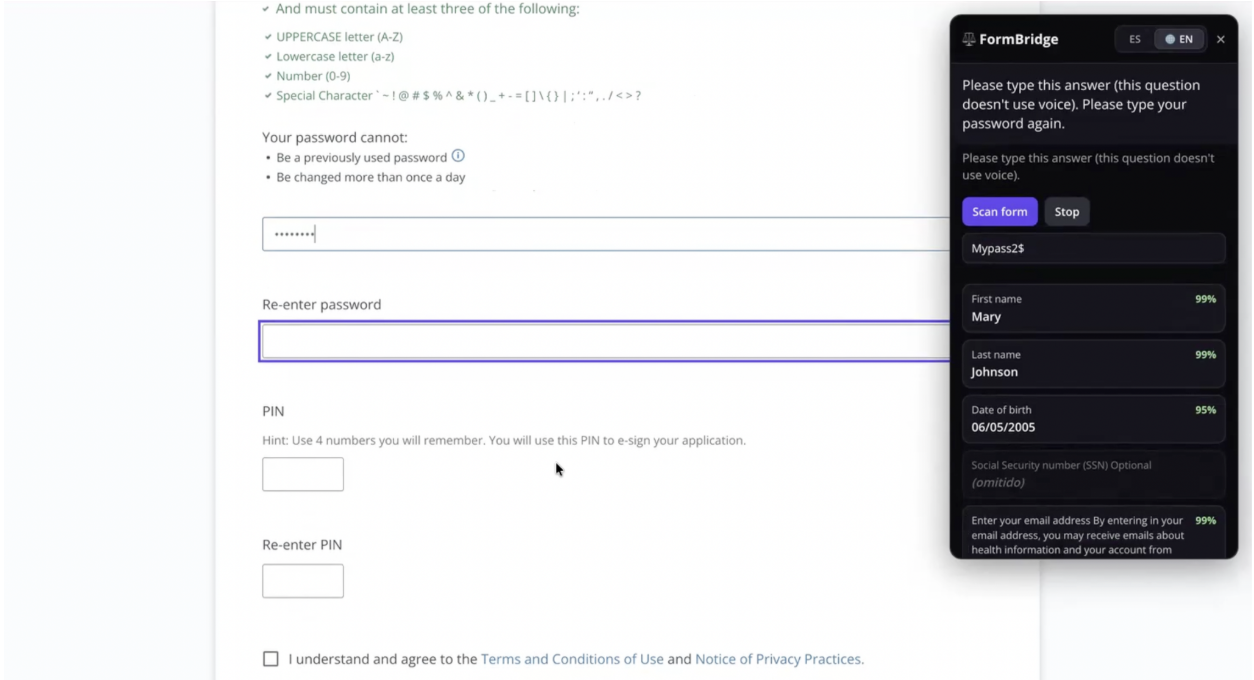
We ensure the system securely prompt users to manually type sensitive data like passwords and social security numbers.
-
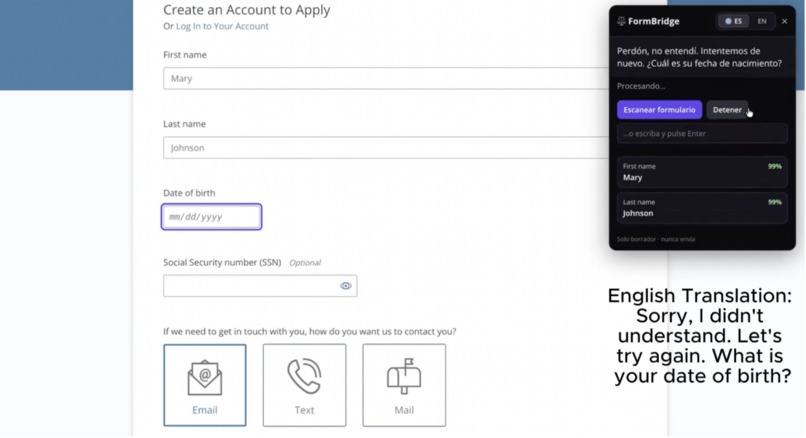
If the user’s response is unclear, FormBridge rephrases the question and awaits an appropriate response.
Inspiration
Roughly 20% of people who qualify for benefits like CalFresh never get them, not because they're ineligible. Instead, the forms are in English and buried in legal jargon. For a monolingual immigrant, completing this paperwork is a challenge. Our goal was to turn this challenge into a simple, clarifying conversation in their own language. We also aimed to prioritize safety for potentially high-stakes legal documents and avoid damage from overly-confident AI hallucinations.
What it does
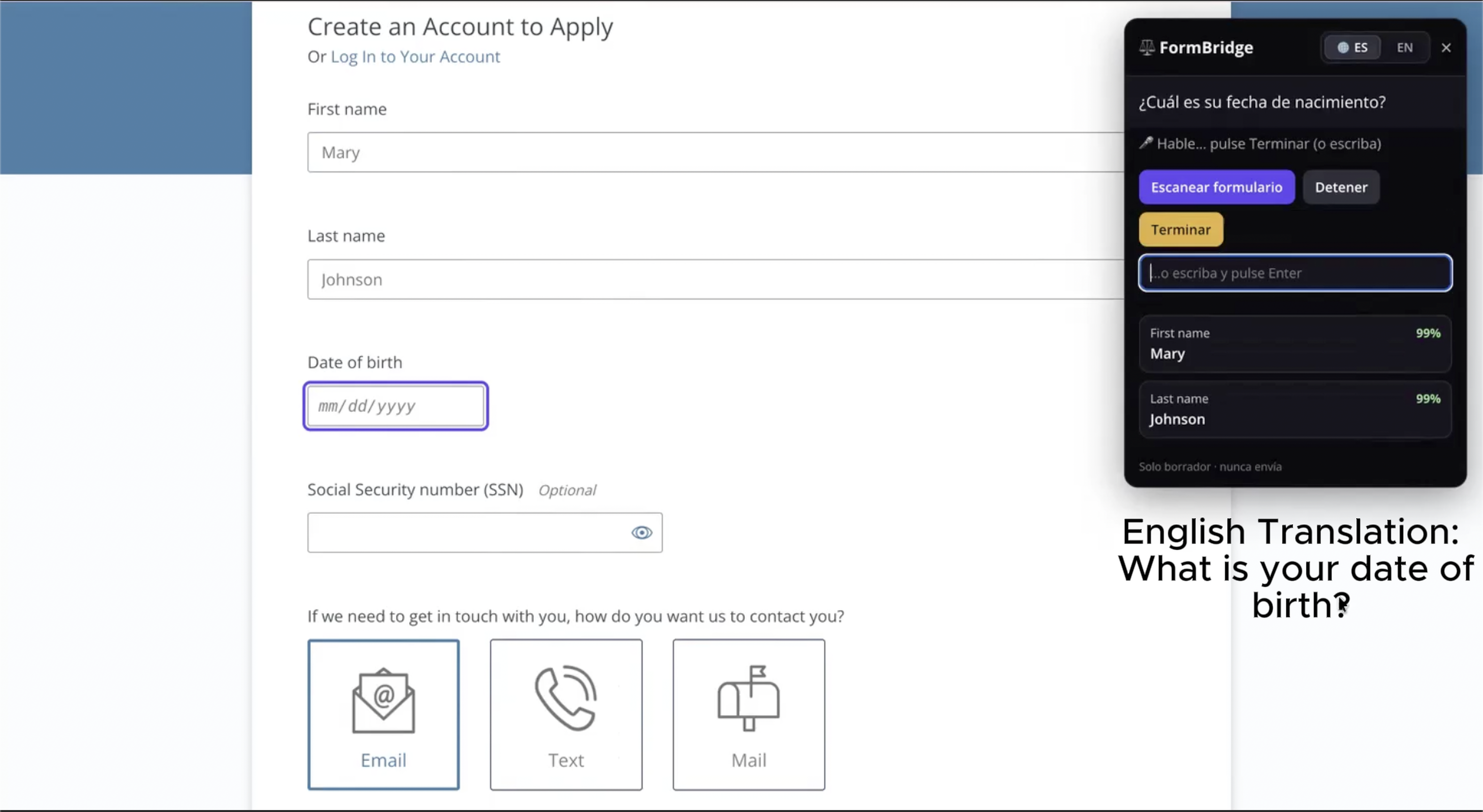
FormBridge is a voice-first AI assistant for legal paperwork. The user first opens a government/benefits form, and FormBridge reads each field. It converts the confusing English question into a simple spoken question in the user’s specific language (Spanish). It then listens to your answer by voice or waits for a written response. Then, it fills in the form with the correct English answer. It's fully bilingual (English to Spanish and vice versa), and is switchable mid-form, so if you respond in a different language than your initial language choice, it changes accordingly. A key feature: it never submits the form for you: it instead produces a draft, and allows time for user review before submitting or advancing to the next page. With this, FormBridge scores each answer's confidence level and flags sensitive or unclear fields if it "needs review" with a plain-language explanation. If it doesn't capture your answer clearly, it rephrases its question and asks again.
How we built it
Frontend — A Chrome extension (Manifest V3) injects a panel onto any web form, scrapes the fields, runs a per-field voice loop, fills the answers directly into the page (handling React/Angular controlled inputs), and shows a confidence + "Needs Review" draft. It never submits. Backend — A FastAPI bridge orchestrates the intelligence behind the extension: ASI:One generates the simplified, plain-language questions. Deepgram speaks them and transcribes the spoken answers (with a typing fallback). Claude converts each natural-language answer into the correct English field value and judges confidence. Redis stores the grounded policy definitions Claude reasons over. Multi-agent layer — We also built the reasoning as a true multi-agent society on Fetch.ai's uAgents: FormReader, Interpreter, Dialogue, PolicyRAG, Review, and Orchestrator agents that message each other over the ASI:One Chat Protocol and are discoverable on Agentverse — so the orchestrator can be queried directly on ASI:One.
Challenges we ran into
It was difficult coordinating a six-agent system over the chat protocol, along with the difference between local agent-to-agent messaging and Agentverse mailbox routing. On the front end, capturing microphone audio inside a content script and streaming it to Deepgram (while keeping a typing fallback that races the voice input) took real iteration. The biggest design challenge, however, was making the system refuse to be overconfident, and surfacing uncertainty as a feature rather than hiding it.
Accomplishments that we're proud of
A working full stack that uses four sponsor technologies from end to end. The safety model — never auto-submit, read-back verification, per-field confidence, and "Needs Review" flags on sensitive fields — is something most AI demos skip, and it's the thing that makes FormBridge trustworthy enough to put in front of a vulnerable person. We're overall proud that we were able to create something that could truly help immigrant populations.
What we learned
We learned how to build and register a multi-agent system on ASI:One/Agentverse using uAgents and the Chat Protocol, and how to architect a clean separation between an orchestrating "brain" and specialist agents. We got hands-on with Deepgram's TTS/STT, Claude for structured extraction with strict-JSON outputs, and ASI:One's LLM. Most importantly, we learned that for high-stakes AI, the engineering that matters most isn't getting the right answer — it's knowing when not to be confident, and designing the human-in-the-loop around that.
What's next for FormBridge
We want to improve FormBridge and make it applicable worldwide by including more languages beyond Spanish. We also want to include a document upload so FormReader can parse any uploaded form PDF and be able to fill it out.
Built With
- agentverse
- asi:one
- chat-protocol
- claude
- deepgram
- fastapi
- fetch.ai
- html
- javascript
- openai
- python
- redis
- uagents


Log in or sign up for Devpost to join the conversation.