Inspiration
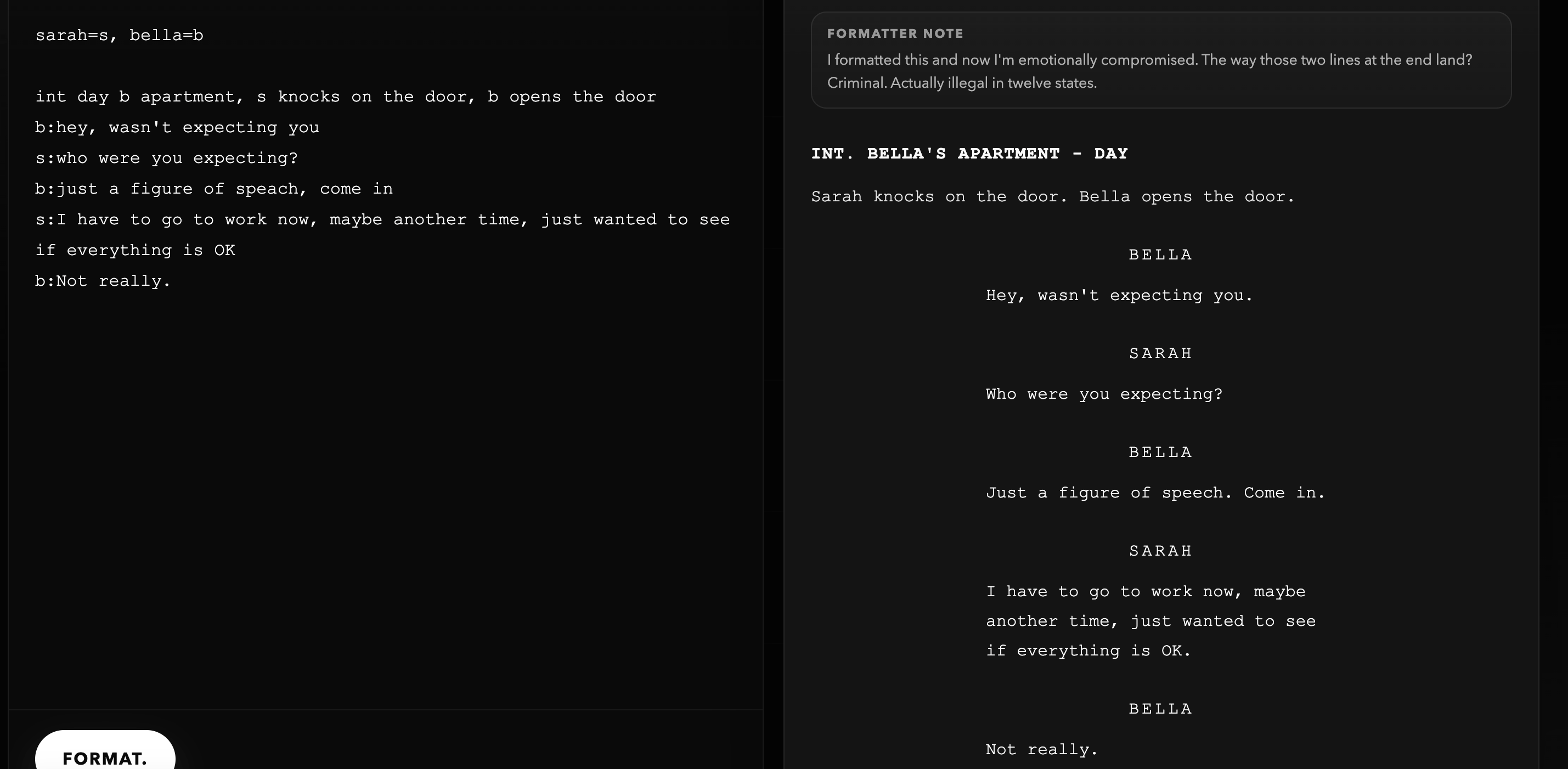
As an amateur screenwriter, I wanted to create something that could be useful for people like me. A lot of writing does not begin in a clean screenplay format. Most of the time, it starts as quick notes and a bit of a mess, because all you want to do is spill out what is in your head before it disappears. Character names are written inconsistently, dialogue is dumped line after line, scene headings are half-written, and ideas are scattered everywhere. I liked the idea of building something for that exact moment, not for the polished final draft, but for the chaotic early version. I wanted format. to feel useful, fast, and a little playful instead of cold and technical.
What it does
format. is an AI-powered script formatter that turns messy draft text into a cleaner screenplay-style structure. You can paste in rough dialogue, scene ideas, or badly formatted script text, and it reorganizes that into something much more readable. The goal is not to replace the writer. The goal is to help the writer get unstuck and move from raw idea to workable draft faster. I also wanted it to have a bit of personality, so it feels less like a utility and more like a creative companion.
How we built it
I built format. around a simple idea: take unstructured text and guide it through an AI layer that understands screenplay-like formatting. The user provides rough text input, and the model is prompted to interpret that input and reshape it into a more structured script form. The product experience was kept intentionally lightweight so the value stays clear: paste text, get a better-formatted version back. A big part of the build was also shaping the voice of the product, because I did not want it to feel generic.
Challenges we ran into
One challenge was finding the balance between structure and flexibility. Screenwriting is not always clean, and different people write rough drafts in very different ways. That means the tool has to be helpful without becoming too rigid. Another challenge was making the output feel improved without making it feel overprocessed. On top of that, giving the product personality without making it distracting took some iteration too.
Accomplishments that we're proud of
I am proud that this became a focused product instead of trying to do everything. It solves one real problem clearly. I am also proud that it has its own voice and identity, because that makes it more memorable than a standard formatter. Most of all, I like that it comes from a real need I personally understand. It is the kind of tool I would actually use when I am trying to turn a messy idea into something readable.
What we learned
I learned that even a very small creative tool can feel valuable when it solves a real pain point well. I also learned that personality matters. Two tools may do similar things, but the one that feels more human and specific is often the one people remember. On the technical side, I learned how important prompting and output control are when the goal is not just generating text, but generating text in a form that feels genuinely useful.
What's next for format.
The next step for format. is to make it smarter and more consistent across different kinds of script input. I would want to improve how it handles longer scenes, more complex dialogue exchanges, and edge cases in messy drafts. Beyond that, I would like to expand it from being just a formatter into something that feels like a real creative assistant for early-stage script development, while still keeping the experience simple and focused.
Built With
- app-platform
- inference-hub
- node.js
- serverless-inference

Log in or sign up for Devpost to join the conversation.