Forma
Making Paperwork Accessible to Everyone
Inspiration
Filling out a form shouldn't require understanding complicated legal terminology, navigating confusing instructions, or being fluent in English. However, millions of Americans face these barriers when accessing essential services, including government benefits, healthcare, and financial assistance.
We wanted to build something that used AI to solve a meaningful accessibility problem. For people with cognitive disabilities, limited literacy, or language barriers, even a seemingly simple form can become an overwhelming obstacle.
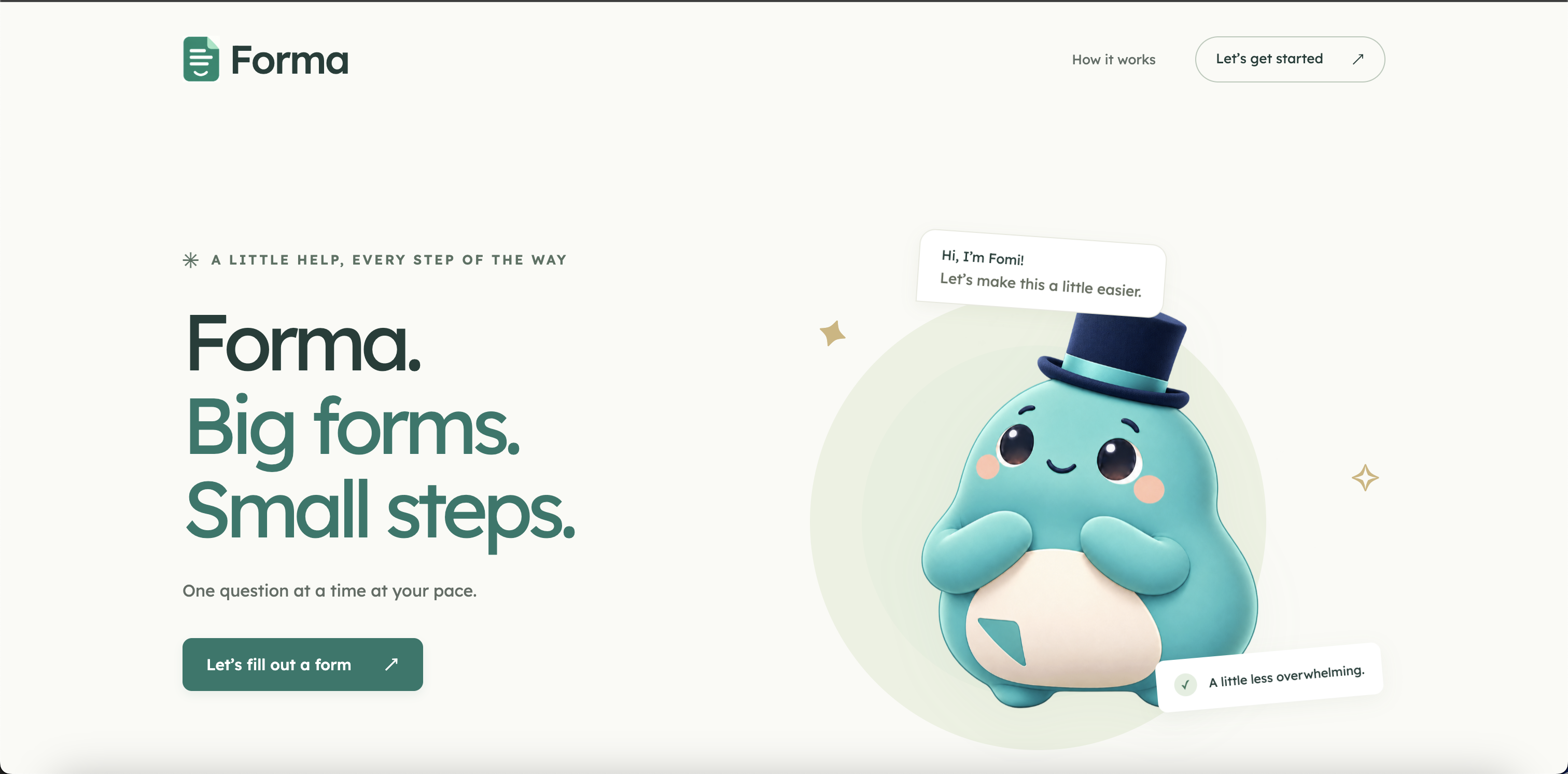
That's why we built Forma, an AI-powered platform that transforms complicated paperwork into simple, guided conversations.
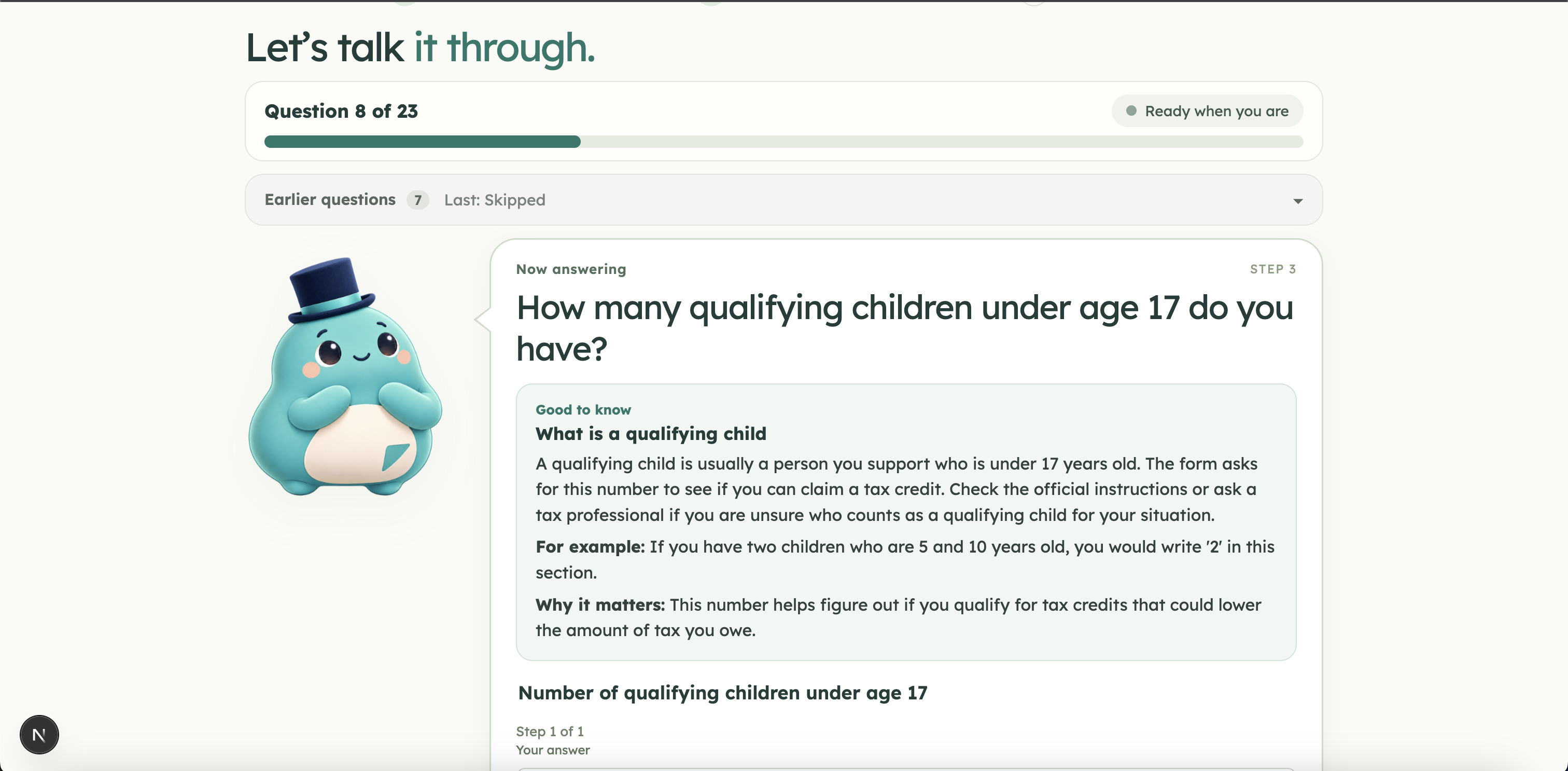
At the heart of Forma is Fomi, our friendly AI companion that walks users through forms one step at a time. Rather than expecting users to understand complex documents, Fomi meets them where they are, explaining questions in plain language, breaking down difficult concepts, and supporting voice-based interactions in multiple languages.
Our goal is to make essential paperwork easier for everyone to understand and complete independently.
What It Does
Forma transforms complicated forms into accessible, interactive experiences.
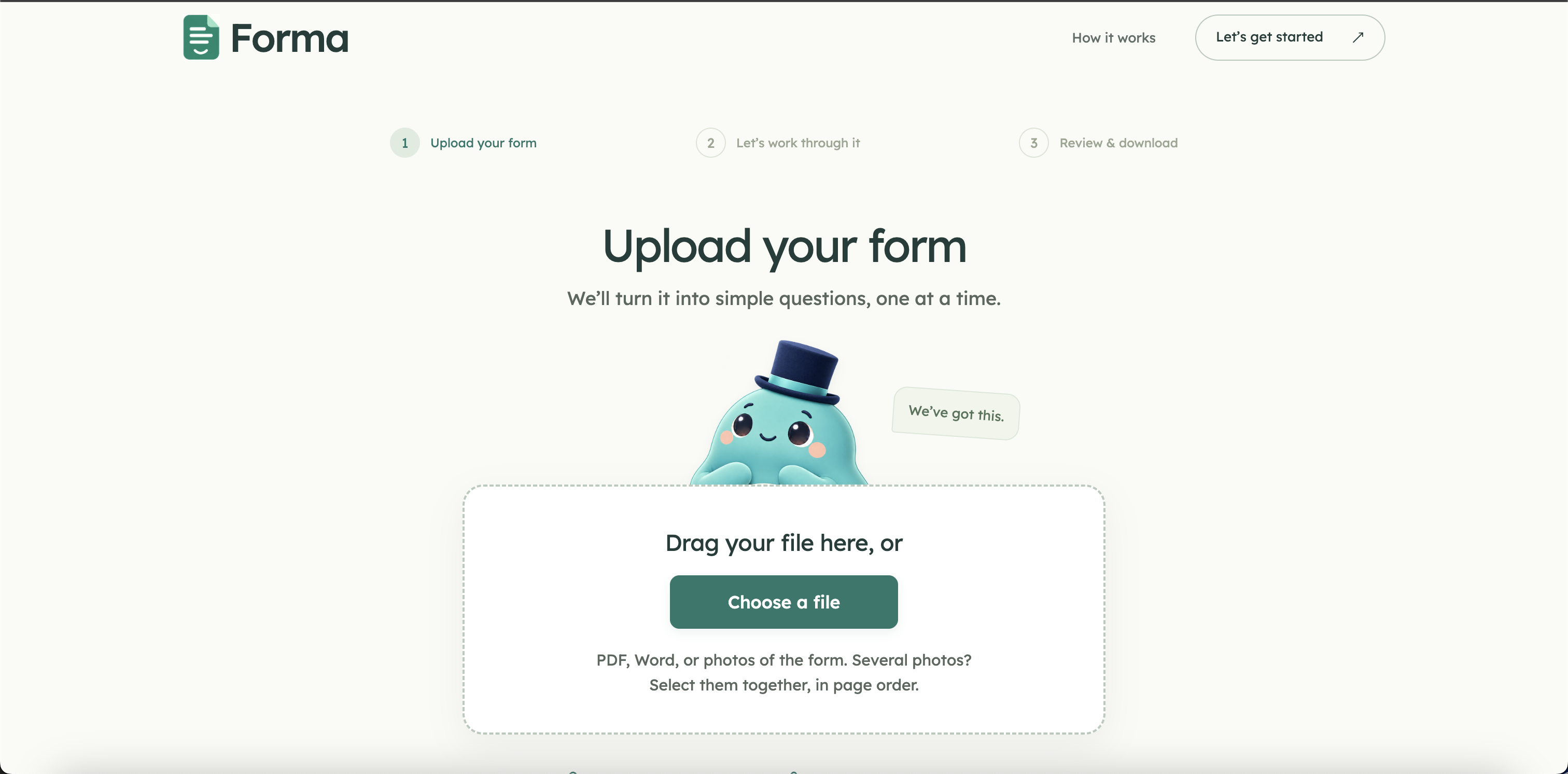
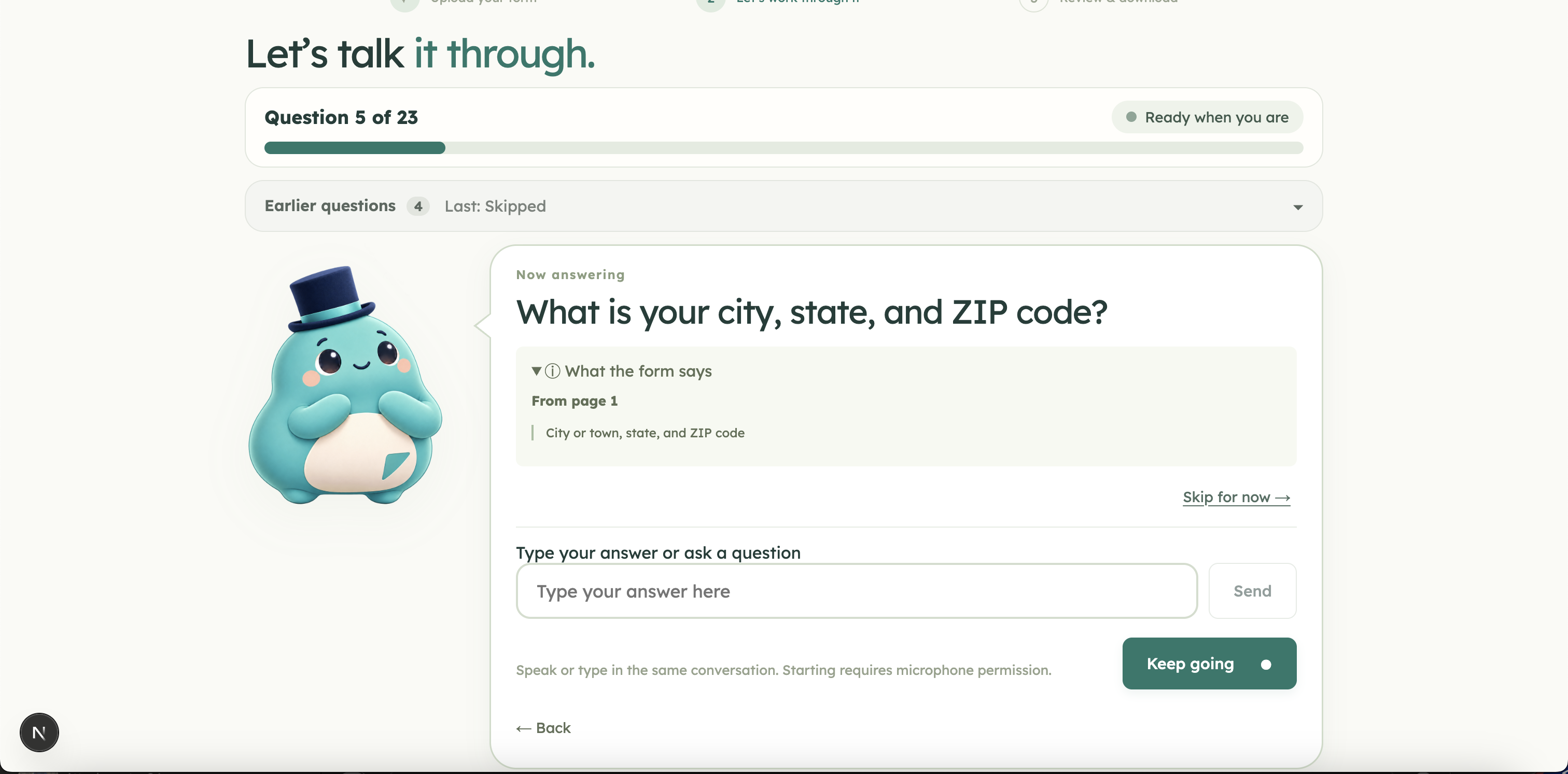
Users upload a document, and Forma analyzes its structure, identifies the information being requested, and guides them through completing it one question at a time with Fomi.
Key Features
- AI-powered form understanding: Extracts questions and instructions from PDFs, including scanned documents, and interprets their structure.
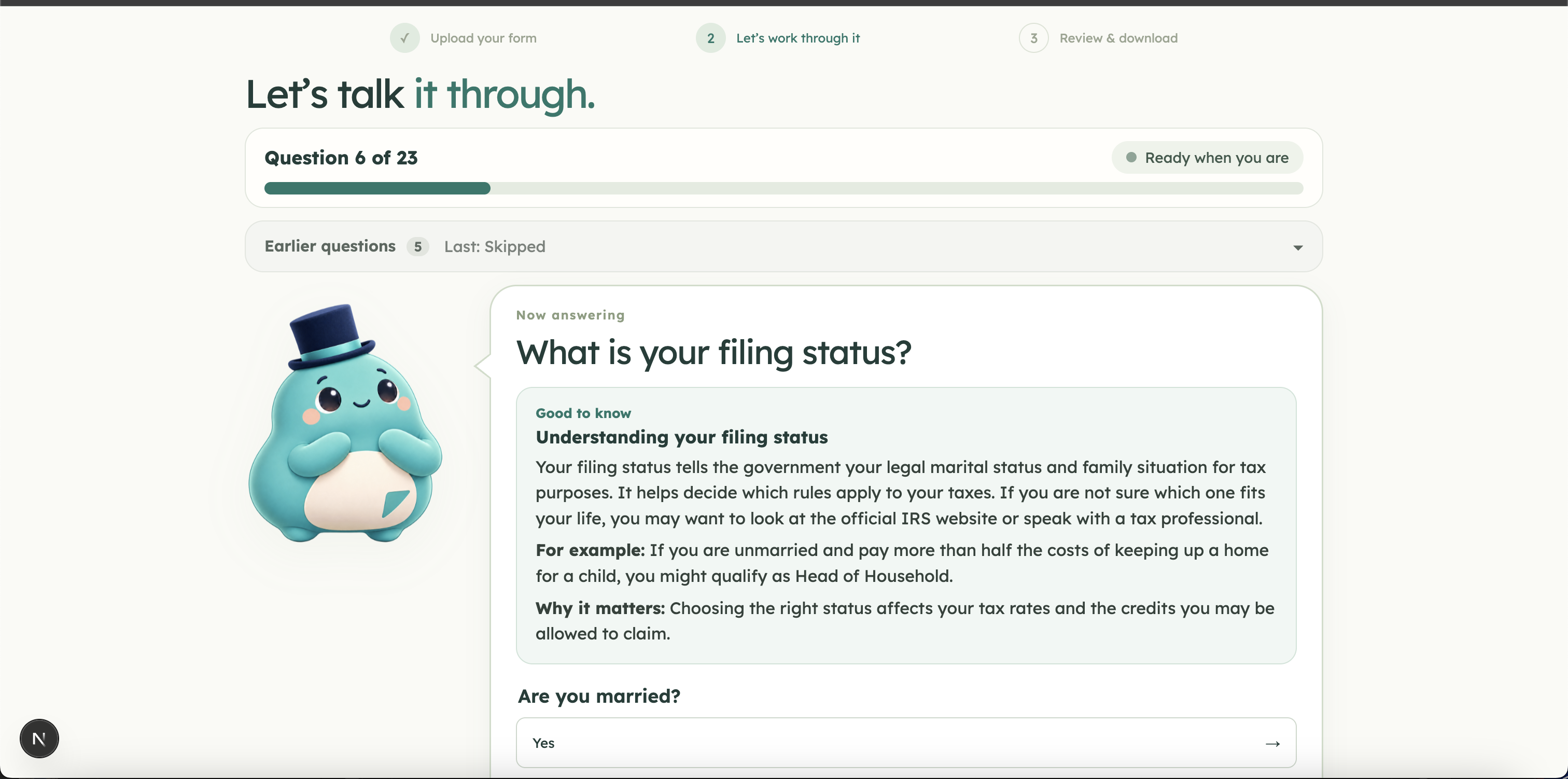
- Intelligent question simplification: Converts complicated terminology into straightforward, conversational language.
- Dynamic question decomposition: Breaks difficult questions into smaller, manageable steps instead of simply rewriting them.
- Conversational voice assistant: Fomi uses ElevenLabs to let users speak naturally, ask follow-up questions, and receive explanations.
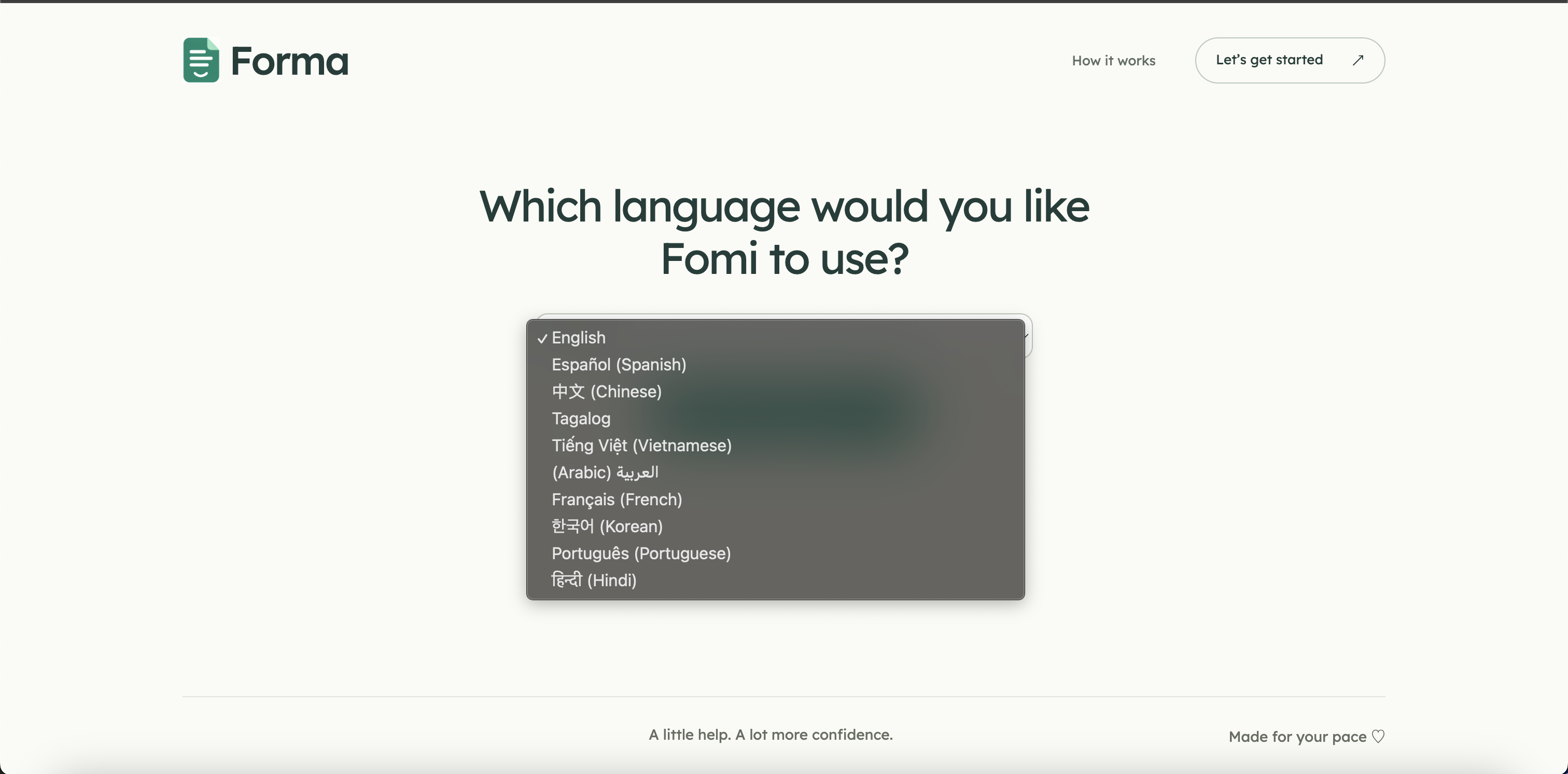
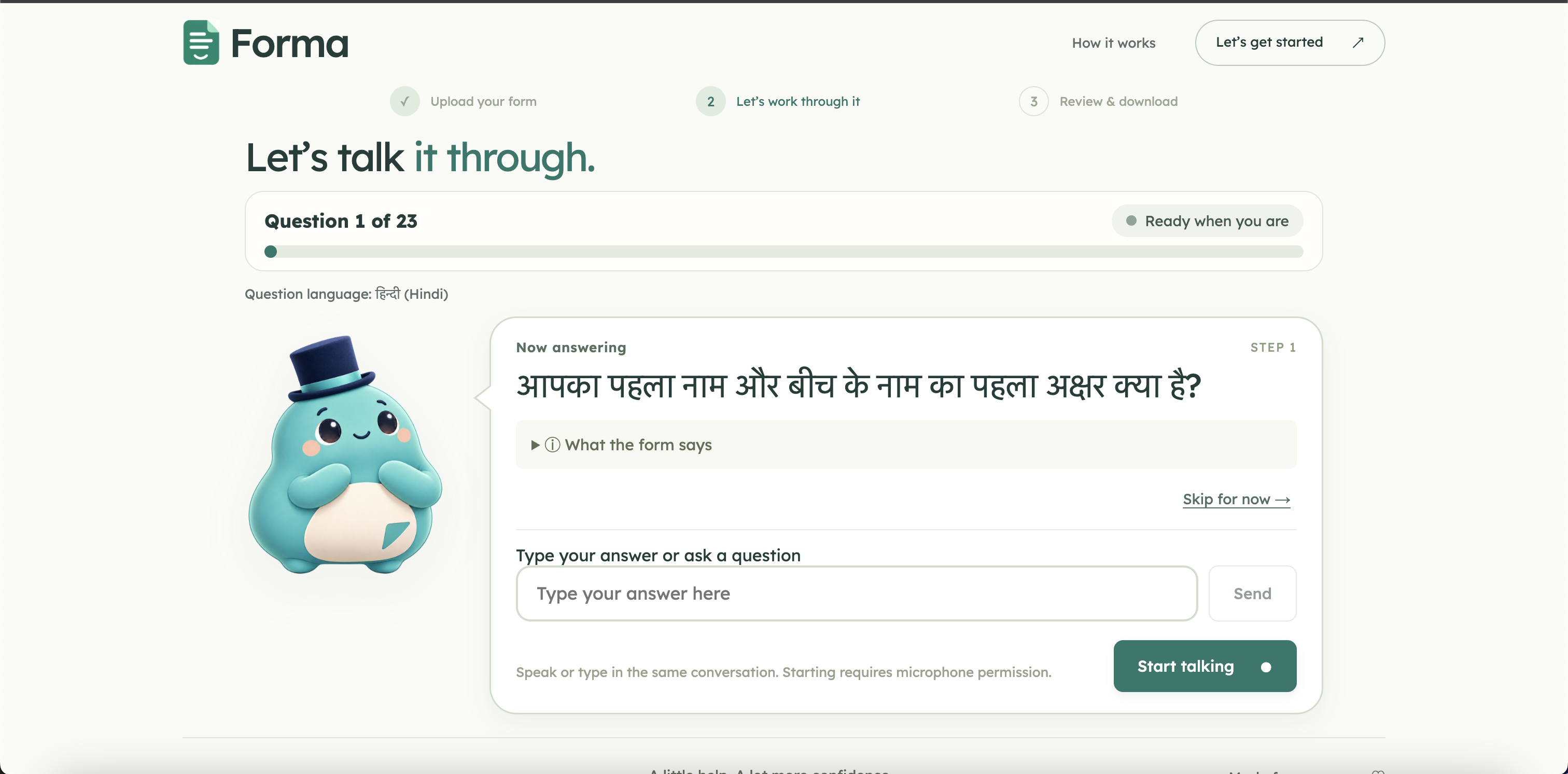
- Multilingual accessibility: Users can interact with Fomi in different languages, making forms more accessible to people with limited English proficiency.
- Conditional question navigation: Uses form context and previous responses to guide users through relevant questions.
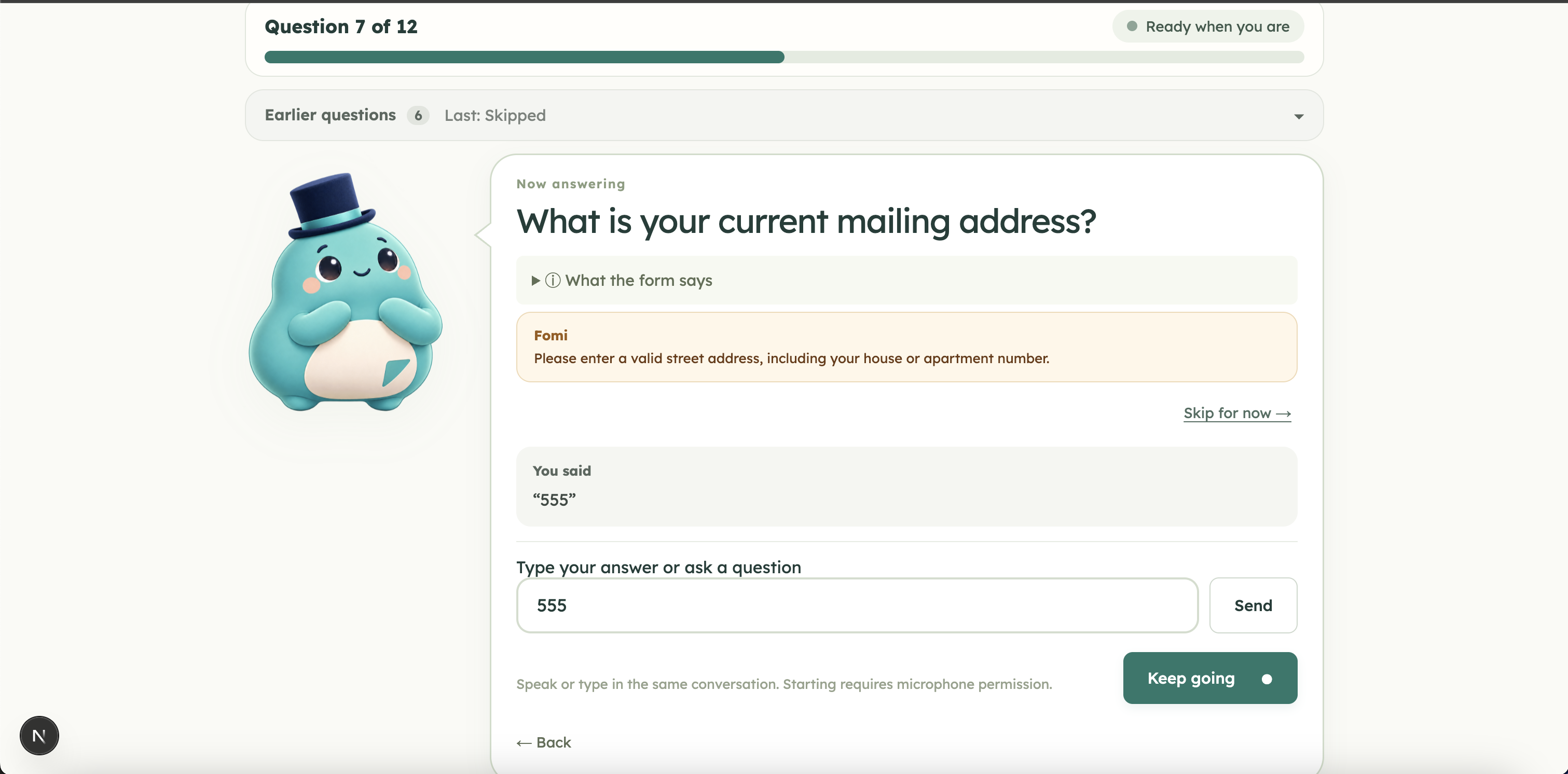
- Answer validation and tracking: Maintains structured answers and tracks progress through the document.
- Document completion: Maps collected responses back to their corresponding form fields for review and export.
For example, instead of simply asking users whether they qualify for exemption from federal income tax withholding, Fomi can explain what withholding means, break down the relevant conditions, and help users understand what information they need before answering.
Forma doesn't just fill out forms. It helps people understand them.
How We Built It
We designed Forma around a modular AI pipeline that separates document understanding, conversational interaction, and form-state management.
1. Document Processing
When a user uploads a form, our document-processing pipeline extracts its text and fields. For scanned documents, OCR helps recover content from images. Our platform supports PDF, DOCX, and screenshot uploads.
The extracted information becomes the foundation for interpreting the document's questions, instructions, and structure.
2. Form Understanding with Google Gemini
We use Google Gemini to analyze the document and generate a structured representation of its questions.
Rather than producing simple paraphrases, Gemini identifies questions that require additional context, decomposes complicated instructions into smaller steps, and identifies dependencies between form sections.
This structured output lets us separate the original document's requirements from the simplified questions presented to users.
3. Conversational Guidance with ElevenLabs
We integrated ElevenLabs to power Fomi, our conversational AI assistant.
Fomi can read questions aloud, listen to responses, answer clarification requests, and guide users through complicated fields.
Users can also interact through text, making the experience flexible for different accessibility needs and preferences.
4. Form State and Conditional Navigation
Behind the conversational interface, Forma maintains structured form state, including user responses, question progress, and field mappings.
This separation is important: Fomi focuses on helping users understand and respond, while the application tracks which information has been collected, validates responses, and determines what information is still needed.
5. Review and Document Export
Finally, Forma organizes the collected answers so users can review their responses and generate a completed document.
Our broader vision is to make this pipeline work across many document types without requiring individual integrations with every government or healthcare platform.
Challenges We Faced
Simplification Isn't Just Rephrasing
One of our biggest discoveries was that making a question shorter doesn't necessarily make it easier to understand.
Our early models often transformed complicated tax terminology into slightly different wording while preserving the same cognitive burden.
For example, asking someone for their "federal tax classification" is not particularly helpful if they don't know what tax classification means.
We worked on improving our question-generation approach so Fomi could distinguish between straightforward questions, questions requiring explanations, and complex questions that should be broken into multiple steps.
Understanding Conditional Logic
Government and tax forms aren't simple lists of independent questions. Some sections apply only under specific circumstances, while others require calculations, supporting worksheets, or information collected elsewhere in the document.
We had to think beyond extracting individual fields and toward representing the relationships between questions.
This was especially challenging because incorrectly interpreting a condition could lead to a user answering an irrelevant question or skipping an important one.
Balancing Accuracy, Speed, and Cost
Processing complicated documents with large language models introduced meaningful tradeoffs between accuracy, latency, and API usage.
We experimented with different models and batching strategies to balance reliable document understanding with a responsive user experience.
Separating document parsing from real-time conversation helped us avoid repeatedly processing the entire form during every interaction.
Designing for Accessibility
Accessibility goes beyond adding voice input or translating text.
We wanted Forma to be approachable for people who may find traditional software intimidating. That influenced everything from Fomi's friendly mascot and our visual design to our one-question-at-a-time interface, plain-language explanations, and ability to revisit original form wording.
What We Learned
Building Forma changed how we think about AI accessibility.
The biggest insight was that an accessible assistant needs to reduce cognitive load, not just simplify vocabulary.
We learned that:
- Good AI assistance often means breaking one complicated task into several understandable decisions.
- Document understanding requires reasoning about relationships and instructions, not just extracting text.
- Conversational AI works best when paired with structured application state and deterministic validation.
- Accessibility should shape the entire product experience rather than being added as a feature afterward.
- For consequential documents such as tax forms, preserving the original meaning and giving users control are essential.
We also gained hands-on experience building a multimodal AI workflow that combines document parsing, language-model reasoning, conversational voice interaction, and structured form completion.
What's Next for Forma?
Tax forms are only our starting point. The same challenges appear across government benefits applications, healthcare intake forms, financial aid documents, housing assistance applications, and countless other essential processes.
We envision expanding Forma into a general-purpose accessibility layer for paperwork, where users can upload almost any form and receive personalized guidance from Fomi in their preferred language.
Future improvements could include deeper worksheet support, stronger accessibility customization, more robust validation against official instructions, and integrations with organizations that help people navigate essential services.
Longer term, we'd love to make Forma available through nonprofits, healthcare providers, educational institutions, and government agencies so that accessibility doesn't become another expense for the people who need it most.
Paperwork should never be the barrier between someone and the help they need.
With Forma and Fomi, we're working toward a world where anyone can navigate complicated forms, one friendly conversation at a time.
Built With
- accessibility
- conversational-ai
- document-ai
- elevenlabs
- fastapi
- generative-ai
- google-gemini
- large-language-models
- multilingual
- ocr
- python
- react
- typescript
- voice-ai

