Inspiration
Developers often have to understand unfamiliar repositories quickly, especially when reviewing a pull request, joining an existing project, or working with a fork. The difficult part is not just seeing what changed — it is understanding what could break because of that change.
A new modification can affect files far from the obvious change, or even reintroduce a bug that was fixed months ago. I built ForkSight to make repository history useful during development instead of something developers only investigate after a failure.
What it does
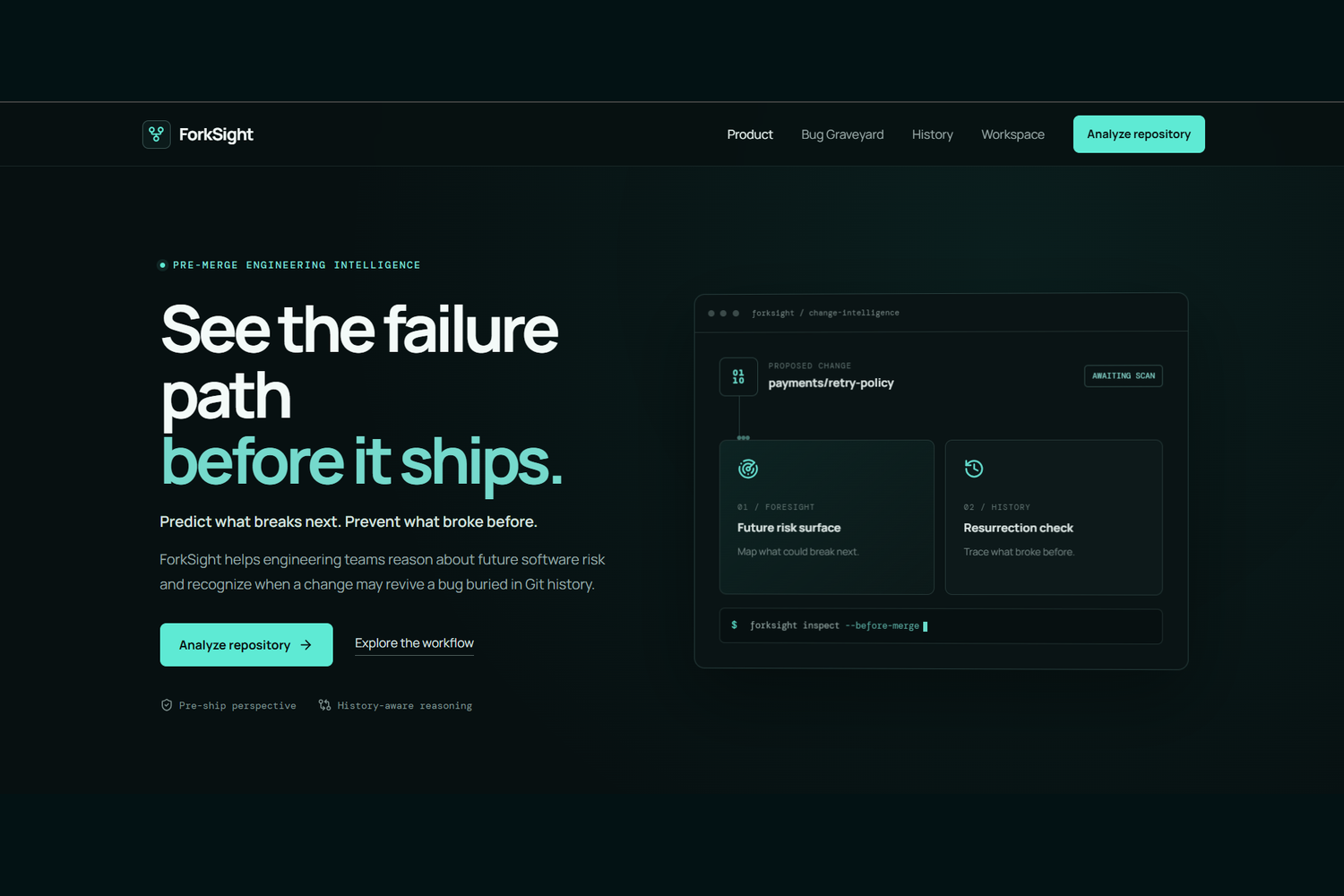
ForkSight is a developer intelligence platform for understanding software risk before a change ships.
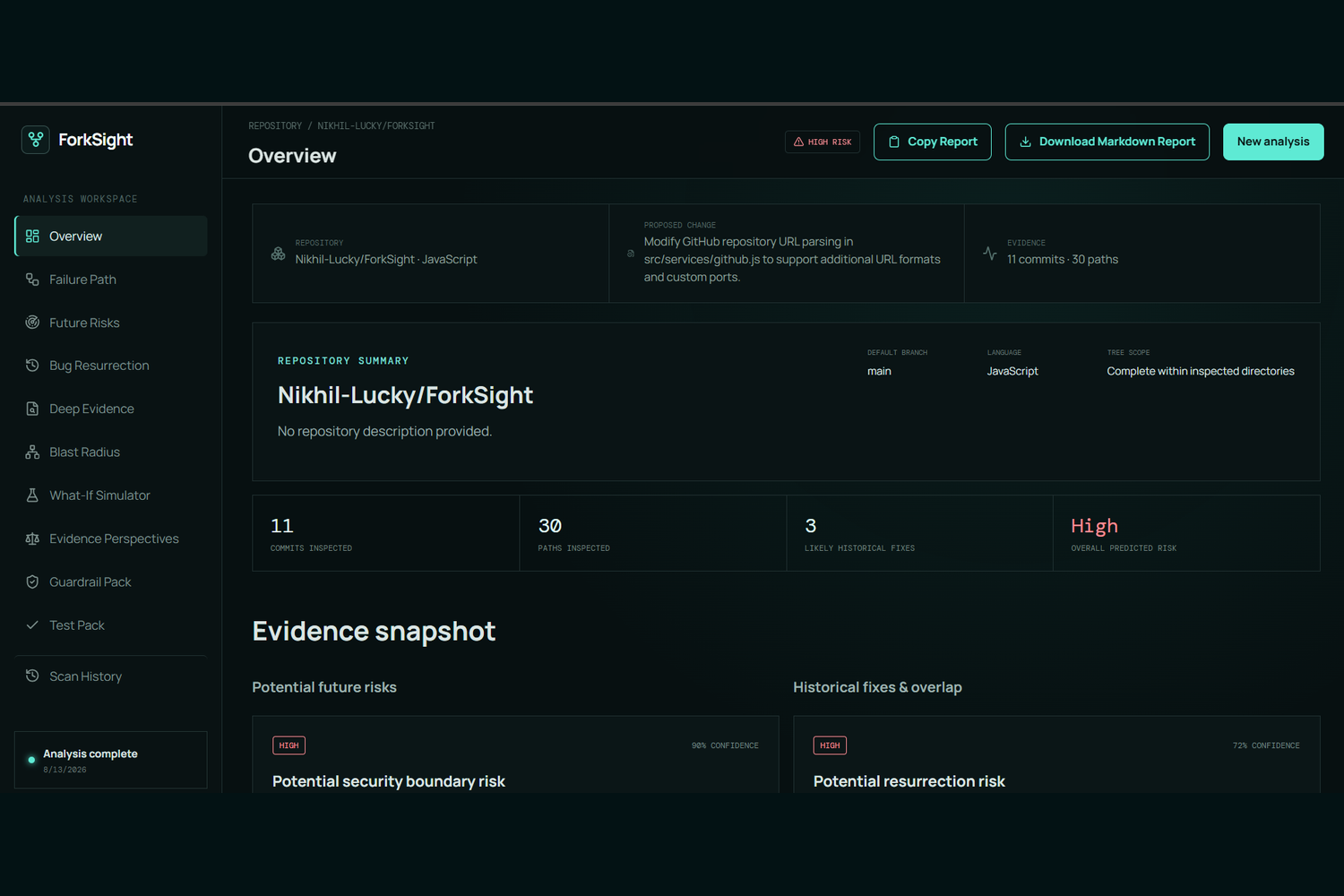
A developer can provide a public GitHub repository or pull request and describe the change they are planning. ForkSight then gathers real repository evidence and turns it into an understandable risk report.
ForkSight can:
- Inspect repository metadata and recent commit history
- Analyze public GitHub repositories and pull requests
- Map relevant parts of the repository structure
- Examine source evidence from important files
- Detect historical commits that are likely to contain previous bug fixes
- Identify possible future risks related to a proposed change
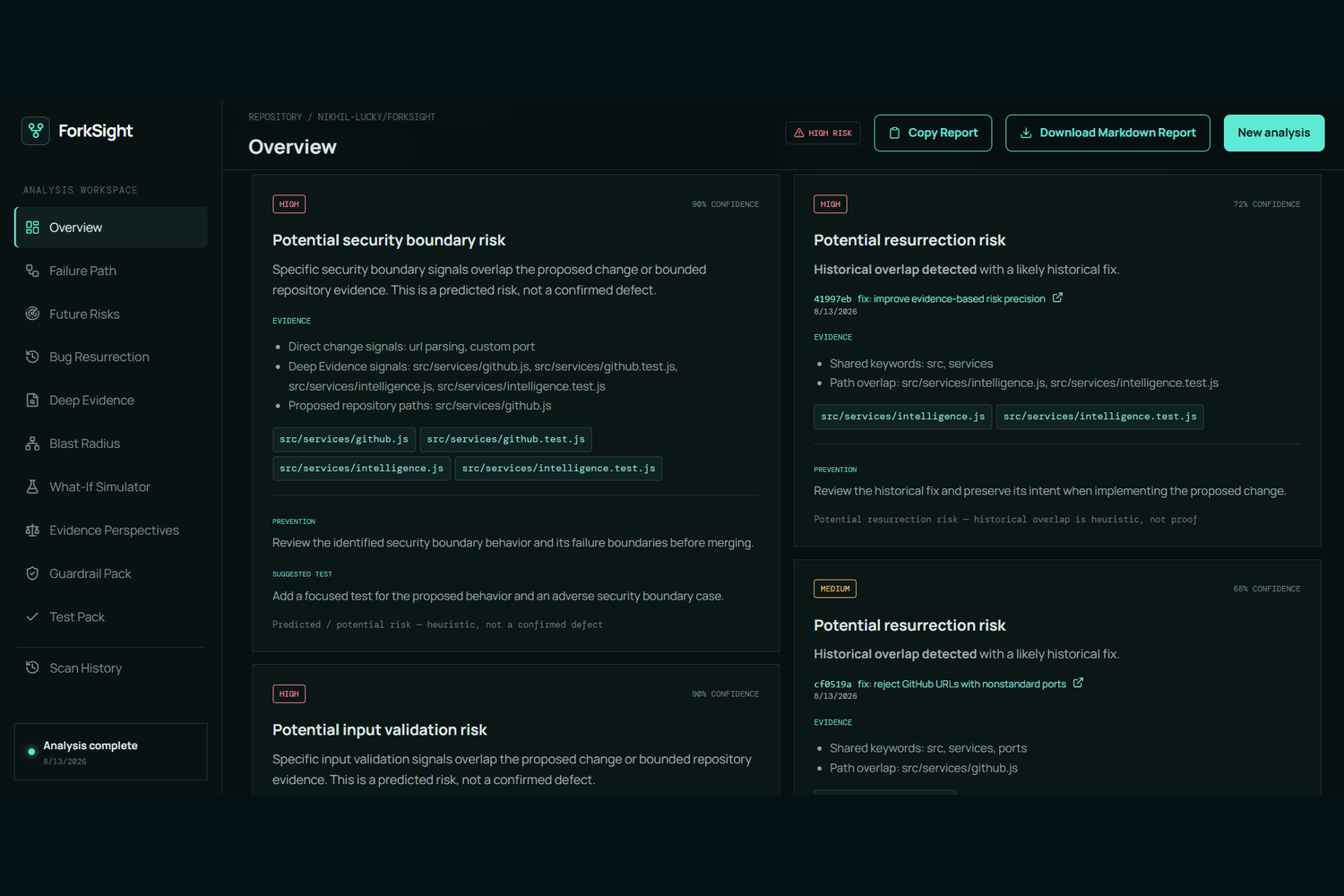
- Detect potential "bug resurrection" where new work overlaps with an older fix
- Estimate affected areas or blast radius
- Assign severity and confidence to findings
- Provide evidence explaining why a risk was identified
- Suggest prevention actions and focused tests
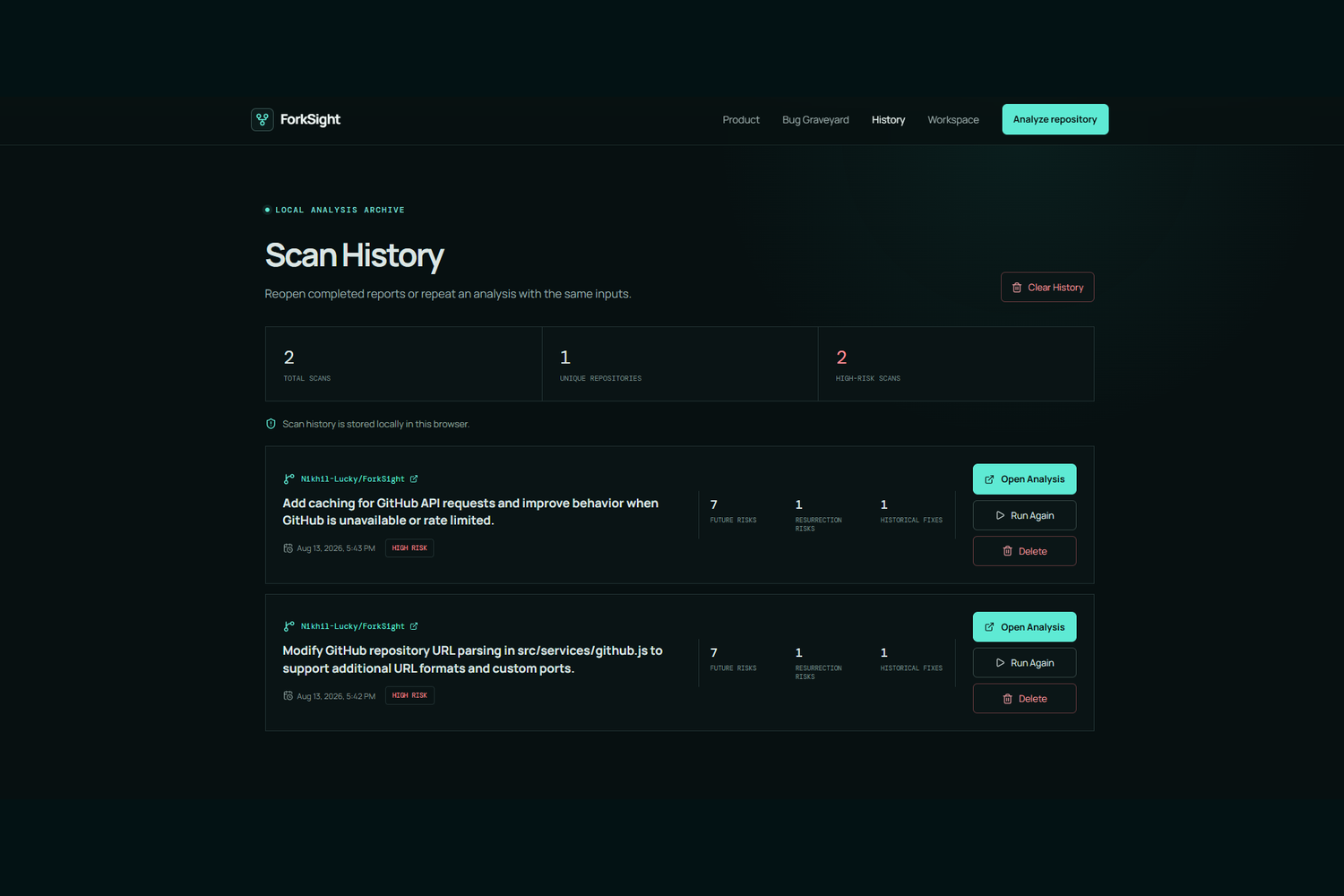
- Save previous analyses so developers can revisit them later
Instead of simply generating a generic warning, ForkSight tries to connect every finding to repository history, file paths, commit evidence, or source-level signals.
How I built it
ForkSight is built as a React web application using React, Vite, JavaScript, React Router, Lucide React, and a custom CSS design system.
The application communicates directly with the GitHub REST API to retrieve repository information, pull request changes, recent commits, repository structure, historical fixes, and relevant source files.
I built a custom intelligence layer that evaluates proposed changes against repository evidence across areas such as input validation, API reliability, rate limiting, caching, compatibility, error handling, security boundaries, authentication, data integrity, performance, dependencies, concurrency, and testing.
Historical fixes are also compared with the proposed change to identify situations where a previously solved problem may accidentally return.
Analysis history is stored locally in the browser, keeping the project lightweight without requiring accounts or a backend database.
Challenges
One of the biggest challenges was making the analysis evidence-based rather than producing impressive-looking but unsupported findings.
Repository analysis can easily create false positives, so I designed ForkSight to require meaningful signals from the proposed change, source evidence, repository paths, or historical fixes before reporting a risk.
Another challenge was working within GitHub's public API limitations while still collecting enough repository context to produce useful analysis. I used bounded repository inspection and selective source retrieval so ForkSight does not attempt to download an entire repository.
Designing the interface was also important because repository analysis can become overwhelming quickly. I focused on presenting severity, confidence, evidence, affected areas, historical context, and prevention steps in a structured workflow.
What I learned
Building ForkSight taught me how much useful engineering context already exists inside Git history when it is analyzed properly.
I also learned more about GitHub API integration, repository and pull-request structures, evidence-based risk scoring, frontend architecture, handling API failures and rate limits, and designing interfaces for complex technical information.
For development, I also used Agent Orchestrator and Codex CLI to help with planning, implementation, debugging, reviewing, testing, and iterative improvement.
What's next
The next step for ForkSight is deeper repository intelligence: richer cross-file dependency analysis, larger history windows, authenticated GitHub access, smarter pull-request comparisons, team collaboration, and more advanced models for understanding code changes.
The long-term goal is simple: help developers answer "What could this change break?" before they merge it.
Built With
- agentorchestrator
- codexcli
- css3
- github
- githubapi
- html5
- javascript
- localstorage
- lucidereact
- react
- reactrouter
- vercel
- vite

Log in or sign up for Devpost to join the conversation.