Inspiration
Robot simulations fail in ways that look trivial and cost days. A pick-and-place arm clips a divider, and a good engineer burns hundreds of hours re-running the same scene, changing seeds, and tweaking controller constants. Half of that time is the re-run loop itself, not the thinking. We wanted agents to own the loop end to end: reproduce the failure, try repairs in parallel, prove a fix on tests the agents never saw, and leave the human with one decision instead of hundreds of iterations.
What it does
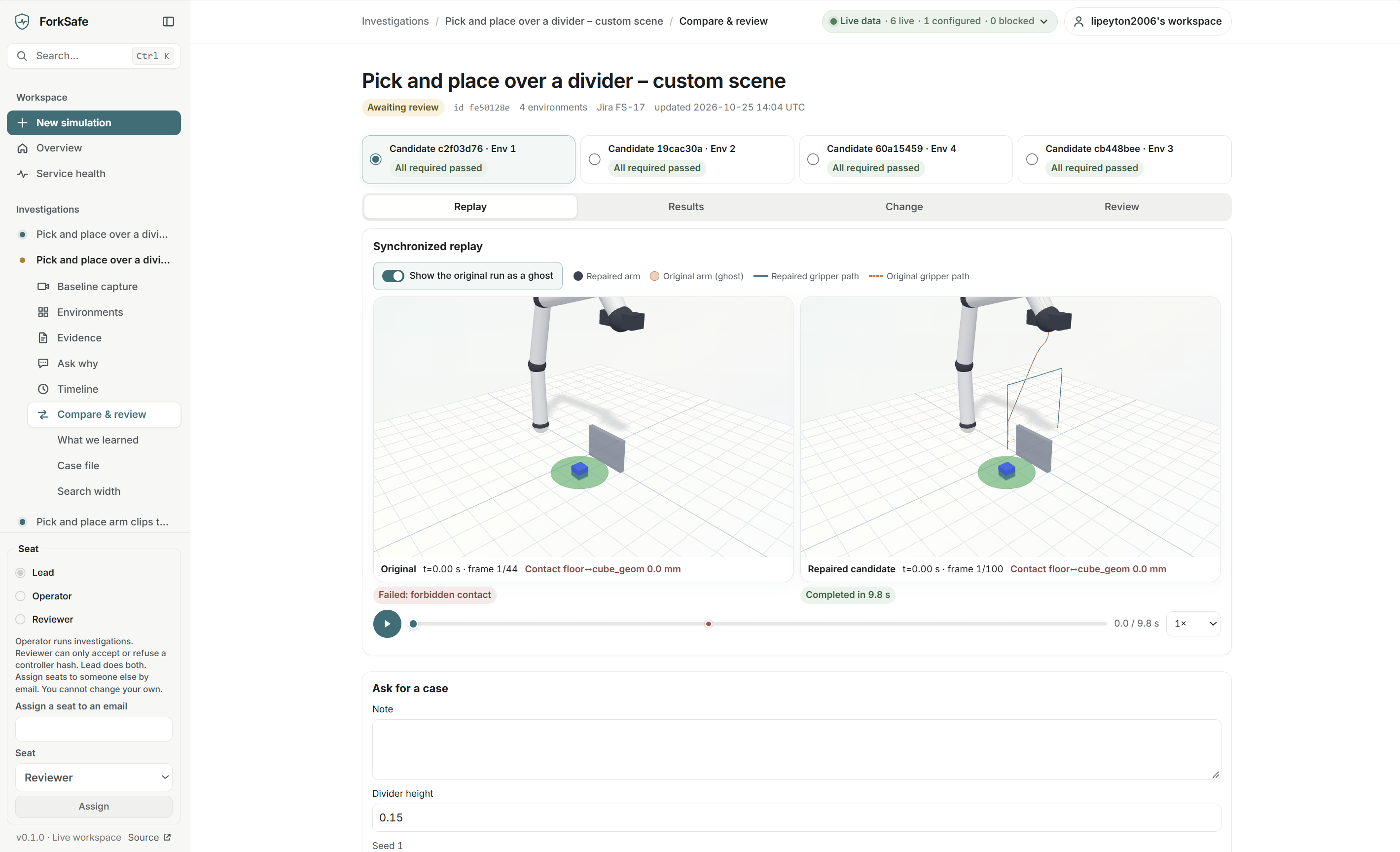
ForkSafe turns a plain-words description of a robot failure into a proven repair. You type what went wrong, it builds the scene, runs the physics in a cloud sandbox, and streams the simulation to your browser live. It then fans out repair agents across separate environments. The agents share findings through a live evidence store, submit exact controller revisions, and each candidate is graded on hidden test cases inside locked sandboxes the agents cannot touch. When a run finishes, a Jira ticket carries the candidates, the scores, and the agents' notes, and the reviewer approves or sends it back inside the ticket. Approving a fix makes it the next run's starting point, so the system learns across runs, not only inside one.
How we built it
- Convex is the orchestrator: investigation state, job admission, budgets, leases, and the outbox that syncs evidence outward.
- Daytona sandboxes run the MuJoCo physics, one fresh sandbox per experiment, plus a locked grader sandbox per withheld evaluation.
- Factory Droid SDK runs the repair agents inside a runner pool hosted on Render.
- SpacetimeDB is the shared evidence store for findings, experiments, candidates, and reviews; it is also how agents learn from each other's dead ends.
- Elastic indexes every finding and experiment, and its Agent Builder answers "why did this fail" questions with citations that are re-validated against the canonical records before they are shown.
- Atlassian Forge hosts a Jira issue panel with approve, reject, and request-more actions, an issue action to start an investigation by hand, and a trigger that starts one automatically when a
forksafe-labeled issue is filed. - The web app is React with a Three.js replay viewer, live frame streaming, per-environment tabs, and honest mode labels wherever a path is not live.
Challenges we ran into
- The hosted runner pool kept being OOM-killed at 512 MB whenever agent sessions ran in parallel; jobs burned retries and runs ended with no candidates. We moved the worker to a 4 GB instance and made the pool cap configurable.
- A SpacetimeDB outage dropped evaluation results mid-run. We built delivery retries with dead-lettering, an operator sweep, and a "not saved" state in the UI, because unsaved results are not allowed to count toward approval.
- Two submit-chain bugs made sessions look successful while rejecting work: a rejection counted as a submission, and cross-run finding citations were rejected even though they were offered as hints. Both are fixed and covered by tests.
- The Jira create-issue event arrived without labels, silently skipping the auto-trigger; the handler now falls back to a REST label lookup and logs the outcome.
- Keeping withheld cases actually withheld meant three fences: the eval sandbox runs separately, the agent's tool layer refuses withheld case ids, and the UI never streams withheld frames.
Accomplishments that we're proud of
- The full loop works live in the cloud: describe in plain words, watch the failure stream in, watch agents repair it in parallel, grade on hidden cases, and gate the fix through a human in Jira.
- Live simulation streaming: frames flow from the sandbox to the browser a second or two behind the physics.
- Cross-run learning: an approved fix becomes the next baseline and prior findings return as hints to the next agents.
- Evidence-only answers: the ask box cites real records and drops any citation it cannot verify, so it cannot invent sources.
- Deterministic everything: same scene, same seed, same result hash, tied to an exact controller revision.
What we learned
Agents need a gate, not freedom. The useful shape is tight budgets, write leases so a dead attempt cannot overwrite a newer one, a grader the agents cannot reach, and a human approving an exact hash. Shared evidence beats shared context: agents got materially better when they could read each other's measured findings instead of working blind. And honest states beat polished lies: "result was not saved" builds more trust than a quietly missing line.
What's next for ForkSafe
More task families (we shipped three: divider pick-and-place, push-through-gap, and toss-into-bin), mobile review so an approval fits in a pocket, richer hints between runs, batch investigations over a scene matrix, and workspace-level learning so one team's fix helps the next team's similar failure.


Log in or sign up for Devpost to join the conversation.