-
-
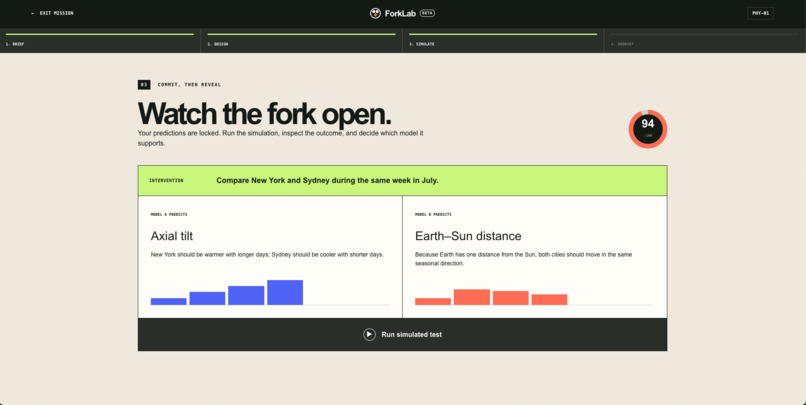
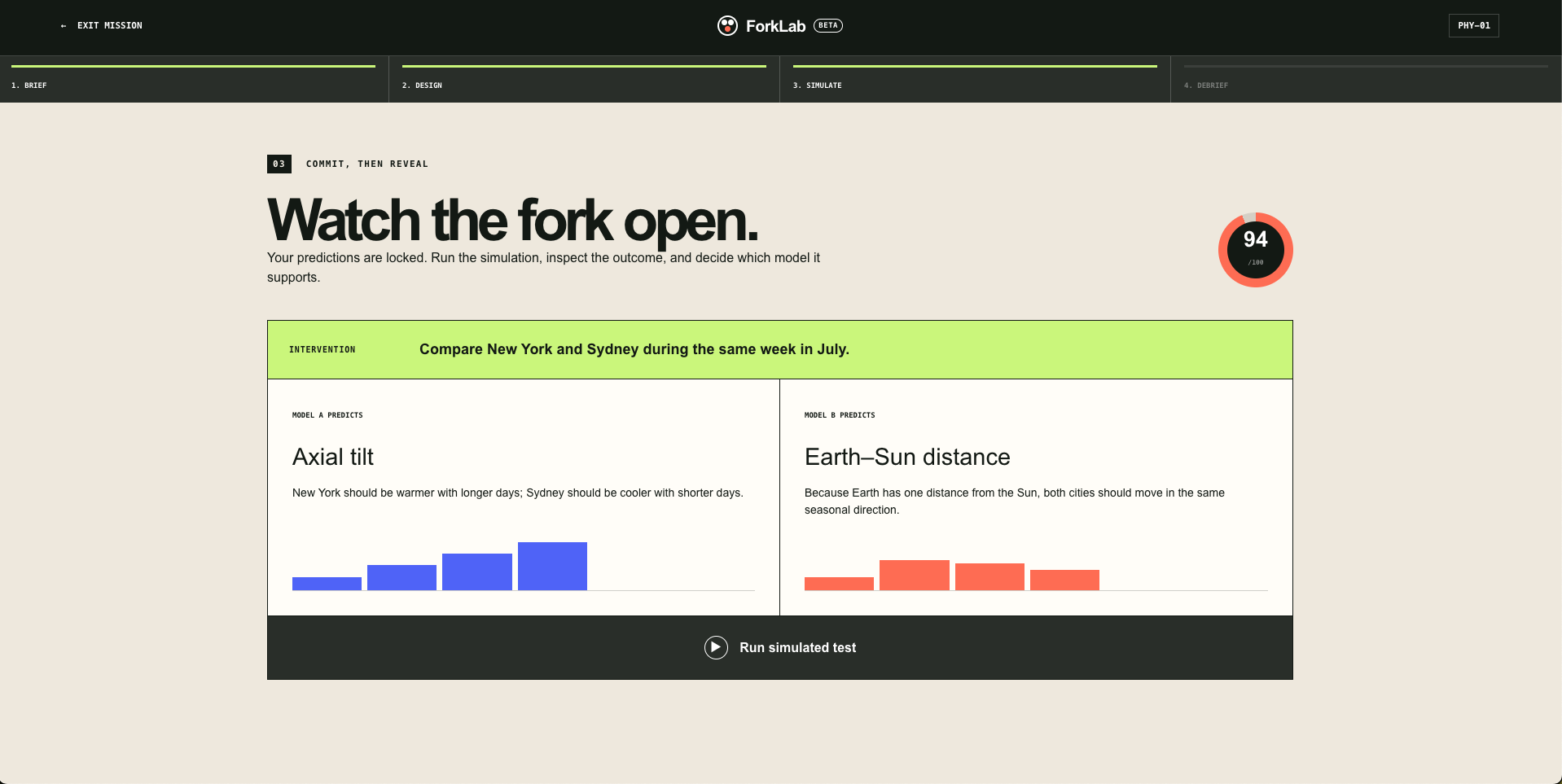
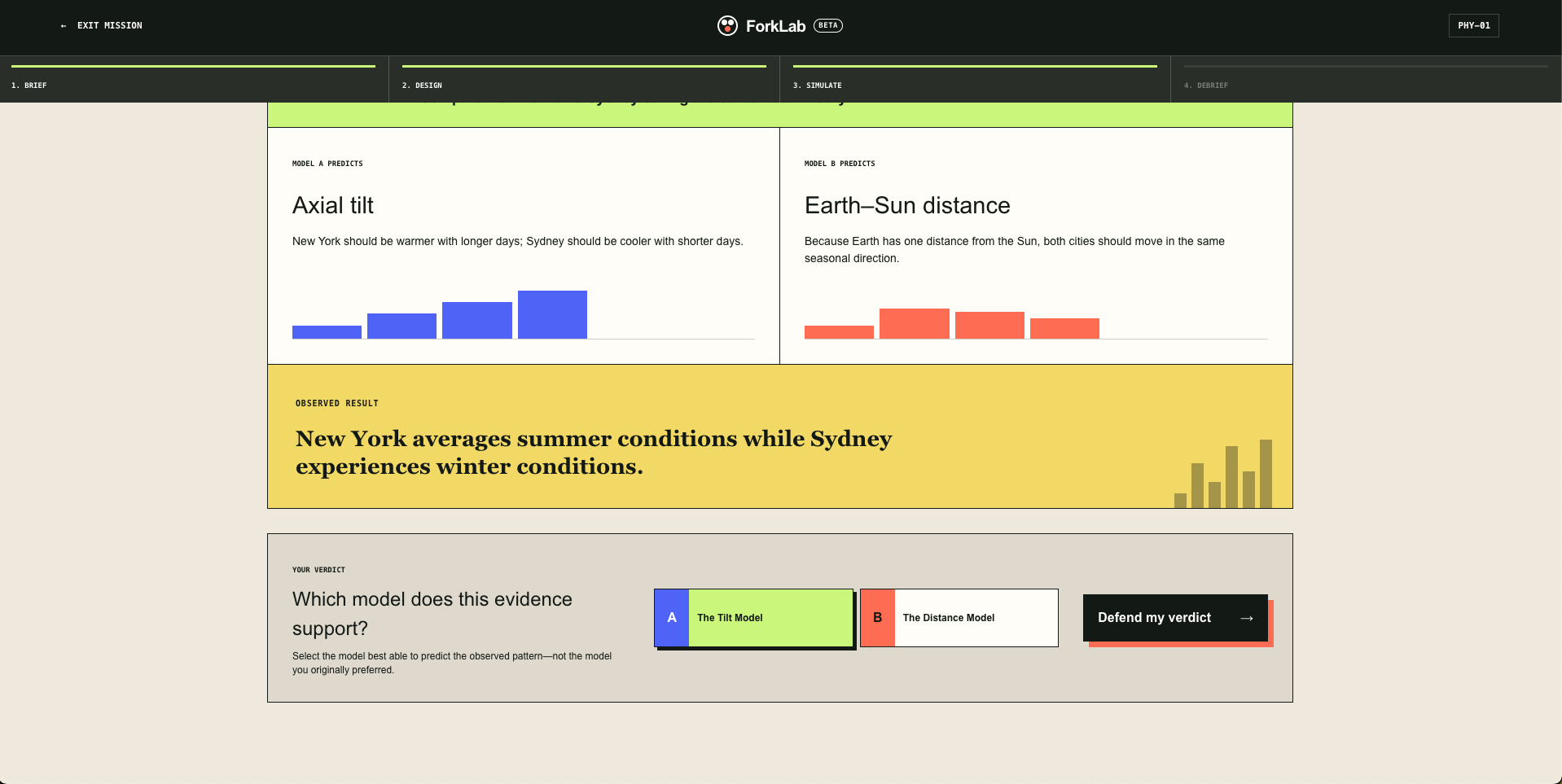
Before revealing the result, ForkLab displays both locked predictions so students cannot alter their reasoning after seeing the evidence.
-
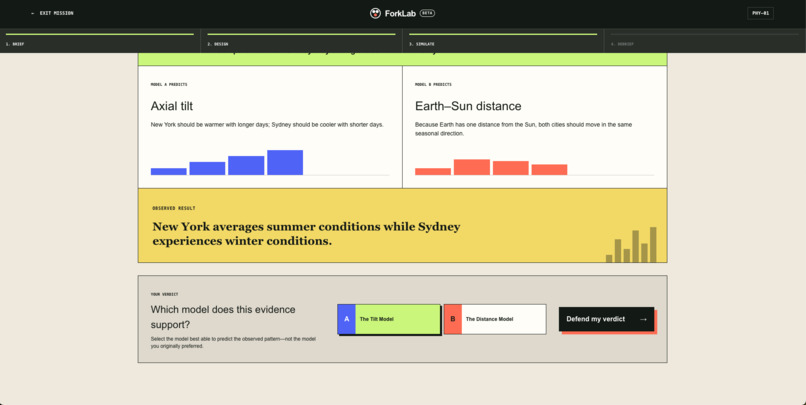
The simulated result forces the models to disagree, allowing the learner to choose the explanation best supported by evidence.
-
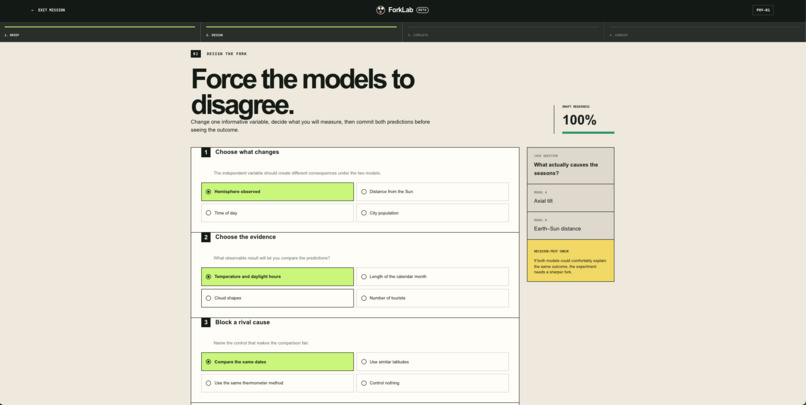
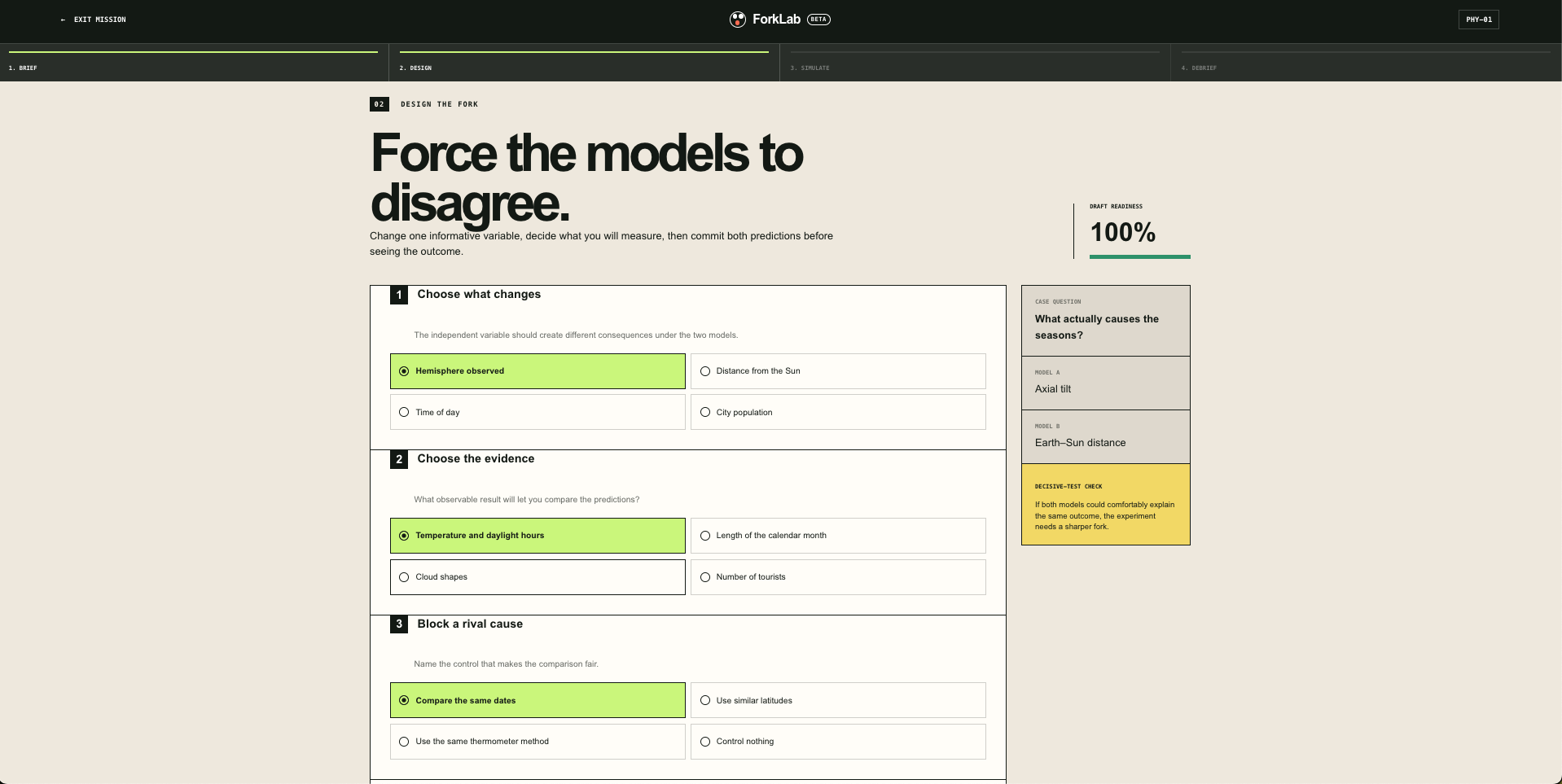
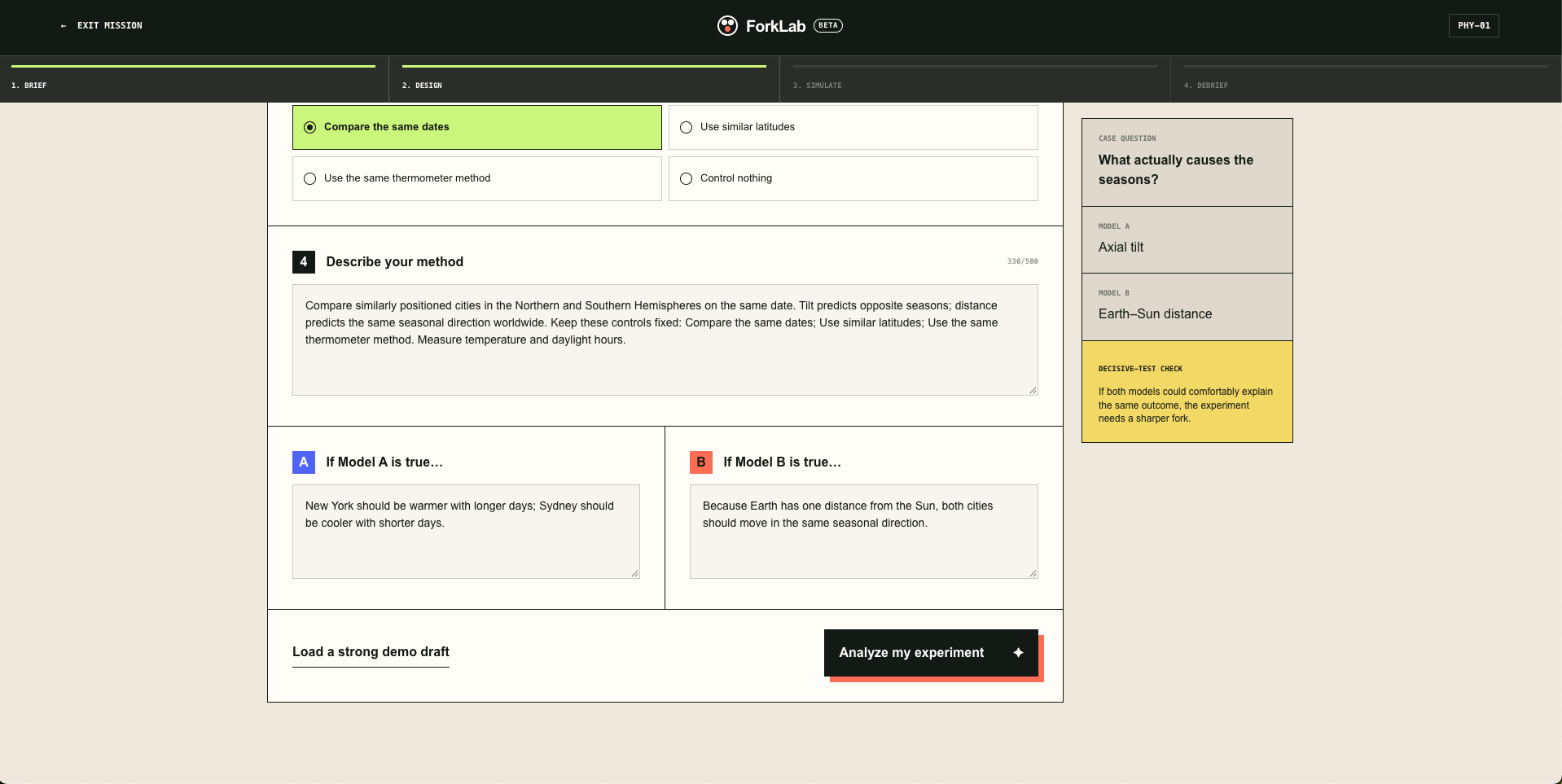
The experiment canvas helps students select an informative variable, measurable evidence, and appropriate controls.
-
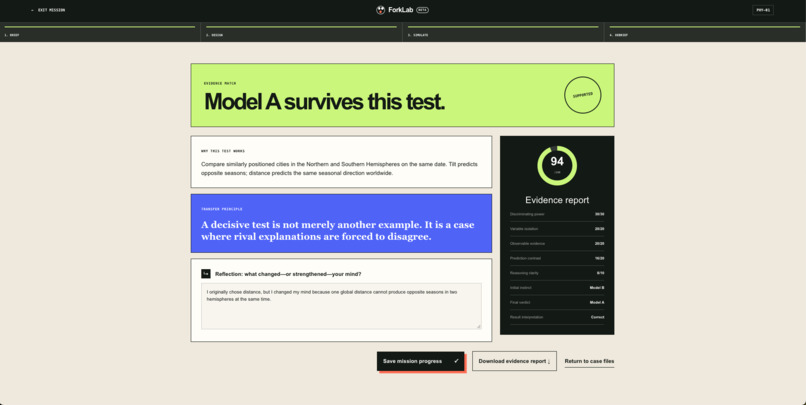
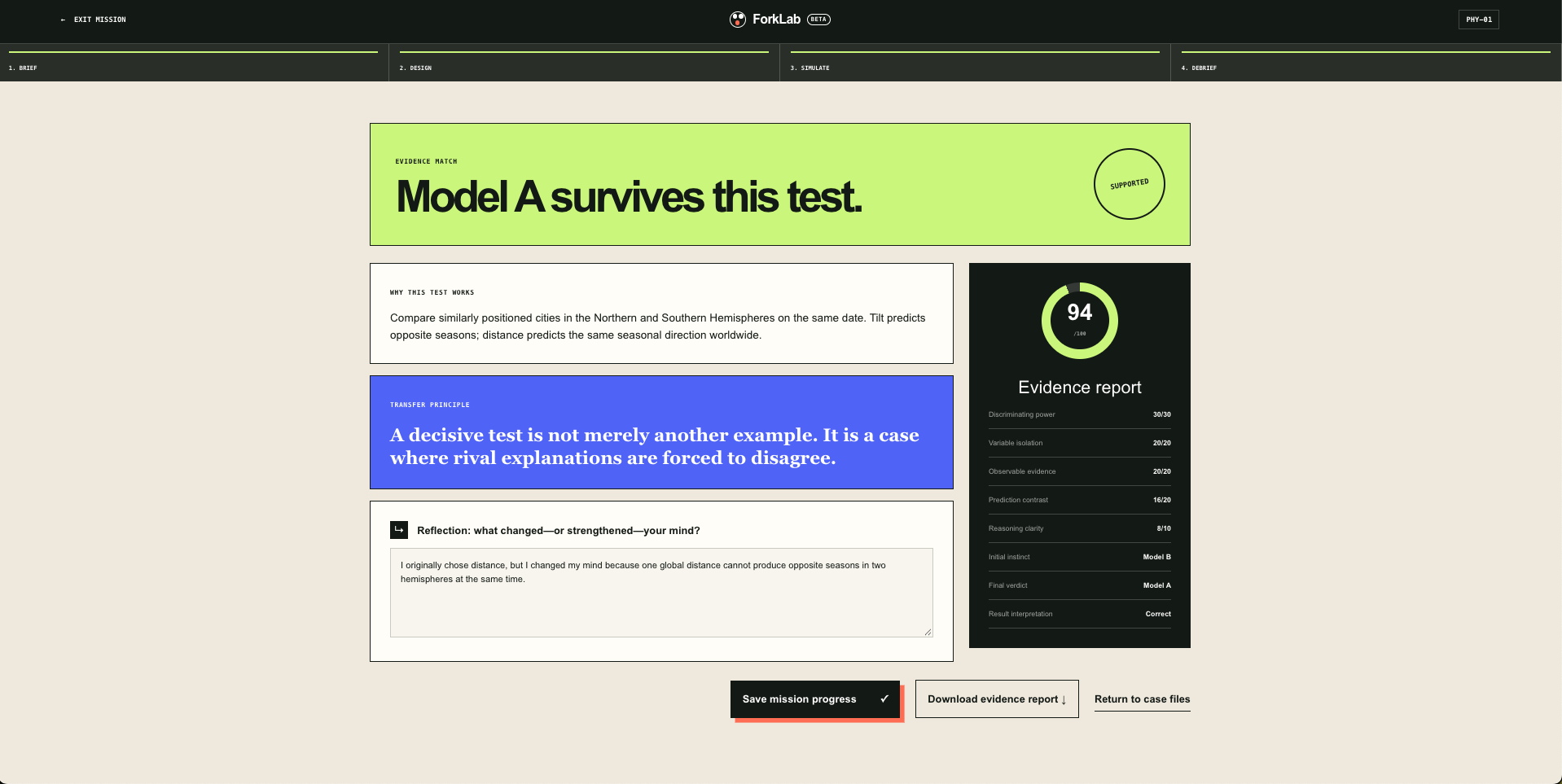
1. The final evidence reports the learner’s initial belief, final verdict, reasoning score, and reflection—making conceptual change visible.
-
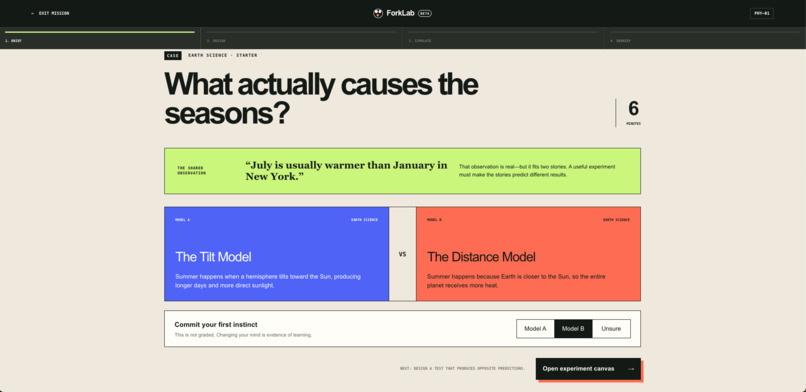
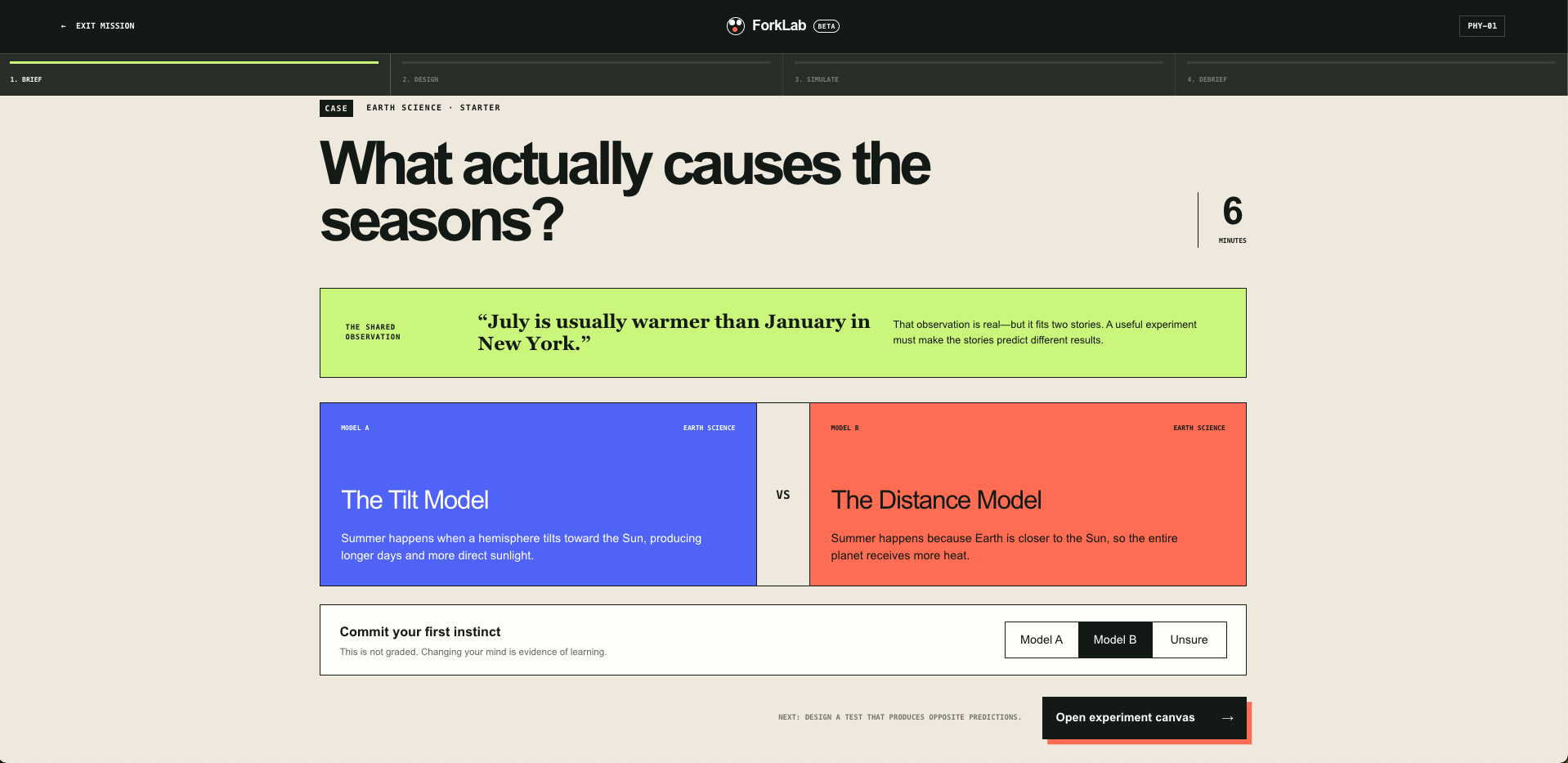
Students begin by comparing two plausible models and recording their initial belief without being penalized for changing their mind.
-
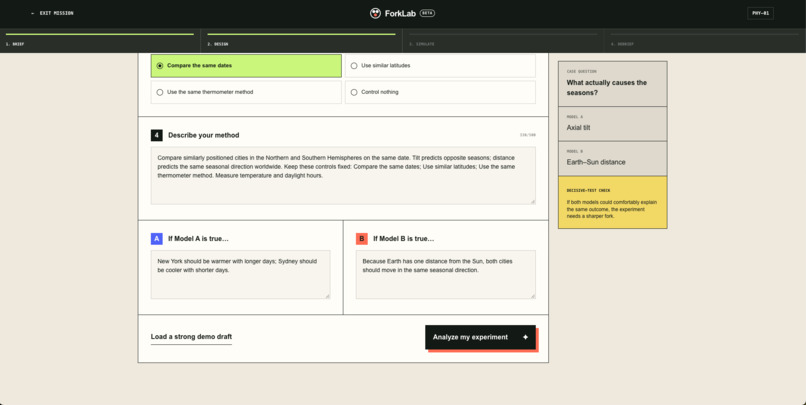
Students describe their method and commit each model’s prediction before seeing the experimental outcome.
-
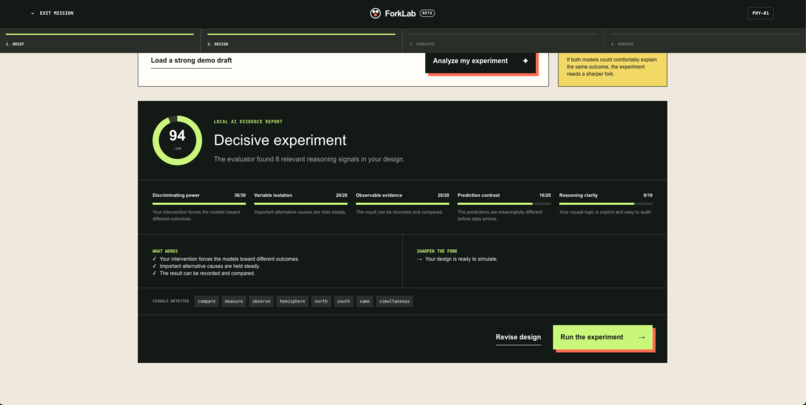
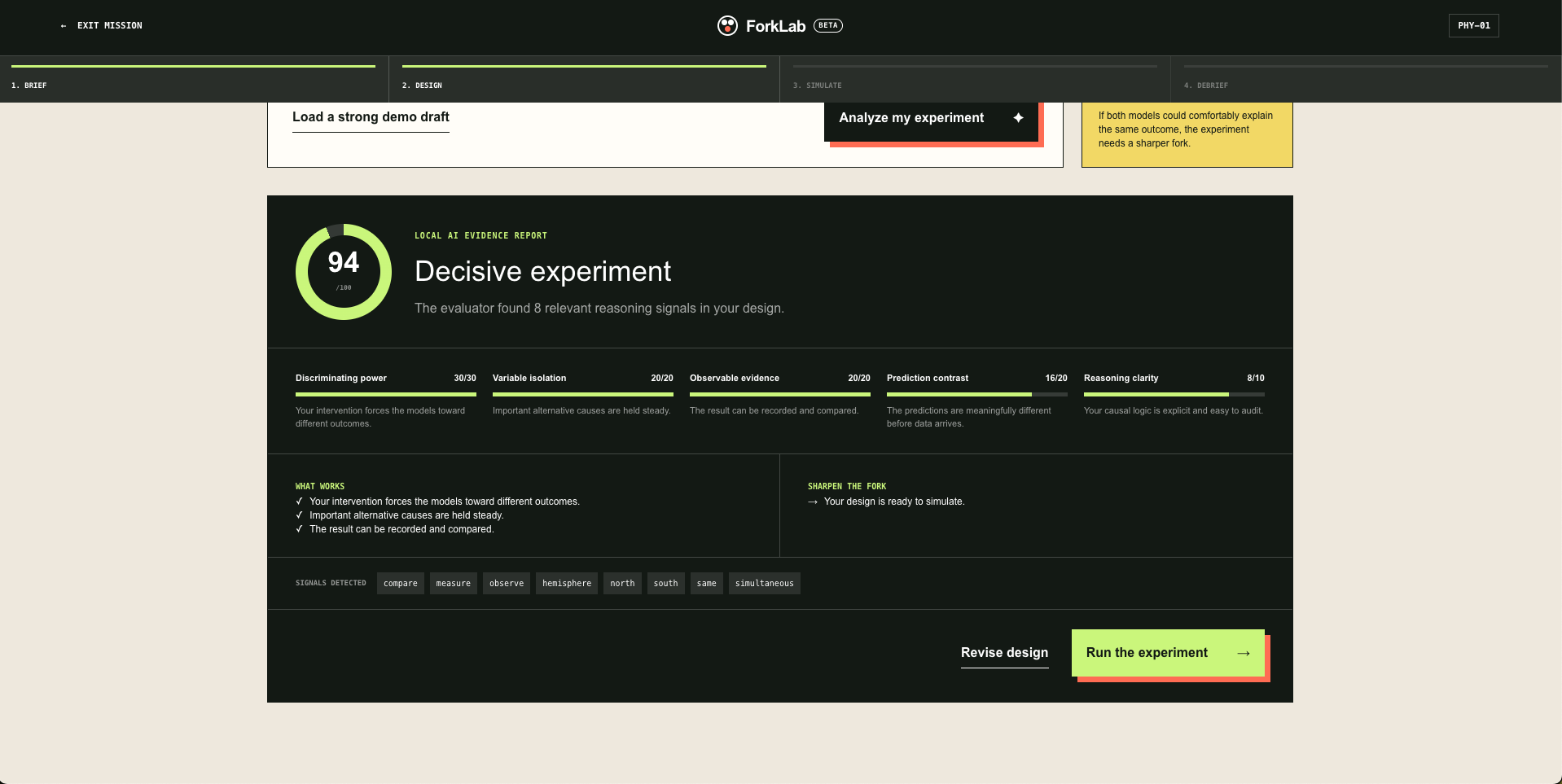
ForkLab provides feedback across five dimensions of experimental reasoning and identifies evidence directly from the student’s design.
-
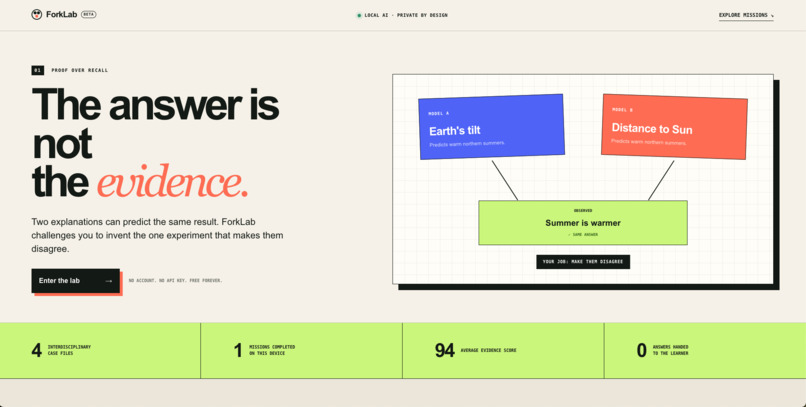
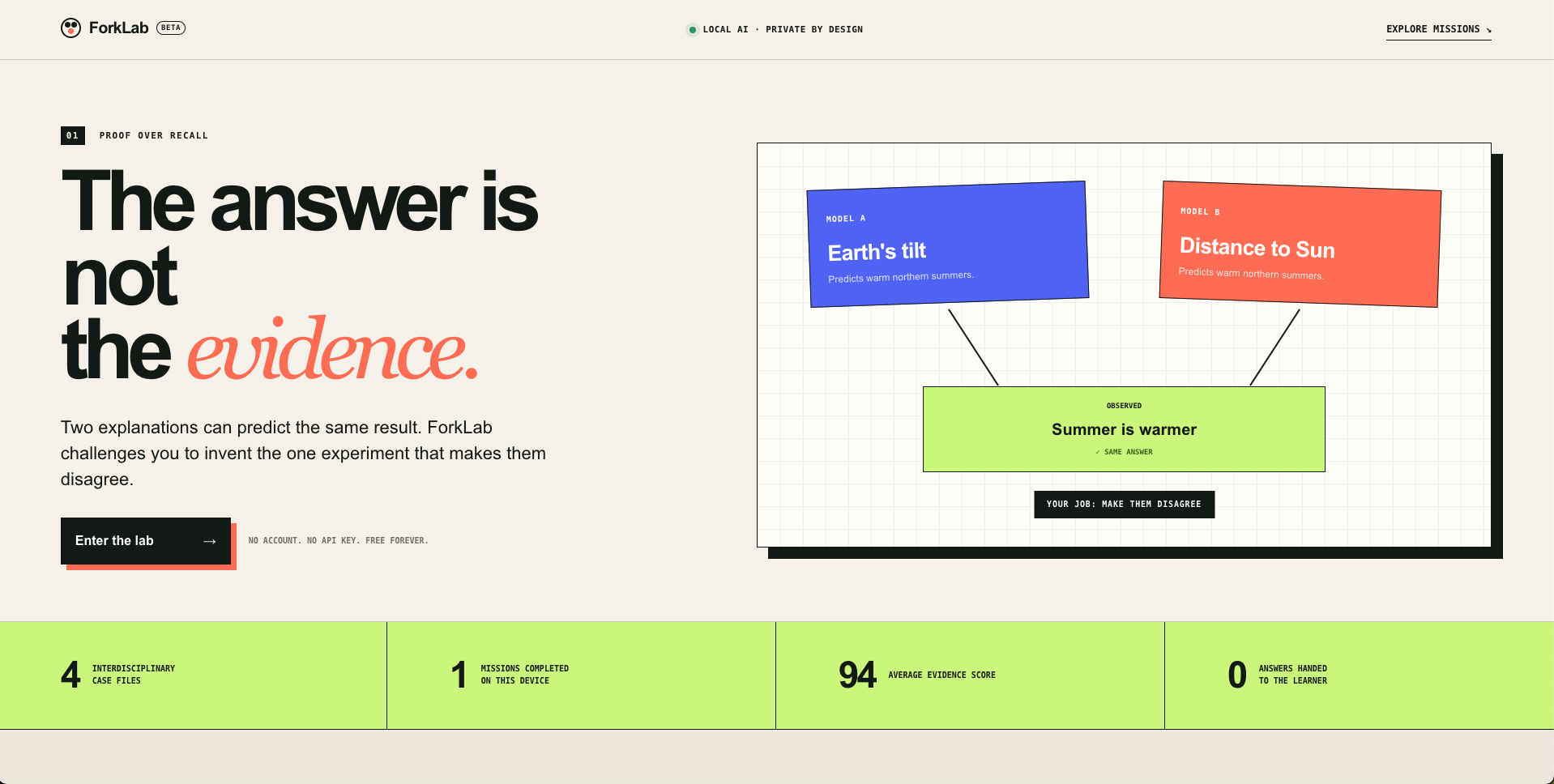
ForkLab turns learning from answer recall into evidence-based reasoning by challenging students to separate competing explanations.
-
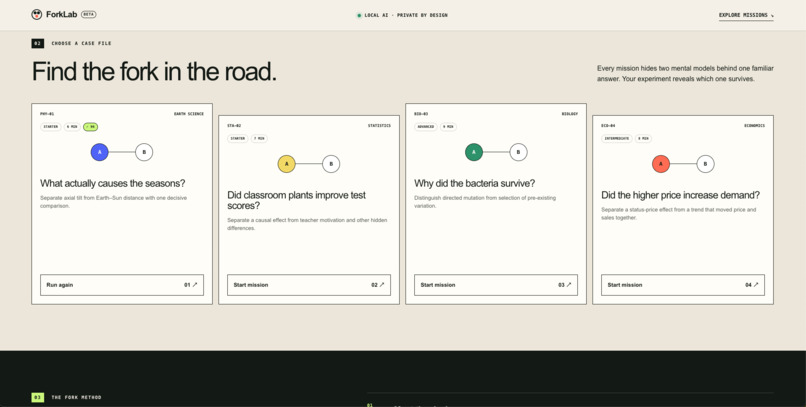
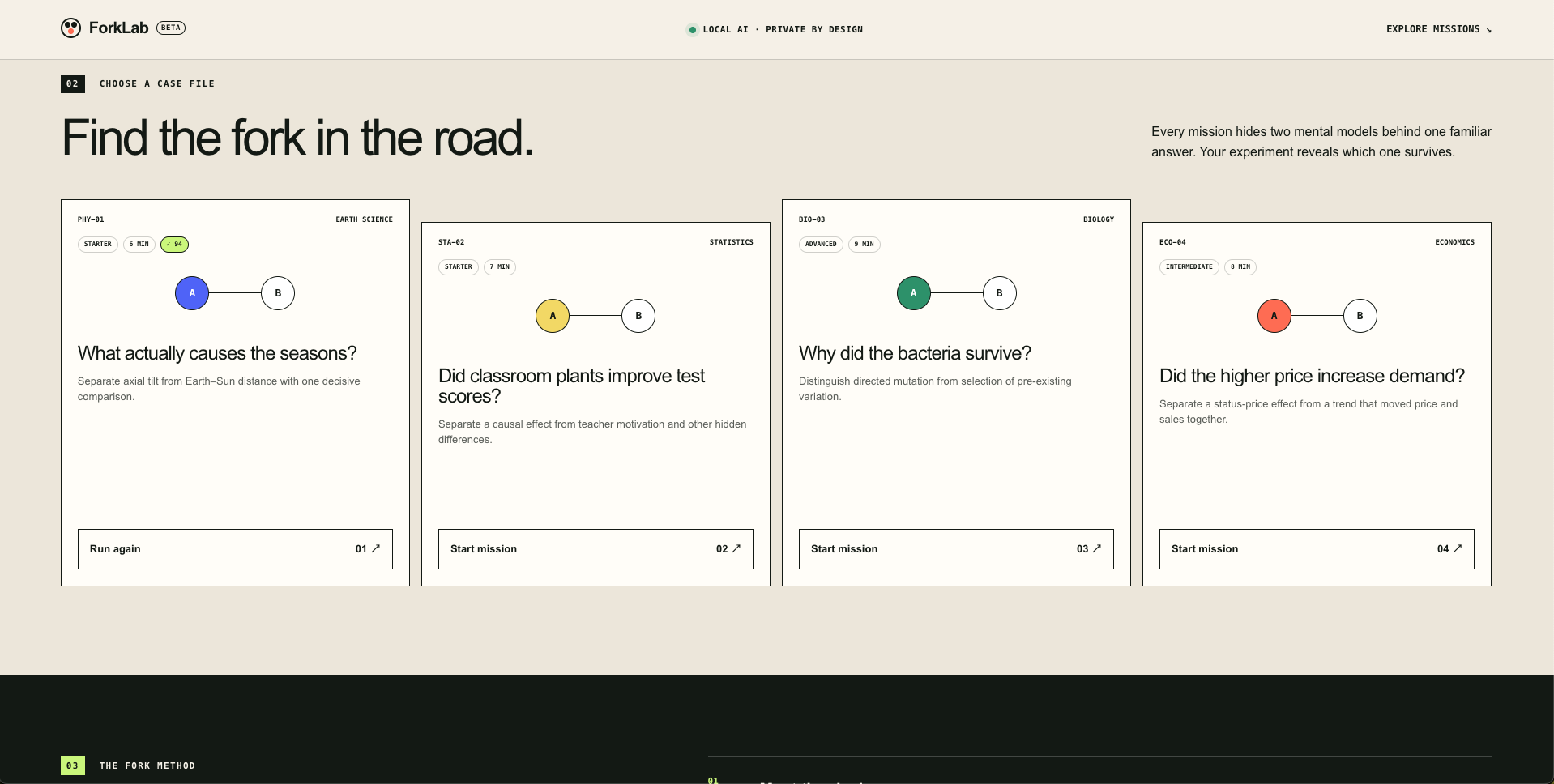
Four interdisciplinary case files let learners investigate questions in Earth science, statistics, biology, and economics.
-
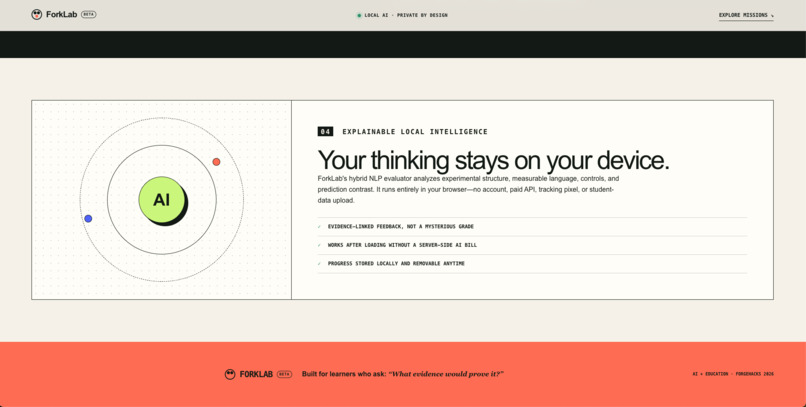
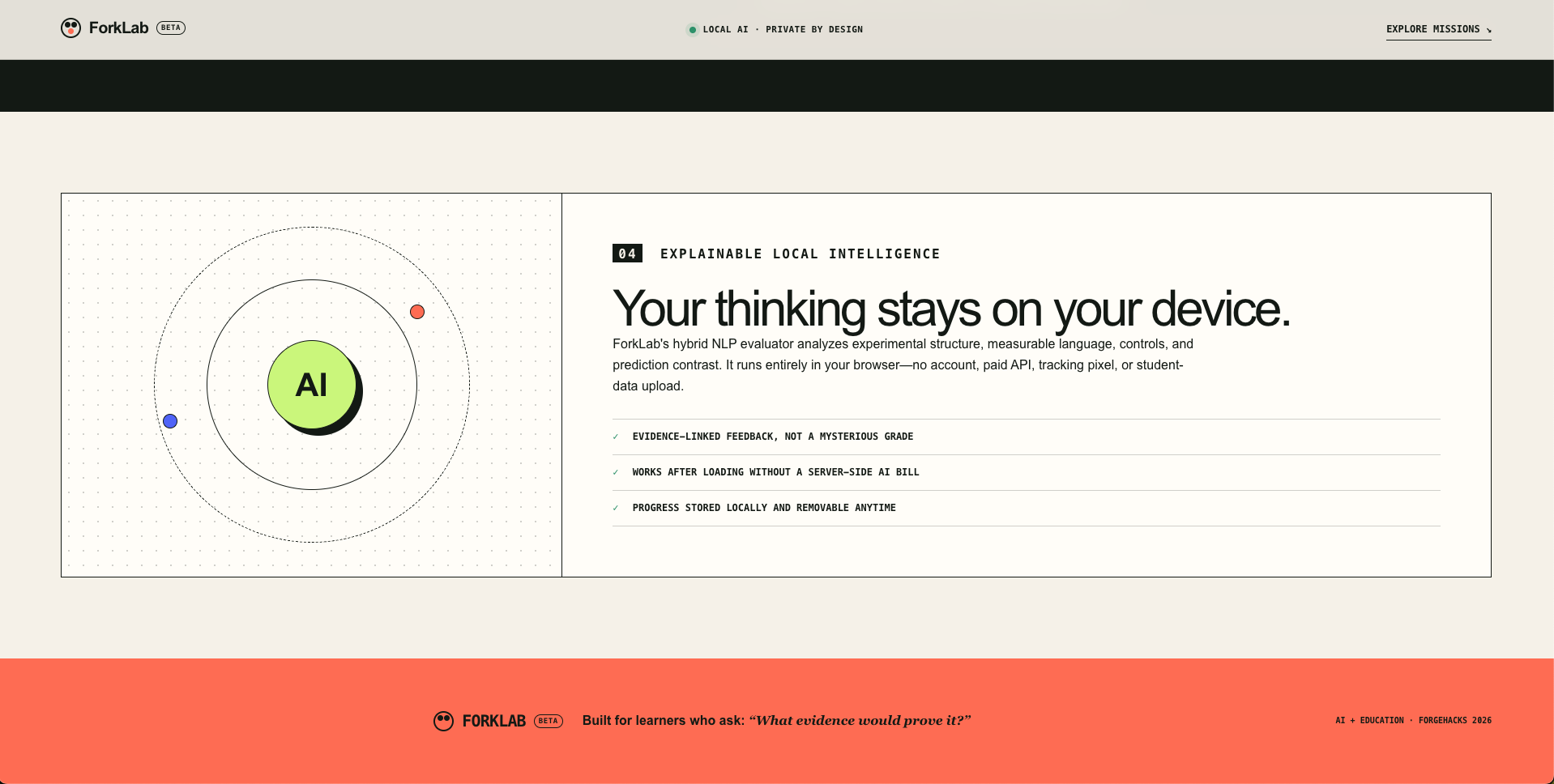
ForkLab’s explainable language analysis runs locally in the browser, keeping student thinking private and eliminating paid API costs.
-
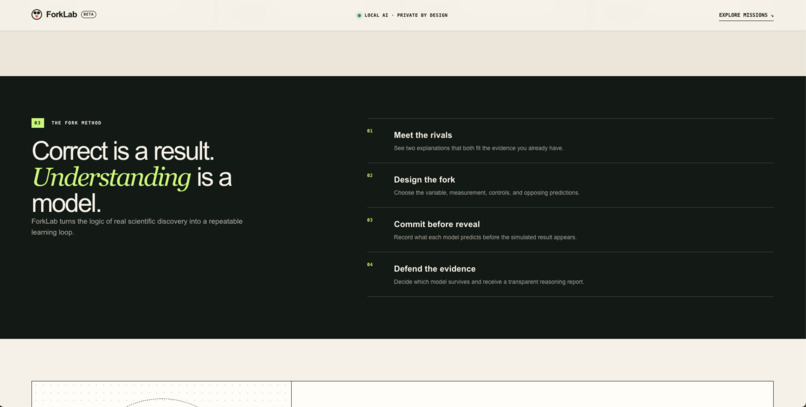
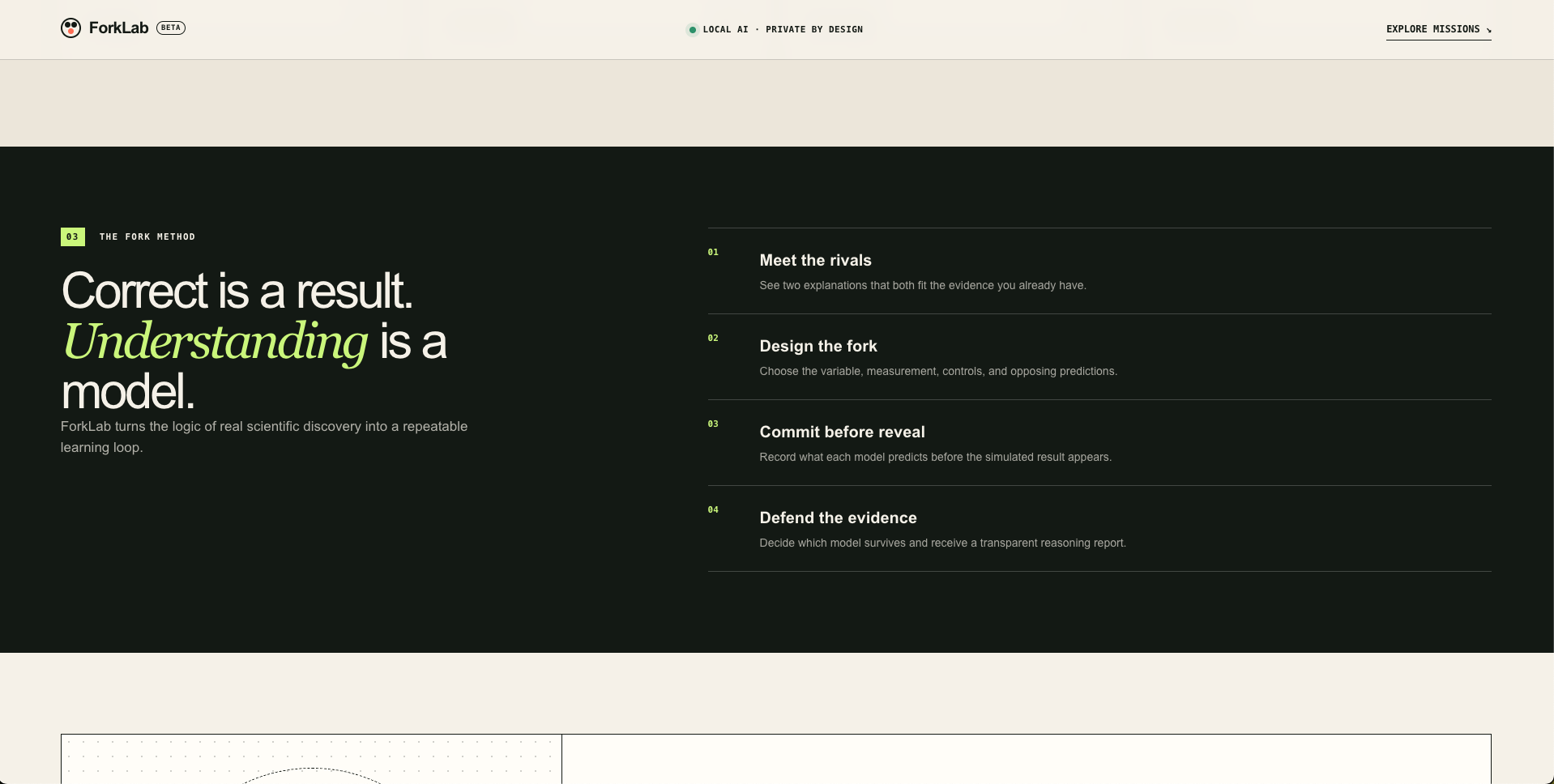
The Fork Method guides learners through four stages: meet the rivals, design the fork, commit predictions, and defend the evidence.
Inspiration
A student can choose the correct answer while still believing the wrong explanation.
For example, “July is warmer than January in New York” appears compatible with two models: Earth’s axial tilt causes summer, or Earth is closer to the Sun during summer. A normal quiz tests whether students remember the accepted answer, but not whether they understand the evidence behind it.
We built ForkLab around a deeper question:
What experiment would force two competing explanations to make different predictions?
Our goal was to use AI without letting it replace the learner’s thinking. Instead of generating answers, ForkLab analyzes the quality of the student’s evidence and experimental reasoning.
What it does
ForkLab is a free, privacy-first AI learning lab for developing critical thinking, causal reasoning, and experimental-design skills.
Every mission presents one observation and two competing explanations that initially appear plausible. The learner must:
- Commit to an initial hypothesis.
- Choose an informative variable.
- Select measurable evidence.
- Control alternative causes.
- Describe an experimental method.
- Predict what each model would produce.
- Run a simulated test.
- Decide which model the evidence supports.
- Reflect on whether their thinking changed.
ForkLab evaluates the experiment across five dimensions:
- Discriminating power
- Variable isolation
- Observable evidence
- Prediction contrast
- Reasoning clarity
Students receive specific feedback, can revise their experiment, save progress locally, and download an evidence report.
The current release includes missions covering Earth science, statistics, biology, and economics.
How we built it
We built ForkLab with React, TypeScript, Next.js-compatible App Router conventions, Vinext, Vite, and Cloudflare-compatible deployment output.
Each mission is stored as a structured, typed case file containing:
- A shared observation
- Two rival mental models
- Possible variables, measurements, and controls
- Model-specific predictions
- A simulated outcome
- A transferable reasoning principle
- Semantic concepts used during evaluation
ForkLab’s custom local AI engine analyzes the learner’s natural-language experiment. It combines semantic concept groups, synonym recognition, causal-language detection, prediction-distance analysis, and transparent weighted scoring.
Unlike a black-box AI grader, it shows which reasoning signals were detected and explains how each dimension could be improved.
The evaluator runs entirely in the browser. Progress is stored with localStorage, so ForkLab requires no account, external database, paid model API, or student-data upload.
Challenges we ran into
The largest challenge was evaluating open-ended reasoning without creating an unpredictable or opaque grader.
We solved this by separating experimental quality into five clearly defined dimensions. Every score maps to observable features in the learner’s response, and low scores generate concrete revision advice.
Another challenge was creating strong mission scenarios. Both explanations must genuinely fit the initial observation, but they must make different predictions under the right experiment. Creating these conceptual “forks” required more careful design than generating ordinary quiz questions.
We also needed the same learning system to work across very different subjects. Experimental reasoning in astronomy differs from reasoning in economics or evolutionary biology, so we created a reusable mission structure with subject-specific evidence rules.
Finally, we wanted ForkLab to remain operational after the hackathon. We avoided paid AI APIs and backend infrastructure so the core experience would not disappear when credits expired.
Accomplishments that we're proud of
We are proud that ForkLab is a complete learning experience rather than a chatbot wrapper.
During the hackathon, we:
- Built four fully interactive interdisciplinary missions
- Created a transparent local NLP evaluation engine
- Developed a complete experiment-design workflow
- Made changes in student thinking visible through initial and final beliefs
- Added personalized strengths and revision feedback
- Added interactive simulations and evidence-based verdicts
- Created downloadable learning reports
- Implemented private, device-local progress tracking
- Built responsive desktop and mobile layouts
- Added keyboard accessibility and reduced-motion support
- Eliminated the need for accounts, API keys, and recurring operating costs
- Structured the platform so additional missions can be added easily ## What we learned We learned that a correct answer is only the output of understanding—it is not proof that understanding exists.
A more revealing assessment asks whether a learner can identify:
- Which evidence matters
- Which variables must remain controlled
- What each explanation predicts
- What result would change their mind
We also learned that educational AI does not always need to behave like a tutor. A constrained and explainable AI system can support learning more effectively by evaluating thought processes without completing the intellectual work for the student.
Most importantly, we learned that changing your mind should not be treated as failure. In ForkLab, revising an initial belief after seeing decisive evidence is the clearest demonstration of learning.
What's next for ForkLab
Next, we plan to:
- Expand from four missions to a larger interdisciplinary mission library
- Add history, computer science, media literacy, medicine, and public-policy cases
- Build a Create Your Own Fork tool for teachers
- Generate shareable links for educator-created missions
- Add difficulty levels and adaptive recommendations
- Support additional languages and read-aloud accessibility
- Calibrate the evaluator using educator-scored student responses
- Create anonymous classroom-level reasoning insights
- Build an educator-reviewed community mission library
- Package ForkLab as an installable offline application
Our long-term goal is to make ForkLab a platform where students do not merely state what they know—they demonstrate what evidence would prove it.
Built With
- accessibility
- cloudflare
- css3
- explainable-ai
- html5
- localstorage
- natural-language-processing
- next.js
- react
- responsive-design
- typescript
- vinext
- vite

Log in or sign up for Devpost to join the conversation.