Inspiration
As quantum computing increasingly relies on cloud infrastructure, protecting proprietary quantum algorithms becomes an emerging cybersecurity challenge. Our project was inspired by research from Beat Buesser and Anil Kurmus at IBM Research on algorithmic intent leakage from transpiled quantum circuits. We wanted to explore whether quantum circuits could be made harder to reverse-engineer without changing their computation.
What it does
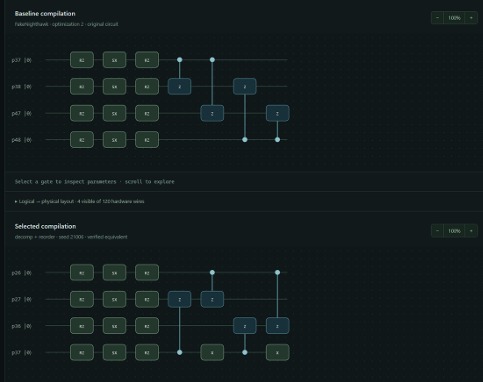
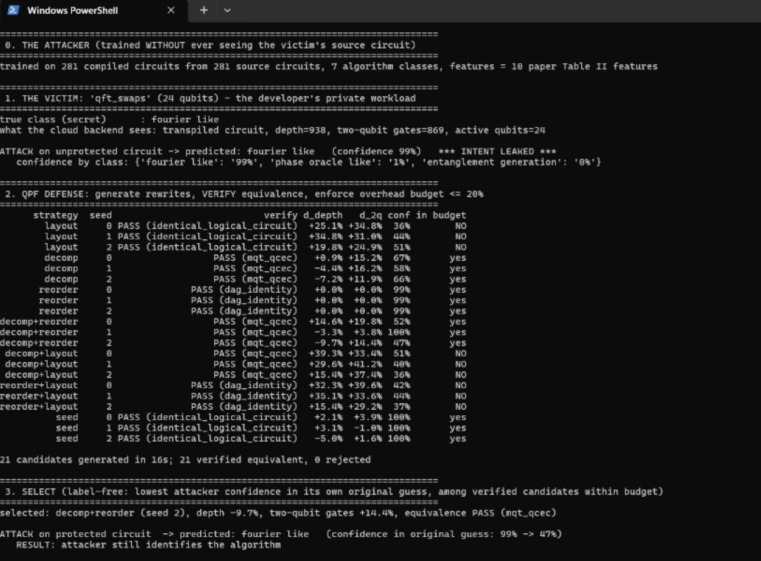
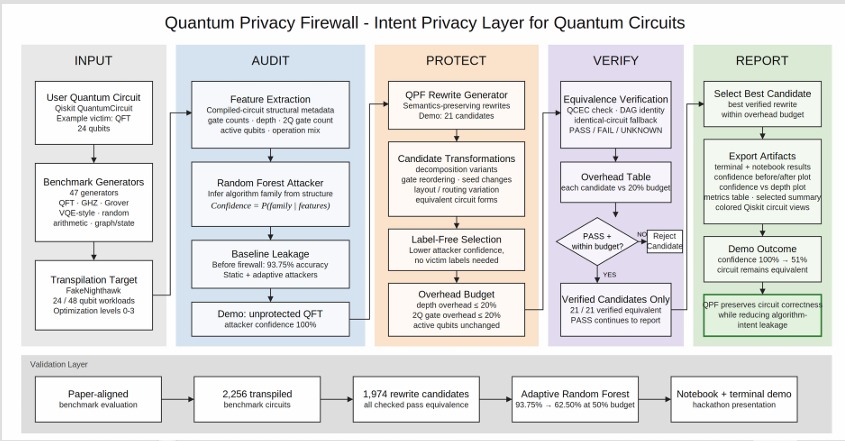
Quantum Privacy Firewall (QPF) is a privacy-aware quantum compilation and auditing framework. It analyzes structural information leaked by transpiled circuits and generates functionally equivalent alternatives through gate transformations, layout diversification, and transpiler randomization. It verifies correctness, measures hardware overhead, and evaluates privacy improvements against adaptive attackers.
How we built it
We used IBM Qiskit and FakeNighthawk to implement a benchmark covering seven algorithm classes, 47 circuit generators, and 24/48-qubit workloads. Ten normalized structural features are analyzed using Random Forest classifiers. Our defense pipeline uses MQT QCEC and other equivalence checks alongside resource-budget filtering. A FastAPI backend and React frontend provide interactive circuit analysis and visualization.
Challenges we ran into
Our biggest challenges were preserving quantum-circuit equivalence, correcting ancilla initialization and uncomputation errors, managing computationally expensive verification, and preventing dataset leakage during machine-learning evaluation. We also discovered that transformations which confuse an initial classifier may be less effective against retrained attackers.
Accomplishments that we're proud of
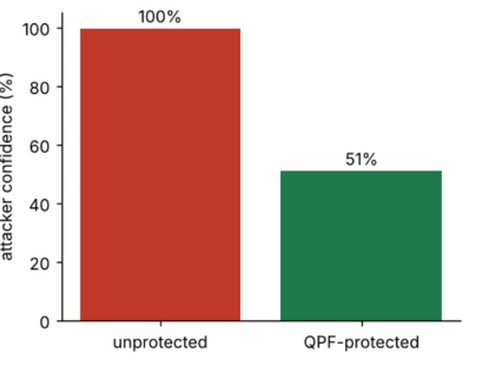
We built an independent algorithm-intent leakage benchmark, implemented circuit transformations with equivalence checks, and developed an adaptive security evaluation pipeline. Our reported experiments achieved 93–99% classification accuracy under matching compiler settings and demonstrated a modest reduction in adaptive attacker macro-F1 from 0.916 to 0.865 under the tested defense configuration.
What we learned
We learned that quantum security extends beyond protecting data and encryption keys to protecting the structure of quantum programs. We also discovered that circuit obfuscation requires balancing three factors: computational correctness, hardware efficiency, and resistance to informed attackers. A lower classifier score alone does not guarantee confidentiality.
What's next for ForkAround&FindOut
We plan to explore stronger privacy-preserving transformations, evaluate more sophisticated attackers, and improve equivalence verification for larger circuits. Our long-term goal is to integrate QPF into Qiskit's compilation workflow as a reusable privacy-auditing tool, with real-hardware validation when resources become available.

Log in or sign up for Devpost to join the conversation.