-
-
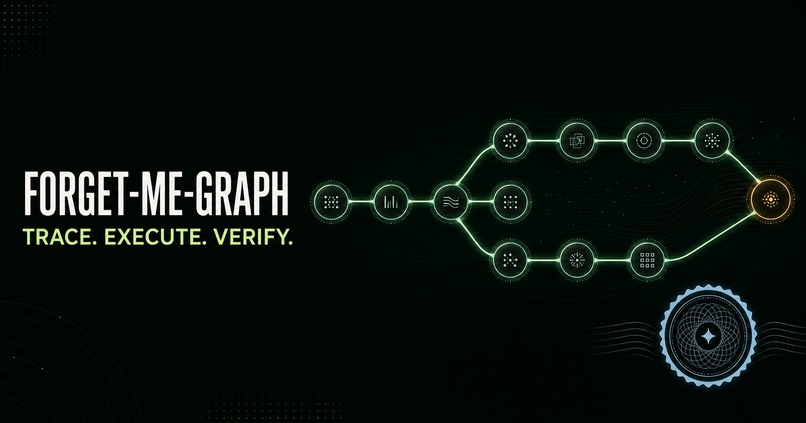
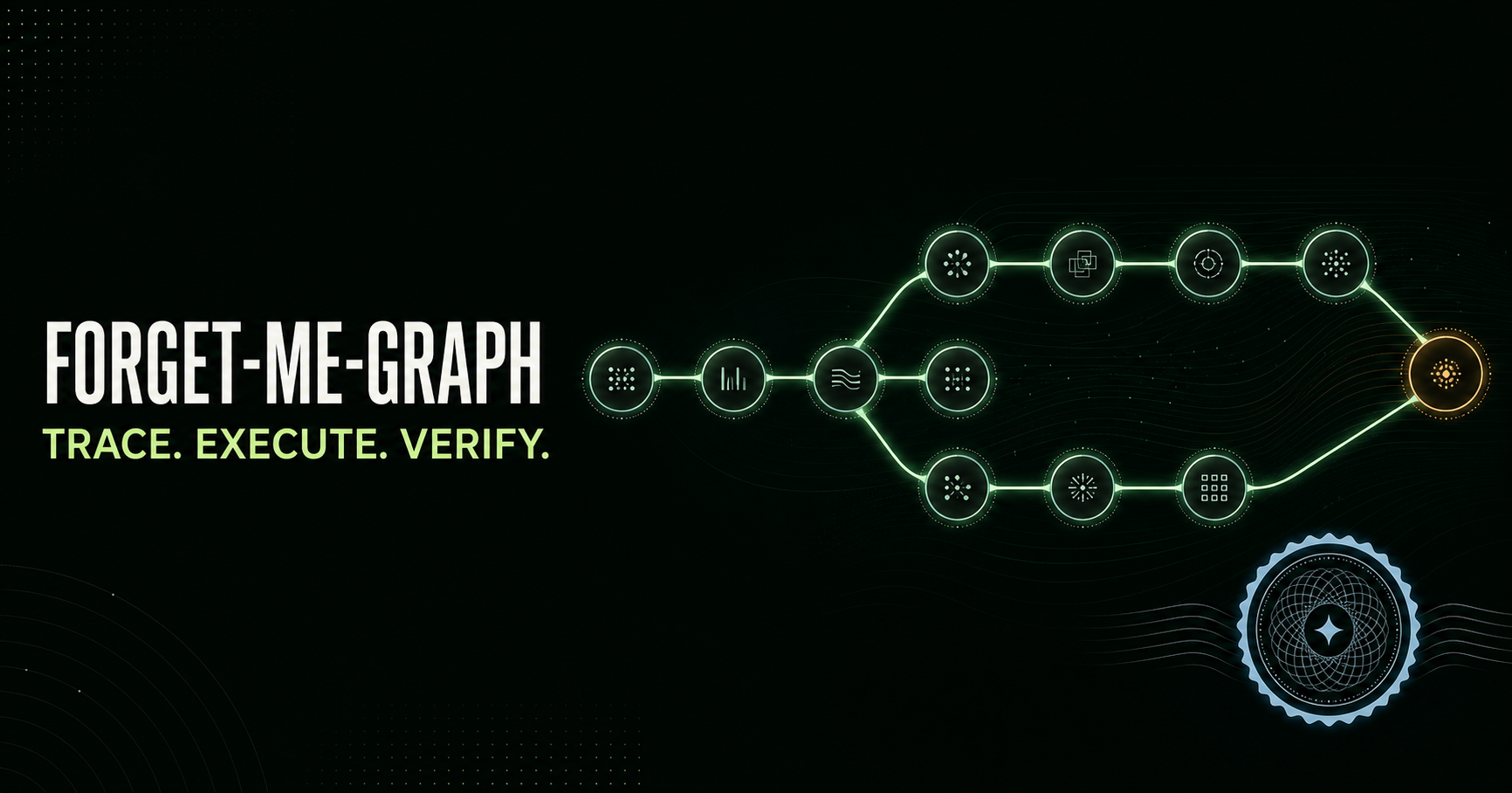
Forget-Me-Graph — trace, execute, verify.
-
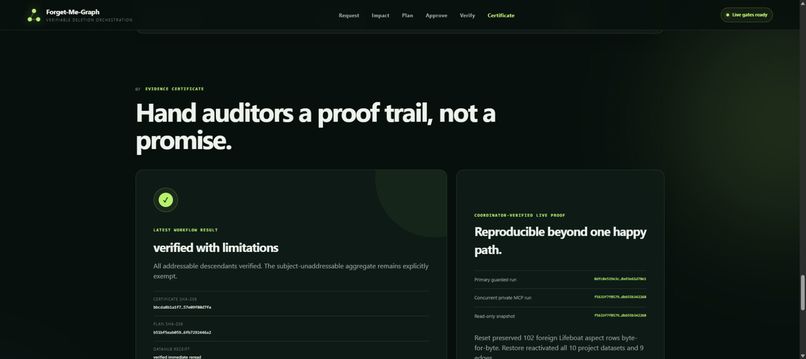
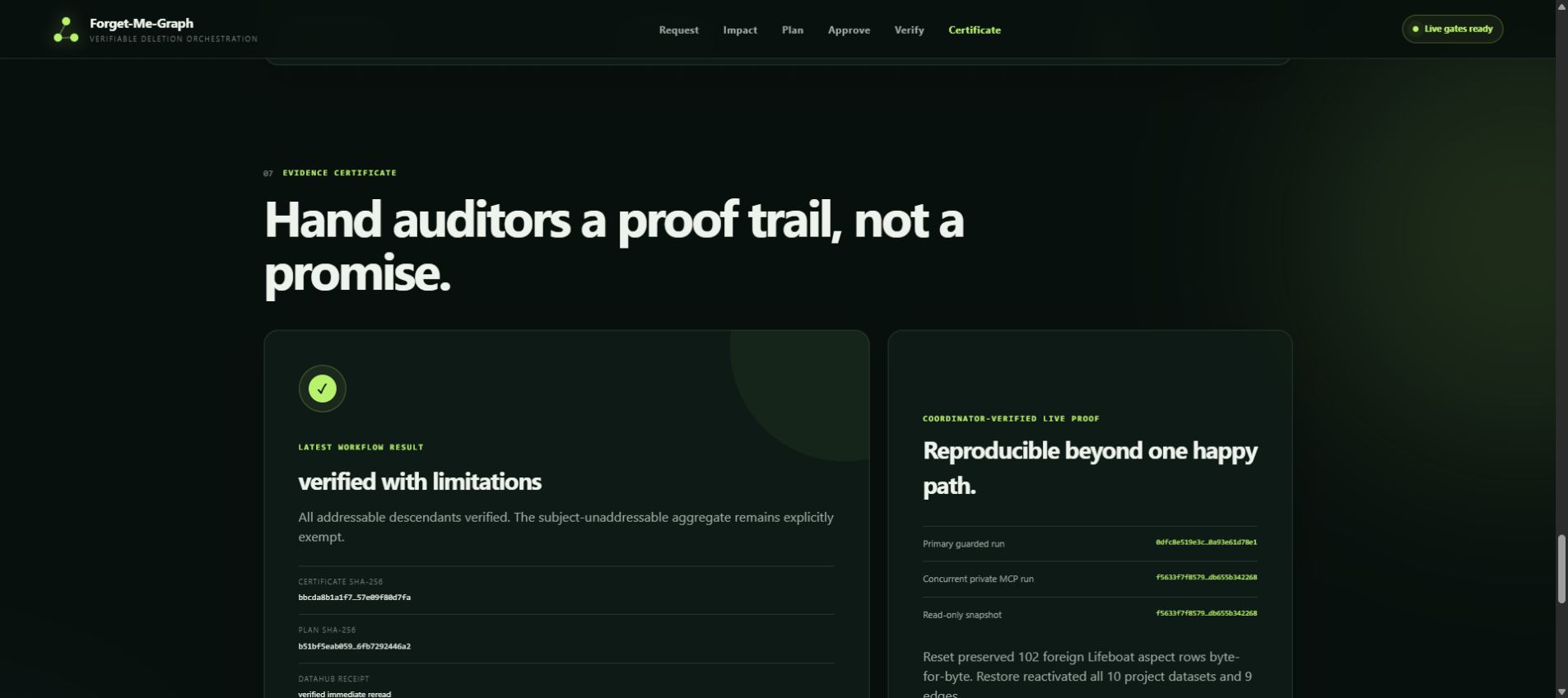
Evidence certificate: nine verified results, zero failures, and one explicit limitation.
Inspiration
Deleting a subject from a system of record says nothing about downstream copies in transformed tables, feature data, embeddings, caches, exports, training snapshots, or models. Data lineage can show the blast radius, but dataset-level edges do not tell an executor how to find one subject. Deletion tools, meanwhile, rarely understand learned artifacts.
I built Forget-Me-Graph as the orchestration and evidence layer between those worlds: use DataHub's graph to identify scope, explicit selector mappings to make each consequence executable, and independent verification to distinguish proved deletion from a promise.
What it does
For one fixed synthetic customer-support estate, Forget-Me-Graph:
- accepts a scoped selector and immediately replaces its visible identity with a protected token;
- requires current DataHub coverage for ten exact assets and nine exact lineage edges;
- translates dataset lineage into executable subject selectors using versioned key mappings;
- deterministically selects purge, rebuild, vector deletion and re-indexing, cache eviction, export replacement, clean-snapshot retraining, verification, or exemption;
- binds human approval to the exact plan SHA-256;
- mutates real disposable DuckDB, SQLite, CSV, vector, cache, snapshot, and scikit-learn artifacts;
- independently re-queries every addressable descendant;
- creates a JSON and Markdown evidence certificate with a reproducible canonical hash; and
- writes five allowlisted evidence properties to DataHub and immediately rereads them for exact equality.
The demonstrated outcome is intentionally verified_with_limitations: nine results are verified,
zero fail, and one aggregate remains exempt because it has no subject-addressable key. The model
is fully retrained from a rebuilt clean snapshot. I do not describe that as mathematical or
universal machine unlearning.
How I use DataHub
Open-source DataHub is the live catalog and dependency graph. The DataHub MCP Server supplies
get_entities and downstream get_lineage context. Every target must be an exact entity inside
the allocated forgetme.* namespace, and readiness verifies the current domain, tag, active
state, fixture properties, assignments, and exact upstream lineage.
The DataHub Python SDK writes request, status, plan, and certificate hashes to allowlisted custom properties, followed by an immediate reread. The workflow never mutates DataHub lineage and never hard-deletes a DataHub entity.
How I built it
The service uses Python, FastAPI, Pydantic, DuckDB, SQLite, scikit-learn, the DataHub SDK, and the MCP Python SDK. A same-origin HTML, CSS, and JavaScript evidence console calls the exact planner, executor, and verifier used by the CLI.
Deterministic code—not an LLM—controls traversal, mapping, action selection, approval binding, execution order, and status aggregation. Missing context, mappings, namespace markers, approval, or verification evidence blocks the relevant work.
Challenges I faced
A successful metadata call can still mean “not found,” so I replaced configuration inference with exact non-mutating readiness checks for the complete allocation and MCP capabilities.
Dataset lineage is also not row-level lineage. Guessing how a subject key propagates would be a privacy defect, so I introduced explicit versioned selector mappings and fail closed when a mapping is absent.
The final challenge was describing model removal honestly. The product proves a rebuilt subject-free training snapshot, a retired manifest, and a fully retrained toy model, while keeping formal unlearning, exemption, failure, and out-of-scope as distinct outcomes.
What I learned
Metadata availability is not evidence of metadata completeness. Readiness has to verify the exact current graph rather than trust an old receipt. I also learned that honest unlearning UX needs more than a green check: a clean retrain, formal unlearning result, documented exemption, failure, and out-of-scope asset have materially different meanings.
What I am proud of
- One approval-gated workflow spans seven real disposable artifact types.
- Current DataHub context gates execution and supported writeback is verified by reread.
- The certificate separates nine verified results from one explicit limitation.
- Public validation proved reset/readiness transitions and preserved foreign project state.
- The hosted experience uses one masked synthetic subject and requires no judge credential.
Limitations and what's next
This is a synthetic reference workflow, not a production privacy certification. It supports the demonstrated mappings and adapters and does not prove that an external estate contains no unrepresented copy. Production adoption would require authenticated approval, organization-owned connectors and mappings, legal review, and platform-specific verification. Next I would add more learned-artifact adapters and a governed workflow for registering selector mappings.
Built With
- css
- datahub
- duckdb
- fastapi
- html
- javascript
- mcp
- pydantic
- python
- scikit-learn
- sqlite

Log in or sign up for Devpost to join the conversation.