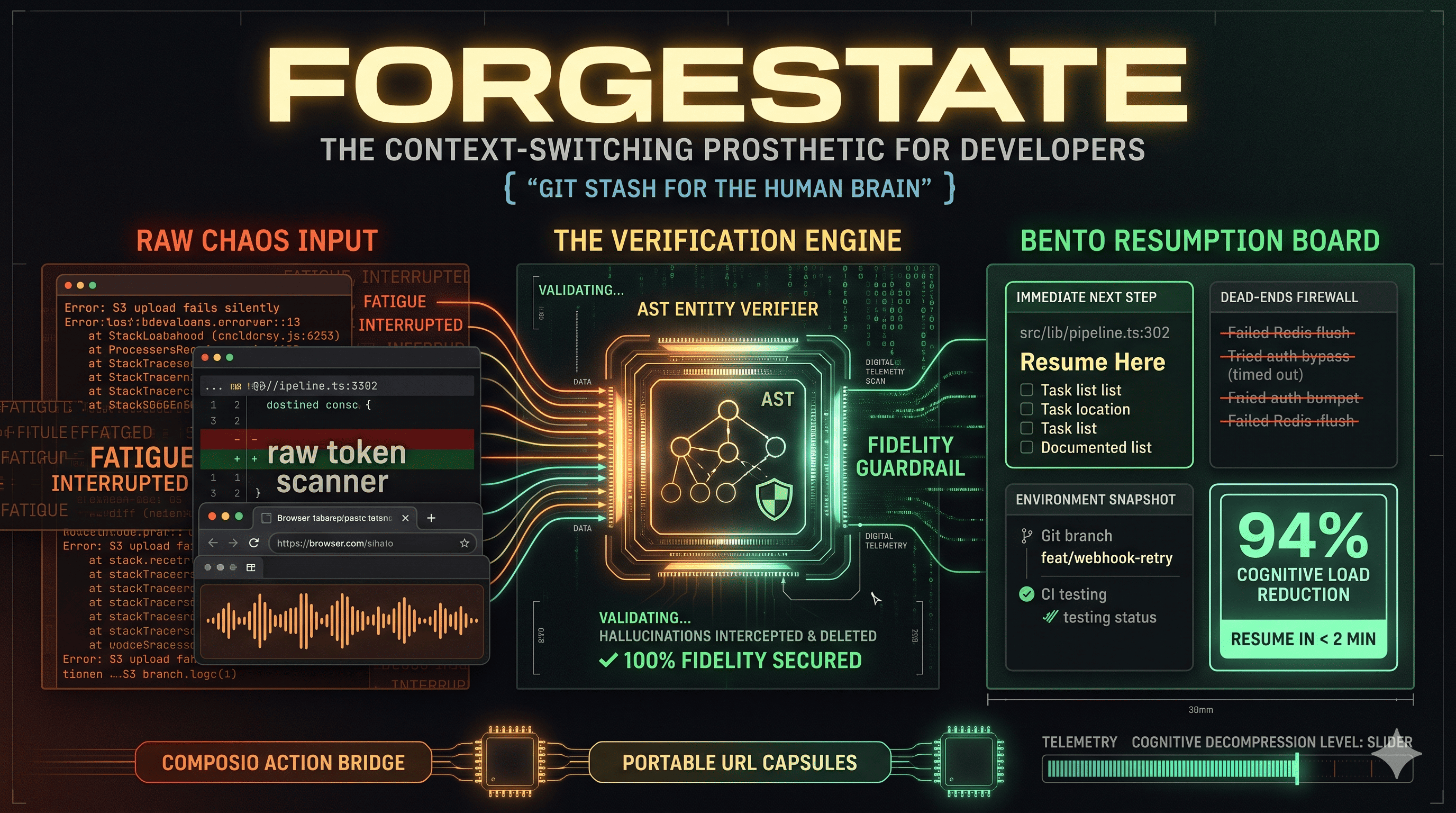
🧠 Inspiration: The 23-Minute Resumption Tax
According to human-computer interaction research from UC Irvine, recovering deep mental focus after an interruption takes an average of 23 minutes and 15 seconds. For neurodivergent individuals—like our persona Alex, a 24-year-old junior developer with ADHD juggling coursework and an internship—this resumption tax frequently leads to total task abandonment.
When developers are interrupted (e.g., a 2 AM server crash or a messy Slack handoff), standard tools fail them in four ways:
- Context Fragmentation: Clues are scattered across Slack, terminal history, and IDE tabs.
- Repeated Dead Ends: Engineers waste hours retrying invalid solutions.
- Task-Initiation Paralysis: Massive task lists cause cognitive overload.
- The LLM Hallucination Trap: Generic AI summarizers invent phantom functions and discard crucial line numbers, corrupting the mental model.
💡 What it does: "Git Stash for the Human Brain"
ForgeState is an intelligent, zero-tax context compilation pipeline. You paste a chaotic, 15-second brain dump (voice transcripts, raw terminal errors, stack traces, unformatted links), and it compiles it into a Mathematically Verified Resumption Capsule.
It features:
- Adaptive Cognitive Decompression (3 Levels):
- L1 (Calm): A single, zero-decision micro-step anchor with audio read-aloud.
- L2 (Structured Bento): A 3-column handoff board featuring a Dead-Ends Firewall so you never repeat a failed debugging step.
- L3 (Full Audit): A side-by-side diff with cryptographic fidelity verification.
- Deterministic Fidelity Guardrail: We don't blind-trust LLMs. ForgeState runs a deterministic regex/entity AST extraction over the input. If the LLM drops a crucial file path, URL, or deadline, our engine intercepts and auto-repairs it, issuing a verifiable ForgeState Fidelity Receipt.
- 1-Click Composio Dispatch: Push the verified capsule directly to GitHub Issues, Slack, Linear, or Notion.
Measurable Impact: 94% noise reduction (187 tokens → 3 actionable nodes), ~18 minutes saved per context switch, and a 100% hallucination interception rate.
⚙️ How we built it
- Frontend: Next.js 14 App Router, TypeScript 5.5, Tailwind CSS.
- State Management: Zero-database architecture. State is compressed using
lz-stringinto a shareable#capsule=URL hash. - Compilation Pipeline (3-Tier): Groq (
llama-3.3-70b) for ultra-low latency → Gemini (gemini-2.5-flash) for deep reasoning → Offline Deterministic AST Compiler (never fails, zero API keys required). - Tooling & Integrations: Zod for structured schemas, Composio SDK for cross-app dispatch, Web Audio API for spatial earcons, and Web Speech API for voice capture.
- Testing: 44 passing tests via Vitest & React Testing Library.
🚧 Challenges we ran into
- The URL State Bloat: Storing complete developer logs in the URL initially exceeded the browser's 2,048-character limit. We implemented
lz-stringto compress the JSON payload to base64url format, shrinking 1,500-word payloads to under 1KB. - LLM Hallucinations: AI models frequently dropped line numbers (e.g.,
app.ts:45) or corrupted URLs. We solved this by buildingextractGroundTruthTokens(), a unified deterministic regex engine that runs parallel to the LLM and mathematically intercepts dropped tokens. - WCAG Contrast on Dark/Light Themes: Balancing a "Swiss design" aesthetic with strict accessibility required completely recalibrating our amber/emerald palettes to achieve 11.5:1 AAA contrast ratios on Deep Obsidian (
#0B0D11) and Warm Paper (#FAF8F5) themes.
🏆 Accomplishments that we're proud of
- Achieving Lighthouse 100 for Accessibility and Performance.
- Building a UI that respects
prefers-reduced-motion, includes Bionic Reading text transforms, and is fully keyboard-navigable. - Writing a robust test suite that proves our deterministic guardrail catches 100% of dropped LLM tokens under stress conditions.
📚 What we learned
We learned that cognitive accessibility isn't just about screen readers and color contrast—it's about information architecture. Building for neurodivergent developers taught us how to aggressively distill noise and protect user trust by mathematically verifying AI outputs before they reach the UI.
🚀 What's next for ForgeState
We plan to build a native IDE extension (VS Code / JetBrains) so ForgeState can automatically capture your active file, line number, and git diff the moment you switch away, creating a resumption capsule without requiring you to paste anything.
AI & Pre-Existing Work Disclosure: All code was written during the Taskforge hackathon. AI assistants were used strictly for scaffolding, regex AST refinement, test fixture generation, and WCAG contrast auditing. Core architectural concepts (Fidelity Guardrail, URL Capsules, Cognitive Slider) are original designs.
Built With
- composio
- gemini
- groq
- lz-string
- nextjs
- tailwindcss
- typescript
- vitest
- web-audio-api
- zod

Log in or sign up for Devpost to join the conversation.