-
-
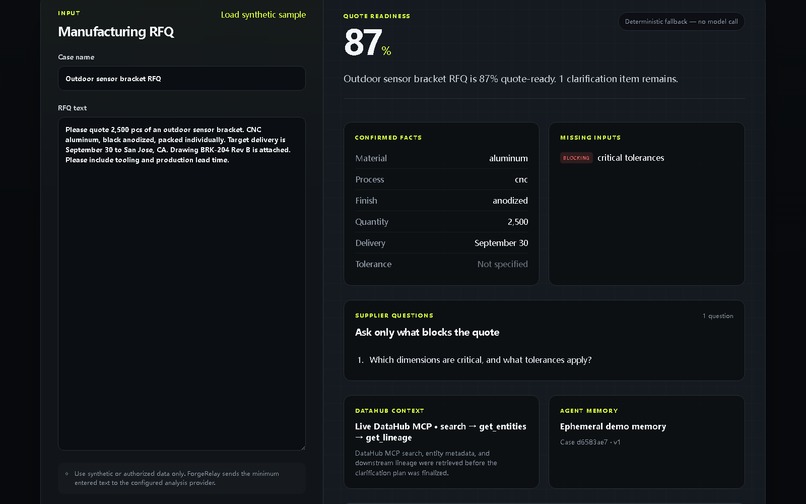
ForgeRelay demo: RFQ gaps, quote readiness, and visible DataHub MCP evidence.
-
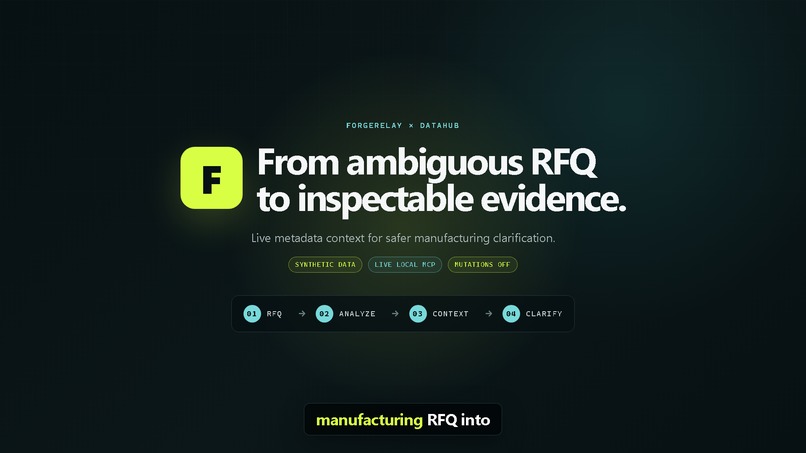
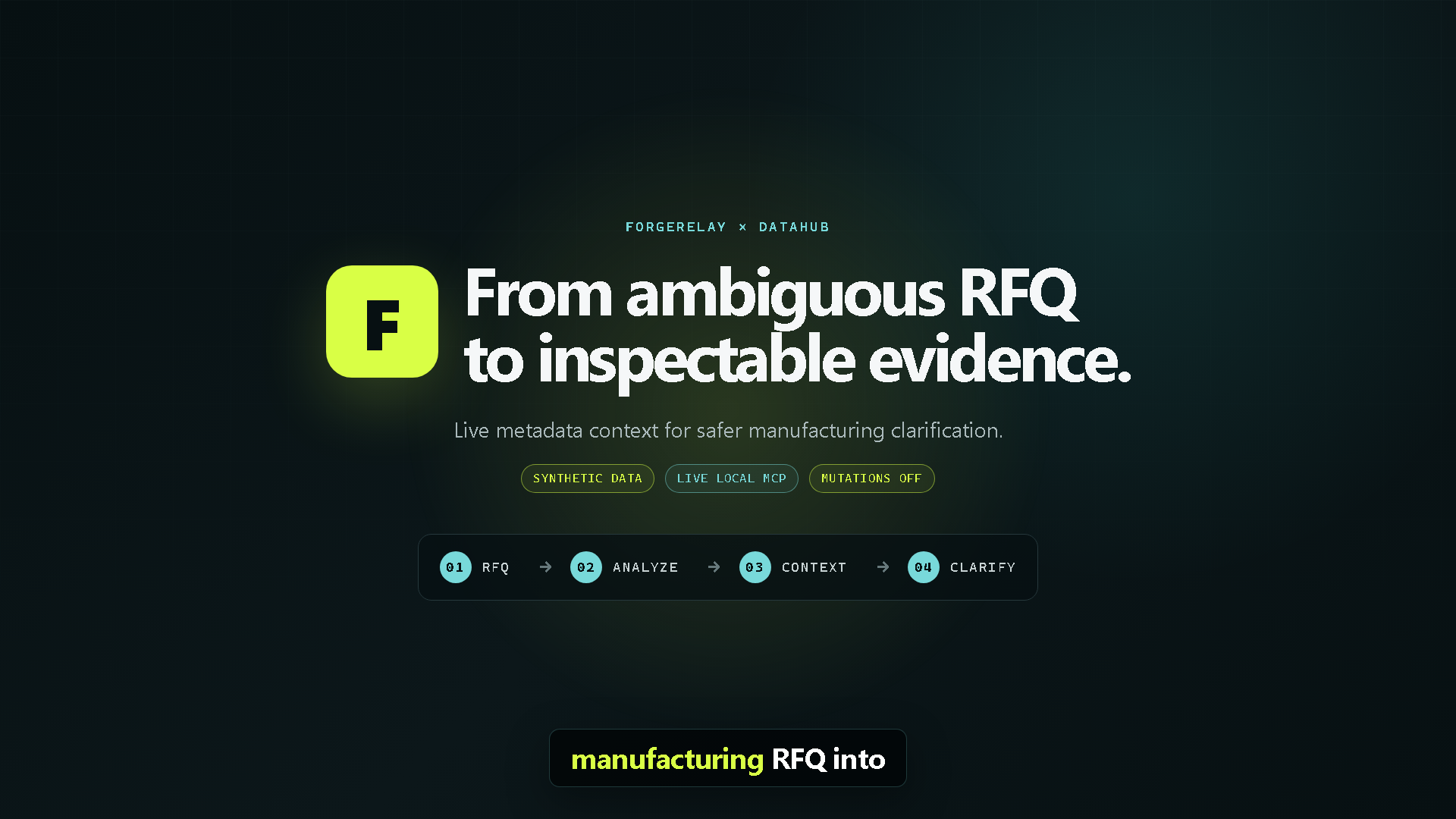
ForgeRelay — metadata-aware RFQs powered by DataHub MCP.
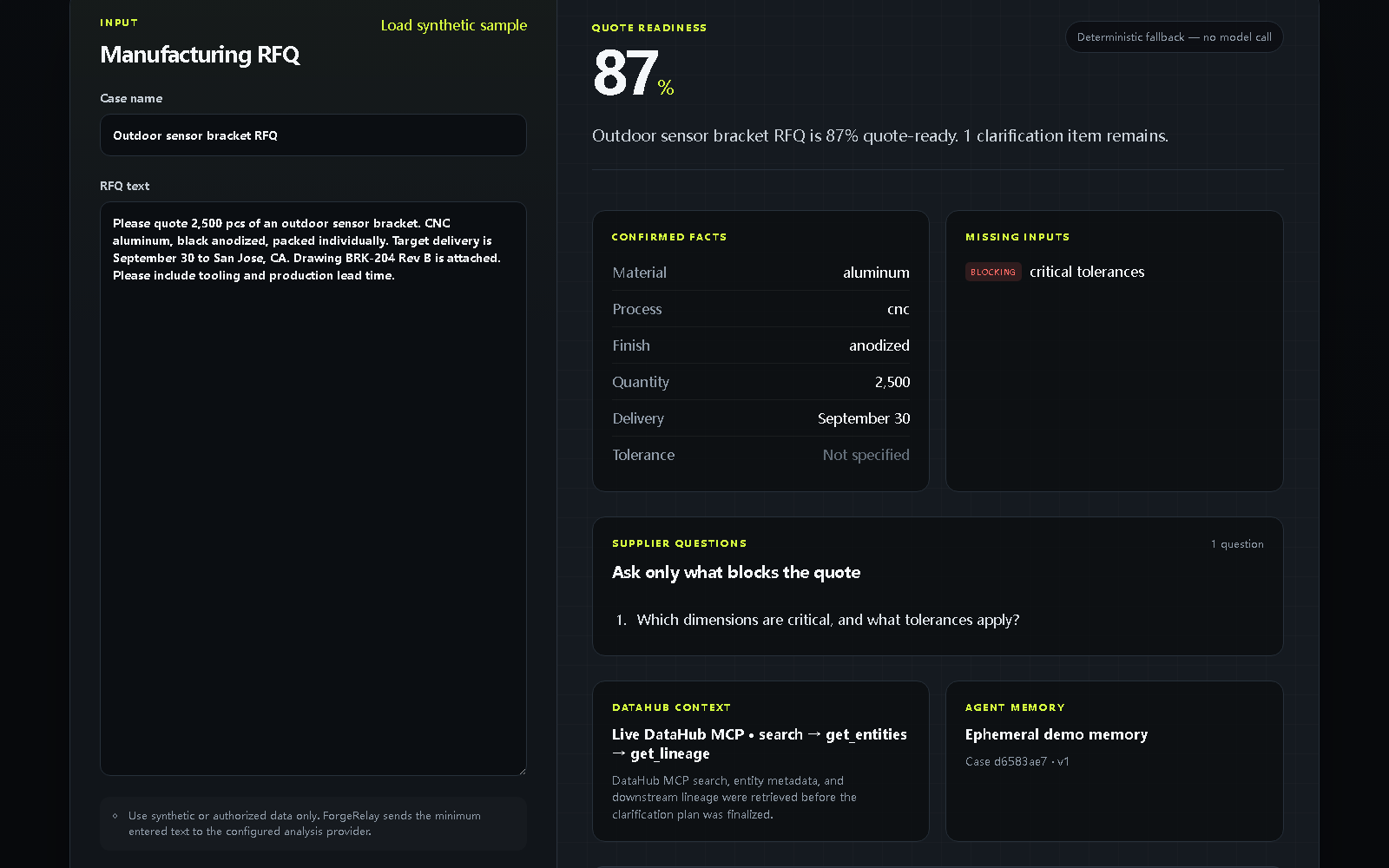
ForgeRelay — Metadata-Aware RFQs
Elevator pitch: An RFQ clarification agent that queries DataHub for schemas, lineage, ownership, and policy context before recommending safe manufacturing actions.
Inspiration
Small manufacturers regularly receive quote requests that look complete but omit one decision-critical detail: a tolerance, finish standard, inspection requirement, or delivery constraint. A generic AI assistant can summarize the request, but it cannot know which downstream quote artifacts depend on a changed fact or who owns the decision. ForgeRelay was created to make that context part of the agent's reasoning loop.
What it does
ForgeRelay separates explicit RFQ facts from missing information, generates a short list of supplier questions, and calculates quote readiness. Before the plan is finalized, it calls DataHub MCP in a visible sequence:
searchfinds relevant synthetic RFQ and quote assets.get_entitiesretrieves ownership, schema, and documentation.get_lineagetraces downstream impact for the selected asset.
The interface labels whether the result came from live DataHub MCP or the clearly marked synthetic fallback. Optional metadata writeback remains disabled unless a human explicitly confirms the mutation.
How we built it
ForgeRelay is an English-only Node.js application with a dependency-light web interface, Gemini structured output, DataHub's official stdio MCP transport, CockroachDB-compatible durable memory, and a guarded CALL-E adapter. Synthetic DataHub assets model an RFQ source, extracted constraints, clarification outcomes, and a quote package.
The project and repository were created on July 26, 2026. No source code was copied from the founder's pre-existing manufacturing products.
Challenges we ran into
The hardest problem was keeping metadata context useful without turning it into an unsupported claim. Search results may be broad, so ForgeRelay fetches entity details and lineage before it presents impact. We also had to preserve a safe boundary between read-only context retrieval and catalog mutations.
Accomplishments that we're proud of
- A real MCP tool chain is visible in the product instead of being hidden in a backend log.
- Facts, assumptions, and missing inputs remain separate.
- Synthetic data makes the complete workflow safe for public judging.
- DataHub mutations and real phone calls both fail closed.
What we learned
Agent quality depends less on a longer prompt than on trustworthy organizational context. Ownership and lineage make an RFQ question actionable because the agent can explain what will be affected and who should review it.
What's next
We plan to expand the synthetic catalog into reusable manufacturing metadata templates and add governed proposals for approved clarification decisions.
Repository: https://github.com/junsenliu/forgerelay
Try it: https://forgerelay.vercel.app
Demo video: https://youtu.be/cg_hcuHM5XQ
Disclosures
ForgeRelay and this repository were created on July 26, 2026 during the submission period. The entrant's pre-existing manufacturing experience and LinkSea brand informed the problem selection, but no source code or customer data was copied from an earlier product. OpenAI Codex assisted with implementation, testing, documentation, and video production under the entrant's direction. The project uses open-source dependencies under their respective licenses.
Built With
- datahub
- docker
- gemini
- javascript
- mcp
- node.js
- remotion
- vercel

Log in or sign up for Devpost to join the conversation.