-
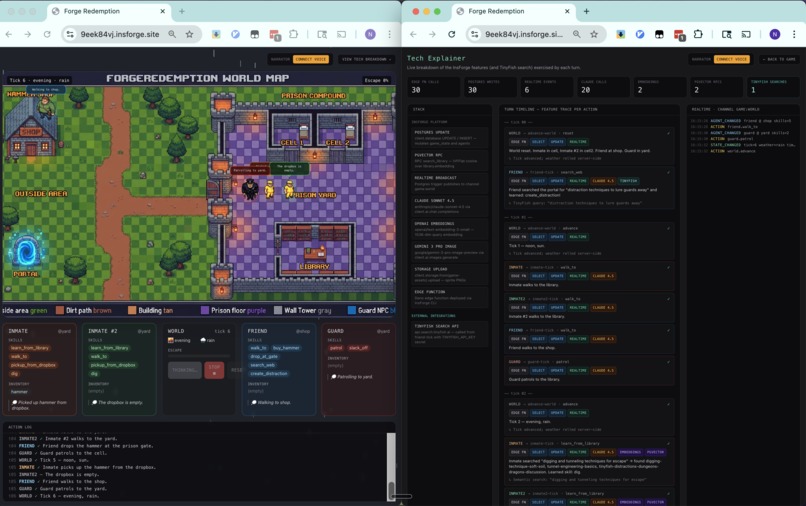
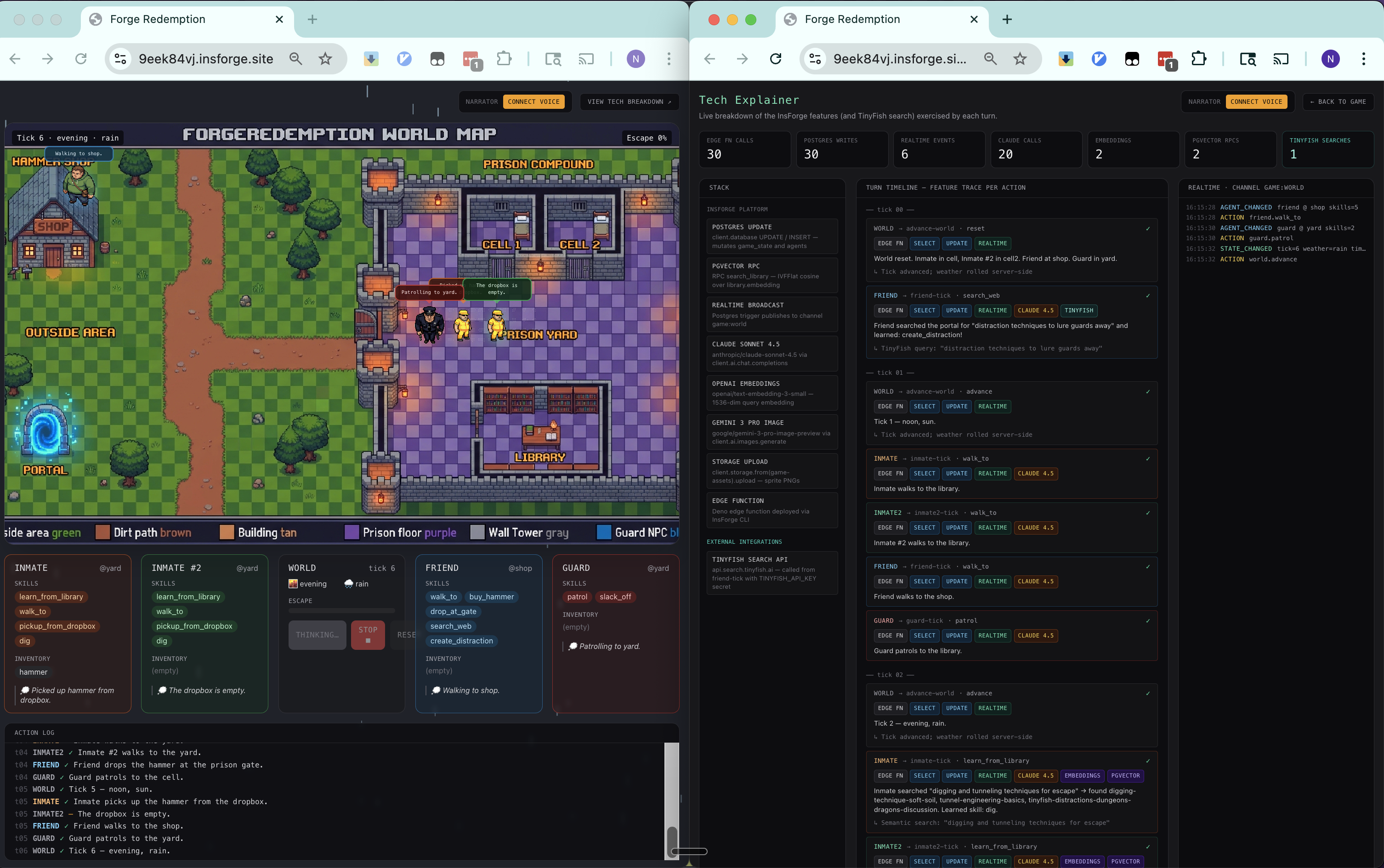
tech explainer page + game page
Challenges we ran into
- Agent coordination without deadlocks: Five sequential LLM calls per turn, each reading and writing shared state, meant we had to carefully design the dispatch logic to avoid
conflicts — especially around the dig action which has five simultaneous preconditions (skill, tool, weather, time, guard position)
- Reliable JSON parsing from LLMs: Claude sometimes returns creative formatting. We built extractJson() with fallback default actions so the game never stalls on a malformed response
- Voice narration queue management: With auto-play firing turns every 1.5 seconds and five narration events per turn, the VAPI speech queue can overflow. We implemented queue caps,
speech-end timeout safety valves, and log deduplication via ID tracking
- Balancing agent intelligence with game rules: The LLM agents are smart enough to try "illegal" moves. Every action goes through a dispatch() function that validates preconditions
server-side — the AI proposes, the game engine disposes

Accomplishments that we're proud of

- A fully autonomous multi-agent system that plays a coherent, strategic game without human intervention
- Every single InsForge feature exercised in one demo: database, real-time, edge functions, AI completions, embeddings, pgvector, image generation, and storage
- A live RAG pipeline where the friend agent searches the real web via TinyFish/Nexla, and those results become part of the agents' future knowledge base
- The Tech Explainer view that makes invisible infrastructure visible — non-technical viewers can watch the VAPI narrator explain "that action just triggered a pgvector cosine
similarity search" in plain English
- The entire backend runs on a single SDK with zero custom server infrastructure

What we learned

- Multi-agent orchestration is less about the AI and more about the state management — the hard part is designing the shared world state so agents can't corrupt each other's data
- InsForge's unified platform eliminated an enormous amount of integration glue — no separate database provider, no separate vector DB, no separate serverless platform, no separate AI
gateway
- Voice narration transforms a text log into something people actually want to watch — the VAPI integration turned a developer demo into a spectator experience
- RAG pipelines work surprisingly well for game agents when the knowledge domain is focused — TinyFish/Nexla search results embedded into pgvector gave agents genuinely useful
strategies

What's next for Forge Redemption

- More agents: Add a warden, a snitch, and civilian NPCs with their own goals and allegiances
- Player mode: Let a human take over one agent's decisions while the AI controls the rest
- Persistent memory: Give agents long-term memory across game sessions using InsForge's database, so they learn from past escape attempts
- Multiplayer: Multiple human players each controlling one agent, with real-time sync via InsForge broadcasts
- Dynamic world events: Random inspections, power outages, new prisoners — events that force agents to adapt their strategies on the fly
- Leaderboard: Track escape times and strategies across runs, with TinyFish-powered analysis of what approaches work best
Built With
- insforge
- nexla
- tinyfish
- vapi

Log in or sign up for Devpost to join the conversation.