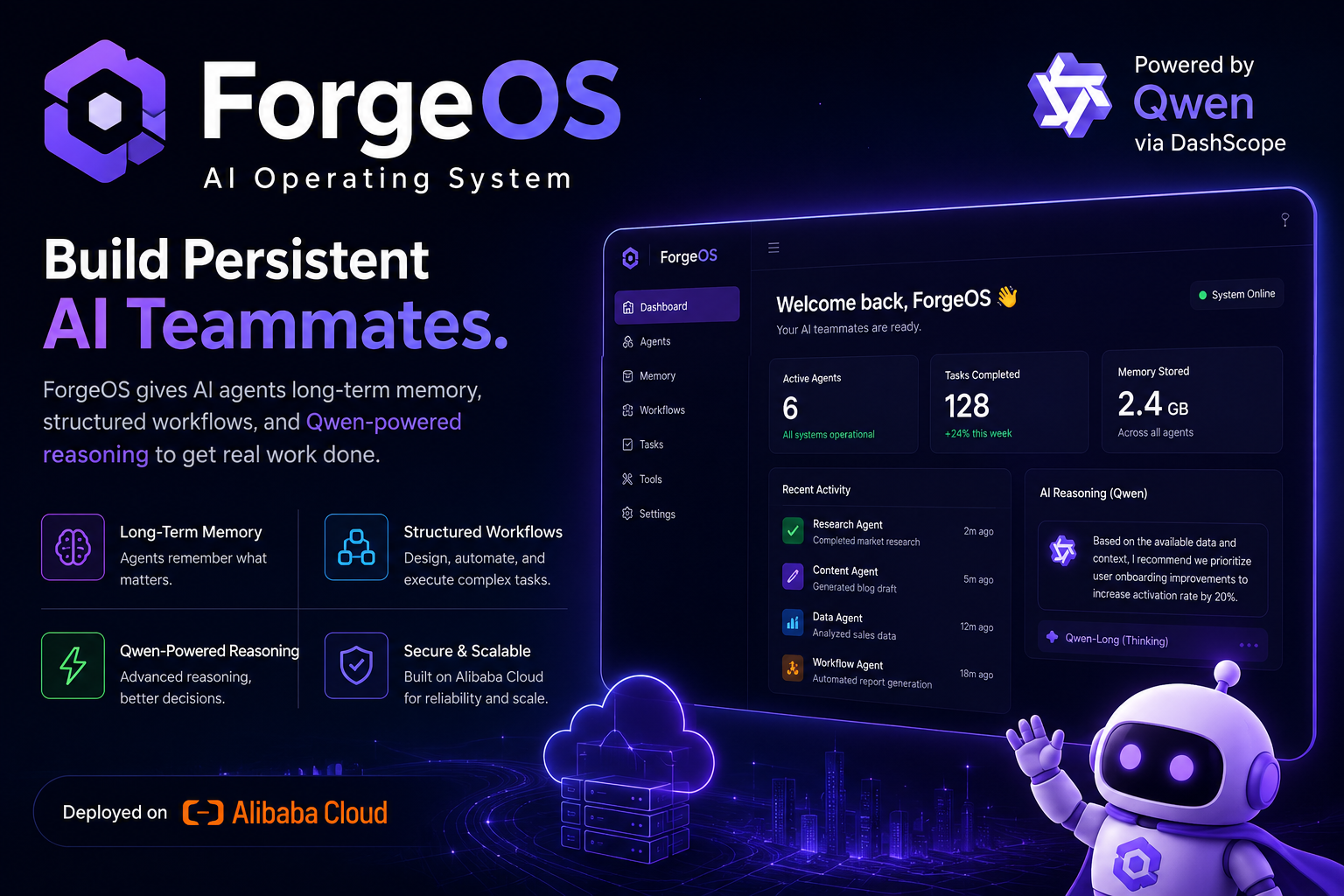
ForgeOS — Persistent Memory for Businesses
Inspiration
As AI agents become more capable, they're increasingly being asked to complete multi-step work that normally requires an entire team. The problem is that most agents are stateless—they forget previous work, cannot coordinate effectively, and have no persistent organizational memory.
We wanted to explore a different idea:
What if AI agents could operate like a real company instead of isolated chatbots?
ForgeOS was built as an operating system for AI organizations. Instead of a single assistant answering prompts, ForgeOS lets specialized agents collaborate, remember previous work, execute missions, and continuously improve over time.
This aligns closely with the vision of persistent AI systems powered by Qwen.
What it does
ForgeOS transforms a natural language request into an organized execution workflow.
Users can:
- create missions
- compile organizational knowledge
- maintain long-term memory
- coordinate specialized AI workers
- persist previous work between sessions
Rather than generating isolated responses, ForgeOS builds a persistent organizational knowledge base that agents can reuse across future tasks.
How we built it
The project is deployed entirely on Alibaba Cloud ECS.
Our stack includes:
- Alibaba Cloud ECS for deployment
- Qwen via DashScope API for reasoning
- Docker & Docker Compose
- FastAPI backend
- SQLite persistent storage
- REST API
- Browser frontend
The deployment automatically:
- provisions the application
- configures Docker
- connects to DashScope
- launches the production server
- verifies deployment through an automated proof script
The backend communicates directly with Qwen models through the DashScope compatible API while storing persistent organizational memory locally on ECS.
Challenges we ran into
Deployment turned out to be one of the biggest challenges.
Some of the issues we solved included:
- ECS account risk-control restrictions during provisioning
- Docker installation differences on Ubuntu images
- missing Docker Compose packages
- security group configuration preventing external access on port 8000
- ensuring DashScope authentication worked correctly inside the deployed environment
- creating an automated deployment proof that verifies both ECS and Qwen connectivity
These challenges ultimately helped us produce a more reliable deployment workflow.
What we learned
Building ForgeOS reinforced an important idea:
LLMs become significantly more useful when combined with persistent memory, structured execution, and cloud infrastructure.
We also gained valuable experience deploying AI-native applications on Alibaba Cloud ECS and integrating Qwen through DashScope in a production environment.
Accomplishments that we're proud of
- Successfully deployed ForgeOS on Alibaba Cloud ECS
- Integrated Qwen reasoning through DashScope
- Built persistent organizational memory
- Automated deployment and verification
- Created a reproducible one-command installation process
- Exposed the application through a live public deployment
What's next for ForgeOS
Our roadmap includes:
- multi-agent collaboration
- shared organizational memory across teams
- distributed execution
- enterprise authentication
- long-running autonomous workflows
- richer knowledge graphs
- additional Qwen model support
- production-ready deployment tooling
ForgeOS is intended to become the operating system for persistent AI organizations rather than a traditional chatbot.


Log in or sign up for Devpost to join the conversation.