ForgeMind OS Inspiration
Software development has become increasingly fragmented. Developers switch between documentation, design tools, issue trackers, AI assistants, testing platforms, and deployment pipelines just to ship one application.
I wanted to explore a different approach: What if software development felt like working with an entire AI software company instead of a single chatbot?
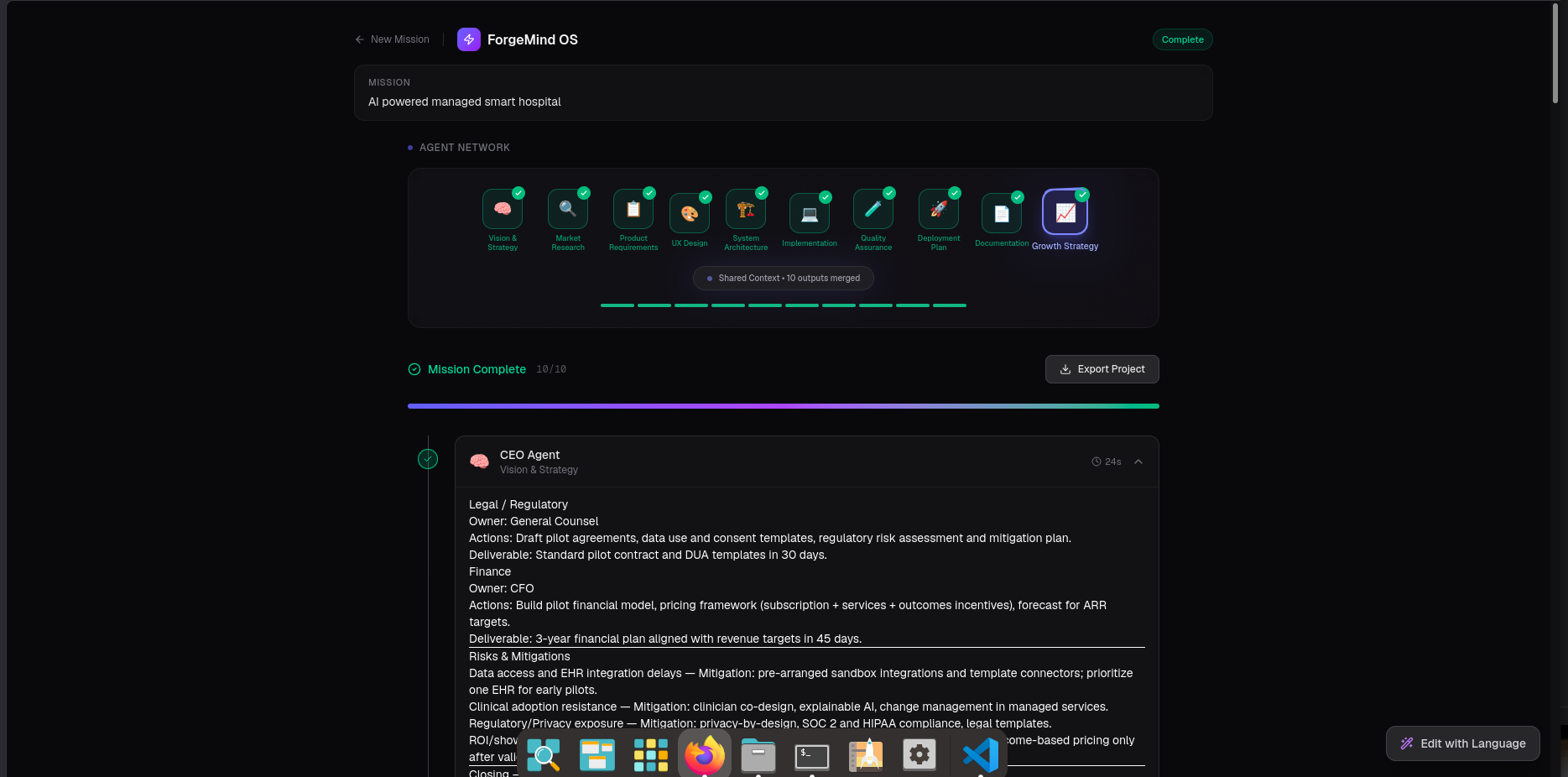
That idea became ForgeMind OS—an AI operating system where specialized AI agents collaborate to transform a single idea into a structured software project.
Rather than replacing developers, ForgeMind OS is designed to amplify their creativity and productivity by automating repetitive planning and engineering tasks while keeping the developer in control.
What it does
ForgeMind OS allows users to describe a software idea in natural language.
The platform then coordinates multiple specialized AI agents that work together to:
Research the project Define requirements Design the software architecture Generate implementation plans Produce documentation Review progress across the development lifecycle
Instead of isolated conversations with one assistant, ForgeMind OS orchestrates a team of AI specialists working toward a shared goal.
How we built it
ForgeMind OS combines a modern web architecture with AI orchestration.
Frontend React TypeScript Tailwind CSS Modern component architecture Interactive dashboard Real-time mission interface Backend Python FastAPI Modular agent architecture REST API Mission orchestration engine AI
ForgeMind OS integrates OpenAI models to power specialized agents that collaborate throughout the software development process. The system is designed so each agent has a distinct responsibility while sharing context across the mission.
Challenges we ran into
One of the biggest challenges was designing a system that feels like a coordinated engineering team instead of a collection of disconnected AI prompts.
Building reusable agent workflows, defining clear responsibilities, and maintaining shared context required rethinking how AI agents communicate and collaborate.
Another challenge was creating an interface that presents complex AI workflows in a way that is intuitive and easy to follow for users.
What we learned
This project reinforced that great AI experiences depend on thoughtful orchestration as much as model capability.
We learned the importance of:
Modular AI agent design Shared context between agents Prompt engineering Backend architecture Real-time user feedback Designing AI systems that remain transparent and user-guided What's next for ForgeMind OS
We plan to expand ForgeMind OS into a complete AI operating system for software teams by adding:
Live collaboration between human developers and AI agents Persistent project memory Code execution and validation tools Automatic pull request generation CI/CD integration GitHub synchronization Multi-user workspaces Additional specialized engineering agents
Our long-term vision is to make ForgeMind OS an intelligent development environment where AI doesn't just answer questions—it collaborates as a true member of the software team.

Log in or sign up for Devpost to join the conversation.