-
-
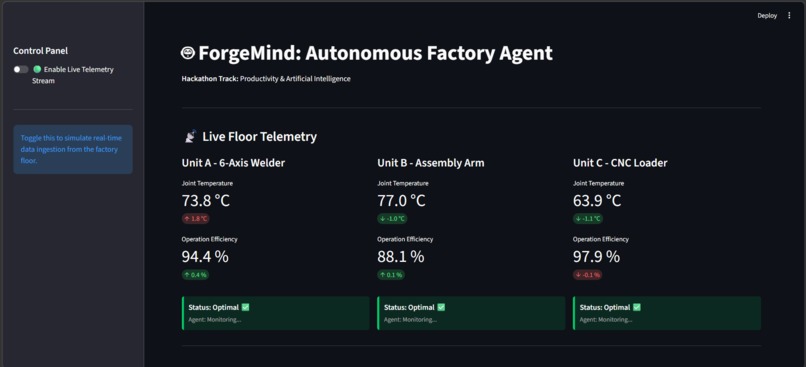
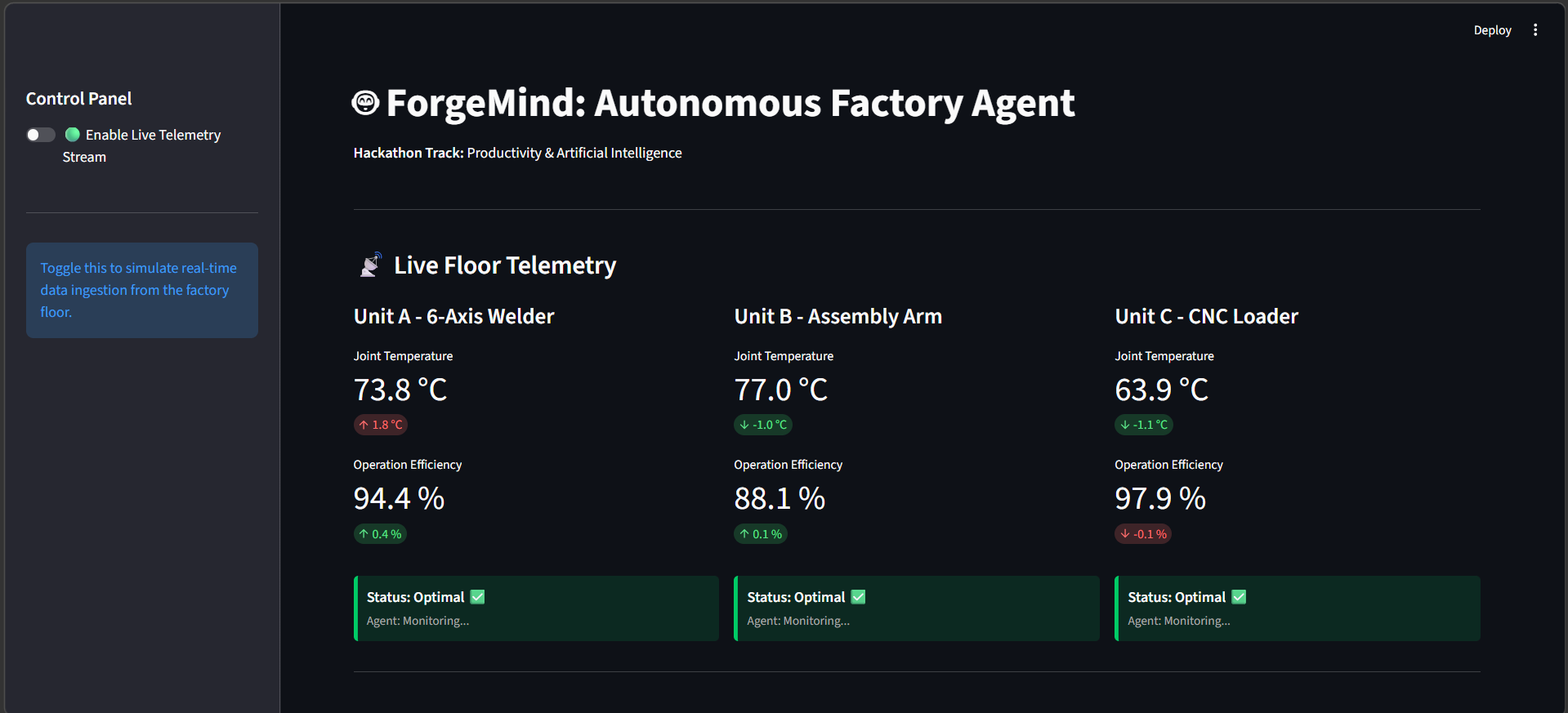
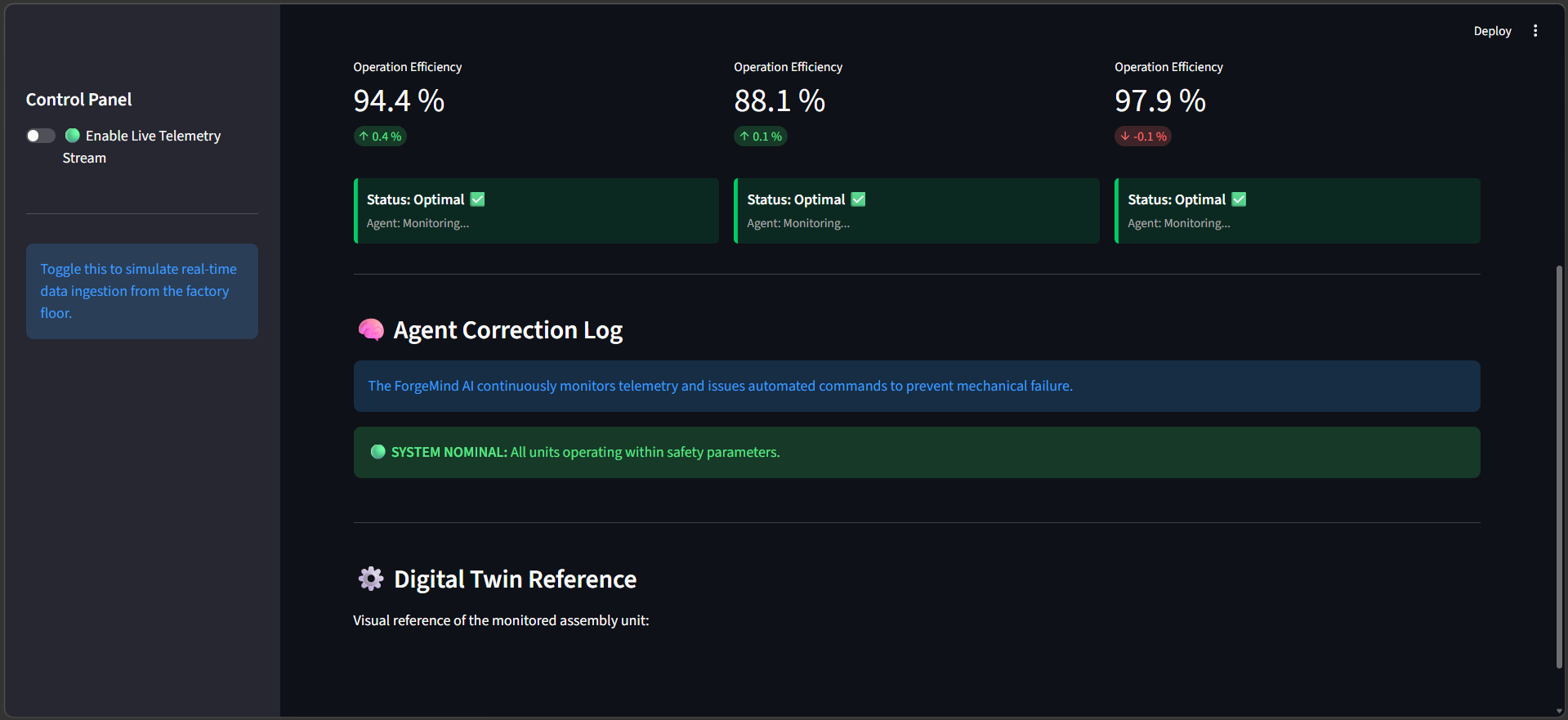
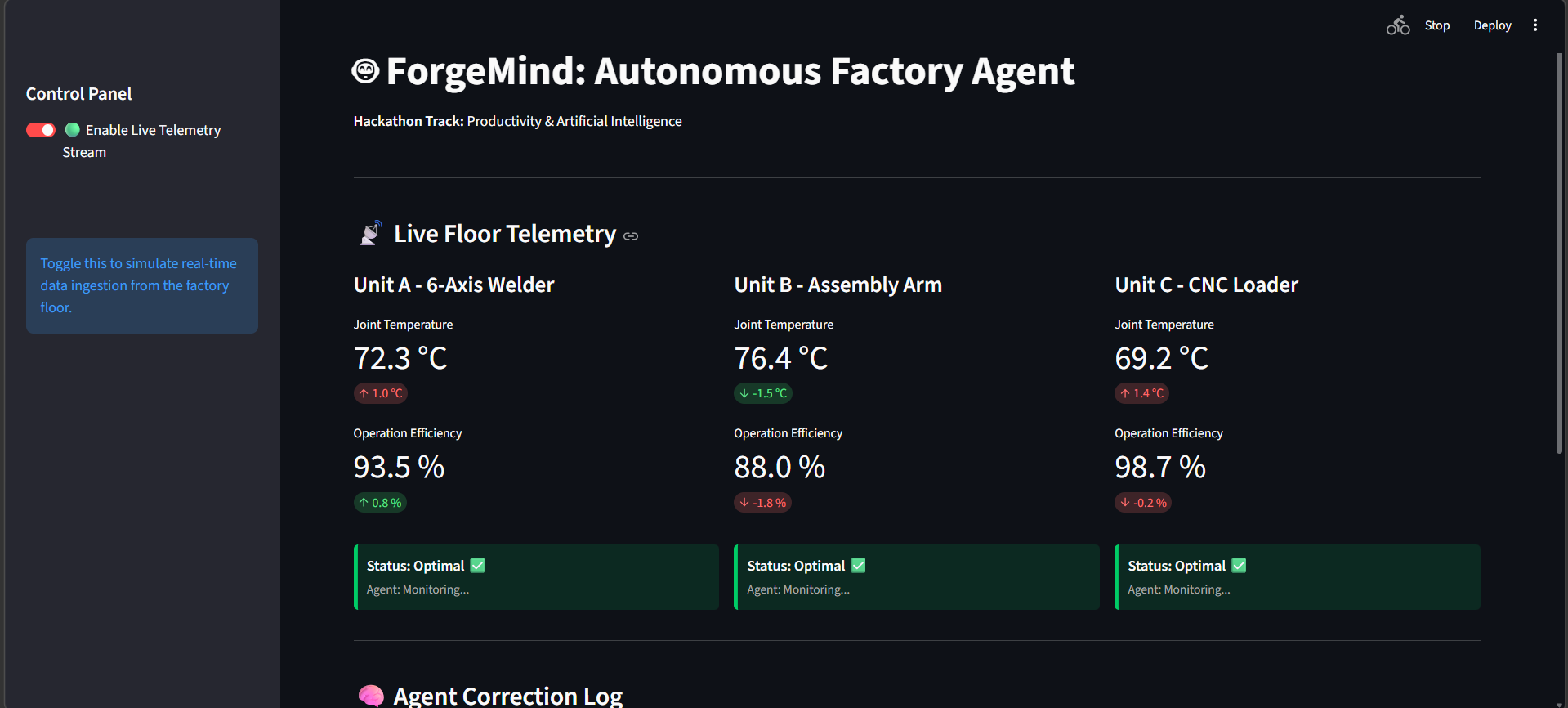
A clean, high-visibility dashboard giving floor managers instant insights into mechanical health and performance trends.
-
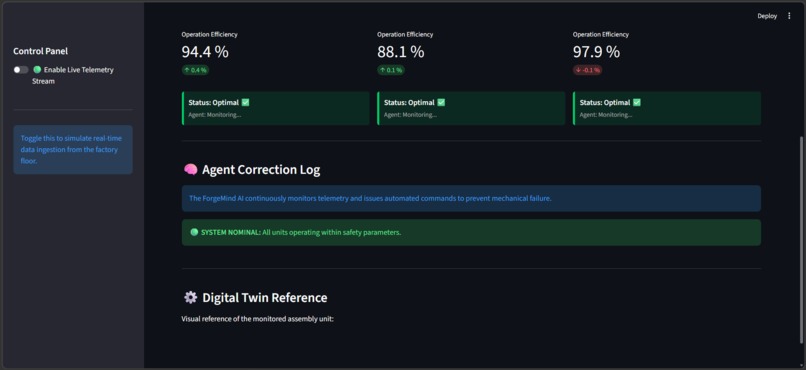
The AI brain in action. ForgeMind continuously monitors safety parameters, ready to issue autonomous commands
-
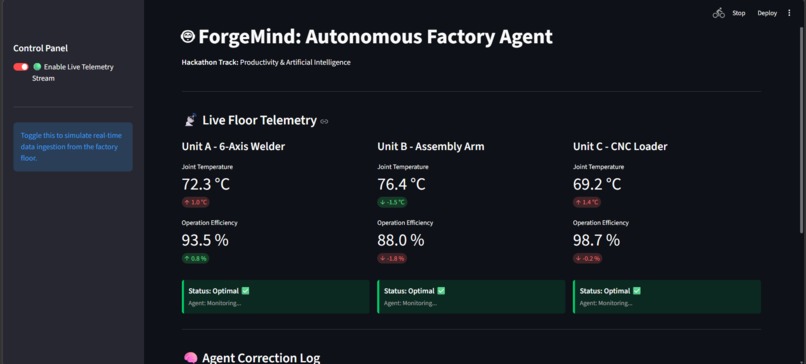
Dynamic monitoring. Toggling the live feed simulates a high-speed production environment
💡 Inspiration In modern manufacturing and production, there is a massive disconnect between physical hardware and software oversight. A single desynced robotic arm or an overheating actuator can halt an entire assembly line, resulting in massive financial losses and safety hazards. Human supervisors simply cannot process real-time telemetry (like temperature and efficiency) from dozens of machines fast enough to prevent these bottlenecks. I wanted to bridge the gap between mechanical engineering design and artificial intelligence to solve this.
⚙️ What it does ForgeMind is an autonomous AI factory agent that acts as a digital supervisor. Instead of being a passive dashboard that just displays numbers, ForgeMind actively intervenes.
Live Telemetry Monitoring: It ingests simulated real-time data from factory robots (e.g., a 6-Axis Welder or CNC Loader).
Autonomous Action: If a machine exceeds its thermal threshold (e.g., spiking over 82°C), the AI Agent instantly issues a corrective command, such as throttling the servo speed by 15% to force a thermal cooldown or rerouting the assembly queue.
Digital Twin Integration: To ground the software in physical reality, the dashboard serves as a functional Digital Twin, utilizing 3D CAD references to show exactly which mechanical assemblies are being protected.
🛠️ How I built it I built the application using Python as the core engine. For the frontend, I utilized Streamlit to rapidly develop a highly responsive, data-driven web interface.
Pandas and NumPy were used to generate the simulated, fluctuating time-series telemetry to mimic real-world IoT factory sensors.
I injected custom HTML and CSS directly into the Python script to create the dynamic, color-coded "Flashcard" effect for critical alerts.
For the mechanical visualization, I utilized Solid Edge to render the 3D reference models.
🚧 Challenges I ran into Simulating a live, continuous data stream in a web app can cause the user interface to flicker or jitter constantly as new elements render. When my AI Agent generated large warning logs, the whole dashboard would bounce up and down. I had to re-architect the layout using Streamlit's empty container placeholders and write custom CSS to contain the dynamic flashcards inside fixed-size metric blocks, resulting in a smooth, professional UI.
🏆 Accomplishments that I'm proud of Coming from a mechanical engineering and product design background, I am incredibly proud of successfully building a software solution that solves a deep, physical manufacturing problem. Translating mechanical variables (like rotor dynamics and joint temperature) into an automated software logic engine proves that the future of industry relies on engineers who understand both the hardware and the code.
📚 What I learned I learned how to manage session states in web applications to calculate live data deltas (showing real-time trend arrows). I also learned how to seamlessly integrate custom styling into Python frameworks to make technical data highly readable for floor managers.
🚀 What's next for ForgeMind The next evolution for ForgeMind is moving from simulated data to physical hardware. I plan to integrate real IoT sensors (using MQTT protocols) to feed live temperature and vibration data from actual mechanical compressors and motors into the dashboard. Additionally, I want to replace the current logic-gate agent with a trained Machine Learning anomaly detection model (using Scikit-Learn) to predict mechanical failures days before they happen.

Log in or sign up for Devpost to join the conversation.