Inspiration
As engineering team scales, understanding team dynamics and collaboration patterns becomes increasingly challenging. Manager spend countless hours manually reviewing Jira state, to understand the complex dynamics, understanding who is blocked on whom and further try to understand whether existing work which has been created is something new or has been already been solved before. Team has spent countless hours working on duplicate issues because no one had time to cross-check references hundreds of tickets.
Hidden Insights: Jira comments contain a wealth of collaboration data that's never analyzed
Manual Overhead: Engineering managers lack tools to quantify team dynamics objectively
Wasted Effort: Duplicate issues slip through because people don't compare new work against existing tickets
What it does
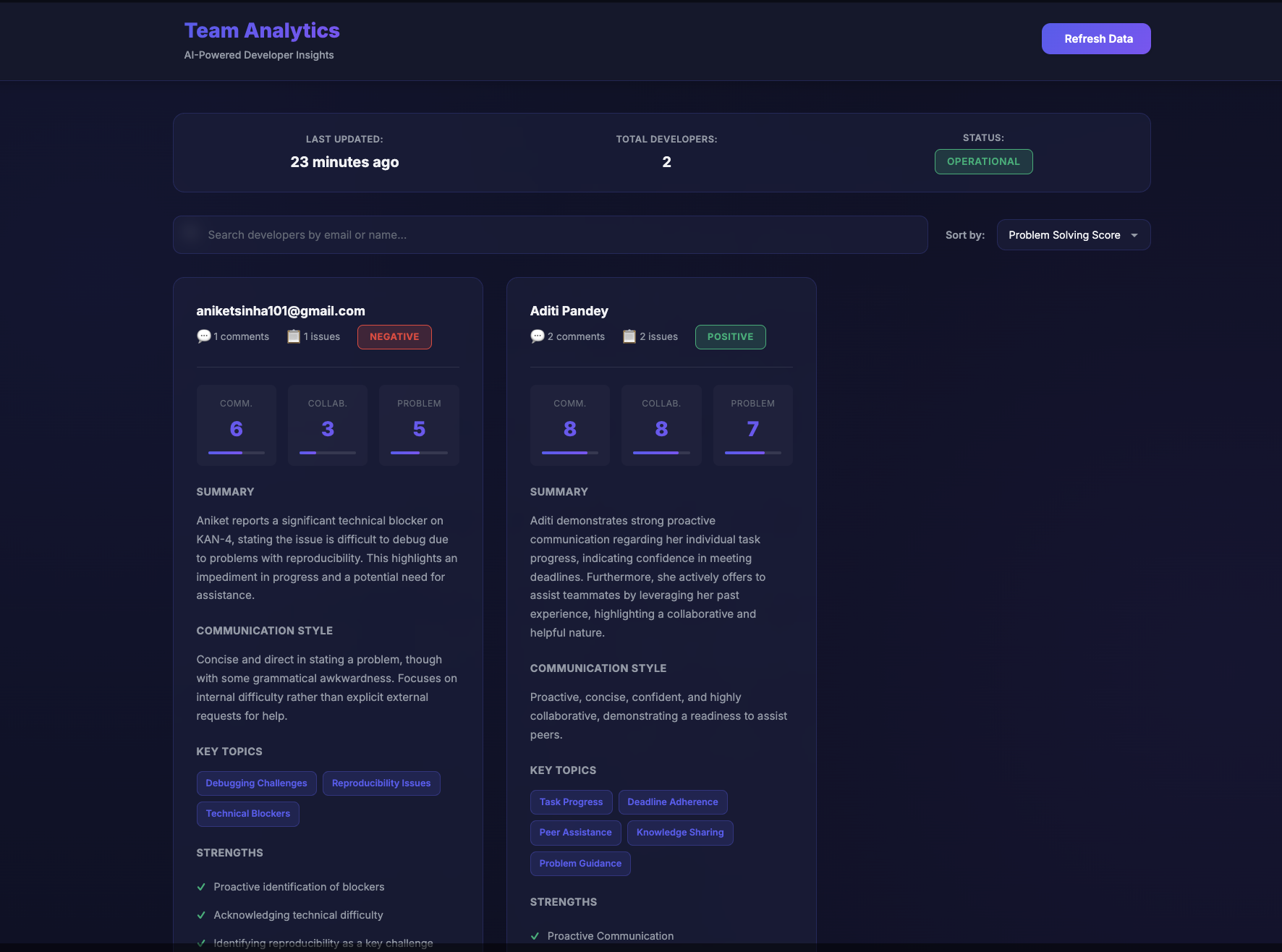
ForgeAnalytics is an AI-powered background service that transforms Jira comments into actionable team insights and prevents duplicate work.
- Automated Developer Analytics
Fetches all team Jira comments automatically (configurable schedule) Uses Gemini AI to analyze each developer's contributions Generates comprehensive reports with: Quantified Metrics: Communication (1-10), Collaboration (1-10), Problem-Solving (1-10) Sentiment Analysis: Positive, neutral, or negative tone detection Key Topics: AI-extracted themes from discussions Communication Style: Personalised profile of how each developer interacts Strengths & Improvement Areas: Actionable feedback for 1-on-1s
- Intelligent Duplicate Detection
Tracks all Jira issues across the team When new issues are created, automatically: Fetches full issue details (summary + description) Compares against recent existing issues using Gemini AI Analyses similarity based on keywords, technical area, and problem domain Flags potential duplicates with similarity scores (70%+ threshold) Displays warnings on dashboard with: Which issues are similar Why they're similar (AI-generated reasoning) Similarity percentage for prioritization
How we built it
Backend (Node.js)
Express.js: RESTful API server Jira REST API v3: Issue and comment fetching (migrated to new /search/jql endpoint) Google Gemini AI SDK (@google/generative-ai): AI-powered analysis using gemini-1.5-flash node-cron: Scheduled background jobs axios: HTTP client for Jira integration dotenv: Environment configuration Frontend (Vanilla JavaScript)
No frameworks: Pure HTML/CSS/JavaScript for maximum performance Modern CSS: Glassmorphism, gradients, smooth animations Google Fonts: Inter family for premium typography Responsive Design: Mobile-first approach
Challenges we ran into
- Duplicate Detection Accuracy
Problem: Initially, duplicate detection only compared issue summaries, missing similarities in descriptions.
Root Cause: Code fetched full details for NEW issues but only basic info (no descriptions) for EXISTING issues.
- Getting Gemini AI to return consistent JSON format for parsing.
Solution:
Explicit JSON schema in prompts Clear scoring guidelines (90-100 = duplicate, 70-89 = very similar, etc.) Regex-based JSON extraction as fallback Graceful error handling with default values
Accomplishments that we're proud of
Fully Functional Duplicate Detection
Integrated Gemini AI for intelligent similarity scoring Tracks issues persistently across runs Beautiful UI with real-time alerts Configurable thresholds and time windows
What we learned
- AI Prompt engineering is critical.
- API versioning matters.
- Data privacy matters in APIs
- Real time data quality.
What's next for ForgeAnalytrics
- Replace JSON storage with MongoDB or PostgreSQL
- Enable historical trend analysis
- Support larger teams (100+ developers)

Log in or sign up for Devpost to join the conversation.