-
-
-
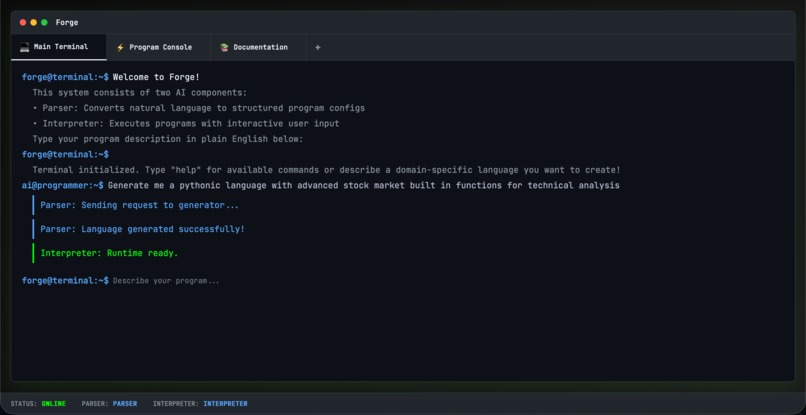
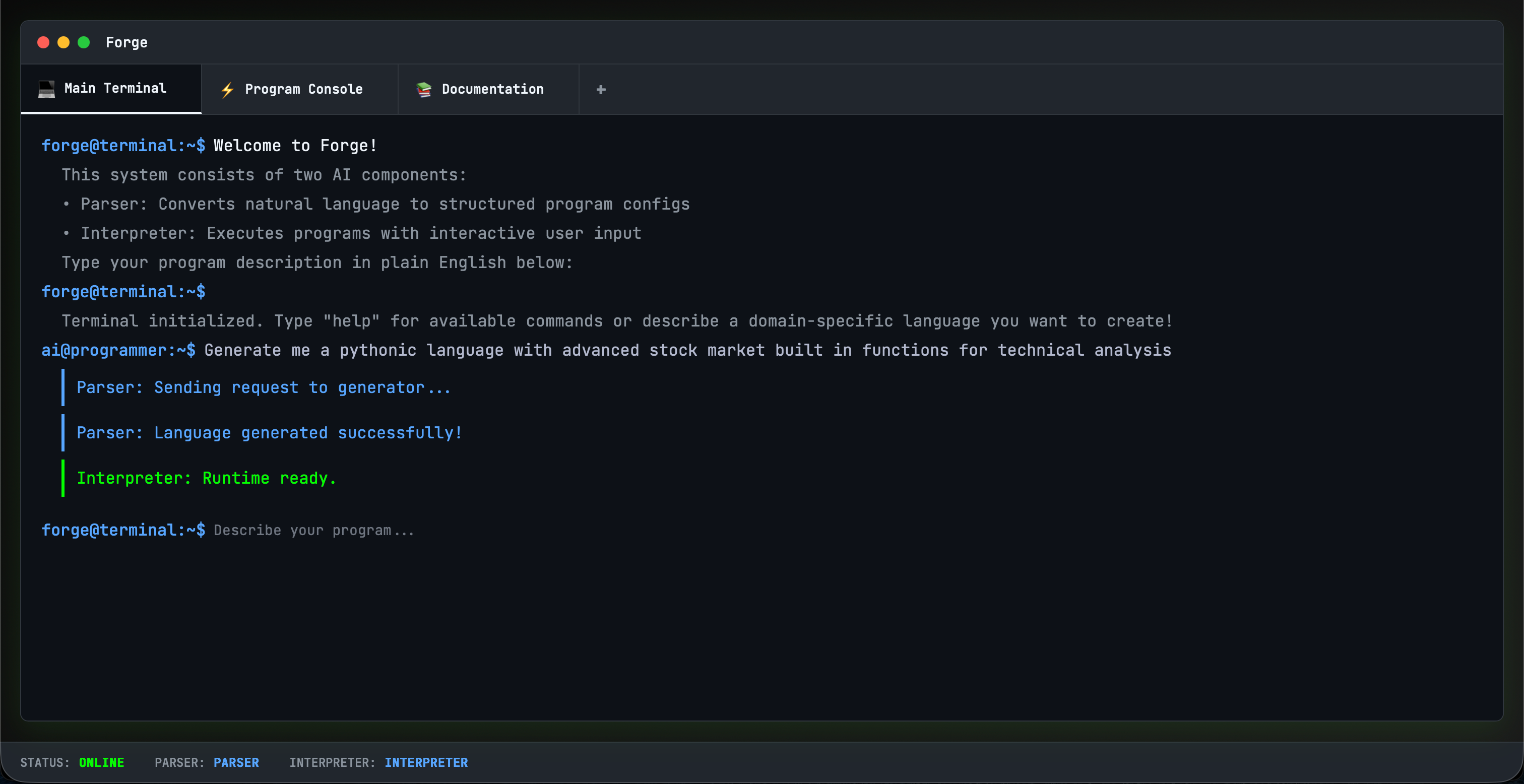
terminal
-
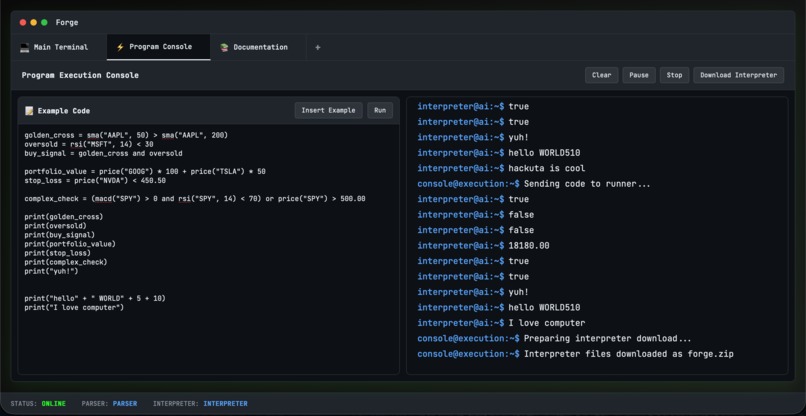
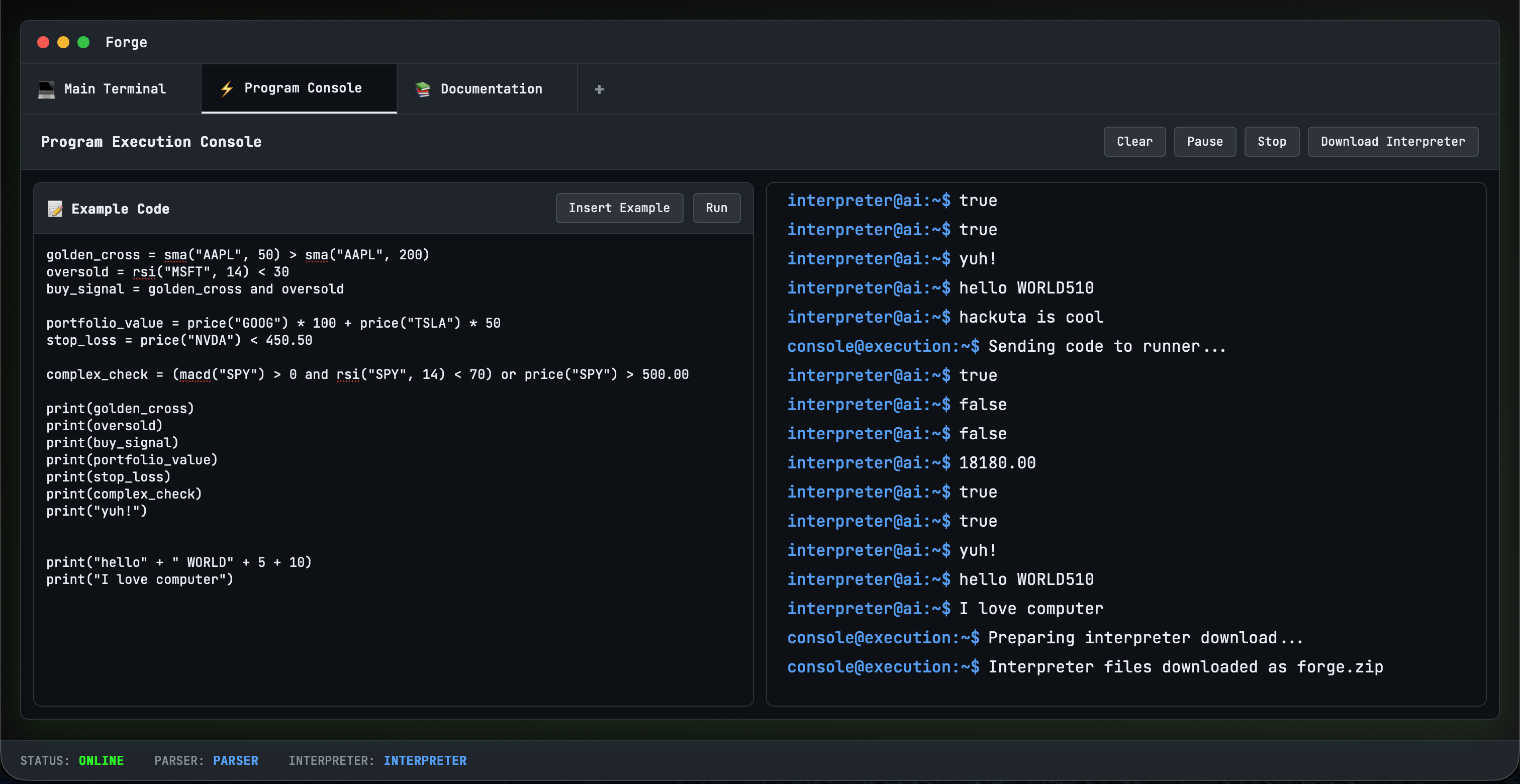
code ide
-
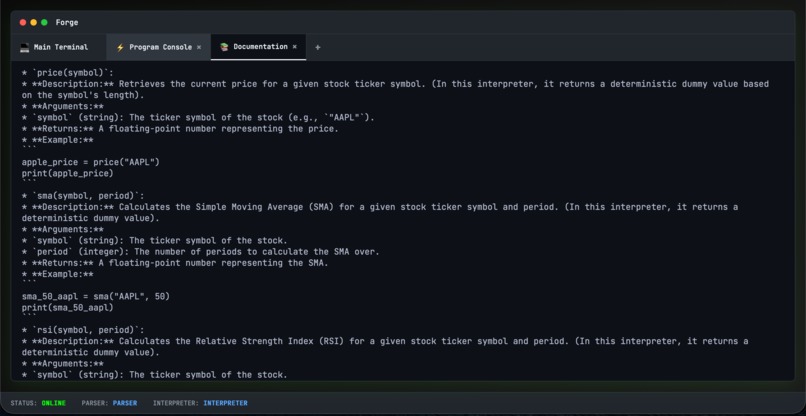
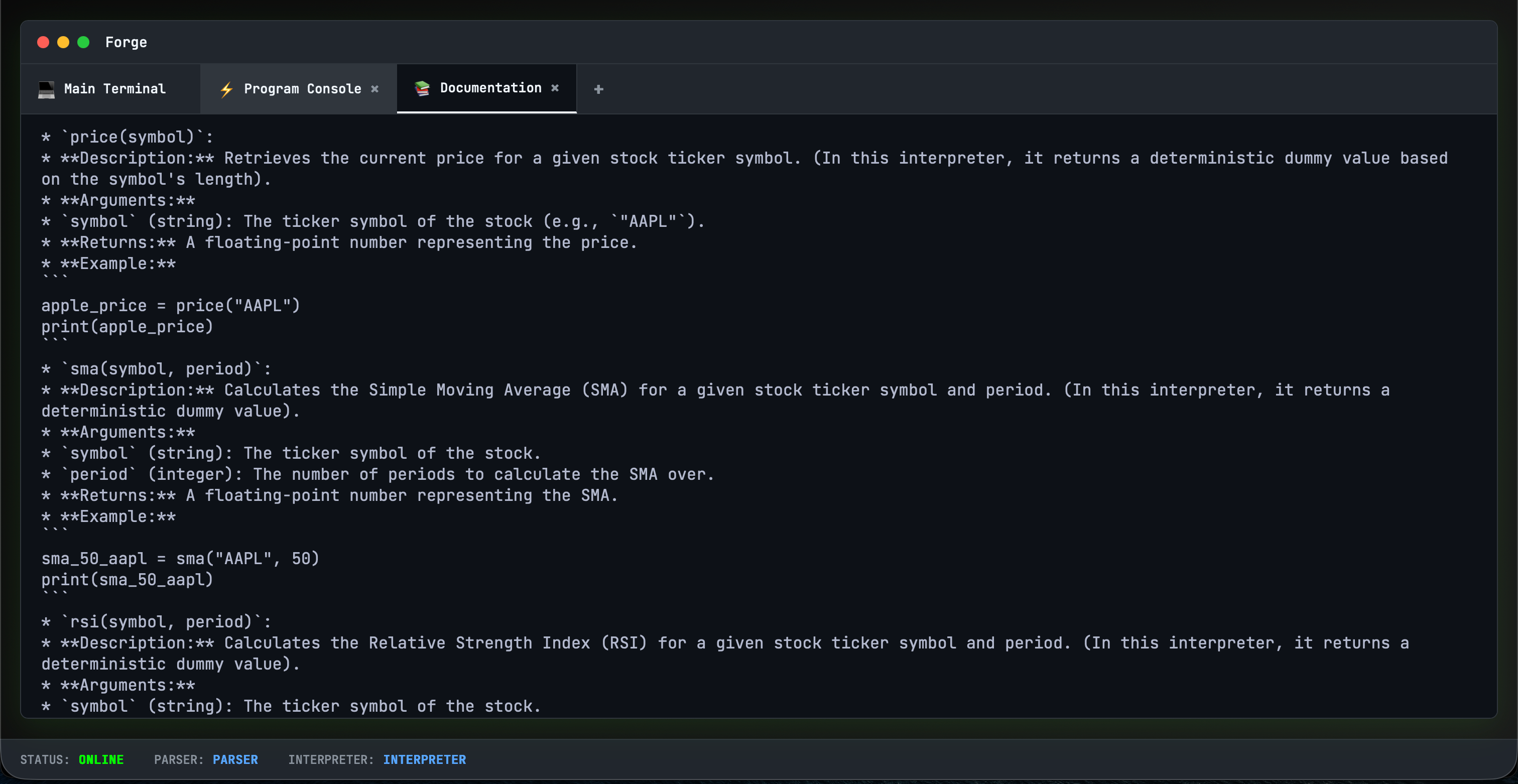
documentation generated for custom language
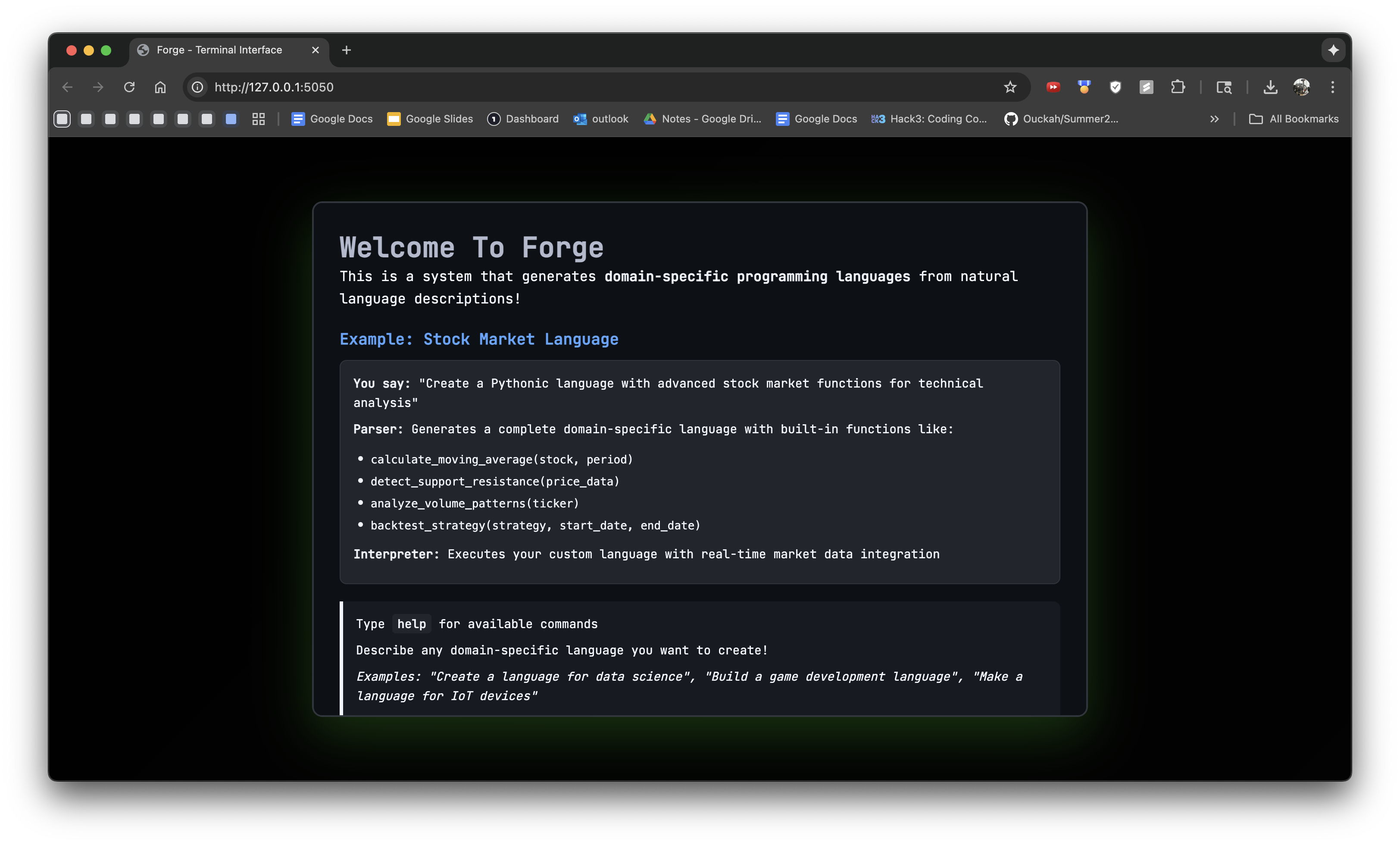
Inspiration
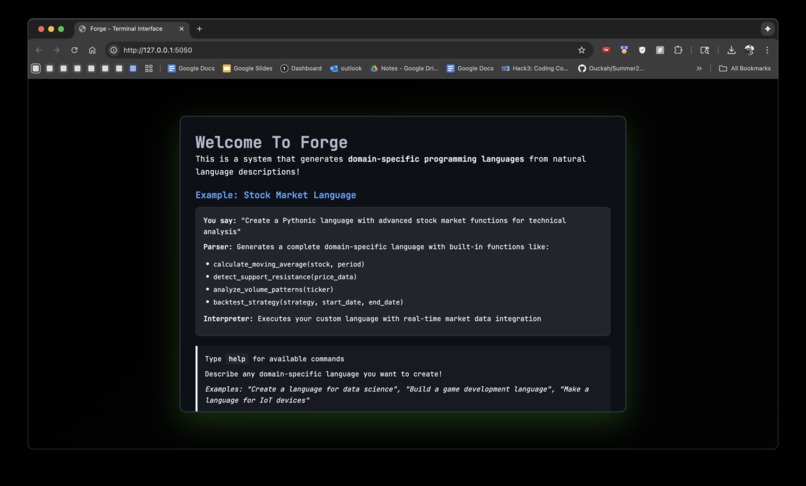
Most ideas don’t fit neatly into existing languages. We wanted a way to invent a new programming language per problem, with the right primitives baked in, from portfolio rebalancing ops to AST surgery, without drowning in boilerplate. Forge turns natural language into a real, first-class interpreted language.
What it does
Forge synthesizes a new language from a short natural language brief and gives you:
- Documentation, clean pretty-printed docs with:
- Grammar and operator precedence
- “Hello, world” + domain-specific examples
- Lint rules and capability notes
- Personal Sandbox, a dark-mode terminal to:
- Run programs
- Inspect traces
How we built it
We built a custom pipeline: Intent → Specification: A short description is converted into a structured language spec. Specification → Parser: We synthesize grammar + precedence tables and generate a parser. Parser → Interpreter: The spec becomes a typed core language executed by our VM. Docs + Sandbox: We auto-generate documentation and spin up an REPL with tracing and safe execution.
Challenges we ran into
One of the hardest parts was getting the parsers to work correctly. The lack of smooth interoperability between the host language (doing the generation) and the target language (being generated) made the process tricky and error-prone.
Accomplishments that we're proud of
We built a deterministic parser generator that reliably produces fast, correct, and fully working parsers every time. It automatically handles grammar normalization, conflict resolution, and precedence, so once a spec is written, the generated parser “just works.” This was a major breakthrough for us, since getting the parser pipeline stable and reproducible was one of the toughest parts of the project. Since this entire project hinged on the parser, we weren't fully confident that such a parser could be created in such a short time, so this breakthrough really accelerated our productivity and boosted our morale.
What we learned
Lead with the IR: once the intermediate representation is clear, everything else, parsing, type checking, documentation, and regeneration, becomes simpler.
What's next for forge
Modules & package registry for sharing dialects.


Log in or sign up for Devpost to join the conversation.