-
-
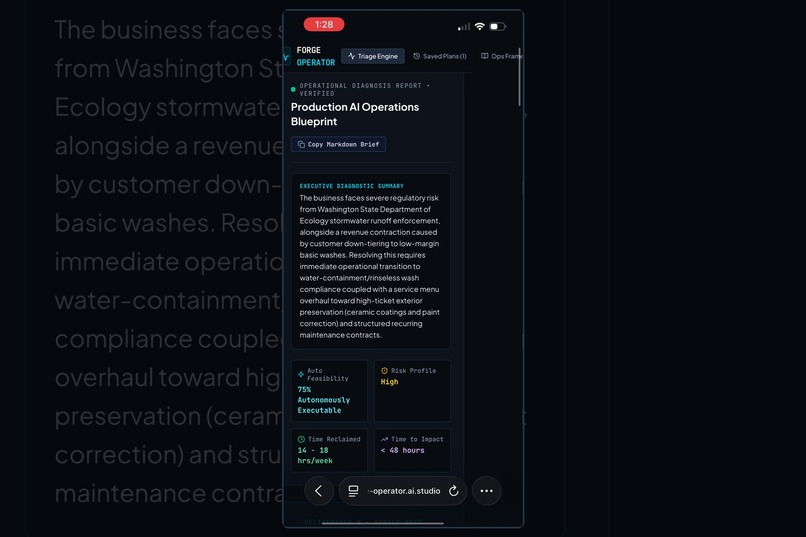
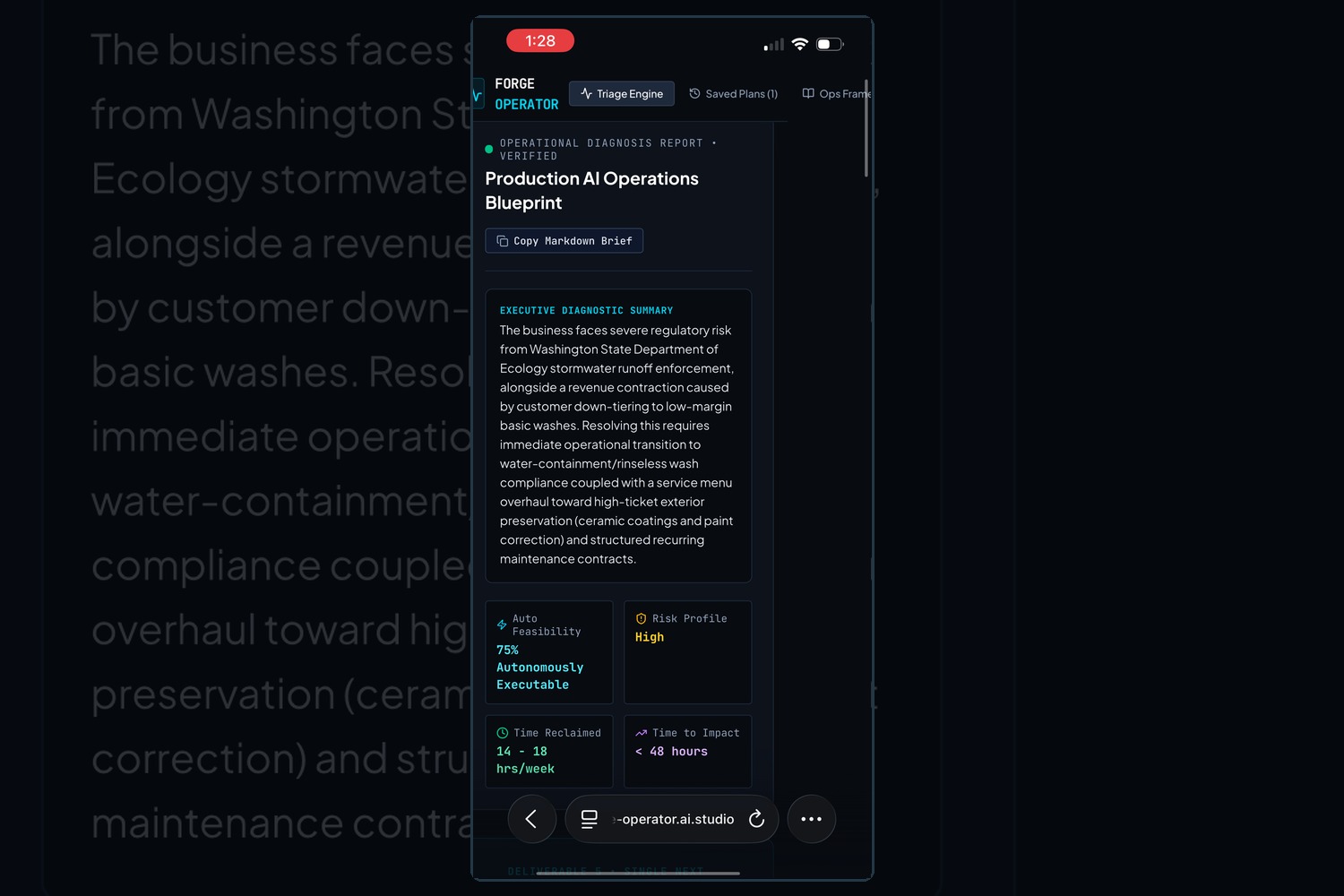
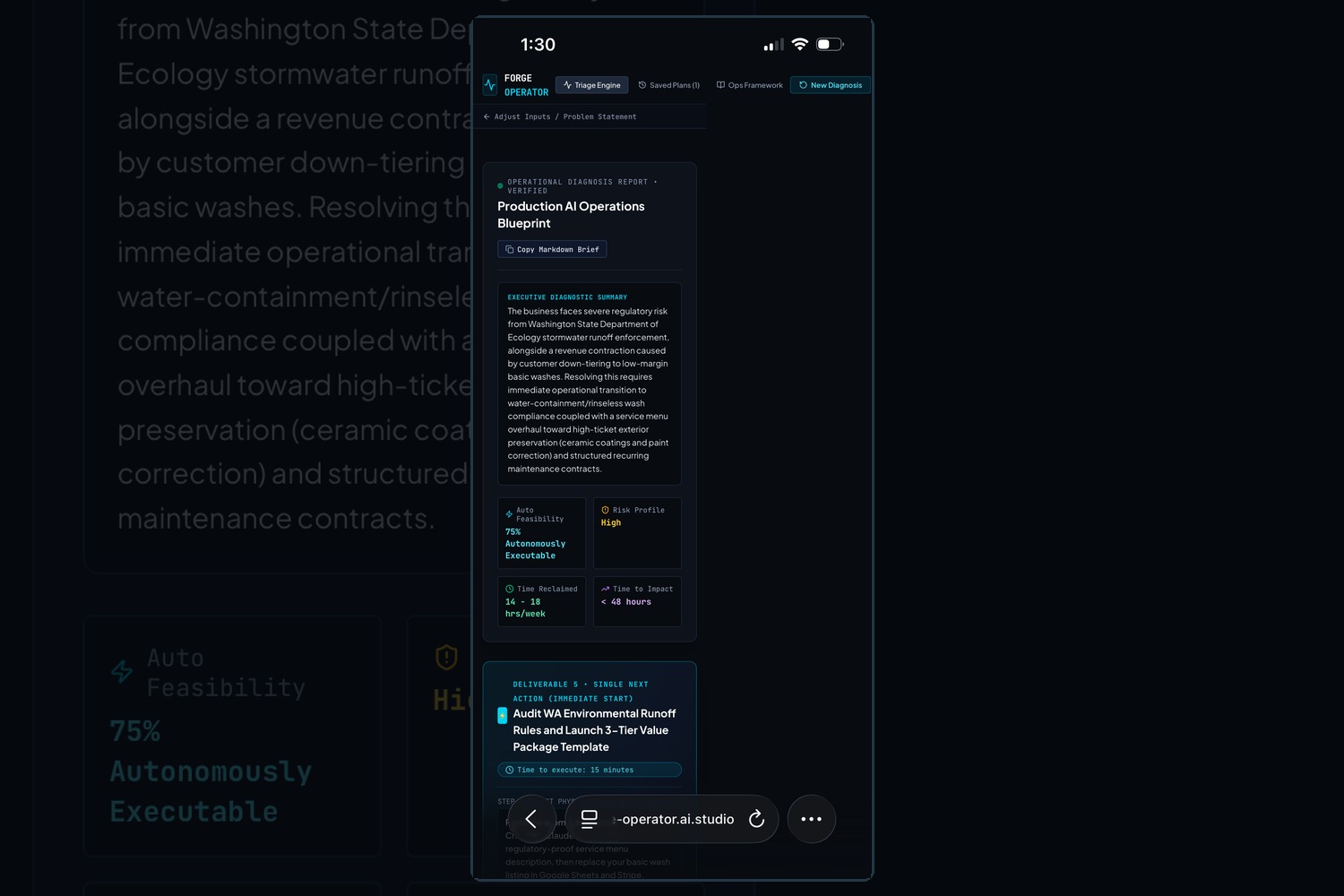
Diagnostic Summary — 75% autonomously executable, risk, time reclaimed, time to impact
-
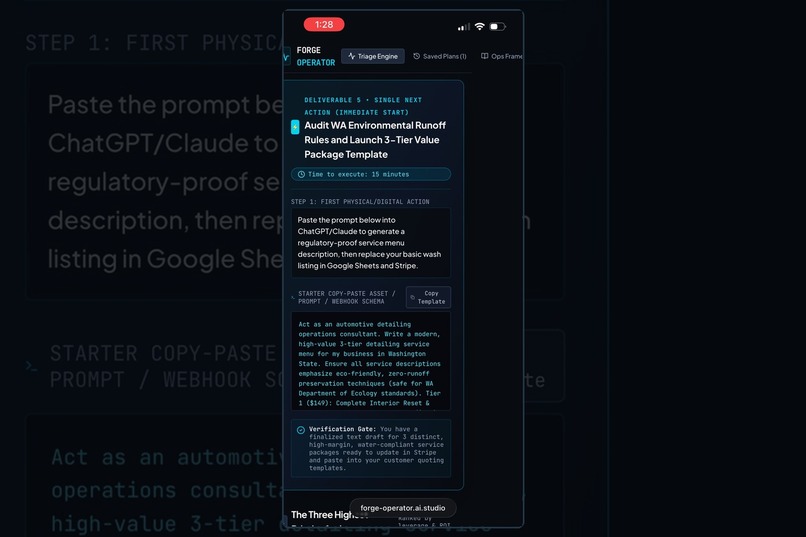
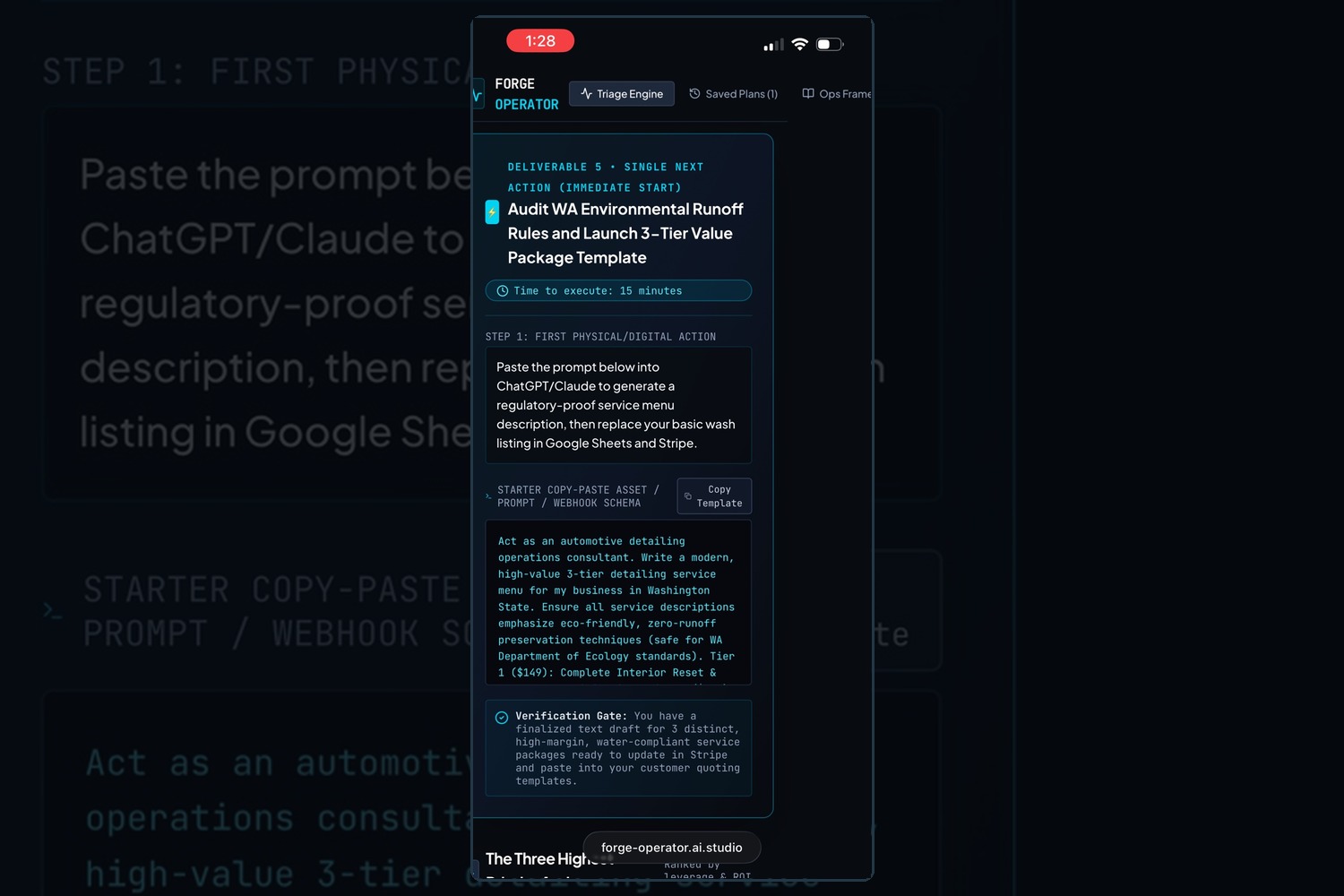
Immediate Action — demonstrates Forge doesn't just analyze, it chooses what to do now
-
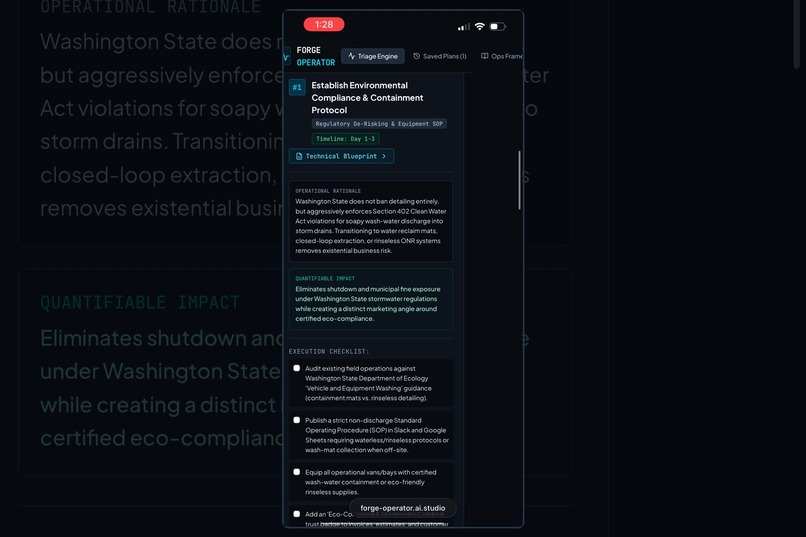
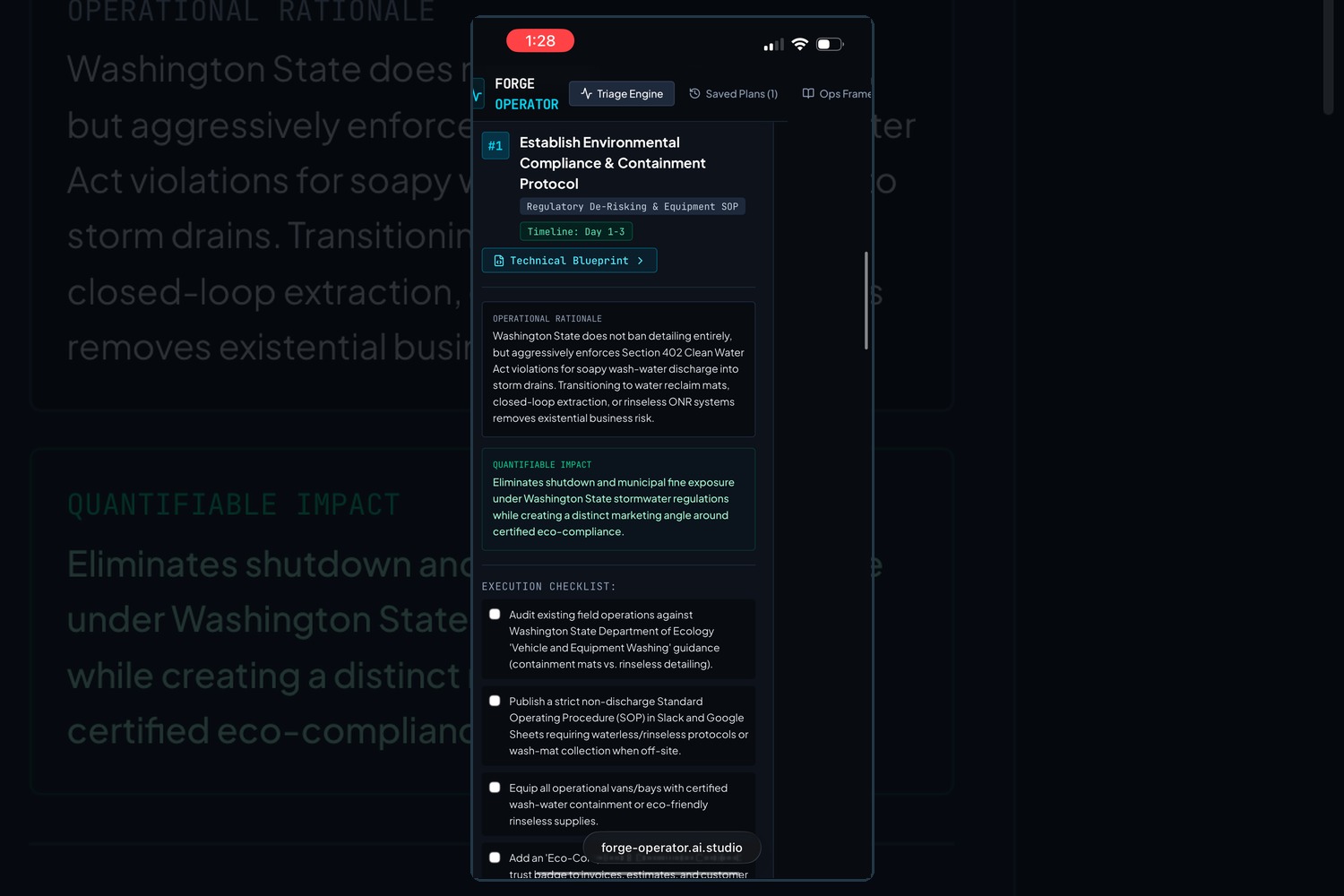
Priority #1: Compliance — operational prioritization
-
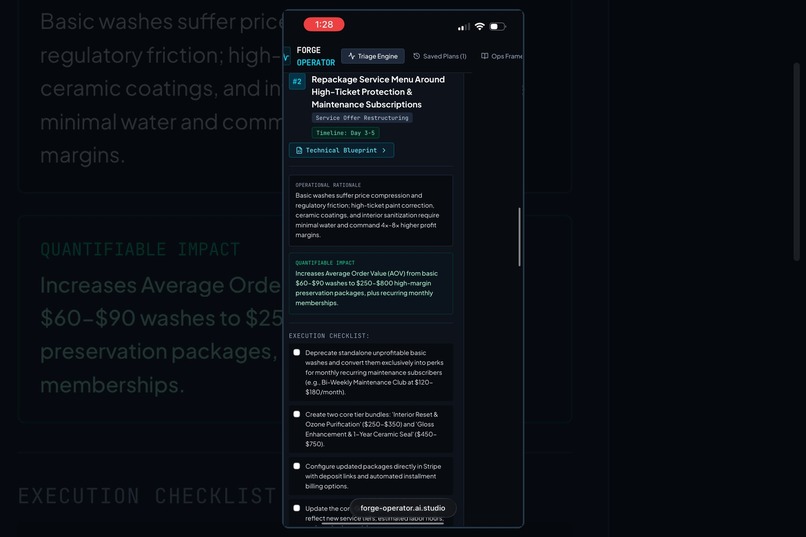
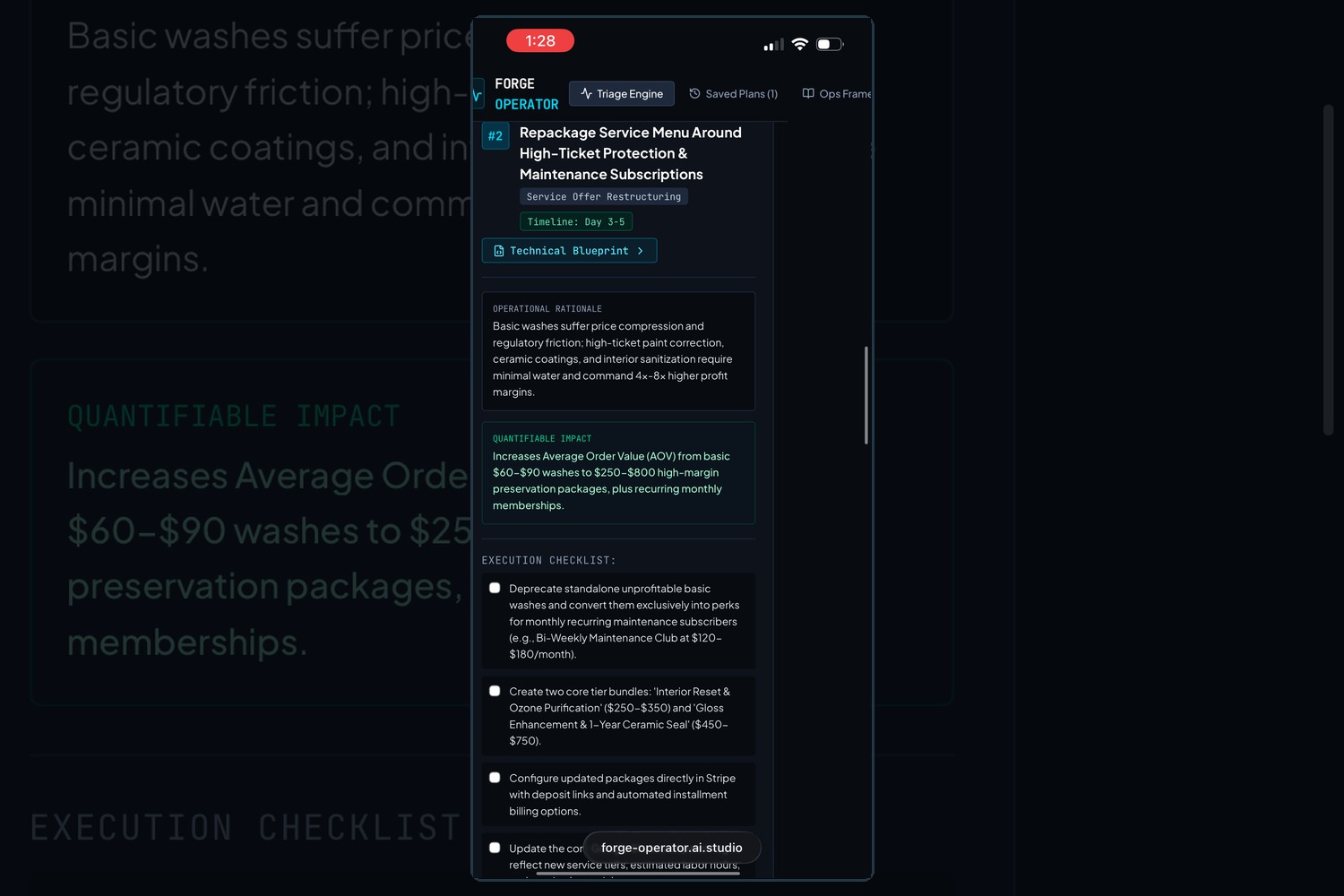
Priority #2: Service Restructuring — business/revenue reasoning
-
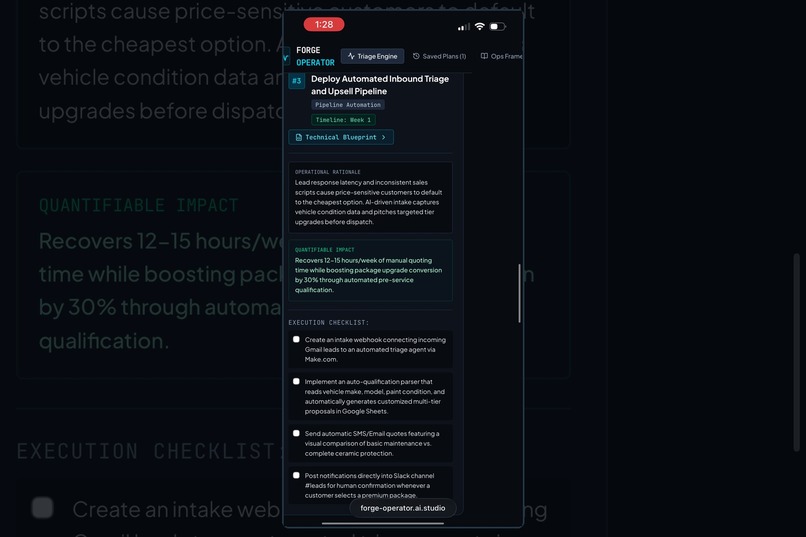
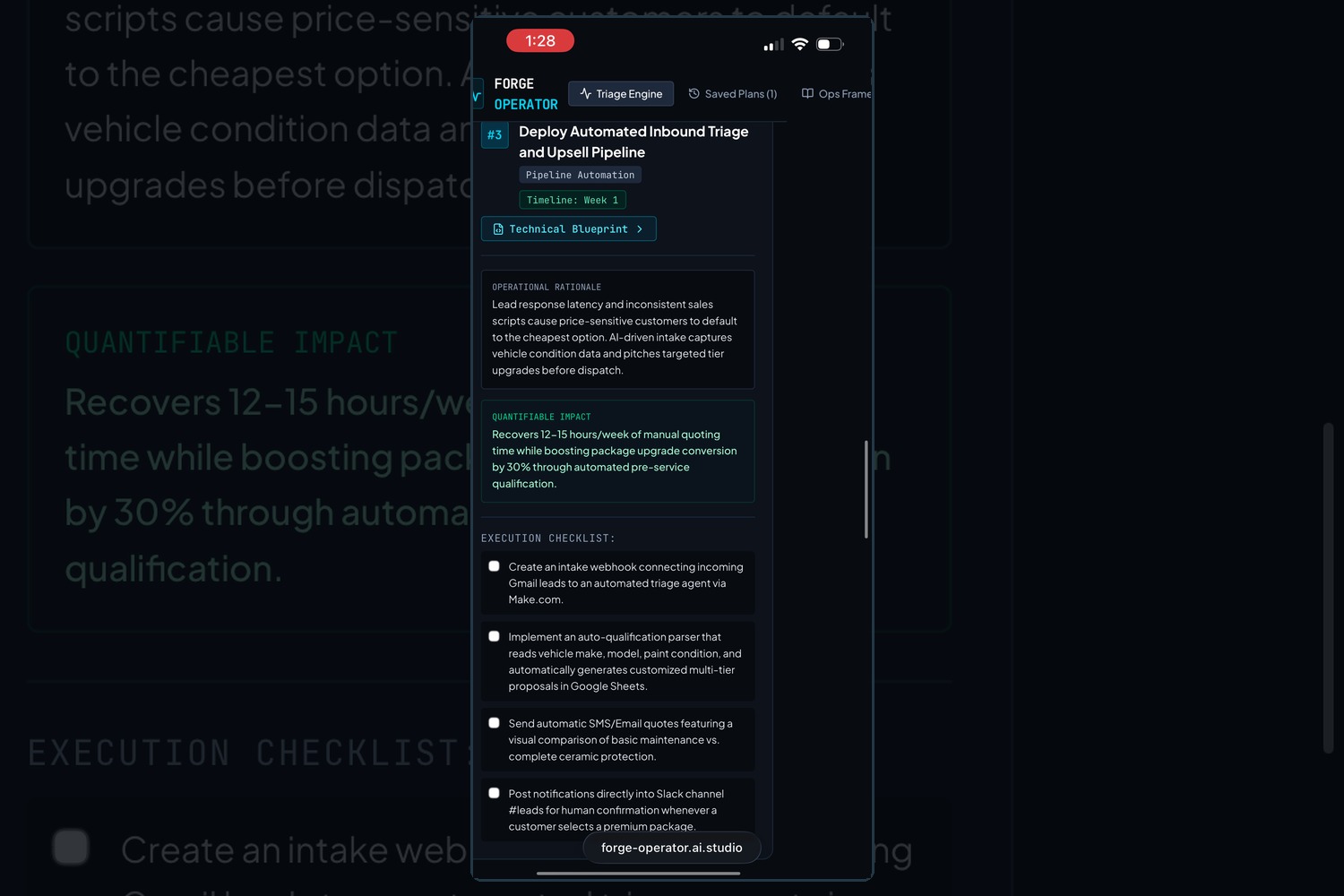
Priority #3: Automated Triage — automation opportunity
-
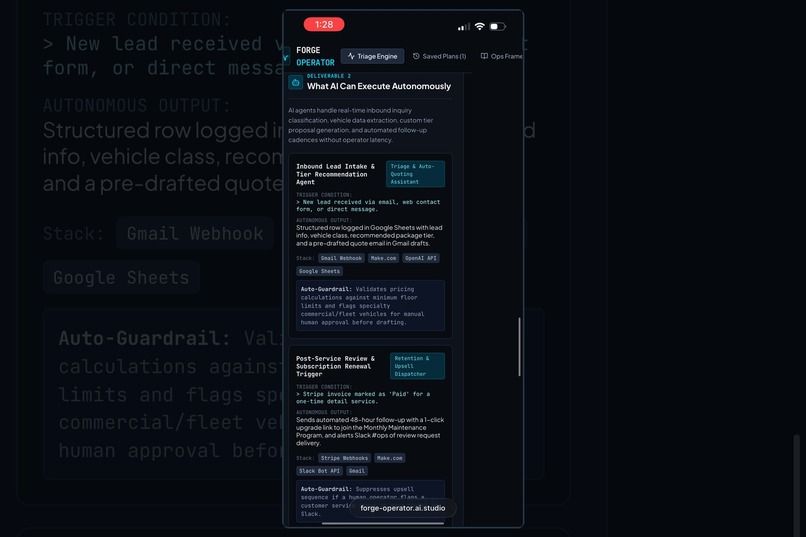
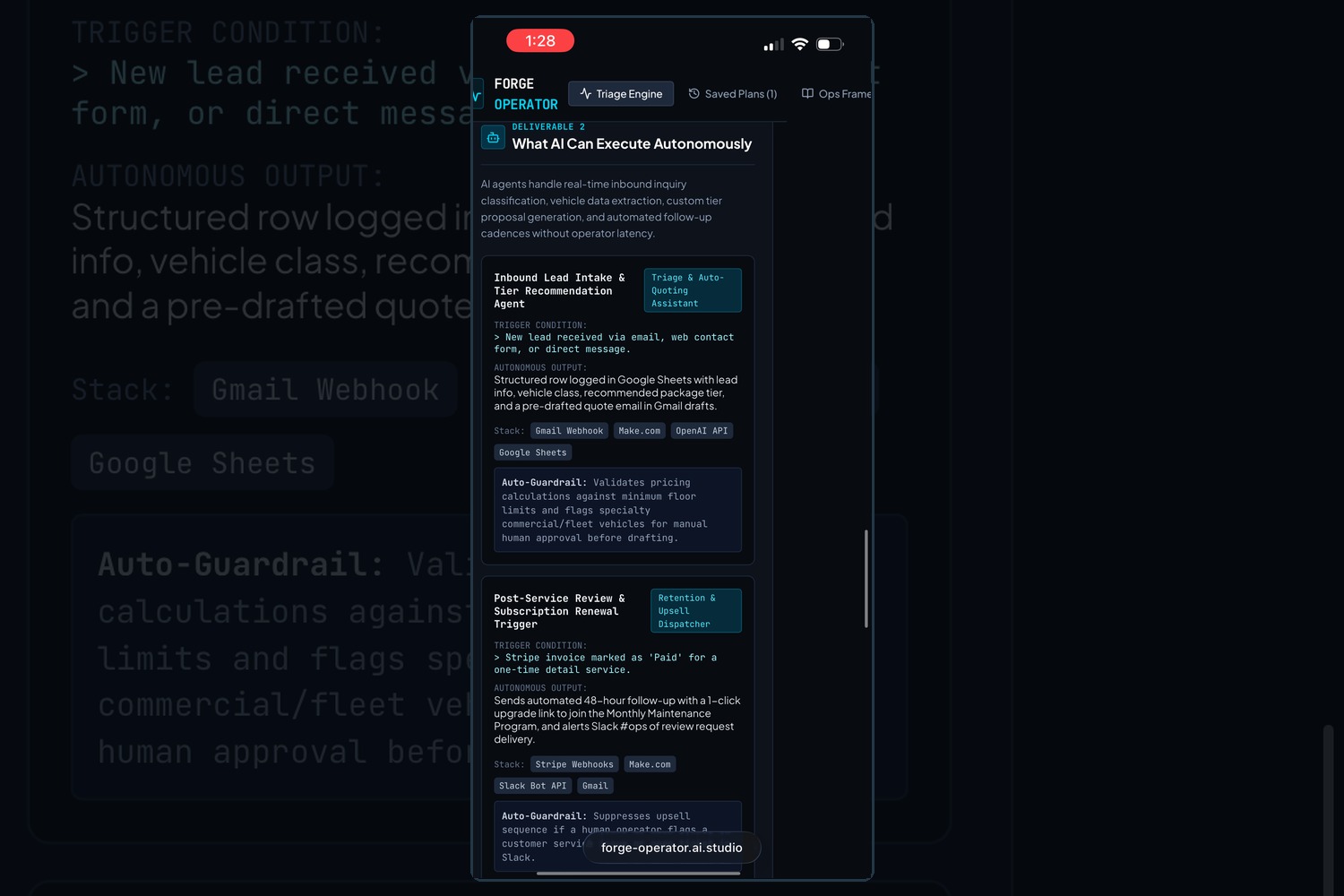
Autonomous Execution — what AI is permitted to do
-
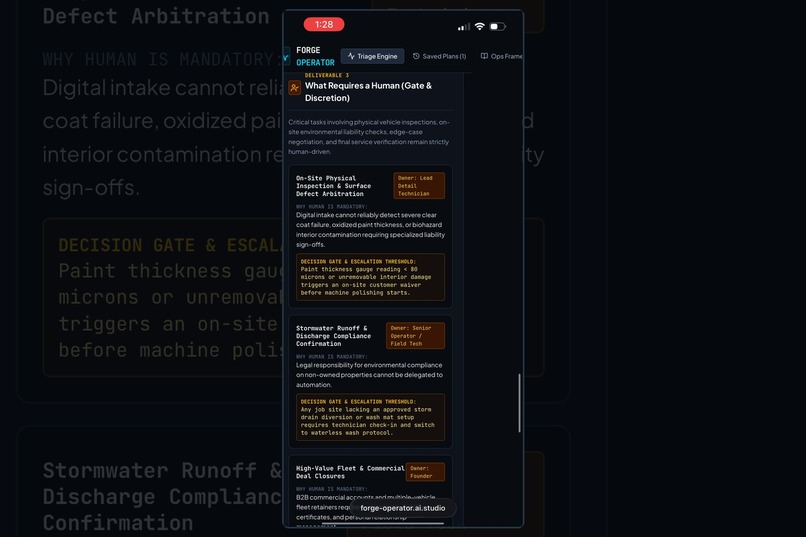
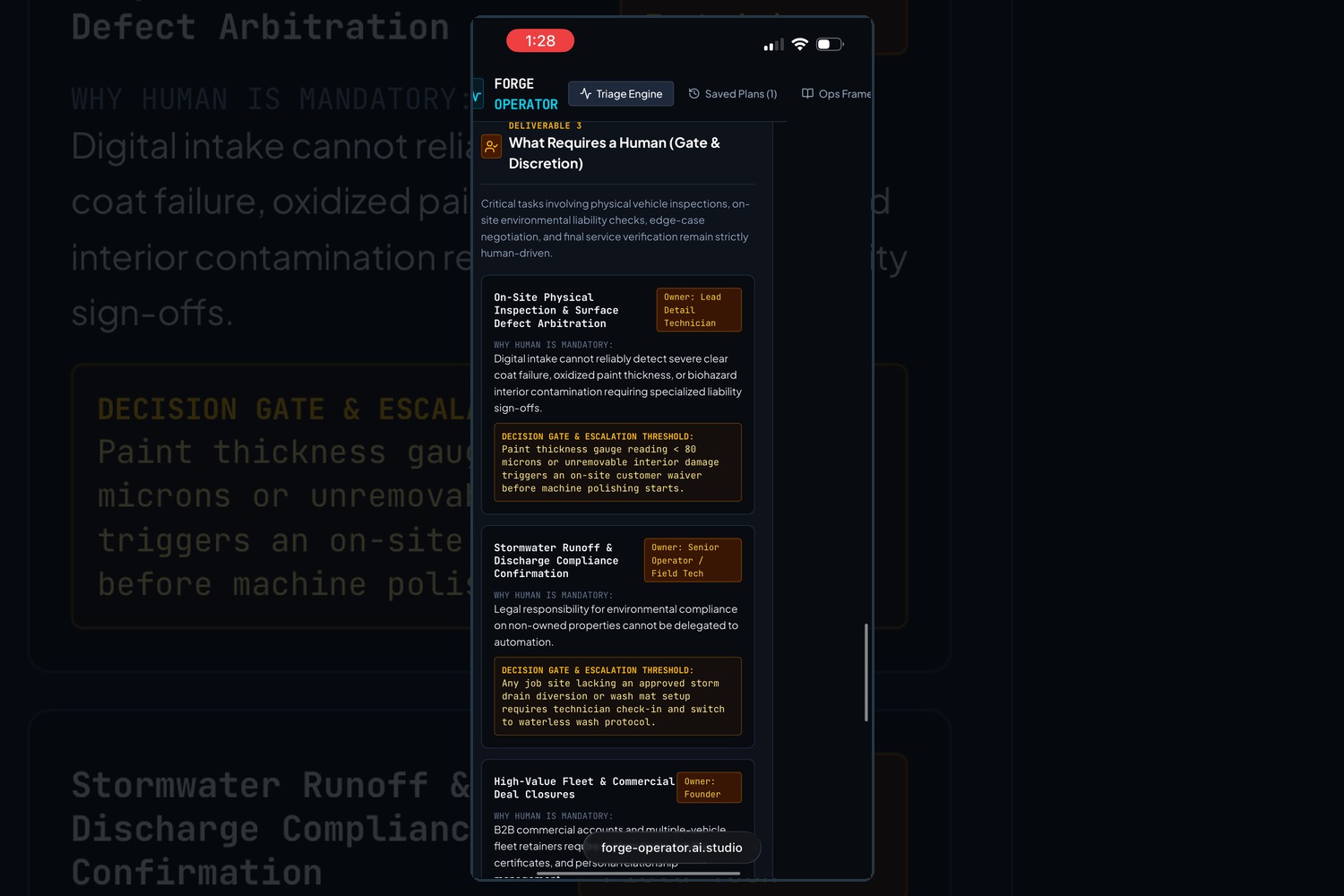
Human Gates — where AI must stop
-
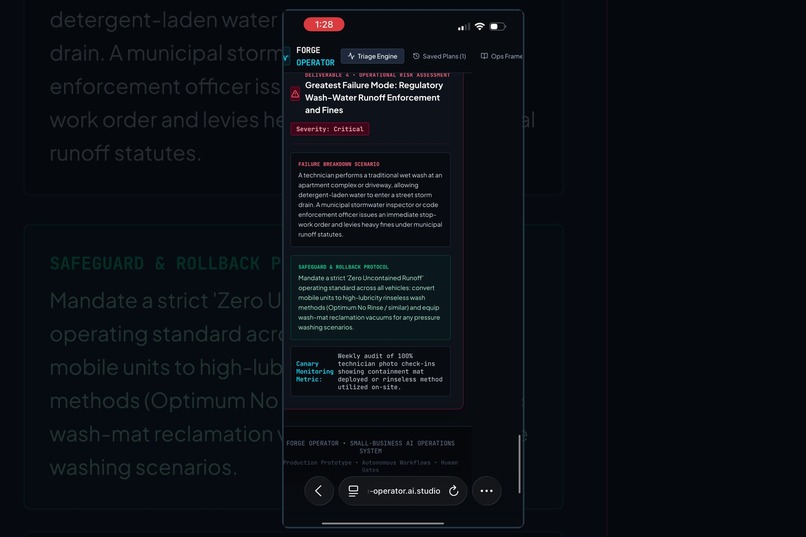
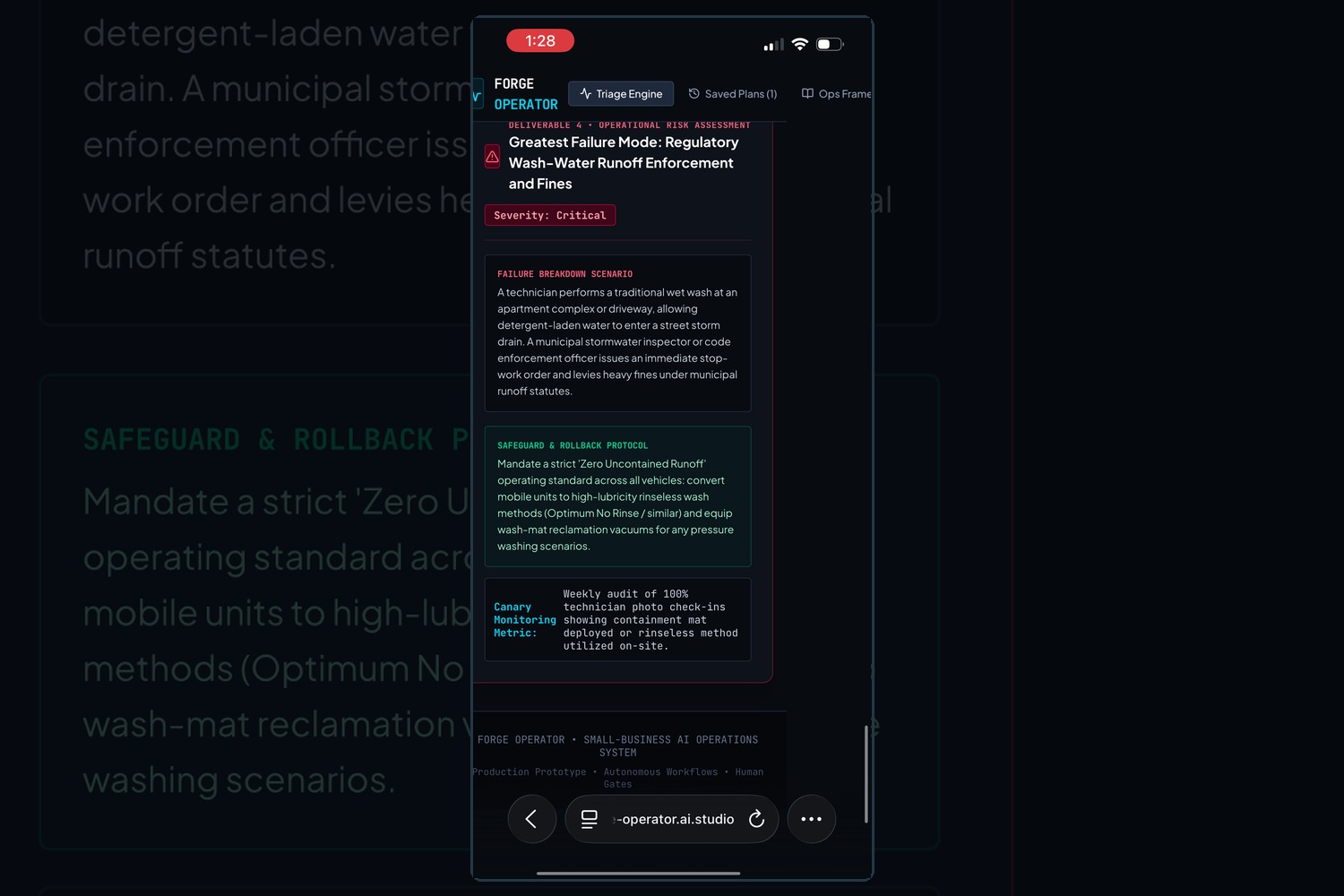
Risk Assessment — failure mode + safeguard
-
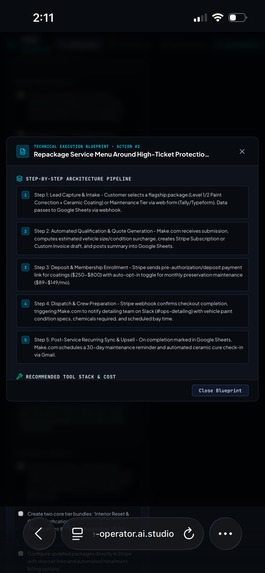
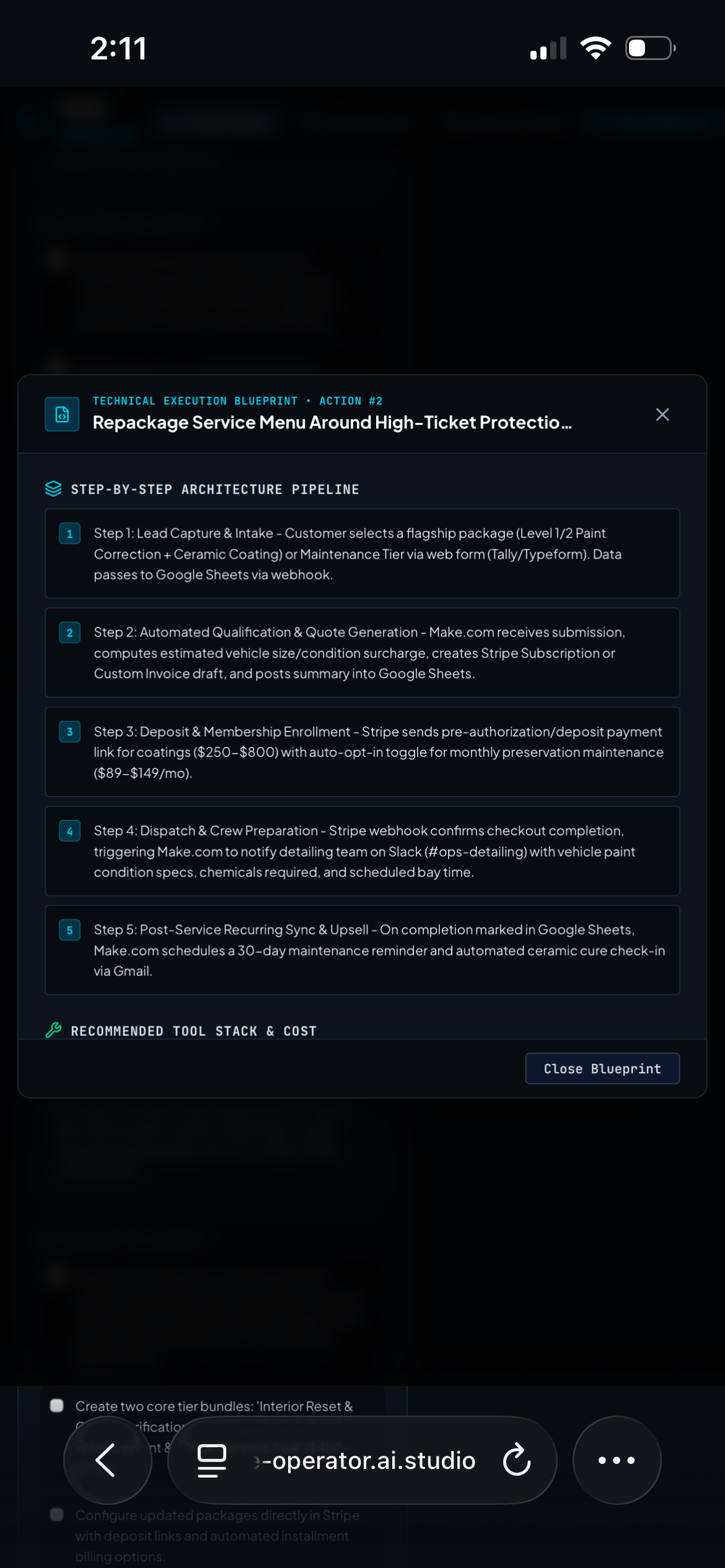
5-Step Architecture Pipeline — actual system architecture
-
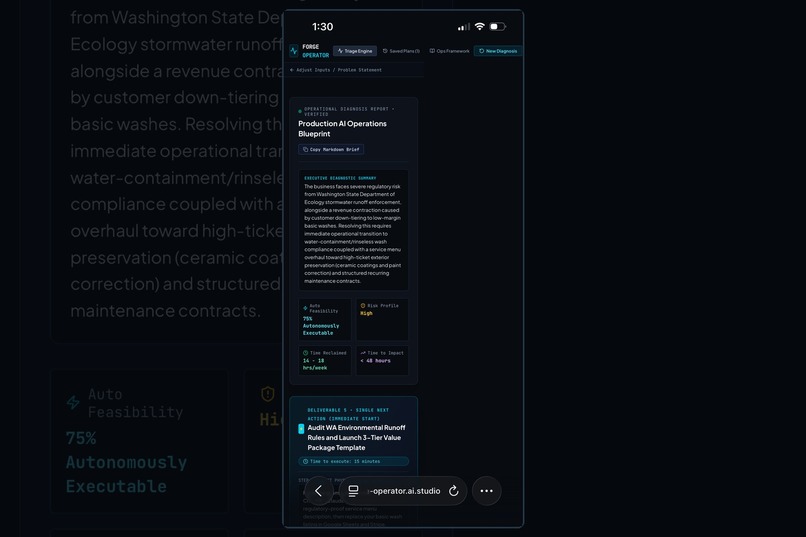
Technical Blueprint Overview — transition from diagnosis into implementation
-
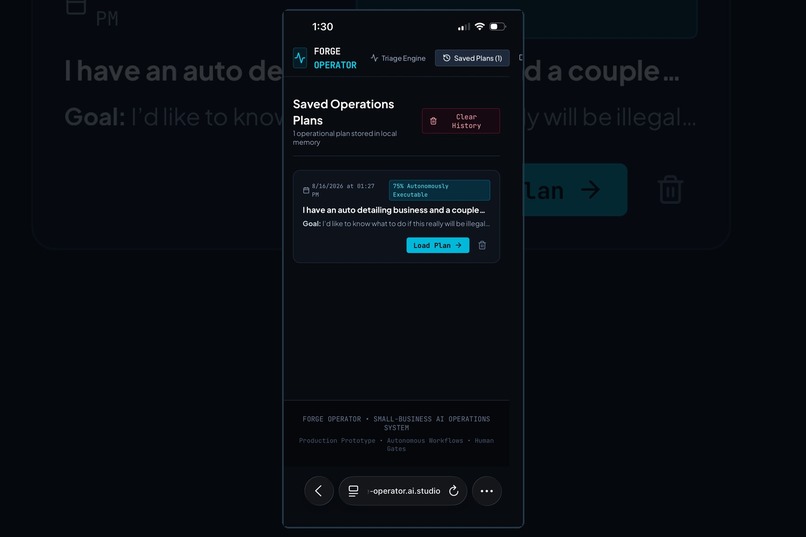
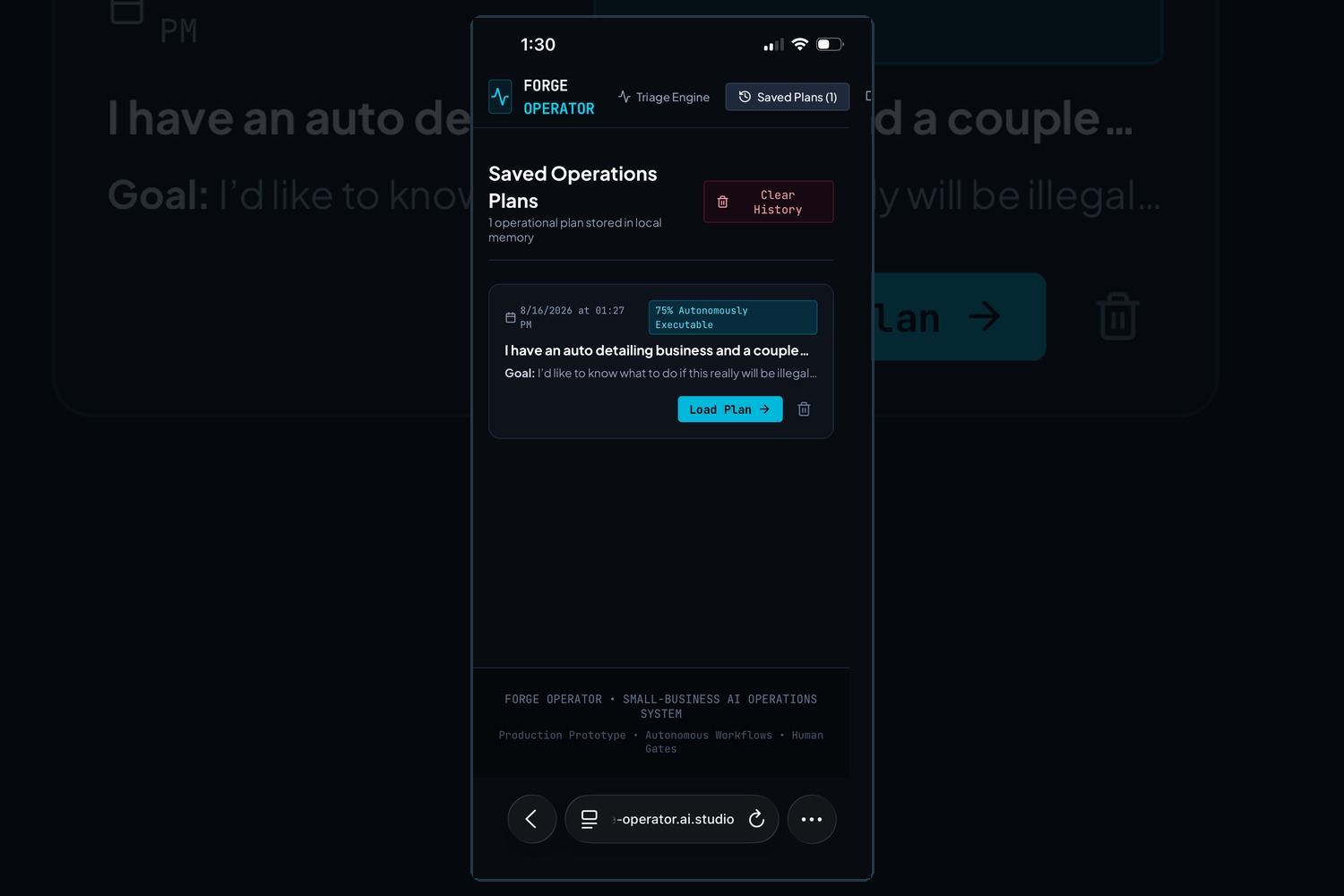
Saved Plan / Persistence — evidence this is an application, not a single prompt
-
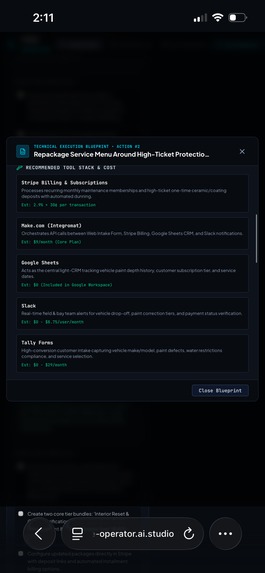
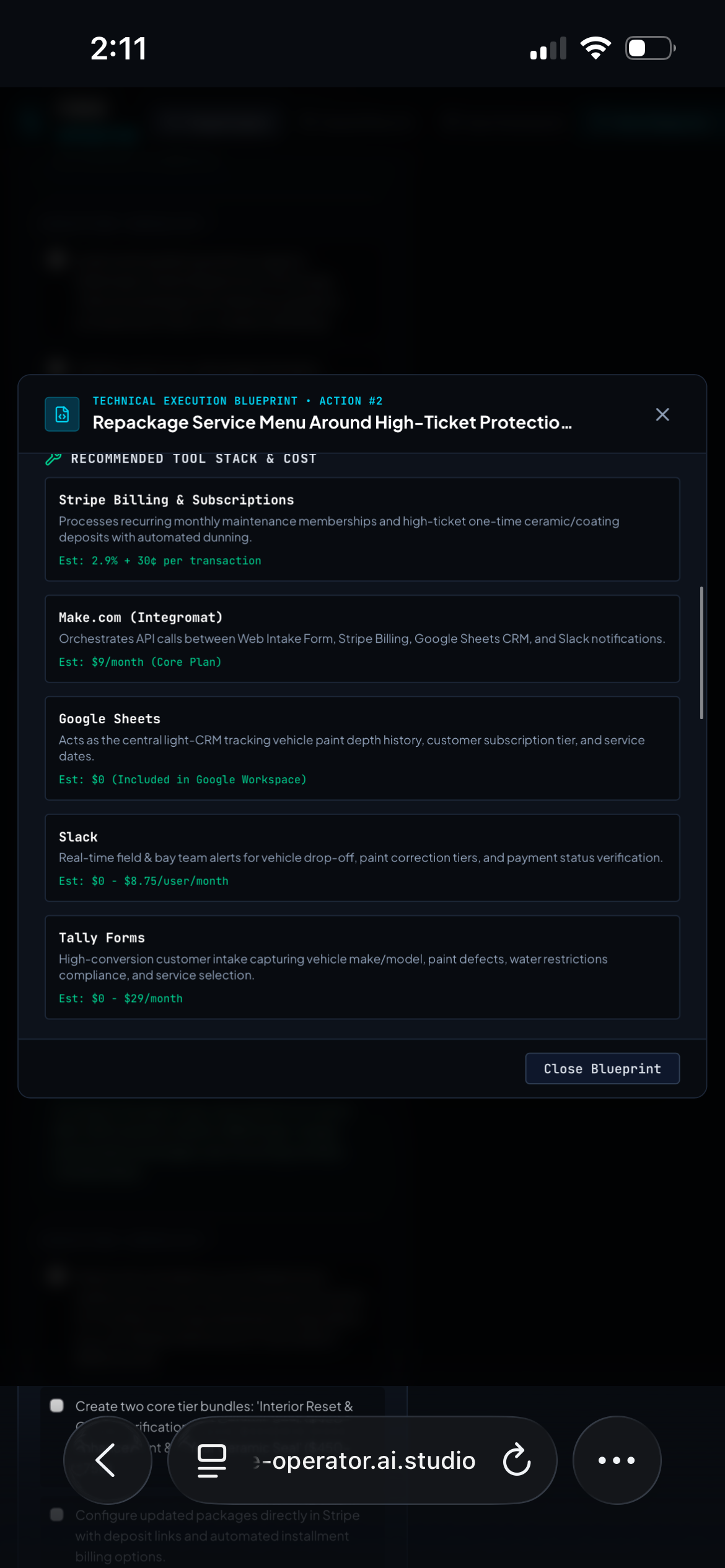
Recommended Tool Stack + Cost — implementation specificity
-
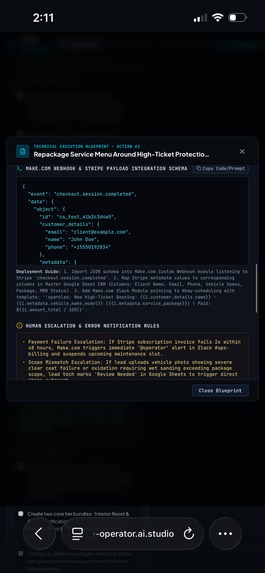
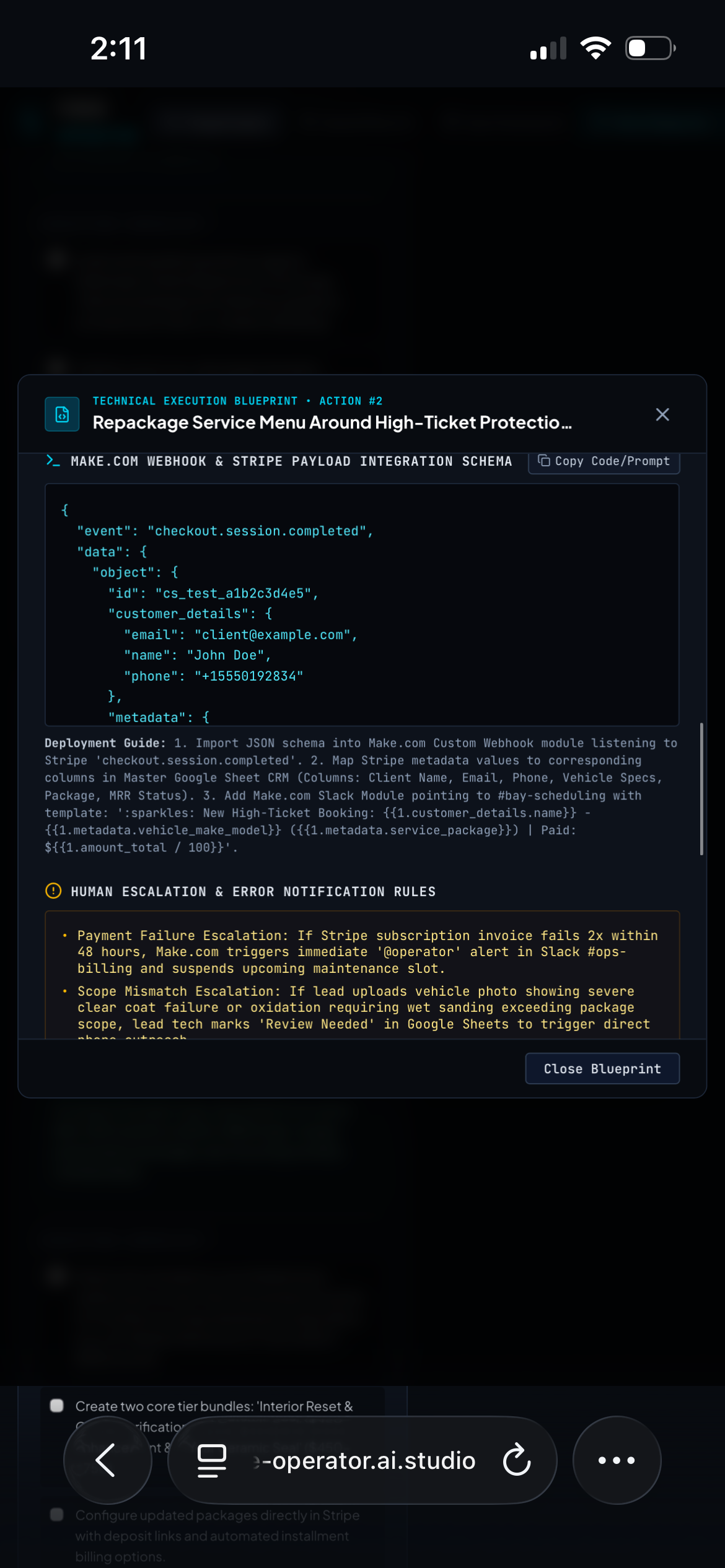
Webhook / Stripe Payload Schema — machine-readable artifact
-
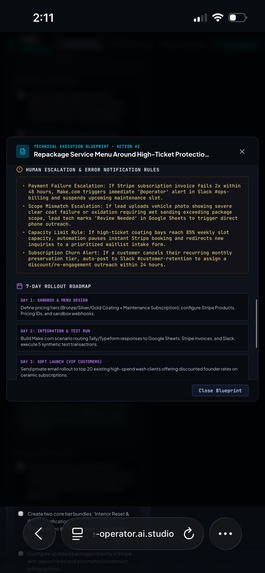
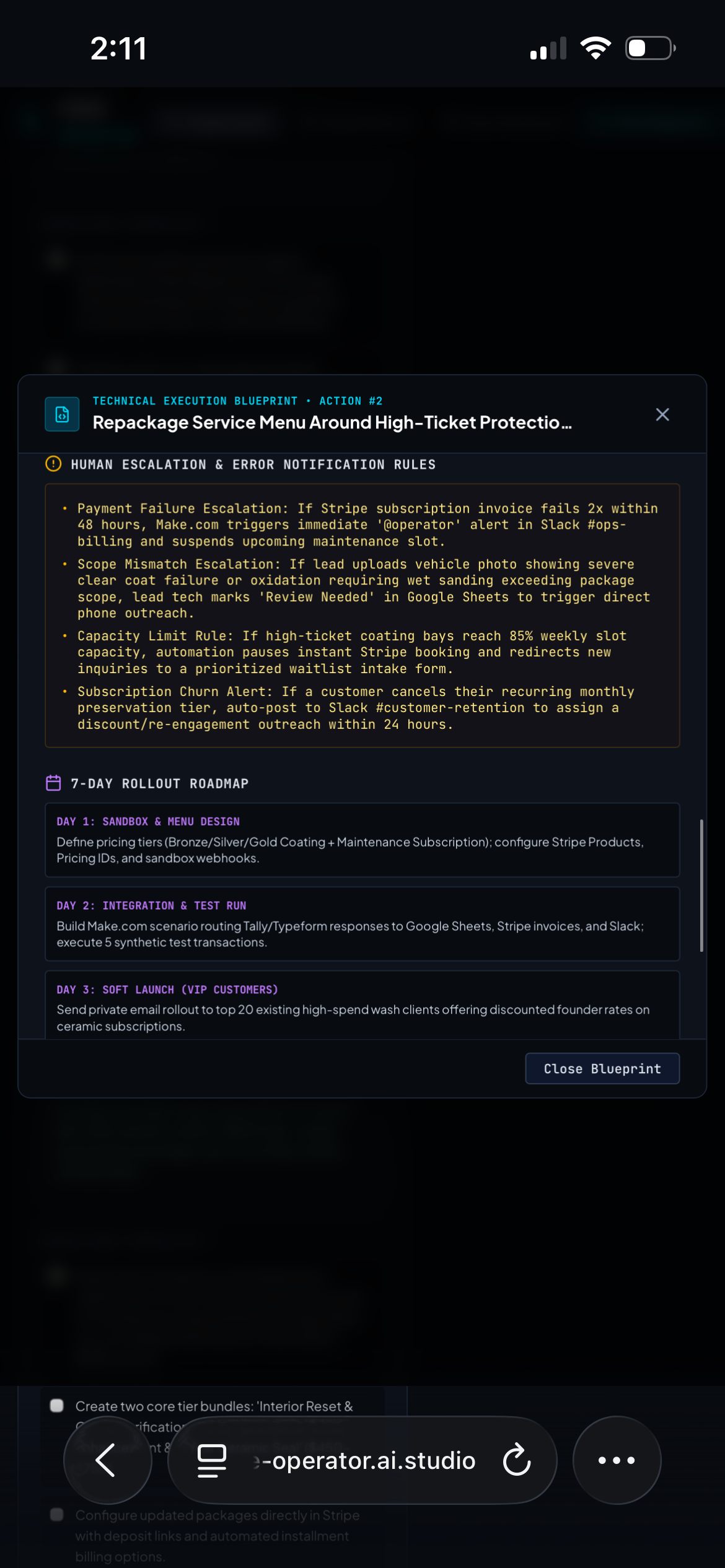
Human Escalation + Error Rules — production guardrails
-
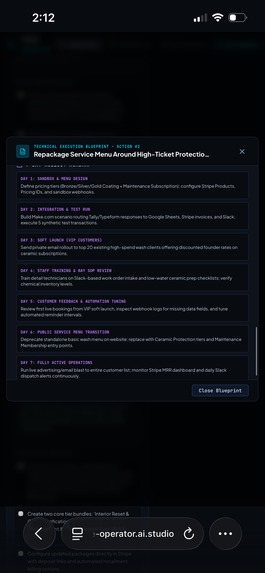
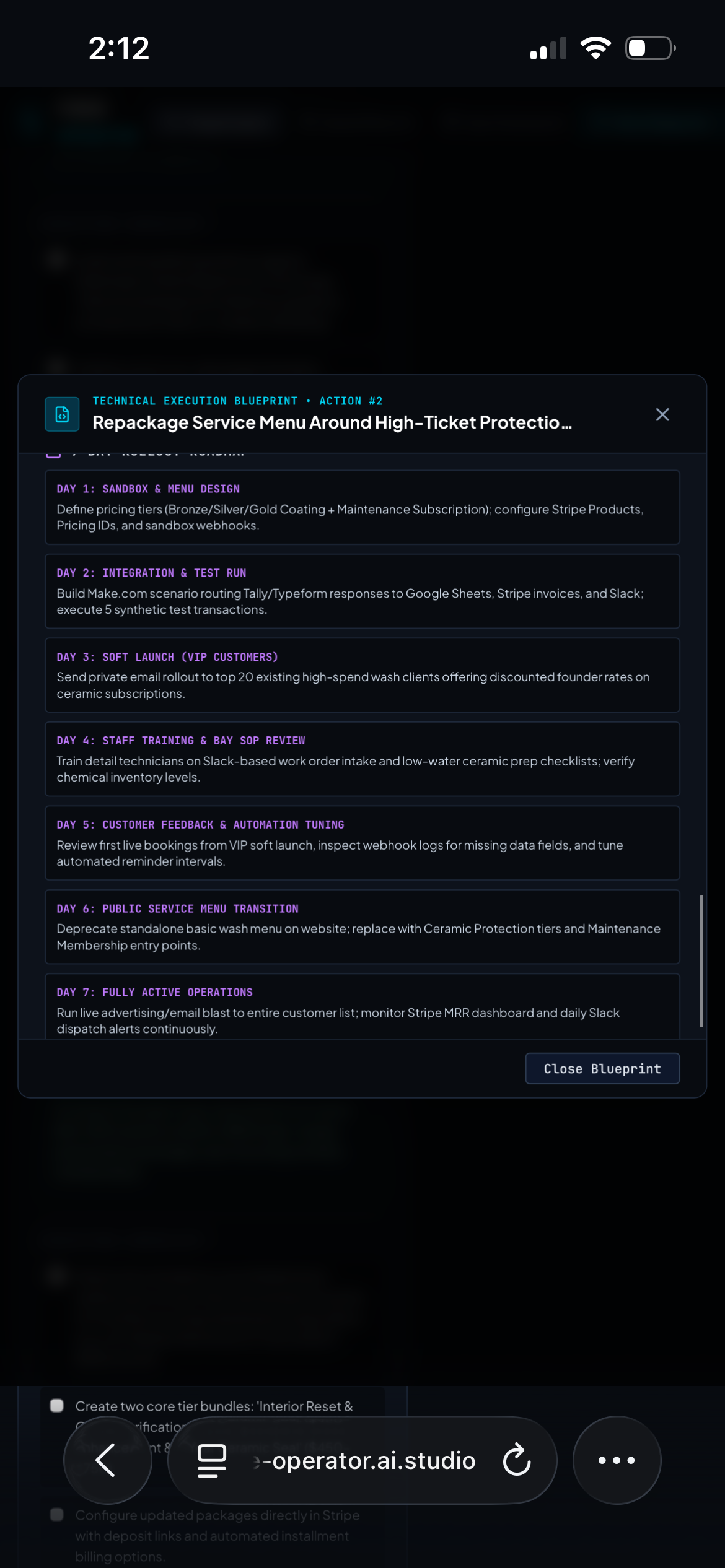
7-Day Rollout Roadmap — turns architecture into deployment sequence
Inspiration
Small businesses do not suffer from a lack of advice. They suffer from a lack of execution capacity.
A founder can ask an AI model how to improve a business and receive pages of recommendations, but someone still has to determine what matters first, translate recommendations into workflows, decide what AI should and should not execute, select the right tools, anticipate failure modes, and turn the resulting plan into something a real business can deploy.
Forge Operator was inspired by a simple question: What if a small business could have an AI operations department?
Not another chatbot. Not another dashboard. An operational intelligence layer capable of diagnosing bottlenecks, designing systems to solve them, defining what can safely be automated, and knowing when a human needs to take control.
What it does
Forge Operator is an AI-native operational triage and execution system for small businesses.
An operator describes a real business bottleneck and a measurable desired outcome. Forge analyzes the situation and produces a structured operational plan identifying the three highest-priority actions, autonomous execution opportunities, mandatory human decision gates, the greatest operational risk, and the single next action the operator should take.
Forge then goes deeper.
For priority actions, it can generate a Technical Execution Blueprint containing a step-by-step architecture pipeline, recommended technology stack and estimated costs, integration logic, implementation schemas and payload examples, human escalation and error-notification rules, and a seven-day rollout roadmap.
Users can also save diagnoses and return to previous operational plans.
The result is designed to bridge the gap between asking AI what a business should do and actually understanding how to implement it.
How we built it
Forge Operator was created as a new project during the competition period using Google AI Studio and Gemini.
Gemini provides the core operational intelligence. Instead of using the model as a general-purpose chatbot, Forge structures the interaction around operational decision-making. Business problems, target outcomes, and operating context are transformed into defined priorities, automation boundaries, human gates, risk assessments, and implementation plans.
We designed the interface around an Operational Triage Engine rather than a traditional chat window. Users provide the business problem and target metric directly, with optional context such as industry, team size, and existing technology stack.
The generated result can then become a deeper Technical Execution Blueprint. This second layer translates strategic recommendations into implementation architecture, tooling, integration logic, escalation conditions, and rollout sequencing.
We also built production scenarios spanning different industries so the system can be demonstrated against substantially different operational problems rather than a single scripted use case.
Challenges we ran into
The hardest challenge was not generating more AI output. It was determining how to make AI output operationally useful.
Generic recommendations are easy to produce. Real operations require prioritization, constraints, measurable outcomes, failure handling, and clear accountability.
A second challenge was defining the boundary between autonomy and human responsibility. We did not want Forge to assume that everything that can technically be automated should be automated. The system therefore explicitly identifies autonomous tasks alongside mandatory human gates and escalation conditions.
The third challenge was speed. We built the working product during the competition window, which forced us to continuously choose between adding more features and making the core operational loop deeper and more useful.
Accomplishments that we're proud of
We are proud that Forge progressed beyond a prompt wrapped in an interface.
The working product can take an unstructured operational problem and convert it into a structured diagnosis, prioritized action plan, automation boundaries, human gates, risk analysis, and technical implementation blueprint.
Its Technical Execution Blueprint can go from a business recommendation to a step-by-step architecture, recommended tools, integration schema, escalation logic, and seven-day deployment roadmap.
We are also proud that the system can operate across substantially different small-business scenarios rather than being hard-coded for one industry.
Most importantly, Forge reached its first real economic validation during early testing: an outside user paid $25 for access to the product. It is a small transaction, but an important milestone because the project moved from something we believed could create value to something another person was willing to pay to use.
What we learned
The biggest lesson was that useful AI autonomy is not simply about giving a model more control.
The more operational responsibility AI receives, the more important boundaries, escalation rules, observability, and human accountability become.
We also learned that there is a large gap between AI advice and AI execution. A recommendation such as "automate customer intake" is only the beginning. An operator still needs to know what triggers the workflow, where the data goes, what systems communicate, what happens when something fails, what the implementation costs, and when a person needs to intervene.
That gap became the central design problem Forge Operator attempts to solve.
What's next for Forge Operator
The next step is moving from generated execution architecture toward increasingly direct execution.
Forge can evolve from diagnosing an operation and generating its implementation blueprint into an agentic operations layer capable of deploying and supervising approved workflows across the tools a business already uses.
That means deeper integrations, persistent operational memory, execution telemetry, measurable before-and-after business outcomes, and stronger human approval controls for consequential actions.
The long-term vision is simple:
Give small businesses access to operational intelligence and execution capacity that historically required an entire operations department.
Built With
- css
- gemini-api
- google-ai-studio
- google-gemini
- html
- javascript

Log in or sign up for Devpost to join the conversation.