-
-
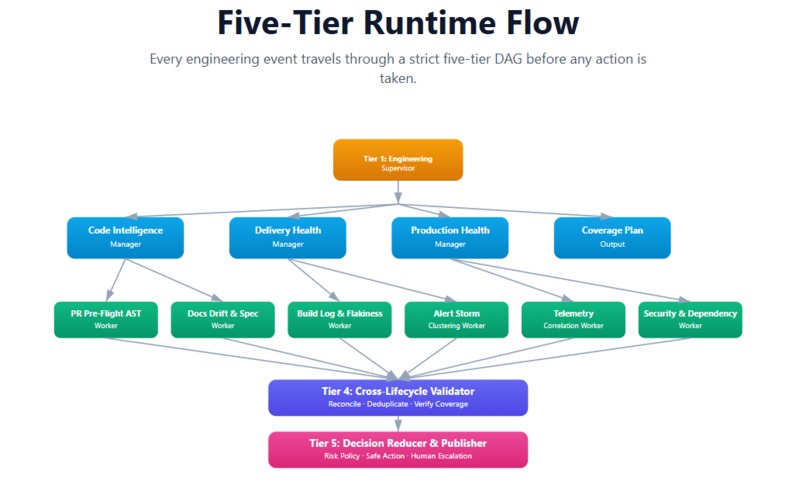
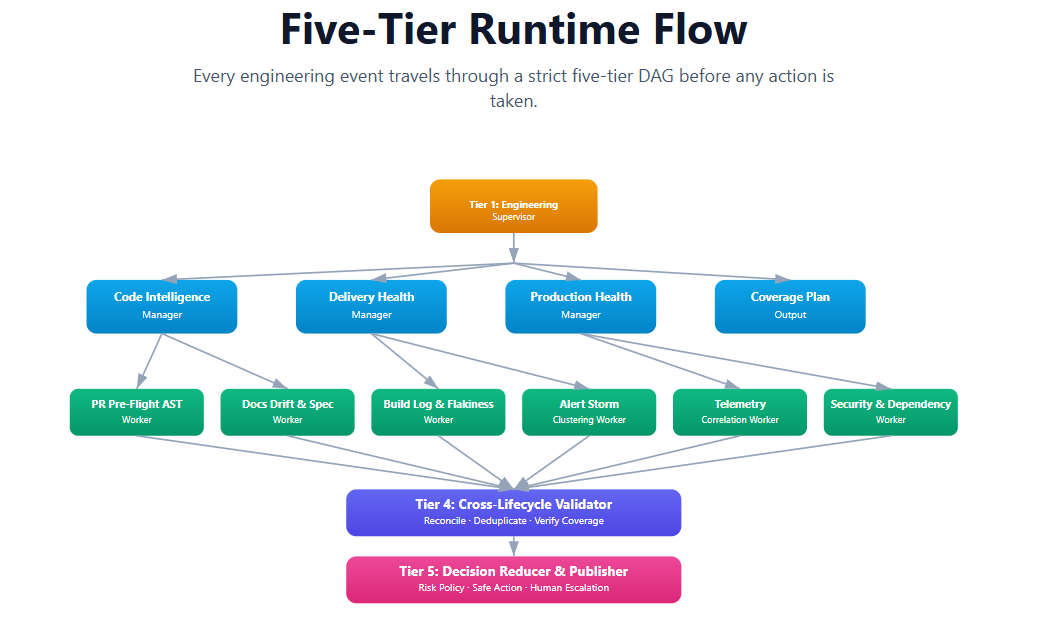
Five-tier DAG: Supervisor → Managers → Workers → Validator → Reducer → Gate. Workers emit evidence. Only Reducer decides. Gate: no bypass.
-
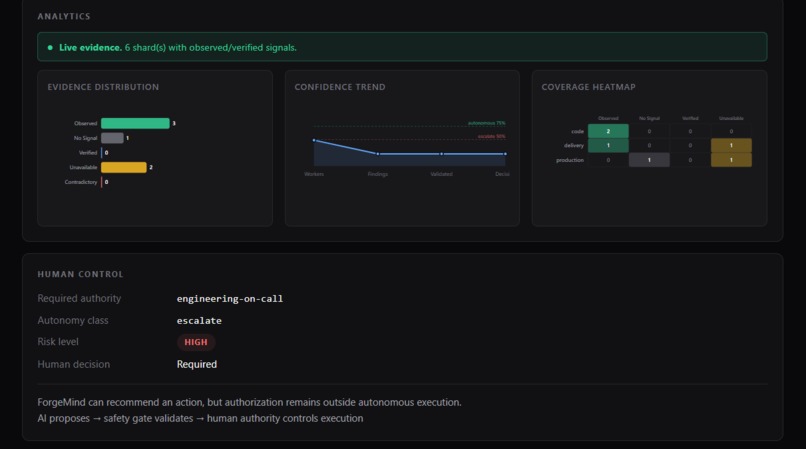
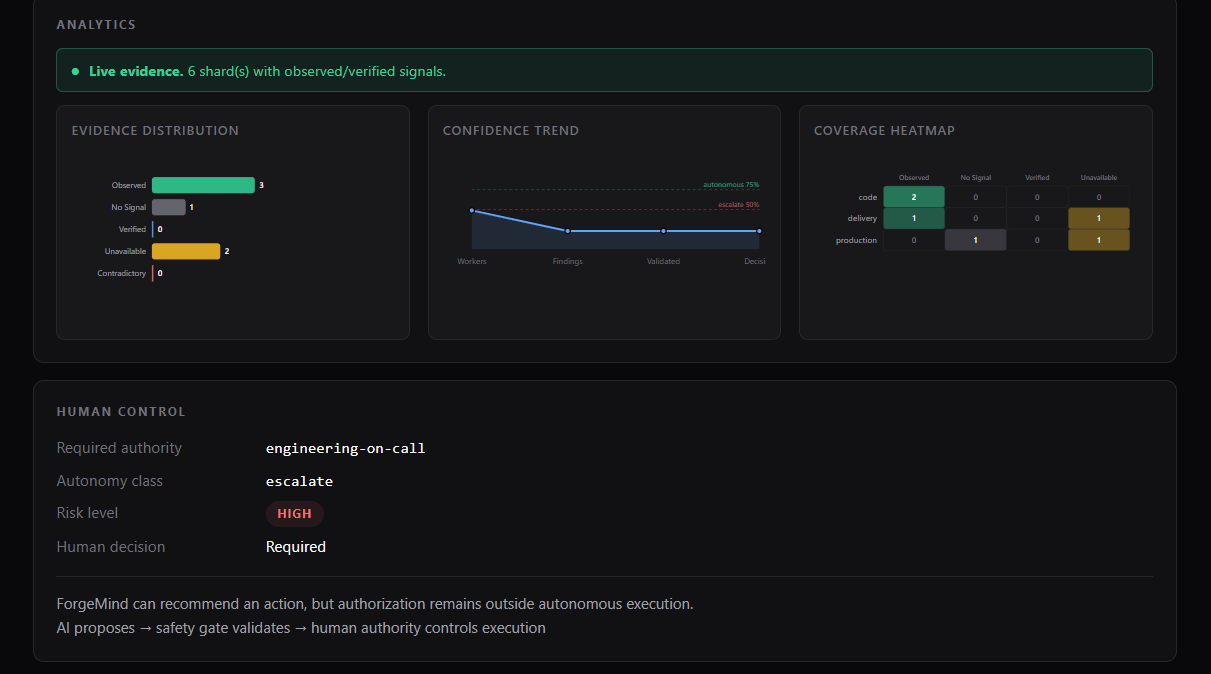
PR #210: CI + docs + scripts. Confidence 0.23, risk high, escalate. Evidence-derived — not heuristic.
-
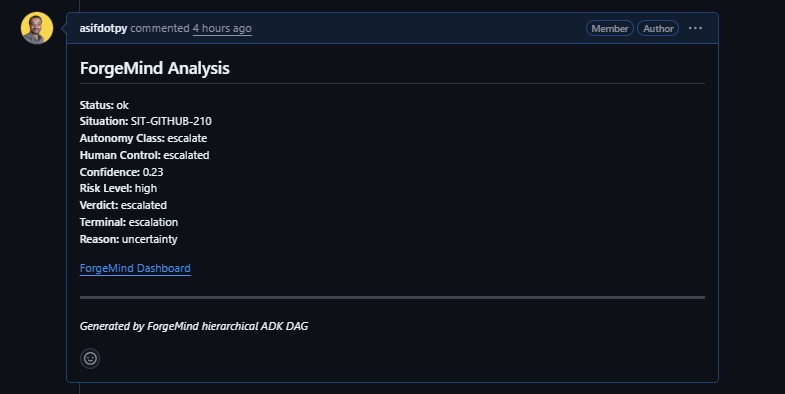
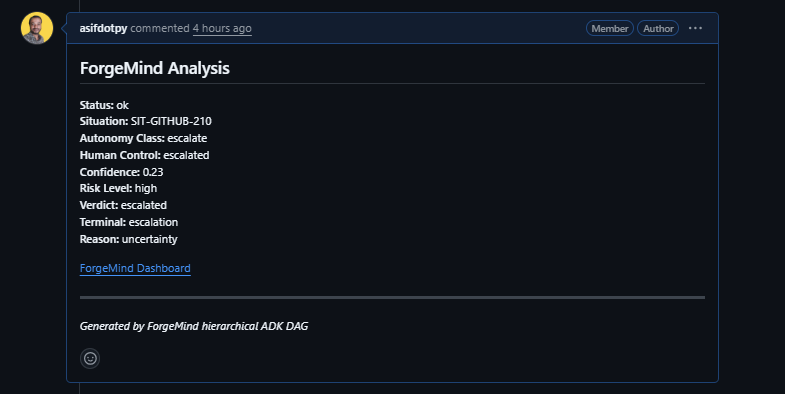
ForgeMind comment on PR #210: confidence 0.23, risk high, escalate. Unique dashboard link included.
-
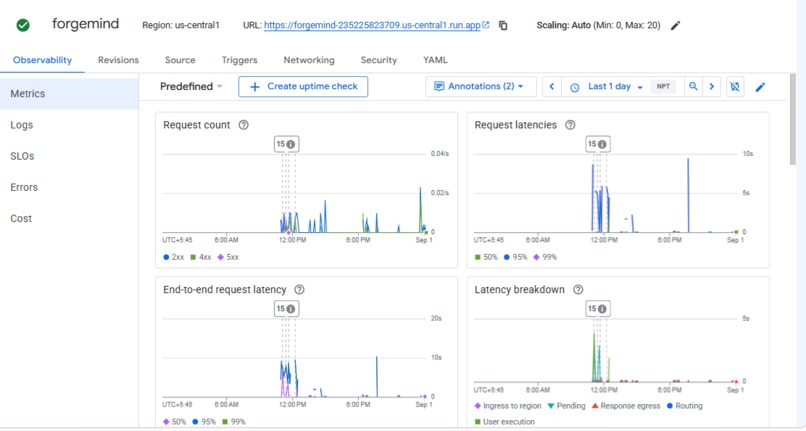
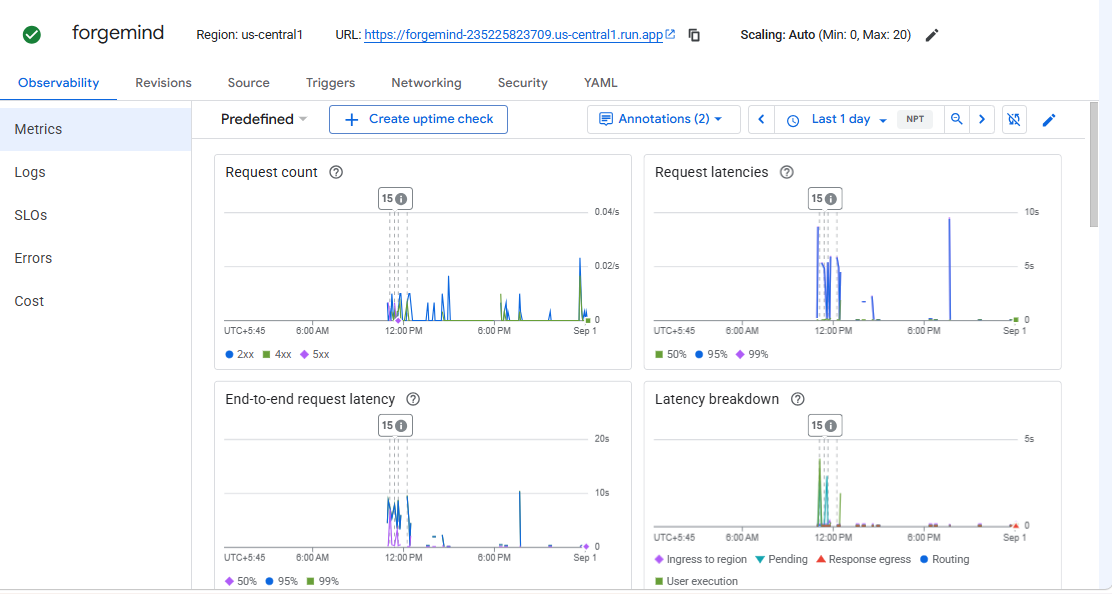
ForgeMind deployed on Google Cloud Run. Production-ready, auto-scaling, pay-per-request.
Inspiration
Engineering teams live in disconnected signals. A PR opens, a build goes red, an alert fires at 2 a.m. — and nobody connects the dots until something breaks in production. Each signal lives in a different tool, a different dashboard, a different tired on-call engineer. We wanted to build the system we wished existed: one that treats a PR, a build failure, and a production alert as the same kind of event — an engineering situation that deserves planning, evidence, validation, and a deliberate decision about whether a machine or a human should act.
The Fortified Enterprise Fleet track gave us the mandate: enterprise agents shouldn't just be clever, they should be governed — with scoped authority, provable evidence, and a hard boundary that keeps a human in control. That became ForgeMind's north star: more autonomy where evidence supports it, honest escalation where it doesn't.
What it does
ForgeMind is an autonomous engineering control plane built on a five-tier hierarchical multi-agent DAG:
Supervisor → Domain Managers → Specialist Workers → Cross-Lifecycle Validator → Decision Reducer
Feed the system a real event — a GitHub PR, a CI failure, a production alert — and it:
- Plans — the Engineering Supervisor derives a CoveragePlan across code, delivery, and production health.
- Investigates — six specialist workers emit durable, schema-validated EvidenceShards with source citations.
- Reconciles — three domain managers aggregate shards into DomainFindings, and the Cross-Lifecycle Validator reconciles them into a ValidatedSituation with explicit coverage and causality assessments.
- Decides — and only then. The Decision Reducer is the sole decision authority. A deterministic autonomy ladder automates low-risk, well-evidenced outcomes and escalates everything uncertain or high-blast-radius to a human — with the full evidence chain attached.
Every artifact carries upstream provenance (Event → CoveragePlan → EvidenceShard → DomainFinding → ValidatedSituation → DecisionRecord → ProposedAction → ActionValidation → Action | Escalation), and a no-bypass ActionValidation gate is the only publish point. The judge-visible surface exposes the four properties that matter: provenance, validation, uncertainty, human control.
ForgeMind is live. It runs on Google Cloud Run and — on the day we're submitting — analyzed two real pull requests on a public repo and posted genuine analysis comments to GitHub. Both were escalated to a human rather than auto-approved, because the evidence did not justify autonomous action. Escalating when uncertain is the feature, not a bug.
How we built it
- Real Gemini 3.5 via Vertex AI (
google-genai), deliberately bounded to a single worker node: it generates evidence narrative and claims, never decisions, and fails closed to deterministic logic on any error. - Google ADK 2 (
google-adk) as the workflow runtime —adk_runtime.pywires the DAG as an explicit, pause/resume-capable workflow with a human-approval gate, and a full ADK 2.0 Runner path drives the stages through tool functions. - Google Cloud Run (
forgemind-v3-prod, us-central1) — serverless, scale-to-zero, with a reproducibledeploy/deploy.sh→ Cloud Build → Artifact Registry → Cloud Run pipeline and a health-checked container. - Contract-first, spec-driven development: 9 canonical JSON Schema contracts, 14 Architecture Decision Records, 7 fixture groups, and a fixture runner that validates the whole
Event → Terminallineage end-to-end. - Engineering honesty as tooling: a failure log that records real incidents (a leaked token we caught and regression-gated, a dead safety gate we found by black-box testing) and the tests that prevent each from returning.
Challenges we ran into
- Keeping confidence honest. Early confidence was inflated by ungrounded reasoning. We rebuilt decisioning around evidence-aware calibration (ADR-011): the calibrated model is
$$c = 0.85 + 0.15 \cdot s$$
where s is the fraction of workers with observed (not assumed) evidence. The same real PR dropped from 0.79 to 0.23 after calibration — humbling, and correct.
- A safety gate that was dead code. Black-box probing showed our "cannot assess ⇒ require human" monitoring gate never fired on the live path — evidence traveled on two channels and one was never read (FAIL-006). We fixed the aggregation and added a full-pipeline contract test.
- Cloud Run's read-only filesystem. The situation store needed an in-memory fallback so the live service survives scale-to-zero and container replacement.
- Scope discipline. The hardest part of the "Fortified" track was resisting LLM-everywhere. We chose bounded, deterministic, testable tiers instead — and kept the suite green as the safety net that makes that choice safe.
Accomplishments that we're proud of
- A real, deployed system — not a mockup. Live on Cloud Run, 6 ADK agents registered, real Gemini-backed enrichment, real comments posted to real GitHub PRs.
- 298 tests green (1 skipped, live-token-gated) across contracts, tier invariants, ADK runtime, secret handling, and adversarial evaluation.
- Provenance as a product feature — every artifact end-to-end traceable, demonstrated on the judge surface.
- An honest autonomous posture. Across 28 real PRs evaluated, ForgeMind approved zero actions it couldn't support and escalated the rest — conservative-by-design behavior the enterprise track rewards.
- Adversarial self-review. A failure log that records what went wrong and how it was fixed — transparency judges can actually read.
What we learned
Google ADK 2.0 is powerful but demands discipline. I built a full ADK Runner path with tool-based state passing — agents calling tools that execute each DAG stage. The learning: ADK's value isn't just "agents," it's explicit, pausable, auditable workflow orchestration. The tool pattern (read state → execute tier → write state) made every transformation traceable.
Google Cloud Run changes your architecture. Read-only filesystem, scale-to-zero, ephemeral containers — these aren't limitations, they're design constraints that force statelessness. I learned to build an in-memory fallback for situation storage and accept that each request is stateless. Serverless isn't just deployment; it's a different way of thinking about state.
Specification-driven development saved me. 9 JSON Schema contracts, 14 ADRs, 7 fixture groups — this felt like overhead until it wasn't. When I refactored the webhook handler or added the cache layer, the contracts told me exactly what I could and couldn't break. The fixture runner became my regression safety net. Spec-first isn't bureaucracy; it's velocity with guardrails.
Real PRs reveal what fixtures never could. My fixtures were clean. Real PRs are messy — missing contexts, unavailable monitoring, files that don't match any domain. Testing against 4 real PRs exposed the dead safety gate (FAIL-006) and the confidence inflation that fixture-only testing never caught. Real data is the ultimate adversarial test.
Fail-closed isn't just safety — it's demo insurance. Any Gemini error degrades to deterministic logic. I demonstrated this live: when I disabled credentials, the system kept running, kept posting comments, kept being useful. Judges don't see "AI broke"; they see "AI gracefully stepped back." That's the Fortified track's core lesson.
Escalation is a product feature, not a failure. The hardest mindset shift: a system that says "I don't know" is more trustworthy than one that guesses. ForgeMind escalated 4/4 real PRs because the evidence didn't justify autonomous action. That's not a limitation — that's the enterprise-grade behavior the track rewards.
What's next for ForgeMind
- Resolve the acknowledged design debt — move from a linear execution pipeline to true hierarchical multi-agent coordination.
- Durable cross-session memory — promote the dev-time Knowledge Brain to a runtime Memory Bank (ADR-009 keeps it dev-only today).
- Managed hardening — Google Cloud Model Armor and OTel-based distributed tracing.
- Slack integration + daily standup (already planned) so humans review and are briefed in the tools they already use.


Log in or sign up for Devpost to join the conversation.